




 한국어
한국어

- Filtered shower heads and shower filters reached roughly $630 million in 2025 and are forecast to hit $1.08 billion by 2032, an 8.0% CAGR (Global Info Research, 2026).
- The category splits into three product forms with different unit economics: integrated filtered shower heads, standalone inline shower filters, and dechlorinating cartridges.
- Media choice decides the chlorine claim. KDF and calcium sulfite strip free chlorine fast in hot water; catalytic carbon is the only reliable answer where utilities run chloramine.
- The recurring cartridge, replaced every 6-9 months at $8-20, is where importers make margin – not the initial fixture.
Bathroom point-of-use filtration is the fastest-moving niche most water treatment buyers still ignore. While the industry argues over RO recovery ratios and PFAS limits, a smaller category has been compounding at 8% a year on the back of one simple promise: less chlorine in the water that touches your skin and hair. That category crossed $630 million in 2025, and the manufacturing base behind it is almost entirely OEM.
For a Guangdong or Ningbo factory that already molds filter housings and fills carbon cartridges, the shower filter is not a new product line. It is a repackaging of components the plant already runs. The difference is the claim language, the certification stack, and the channel – and those three are exactly where importers get burned.
Three product forms, three different businesses
Calling everything a “shower filter” hides three distinct SKUs with different tooling, margins, and buyers. A procurement team that treats them as interchangeable will source the wrong part for the wrong channel.
| Product form | What it is | 2025 market | CAGR (to 2032) | Typical channel |
|---|---|---|---|---|
| Integrated filtered shower head | Shower head with built-in replaceable cartridge | $387M | 7.1% | DTC, e-commerce, bathroom fixture retail |
| Standalone inline shower filter | Cartridge housing fitted between arm and head | $630M (combined head + filter) | 8.0% | DIY retail, hotel projects, subscription |
| Dechlorinating shower filter | Media cartridge focused on chlorine/odor reduction | $609-641M | 7.9-8.4% | Beauty-wellness DTC, hospitality |
The numbers come from three research houses and they do not line up cleanly, which is itself a signal about how young the category is. Global Info Research sized the filtered shower head and shower filter segment at $630 million in 2025, growing to $1.08 billion by 2032 at 8.0%. LP Information’s narrower dechlorinating shower filter cut lands at $609 million for 2025 at an 8.4% CAGR, while its filter-shower-head-only view is a smaller $387 million at 7.1%. The overlap is the point: the biggest piece of value sits in the replaceable media, not the plastic around it.
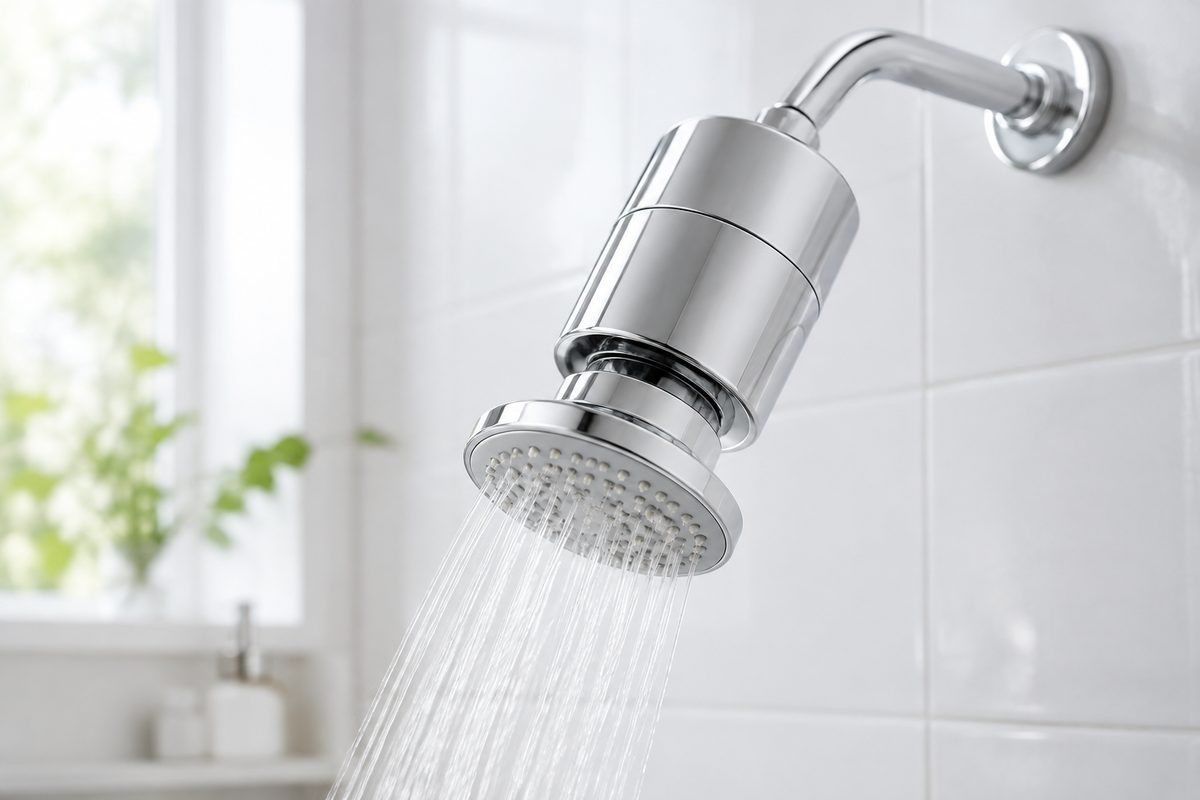
Filter replacement volume tells the same story. Global sales of filtered shower heads and filters ran about 24.8 million units in 2025 at an average price near $24.70, and dechlorinating filters alone are estimated at roughly 34.6 million units at about $18 each. The replacement cycle – six to nine months, or up to 20,000 liters per cartridge – is what converts a one-time fixture sale into a subscription line.
The media decision is the product decision
A shower filter is a media cartridge first and a plumbing fitting second. What the buyer stocks inside the housing determines the claim the brand can legally print on the box, and the two most common media choices do not do the same job.
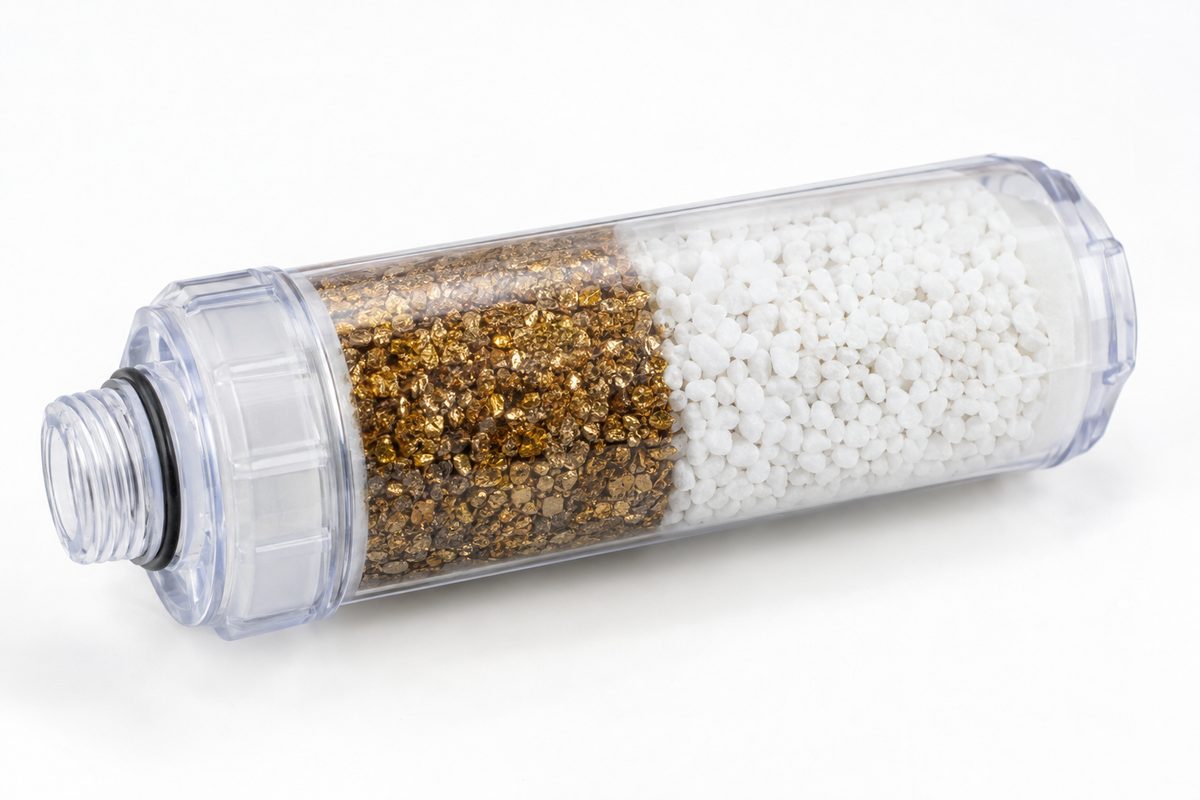
KDF, a copper-zinc redox alloy, strips free chlorine by electron transfer – the zinc gives up electrons and the chlorine is reduced to chloride. It is fast, it works in hot water, and it holds up well at shower temperatures where activated carbon performance drops. Calcium sulfite does the same job by chemical neutralization and is the workhorse of low-cost dechlorinating cartridges because it reacts quickly at high flow.
Neither handles chloramine. Where a utility uses chloramine instead of free chlorine – common across much of the United States and the UK – KDF and calcium sulfite only partially reduce it. The correct media there is catalytic carbon, which breaks the chloramine bond into ammonia and chloride. This is the single most common compliance mistake in the category, and it is covered in more detail in the chlorine versus chloramine removal guide.
| Media | Removes | Hot-water behavior | Best use |
|---|---|---|---|
| KDF (copper-zinc) | Free chlorine, some heavy metals | Stable at shower temperature | Chlorine cities, premium claim |
| Calcium sulfite | Free chlorine | Fast, high flow | Low-cost dechlorination |
| Catalytic carbon | Chloramine, chlorine, some VOCs | Reduced capacity when hot | Chloramine utilities (US/UK) |
| Vitamin C (ascorbic acid) | Chlorine (neutralizing) | Consumed quickly | Beauty-positioned cartridges |
| PP sediment | Rust, sediment, particles | N/A (mechanical) | First stage, water with iron |
The honest limitation importers need to accept: a shower filter does not soften water. It will not remove calcium and magnesium hardness, and it will not turn hard water soft no matter what the marketing says. Buyers positioning a shower filter as a “water softener” for the bathroom invite returns and regulator attention. The correct architecture for actual hardness is a whole-house softener, which is a separate – and larger – sale that pairs naturally with bathroom point-of-use. That upstream product is covered in the whole-house water softener sourcing guide.
What the certification stack actually covers
Shower filters sit in a lighter regulatory lane than drinking-water devices, and that lightness is both an opportunity and a trap. There is no health-based requirement to filter shower water, so the relevant standard is aesthetic, not safety.
North American brands lean on NSF/ANSI 177, the standard for shower filtration systems that covers chlorine reduction and similar aesthetic claims. It is not the same as NSF/ANSI 42 or 53, which apply to drinking-water treatment. A shower filter marketed on “reduces chlorine” should carry a 177 listing; one marketed on taste or health-effect language is overstepping what the standard supports. Importers who print “removes lead” or “makes water safe to drink” on a shower filter are making a drinking-water claim on a device never tested to that bar.
There is a scope boundary ONEMI applies across its own line that importers should copy. Whole-machine certifications for ONEMI equipment are CE, UL, FCC, and RoHS. NSF applies to the filter cartridge, not the complete appliance. A supplier that claims whole-machine NSF certification on an imported shower filter is waving a compliance flag, not a selling point. The general rules for reading these claims are laid out in the NSF/ANSI standard importer guide.
Where the margin actually lives
The fixture is a race to the bottom. The media cartridge is a recurring-revenue line with gross margins in the 35-60% range, and it is the part of the category worth building a business around.
Run the arithmetic. A standalone inline filter wholesales for a few dollars above its landed cost, and the buyer replaces the cartridge two or three times a year at $8-20 per cartridge. Over a two-year relationship, the consumable out-earns the initial sale by a wide margin, and it locks the customer into a replacement schedule the brand controls. This is the same razor-and-blade logic that already drives the drinking-water cartridge market, and the cartridge recurring-revenue sourcing framework explains the mechanics in full.
The subscription angle is where DTC beauty-wellness brands have pulled ahead of legacy plumbing brands. They sell the head cheap, then auto-ship a cartridge every six months. For an OEM importer, the defensible position is not to compete on the head price – it is to own the cartridge design, the media formulation, and the replacement schedule. Tooling a proprietary cartridge lock, so the consumer must buy the matching refill, is the single highest-leverage decision in the whole category.
Sourcing a shower filter line in 2026
The manufacturing base for this category is concentrated, and most of it is OEM. Chinese factories – concentrated in Guangdong, Ningbo, and the Pearl River Delta – mold the housings and fill the media, while Korean producers own a meaningful slice of the vitamin-C and beauty-positioned cartridges. North American and European brands in the space are largely marketing layers over that shared supply chain.
For a buyer entering the category, the qualification checklist is short but non-negotiable. Confirm the media source and formulation, not just the finished unit – two housings can look identical and perform differently because of what is inside. Ask for the chlorine-reduction test report and check which standard it was tested against, because a 90% figure from a lab test at cold flow means little in a hot shower at 9 liters per minute. Verify the cartridge lock design and whether the refill is proprietary, since that determines the recurring-revenue position. And get the tooling, not a generic housing, if the plan is to build a brand rather than resell a commodity.
The sediment and pre-filtration side of the same bathroom market follows a similar sourcing logic, and the sediment filter OEM distribution guide covers the parallel for whole-house pre-filters.
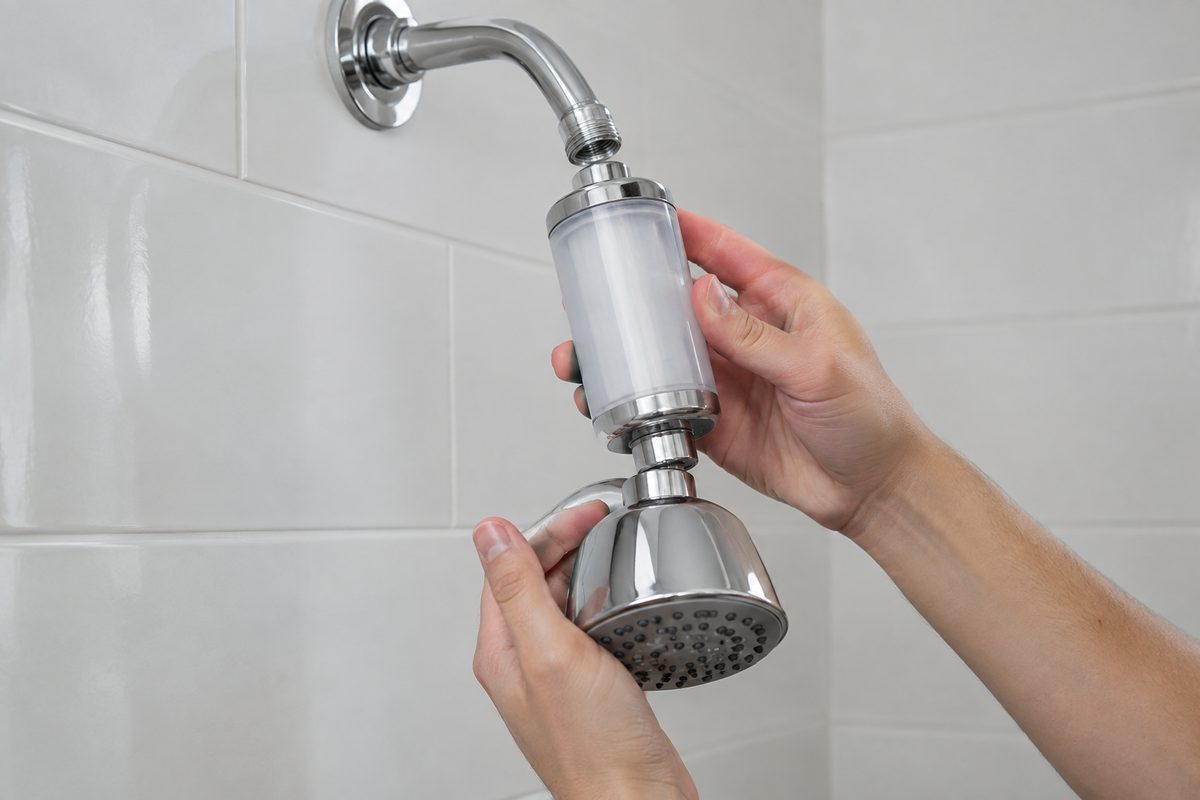
ONEMI, a Guangdong-based water purification equipment manufacturer, runs its product line on exactly this media-and-tooling logic. The same injection-molding and filter-media sourcing that powers its whole-house softening and filtration systems applies directly to bathroom point-of-use products, and its cartridge OEM program supplies the recurring consumable rather than a one-off fixture. For a buyer building a private-label brand, the starting point is the cartridge and the lock design – the private-label OEM playbook walks through tooling, MOQ, and the decisions that determine whether the brand owns its refill market or competes on price.
What to watch through 2032
Three forces will shape the next six years of the shower filter category. First, the chloramine problem keeps spreading as utilities switch disinfectants, and every switch quietly expands the addressable market for catalytic-carbon cartridges – a media upgrade most current products skip. Second, the subscription model consolidates, and brands that own a proprietary cartridge lock will capture the replacement stream while generic-housing resellers compete on price alone. Third, hotel and wellness operators are becoming a serious commercial channel, and their procurement asks for documented chlorine-reduction claims and six-to-nine-month replacement schedules rather than beauty-brand storytelling.
For importers, the practical move is the same one that works elsewhere in water treatment: lead with the media formulation and the test report, lock down the cartridge design before the housing, and treat the refill as the product and the fixture as its first sale. The shower filter market is not the largest segment in the industry, but it is the one where a small, well-specified cartridge turns into a compounding recurring-revenue line with almost no engineering risk.