



 한국어
한국어

- Sediment filters are the highest-frequency reorder SKU in water filtration — cartridges swap every 3-6 months, turning a low unit value into the most predictable revenue line in a distributor’s catalog.
- The order is decided on three specs: micron rating (1-20 µm for the workhorse range), form factor (spun PP, pleated, or backwash), and market certification (NSF/ANSI 42 in the US, WRAS/BS 6920 in the UK, CE in the EU).
- Global water purification was roughly a $37.7 billion market in 2025, growing toward $72.8 billion by 2034 at a 7.6% CAGR (Fortune Business Insights); sediment prefiltration rides that growth as the entry stage on every whole-house and point-of-use install.
Sediment filtration rarely gets the headline. It removes no lead, no PFAS, no bacteria. What it does is protect every device installed downstream, and it is the one category that generates a reorder on a three-to-six-month clock no matter what the broader market does. For a water purification OEM building a global distribution line, that cadence is the point. It is the anchor that keeps an account open between the big-ticket system sales.
Why the Lowest-Value SKU Carries the Account
A sediment filter sits at the front of nearly every system a distributor sells. A point-of-use RO unit needs a pre-filter stage to keep silt from fouling the membrane. A whole-house softener needs a main-inlet stage to keep sand and rust out of the resin bed. A commercial kitchen line needs one to protect pumps and solenoids. The cartridge is therefore attached to every higher-margin sale, and unlike the systems it protects, it is a consumable.
For an OEM the arithmetic is simple. A distributor who places ten thousand whole-house systems this year will reorder sediment cartridges every quarter, not once. The cartridge is the only SKU in the line whose revenue does not depend on winning a new account. It depends on the installed base growing. That makes the sediment line the most defensible position in the catalog.
The Three Form Factors a Distributor Actually Stocks
A robust sediment program is not one SKU but a small set that maps to different water conditions.
| Form factor | Filtration | Maintenance | Typical market |
|---|---|---|---|
| Spun polypropylene cartridge | 1-20 micron depth filtration | Cartridge swap every 3-6 months | Municipal supply, POU pre-stage |
| Pleated cartridge | 1-50 micron surface filtration | Cartridge swap every 6-12 months | Higher flow, lower pressure drop |
| Backwash / spin-down | 40-100 micron screen | Manual or auto flush, no consumable | Well water, heavy sediment |
The spun polypropylene cartridge is the volume workhorse. It is cheap to mold and it does the heavy lifting as the pre-stage on an RO system. The pleated element wins where a distributor’s installers want lower pressure drop on a whole-house line. The backwash unit is the no-consumable option for well-water and high-turbidity accounts. An OEM that can supply all three, in standard 10-inch and 20-inch form factors, covers the channel instead of a slice of it.
The Spec Sheet That Decides the Order
Buyers do not evaluate a sediment filter on brand. They read three numbers. First, the micron rating: 5 to 20 microns is the workhorse range for a whole-house main inlet, while a 1-micron or 5-micron element protects an RO membrane downstream. Second, the flow rate the housing sustains: a standard 10-inch housing handles roughly 5 to 10 gallons per minute, and a 20-inch Big Blue housing handles 20 to 35 GPM on a 1-inch inlet. Third, the pressure rating and the material grade: food-grade polypropylene for the cartridge, and a housing rated to at least 6 to 8 bar for municipal supply spikes.
The material claim is where most OEM factories slip. A cartridge that says “food grade” without a test report is a claim, not a spec. The buyer who verifies material certifications is the one who reorders, because they are stocking for retail shelves and plumber supply houses that will ask for the paper trail.

Certification Is a Market-by-Market Gate
The same cartridge needs different paperwork depending on where it lands. In the United States, the gate is NSF/ANSI 42, which covers the particulate and turbidity claims a sediment filter makes; materials that contact drinking water fall under NSF/ANSI 61, and lead content in wetted parts under NSF/ANSI 372. A distributor will pull an SKU that cannot show a 42 listing.
In the United Kingdom, the gate is WRAS approval under the Water Supply (Water Fittings) Regulations 1999, built on BS 6920 material testing. Large UK retail and trade channels treat WRAS as pass-fail. In the European Union the baseline is CE marking with material compliance, and in the UK the UKCA mark is replacing CE on the construction-products side after Brexit. An OEM that carries one material report and assumes it travels is the factory a distributor drops at the first compliance review.
The Demand Tail Is Global and Structural
Sediment filtration is not a discretionary purchase; it is attached to water infrastructure. Fortune Business Insights sized the global water purification market at roughly $37.7 billion in 2025, growing toward about $72.8 billion by 2034 at a 7.6% CAGR. The US slice alone was about $6.75 billion in 2024, and the EPA’s lead service line replacement mandate keeps pulling main-inlet filtration into new construction and retrofit work. Every one of those installs starts with a sediment stage.
For an OEM the conclusion is that sediment demand does not cycle the way a premium appliance does. It compounds with the installed base. A distributor adds accounts, the accounts add filters, and the reorder curve rises whether or not a single new flagship system ships.
What ONEMI Builds on the Sediment Line
ONEMI is a Guangdong-based water purification equipment manufacturer. On the sediment side the relevant capabilities are a 1-to-50-micron cartridge range across spun PP, pleated and string-wound constructions, housings in both 10-inch and 20-inch form factors with 1-inch inlets, and a material set that is NSF/ANSI 42, 61 and 372-ready for North America and BS 6920 / WRAS-ready for the UK market. The point for a distributor is a single source for the pre-filter and everything downstream: the OEM/ODM whole-house softener, the backwash carbon system, and the point-of-use RO. The account does not fragment across three factories. The cartridge that opens the relationship comes from the same vendor that supplies the whole-house entry stage and the maintenance decision that follows.
The Margin Lives in the Reorder, Not the First Sale
No factory gets rich on the unit economics of a single sediment cartridge. The value is in the cadence. A distributor who stocks a sediment line from one OEM is committing to a repeat purchase every quarter, and each of those reorders is a touch point for the higher-margin systems that ride the same relationship. An OEM that treats the sediment filter as the entry product, spec’d correctly, certified for the target market, and built to reorder, is growing a distribution line that compounds rather than shipping a one-off container.
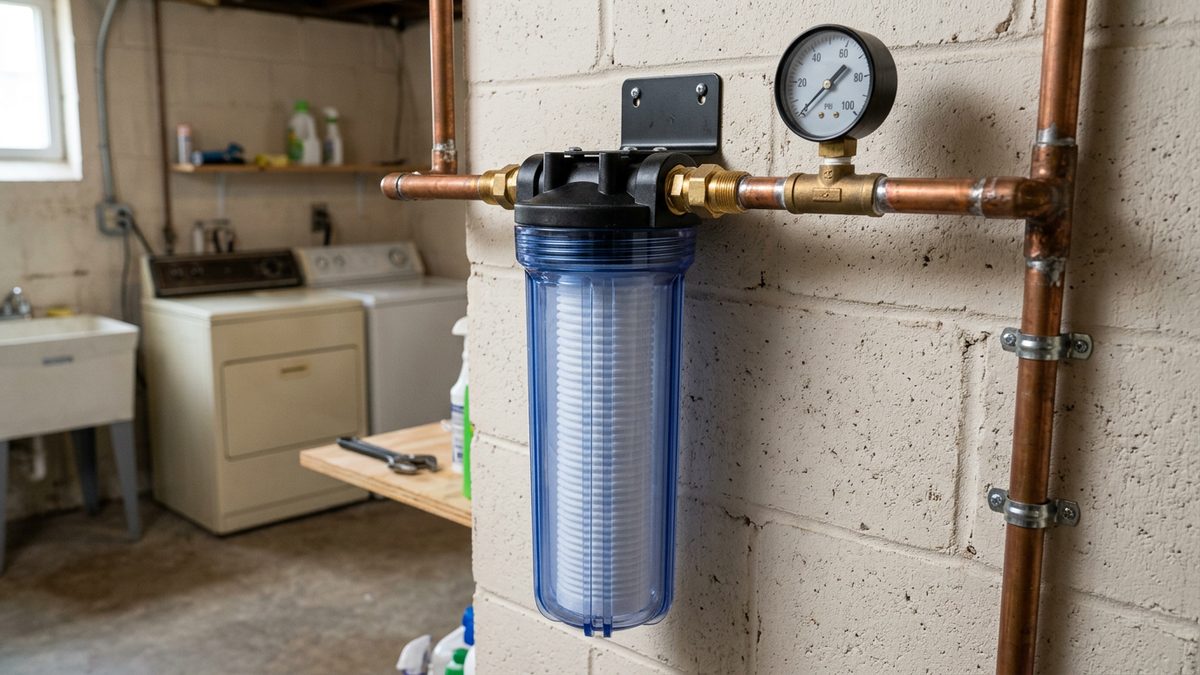
The sediment filter will never win a design award. It is the SKU that keeps the account, the certification that clears the gate, and the reorder that makes the line predictable. For an OEM building a global distribution network, that is a better foundation than a flagship product that sells once.