

 한국어

- “Commercial water filter” market estimates range from $3.3 billion (catering-specific) to $84.9 billion (broad commercial) depending on scope — anchor on the segment that matches what you actually buy.
- QSR demand is a consistency problem, not a safety problem: water variability shows up as inconsistent coffee, cloudy ice, and scale-clogged steam equipment, all of which hit repeat revenue.
- Multi-stage RO plus carbon plus UV, backed by NSF/ANSI 42/53/58 and IoT monitoring, is now the baseline spec for multi-location food service operators.
Water stopped being a utility the moment it started costing repeat customers
For most of the quick-service era, water filtration sat in the back-of-house budget next to grease-trap maintenance — a cost to be minimized, not a decision anyone thought about twice. That changed quietly, and it changed for a reason that has nothing to do with water safety and everything to do with consistency economics.
A QSR chain does not sell coffee, it sells the same cup of coffee in two hundred locations. Ice is not a beverage ingredient, it is the texture of the fountain drink. Steam is not a utility, it is the thing that makes a sandwich bread warm in eleven seconds instead of forty. Every one of those outputs is downstream of water chemistry, and water chemistry is not uniform across a franchise footprint.
Hardness varies by municipal source. Residual chlorine varies by season. Sediment varies by pipe age. When a chain standardizes a coffee recipe but not the water behind it, the recipe drifts location to location, and the customer notices before the operations team does.
That is why food service water filtration is being pulled out of the utility ledger and treated as a margin and repeatability decision. The shift is visible in the numbers, but the numbers need to be read carefully — because “the commercial water filter market” is not one market, and treating it as one is how buyers end up anchored to the wrong figure.
The market size problem: one phrase, three scopes, three very different numbers
Any conversation about commercial water filtration growth has to start by asking what, exactly, is being counted. Depending on the research house and the scope of the category, the “commercial water filter” number in 2026 can be off by an order of magnitude:
| Scope definition | 2025 value | Forecast | CAGR | Source (year) |
|---|---|---|---|---|
| Broad commercial water filters (all non-residential) | $24.1 billion | $84.9 billion by 2035 | 13.4% | Market Research Future (2026) |
| Commercial water filtration systems (equipment) | $6.1 billion | $7.3 billion by 2032 | 2.6% | GlobalInfoResearch (2026) |
| Water filters for catering (food service specific) | $3.3 billion | $7.1 billion by 2032 | 11.7% | GlobalInfoResearch (2026) |
| Catering water filters (alternate estimate) | $4.2 billion (2026) | $9.8 billion by 2033 | 12.7% | WENKH Market Research (2026) |
Two things matter here. First, the gap between the $3.3 billion catering number and the $84.9 billion broad number is not a conflict over growth — it is a difference in what counts as “commercial.” The broad figure folds in industrial process water, healthcare, and municipal-adjacent applications that a food service buyer will never touch. The catering-specific figures, which land in the $3–4 billion range today, are the ones that describe the kitchens and beverage stations this article is about.
Second, even the narrower figures carry a useful signal: the catering and food service slice is growing at 11–13% a year, roughly four to five times faster than the mature residential equipment market, which Fortune Business Insights pegged at a 5.5% CAGR through 2032. Food service is where the expansion is, and it is expansion driven by a specific kind of buyer — one for whom water quality is an operational KPI, not a household preference.
What is actually driving food service demand
Strip away the “rising health awareness” language that fills most market reports and you find four concrete drivers, each of which maps to a line item a franchise operator can measure:
- Beverage consistency. Coffee extraction is sensitive to hardness and alkalinity; the Specialty Coffee Association’s water standard targets a total hardness window and a specific carbonate range precisely because water outside that band produces flat or bitter extraction. A chain that specs water-to-recipe is buying repeatability.
- Ice clarity and taste. Ice is the largest single water consumer in a QSR. Cloudy, chlorine-tasting ice is the most common customer-facing water complaint in food service, and it is entirely a filtration problem.
- Steam equipment scale. Combination ovens, espresso machine boilers, and proofers accumulate limescale that directly raises energy cost and shortens equipment life. Scale control is a maintenance-cost play with a measurable payback.
- Bottled-water replacement. Operators replacing bottled or jugged water with point-of-use filtration cut a recurring consumable line and remove a delivery/logistics dependency.
These drivers share a common shape: none of them is about regulatory compliance in the classic sense. They are about protecting revenue and controlling operating cost. That is why the buyer persona is shifting from “facilities manager ticking a food-safety box” to “operations director defending a P&L line.” For suppliers, that persona shift changes what the product has to demonstrate. See our breakdown of how restaurant and café water filtration affects ice, coffee, and steam output for the equipment-level view.
The technology stack buyers are specifying now
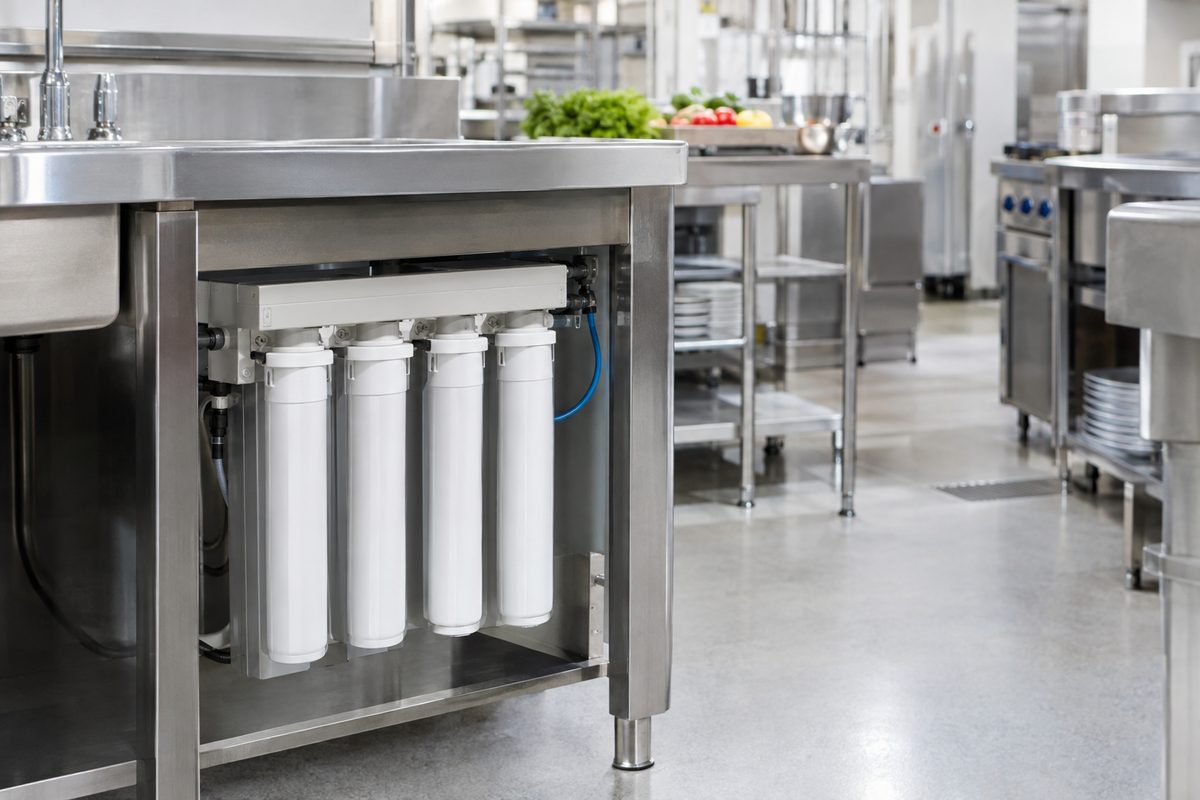
Food service filtration is rarely a single cartridge anymore. The dominant pattern is a staged train that addresses different failure modes in sequence, because no single media handles scale, chlorine, and microbial risk at once:
| Stage | Media / technology | What it removes | Food service role |
|---|---|---|---|
| 1 | Sediment / PP pre-filter | Sand, rust, particulates | Protects downstream media and ice machine valves |
| 2 | Activated carbon | Chlorine, chloramine, taste/odor, some organics | Beverage taste, ice clarity |
| 3 | Scale inhibition / softening | Hardness minerals | Steam equipment and coffee machine protection |
| 4 | Reverse osmosis (optional) | Dissolved solids, heavy metals, micro-contaminants | High-purity water for coffee/steam, TDS control |
| 5 | UV disinfection | Bacteria, viruses | Microbial safety at point of use |
Reverse osmosis remains the workhorse where water chemistry is genuinely poor or where a chain wants a single consistent TDS baseline across locations — which is precisely the multi-location use case. The tradeoff is wastewater and flow rate, which is why tankless high-flow RO configurations have displaced the traditional storage-tank design in food service. Storage tanks breed biofilm and deliver inconsistent pressure; direct-flow designs produce on demand and keep the water path short.
The standards that actually matter in food service
Food service buyers should anchor on a short list of certifications rather than the vague “food-grade” language that appears on a lot of equipment. In the US market, the operative standards are:
- NSF/ANSI 42 — aesthetic effects (chlorine, taste, odor, particulate). This is the baseline for any filter touching beverage water.
- NSF/ANSI 53 — health effects (lead, cysts, VOCs, and, as of the 2024 revision, PFAS reduction). This is the one to demand when the local supply carries lead or emerging-contaminant risk.
- NSF/ANSI 58 — reverse osmosis systems, covering TDS reduction and structural integrity.
- NSF/ANSI 372 — lead content of wetted components (weighted average ≤0.25% lead).
Beyond the certification marks, food service operators increasingly read the ice and beverage water requirements through the lens of their HACCP plan and local health-code inspections. A filter that is certified but not documented for inspection is only half the purchase; the paperwork — a spec sheet, a replacement schedule, and a maintenance log — is part of the product. For a fuller picture of what certification means at the component level, see ONEMI’s certification reference.
Where ONEMI fits: tankless RO built for multi-location consistency
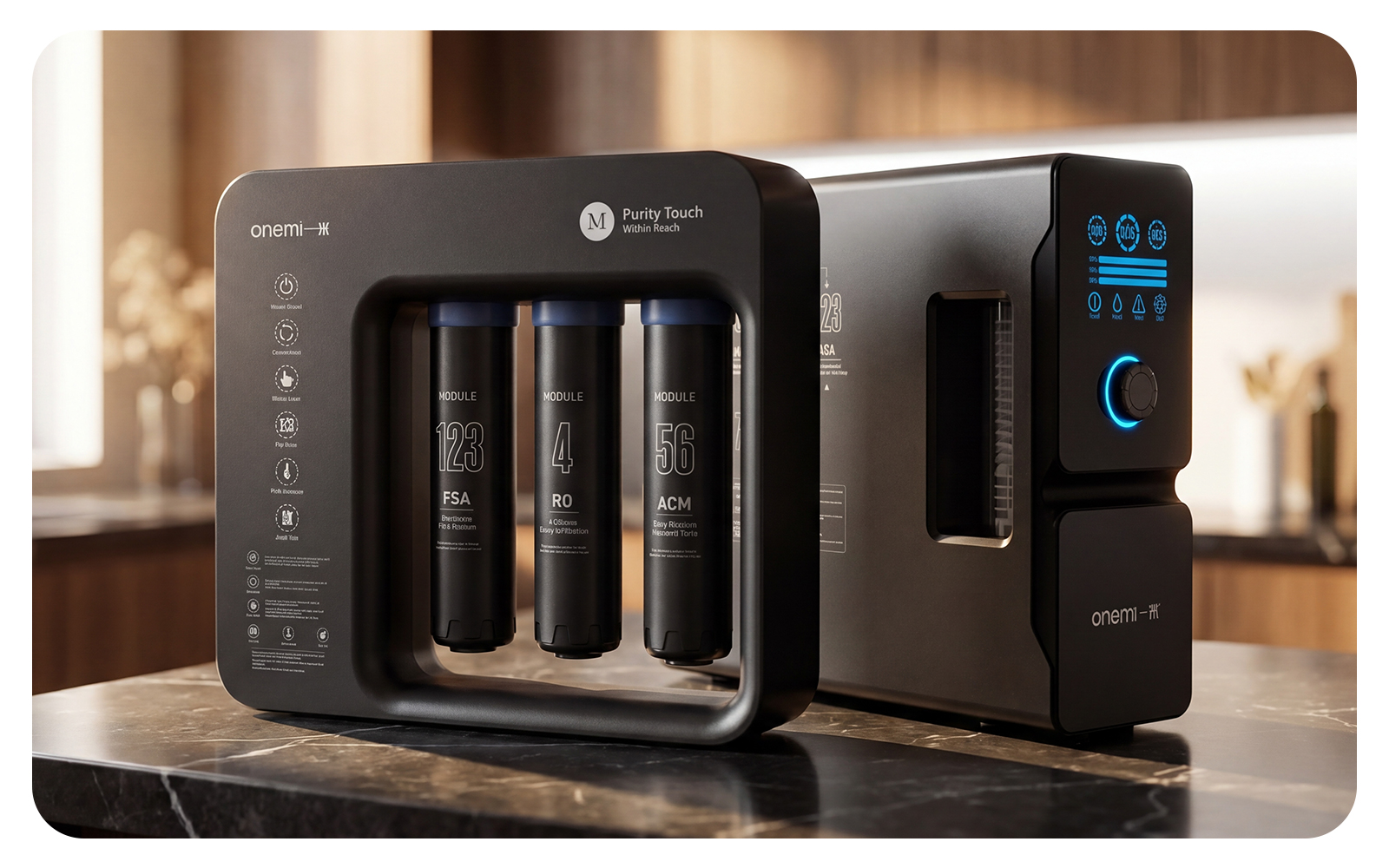
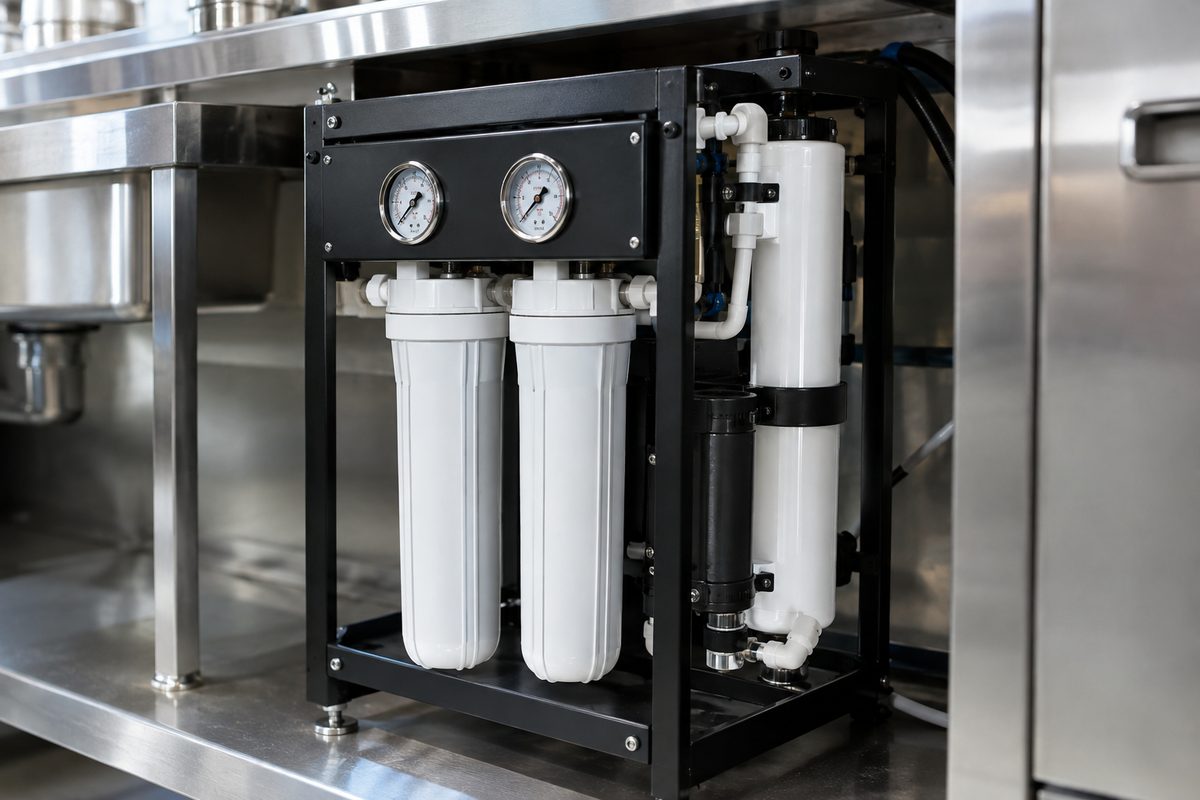
As a Guangdong-based water purification manufacturer, ONEMI builds for exactly the consistency problem described above. The relevant product pattern for food service is the high-flow tankless RO platform — exemplified by the H-series, a 600 GPD (about 2,271 litres per day) direct-flow system with a 0.0001 μm RO membrane, an 18-second automatic flush cycle, and dual pressure gauges that monitor source and membrane pressure to flag clogging two to four weeks before it degrades output.
The design choices matter for food service specifically. Tankless means no storage vessel to sanitize. Dual pressure gauges mean a store manager can see a filter problem coming instead of discovering it through a slow coffee machine. The 100–240 V / 24 V DC, 96 W configuration and a 10-inch universal cartridge footprint keep maintenance simple across a multi-unit rollout, where standardization of consumables is the difference between a clean service program and a spare-parts mess.
For smaller cafes or single-store operators, the same engineering philosophy scales down: see the ONEMI RO-100G reverse osmosis system for a compact point-of-use unit, and the OEM/ODM manufacturing program for buyers who need private-label or custom-configured systems under their own brand.
What to check before you buy: a procurement checklist
The original insight worth carrying out of this market review is that most food service filtration mistakes are not technical — they are scoping mistakes. Buyers anchor on the wrong market number, or buy a residential unit for a commercial duty cycle, or spec a filter without a replacement plan. Four checks prevent most of it:
- Match flow rate to peak demand, not average. An ice machine and a coffee bar both spike in the same lunch window. Size for the peak, not the daily average.
- Get the water report first. Hardness, chlorine residual, and TDS from the local utility determine whether you need softening, carbon, or full RO — in that order of cost.
- Demand the documentation chain. NSF/ANSI 42/53/58 marks, a spec sheet, and a maintenance log that survives a health inspection.
- Price the consumables, not just the unit. A system whose replacement cartridges are proprietary and expensive reverses the savings within two years. Standard 10-inch cartridges keep the recurring line honest.
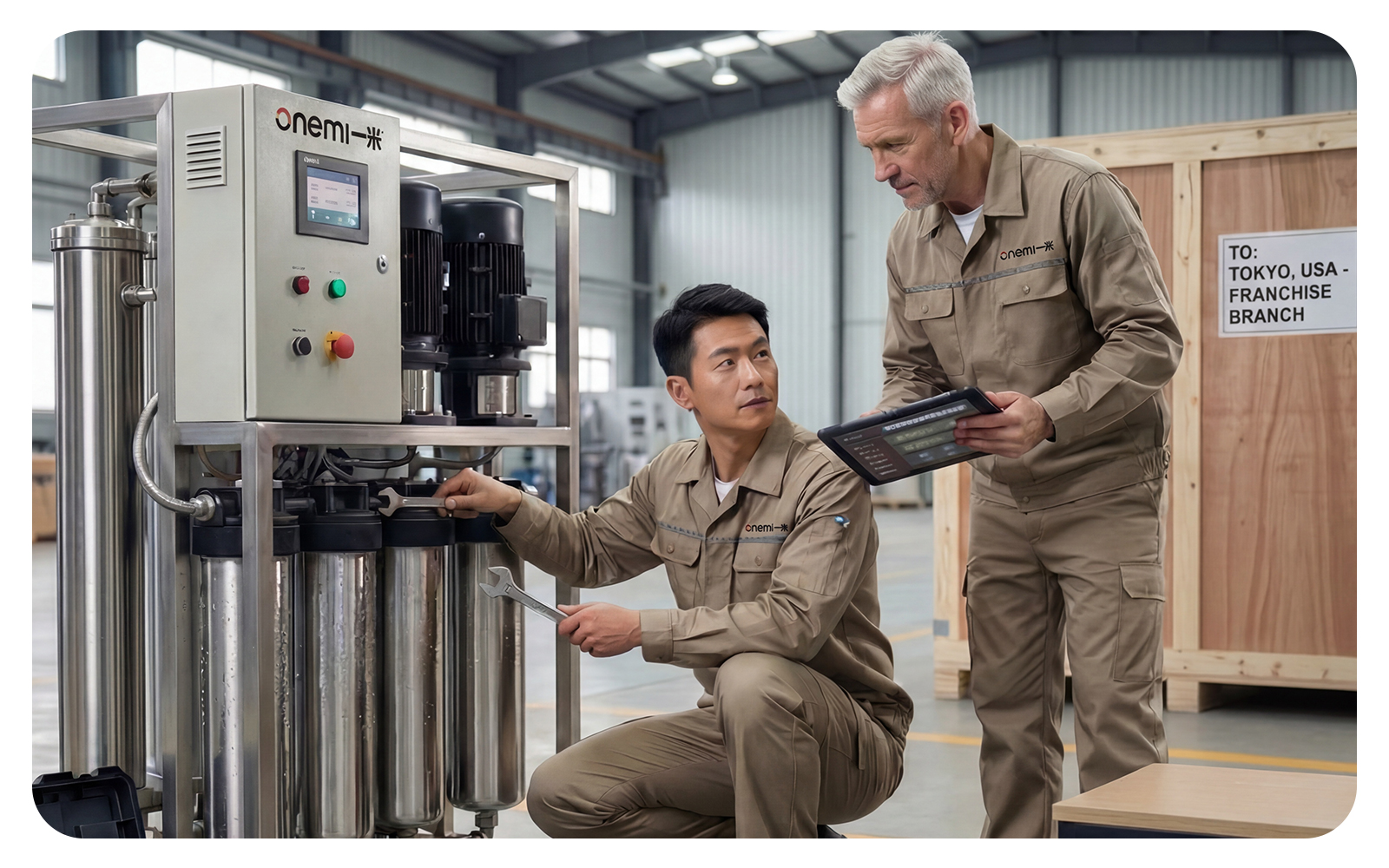
For multi-unit operators, the deeper question is whether the water spec can be standardized the way the menu is. That is a supply-chain decision as much as an engineering one — and it is why the buyers winning in 2026 are the ones who treat water as a repeatable input, with a written specification for commercial RO systems rather than a per-store ad-hoc purchase.
The market numbers will keep climbing, but the operators who benefit are not the ones who buy the most filtration. They are the ones who buy the same water in every location.