


 한국어
한국어

Imagine standing on the deck of a commercial fishing vessel 40 miles off the coast of Maine, or managing a boutique eco-resort on a remote bahamian key. The ocean stretches to the horizon, yet you are completely out of drinking water. Historically, your only options were hauling heavy freshwater payloads, which burns expensive fuel, or relying on massive, municipal-scale multi-stage flash distillation plants that require millions of dollars in infrastructure. For remote coastal communities, island properties, and marine vessels, water security has always been a logistical nightmare.
That reality is shifting rapidly. The global small-scale desalination market is projected to grow from $5.8 billion in 2024 to $9.2 billion by 2030, representing a Compound Annual Growth Rate (CAGR) of 7.8%. This surge is driven by a convergence of severe localized droughts, falling membrane manufacturing costs, and the urgent need for decentralized water infrastructure. Today, compact reverse osmosis (RO) systems are capable of transforming raw seawater into high-purity drinking water right at the point of consumption, bypassing the need for sprawling distribution grids.
Executive Summary
- The small-scale desalination market will reach $9.2 billion by 2030, driven by decentralized water demands.
- Modern compact RO units utilize 0.0001-micron thin-film composite polyamide membranes to achieve a 99.6% NaCl rejection rate.
- Energy Recovery Devices (ERDs) cut operational power demands by up to 60%, making localized solar-powered desalination viable.
The Chemistry and Physics of Small-Scale RO

To understand why modern compact systems are so effective, we have to look at the molecular level. Seawater typically contains between 35,000 and 45,000 parts per million (ppm) of Total Dissolved Solids (TDS), primarily consisting of sodium and chloride ions, alongside magnesium, calcium, and sulfates. For context, the U.S. Environmental Protection Agency (EPA) sets the maximum contaminant level for drinking water TDS at 500 ppm. Bridging this massive gap requires overcoming natural osmotic pressure.
Osmosis is the natural tendency of water to flow through a semipermeable membrane from a low solute concentration to a high solute concentration. To reverse this flow, we must apply pressure that exceeds the natural osmotic pressure of seawater. For standard 35,000 ppm seawater, the baseline osmotic pressure is approximately 380 pounds per square inch (psi). In practice, to overcome this resistance and achieve a viable flow rate of purified water, compact RO systems must operate at pressures ranging from 800 to 1,000 psi.
At the heart of this process is the membrane. Modern small-scale systems utilize thin-film composite (TFC) polyamide membranes. These membranes feature an incredibly dense active barrier layer with a pore size of approximately 0.0001 microns. This structure is so tight that it permits the passage of water molecules while physically blocking 99.6% of dissolved sodium chloride ions, as well as bacteria, viruses, and microplastics.
How does this perform in a real-world scenario? Let us look at the typical feed water composition versus the output of a high-efficiency compact RO unit:
| Water Quality Parameter | Raw Seawater Input (Typical) | Post-RO Product Water | Rejection/Reduction Rate |
|---|---|---|---|
| Total Dissolved Solids (TDS) | 35,000 – 42,000 ppm | 150 – 350 ppm | > 99.4% |
| Sodium (Na+) | 10,500 ppm | 80 ppm | 99.2% |
| Chloride (Cl-) | 19,000 ppm | 140 ppm | 99.3% |
| Sulfate (SO4 2-) | 2,700 ppm | < 5 ppm | > 99.8% |
| Boron | 4.5 – 5.5 ppm | 1.2 – 1.8 ppm | 65% – 75% |
| Turbidity | 1.5 – 10 NTU | < 0.1 NTU | > 99.0% |
Notice the boron levels in the table. This represents one of the major technical limitations of single-pass reverse osmosis: boron molecules are small and uncharged at neutral pH, allowing them to slip through the polyamide matrix far more easily than larger, charged ions. In agricultural applications where boron can be toxic to crops like citrus, a second-pass system or pH adjustment is often required to bring boron levels down below 0.5 ppm. For drinking water, however, the standard single-pass output is perfectly safe and well within World Health Organization (WHO) guidelines.
Anatomy of a Compact Seawater RO System
A reliable small-scale seawater desalination unit is not just a pump and a membrane. It is an integrated chemical processing plant engineered into a footprint often no larger than a standard suitcase or a small pallet. Let us trace the water path through a professional-grade configuration to see exactly how these systems function in the field.
First, the intake pump draws raw seawater. This water immediately encounters the pre-filtration stage, which is critical for protecting the high-pressure pump and the delicate RO membranes from fouling. Pre-filtration typically begins with a coarse 50-micron screen filter to capture large organic matter, followed by a dual-gradient depth filter grading from 20 microns down to 5 microns. In areas with high organic activity or seasonal algae blooms, operators also install an active carbon block or a media filter to absorb dissolved organic compounds that can cause rapid biological fouling on the membrane surface.
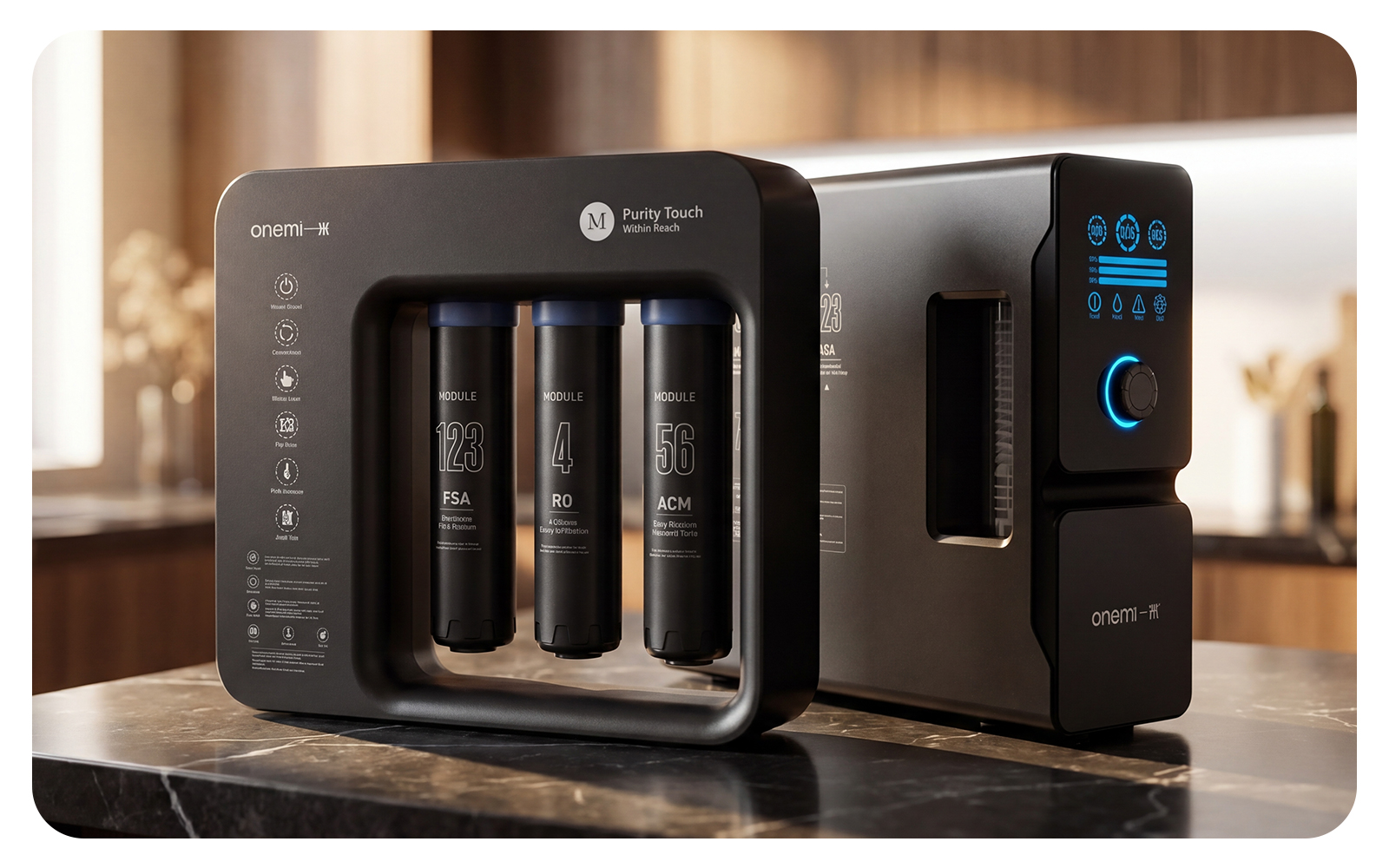
After pre-filtration, the water is pressurized. This is where the engineering gets intensive. High-pressure plunger pumps, constructed from corrosion-resistant Super Duplex stainless steel, drive the water up to operating pressures of 800 to 1,000 psi. In standard residential water systems, like those running an ONEMI under-sink drinking water filter, operating pressures rarely exceed 60 psi. Scaling this up to 1,000 psi requires robust, industrial-grade components, heavy-duty fittings, and high-pressure flexible hoses rated for marine environments.
Once pressurized, the water enters the pressure vessel containing the spiral-wound polyamide membrane. Here, the stream is split into two paths: permeate (the purified drinking water) and concentrate (the highly concentrated brine). The permeate flows through a central collection tube to a post-treatment stage, where it typically passes through a calcite cartridge to reintroduce essential minerals and balance pH, followed by a UV sterilizer to ensure complete biological safety. The brine, still under immense pressure, is discharged.
In older designs, the residual pressure in the brine stream was simply wasted, dumped back into the ocean through a pressure relief valve. This made small-scale desalination incredibly energy-intensive. Modern compact systems solve this by integrating Energy Recovery Devices (ERDs), such as rotary isobaric chambers or reciprocating pressure exchangers. These devices capture the hydraulic energy from the high-pressure reject stream and transfer it directly to the incoming feed water, reducing the net electrical energy required by the high-pressure pump by up to 60%. This breakthrough has lowered the energy consumption of small-scale systems to around 3.0 to 4.5 kWh per cubic meter of produced water, making them highly compatible with off-grid solar arrays.
Real-World Operational Challenges and Maintenance
Operating a desalination system on a remote island or a vessel is a continuous battle against biology and chemistry. The single most common failure point is membrane fouling, which occurs when suspended solids, microorganisms, or mineral scales accumulate on the membrane surface, blocking water passage and driving up operating pressures.
There are three primary types of fouling that operators must manage:
- Biological Fouling: Bacteria and algae attach to the membrane feed spacer and multiply, creating a slimy biofilm. This restricts flow and causes localized pressure drops.
- Organic Fouling: Humic substances, oil traces, and proteins adsorb onto the polyamide membrane chemistry, reducing its permeability.
- Scaling: As water is squeezed out of the feed stream, the concentration of sparingly soluble salts like calcium carbonate and sulfate exceeds their solubility limit, causing crystals to precipitate directly onto the membrane surface.
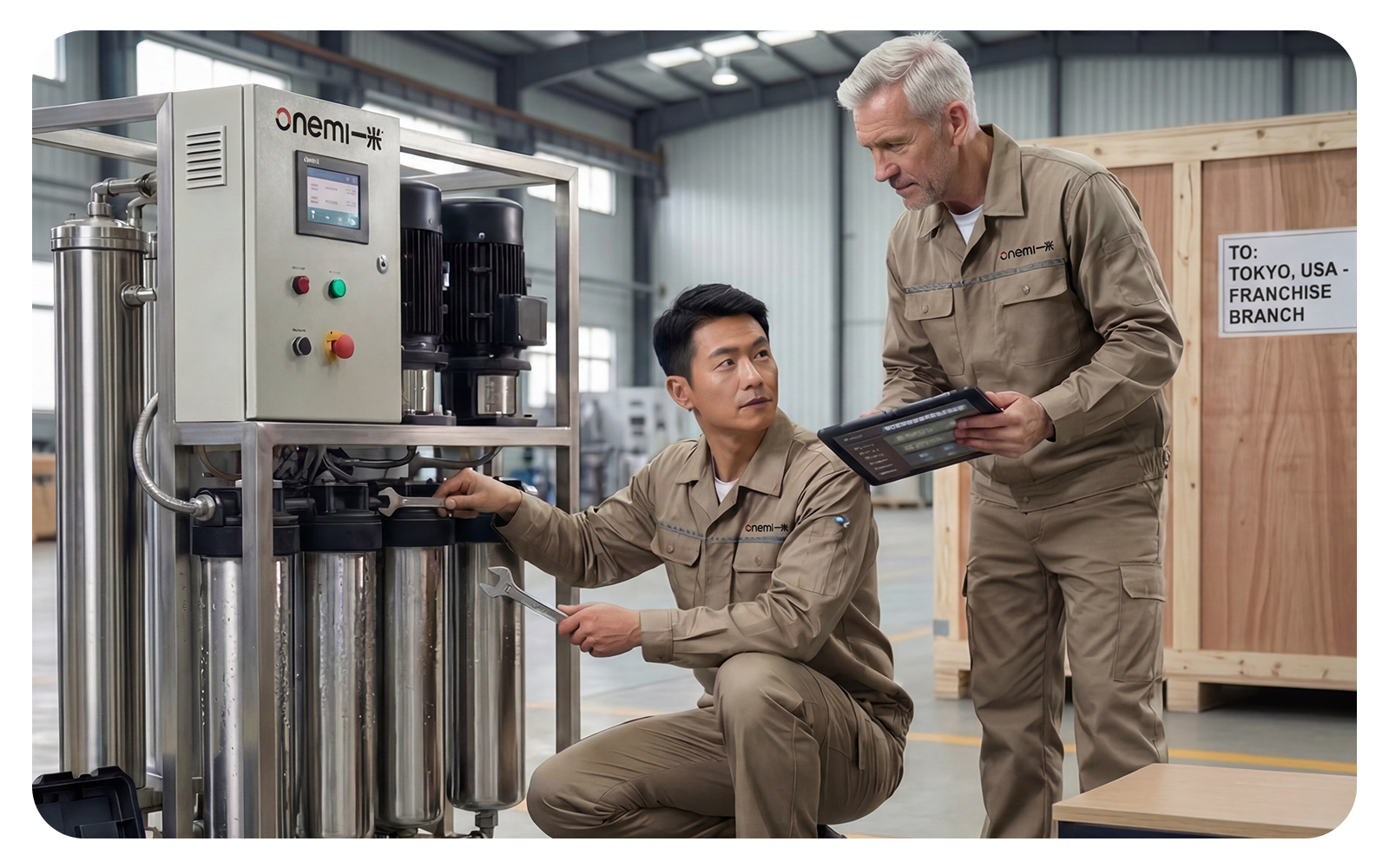
To combat this, professional installations utilize automated freshwater flushes. Every time the system shuts down, it automatically purges the high-pressure side with fresh permeate water. This simple step displaces the highly concentrated brine and prevents salt precipitation and biological growth while the system is idle. When operating in challenging environments, standard practice also includes periodic Clean-in-Place (CIP) cycles. This involves circulating specialized chemical solutions through the membrane—typically an acidic wash (such as citric acid at pH 2-3) to dissolve mineral scale, followed by an alkaline wash (such as sodium hydroxide at pH 11-12) to break down organic biofilms and oils.
Consider a practical scenario from a remote research station in the Florida Keys. The station installed a small-scale RO unit to supply 500 gallons of water per day. During the first summer, the operators noticed a sudden 15% drop in permeate flow over a two-week period, accompanied by an increase in feed pressure. Rather than immediately replacing the expensive membrane element, they performed a targeted CIP cycle. They discovered that local seagrass die-offs had increased the dissolved organic carbon in the shallow intake bay. By adjusting their pre-filtration stack to include a 1-micron carbon block and implementing a daily freshwater flush, they restored membrane performance to 98% of its baseline and extended the membrane life by three years.
Selecting and Sizing a Compact Desalination System
Choosing the right system requires a precise understanding of your water demands and the local environment. A common mistake is sizing a system based solely on its maximum rated output under ideal laboratory conditions. Manufacturers rate membrane capacity at a standard temperature of 25°C (77°F) and a standard salinity of 32,000 ppm TDS. If you are operating in the cold waters of the Pacific Northwest (where water temperatures can drop to 8°C), water viscosity increases significantly, which can cut your actual permeate production in half.
Conversely, if you are operating in the Persian Gulf, where salinities can exceed 45,000 ppm TDS and water temperatures can reach 35°C, the system must work much harder to overcome the elevated osmotic pressure. This requires a high-pressure pump capable of maintaining output without overheating or exceeding the structural pressure limits of the membrane vessels.
Before purchasing any equipment, perform a detailed water quality analysis of your source water. This should measure TDS, temperature range, turbidity (NTU), and the presence of iron, manganese, or hydrogen sulfide, which can ruin membranes rapidly. For residential or light commercial properties that require ultra-pure drinking water from municipal or brackish wells rather than raw seawater, a high-pressure seawater system is often overkill. In those scenarios, a multi-stage filtration setup—such as those designed by ONEMI—offers a more cost-effective, low-pressure solution that delivers exceptional purity without the high energy costs and complex maintenance of a 1,000 psi seawater system.
For true marine and coastal applications where seawater is the only source, ensure your selected compact RO system features a rugged, marine-grade aluminum or stainless steel frame, automated control valves, continuous TDS monitoring with an automatic reject diversion valve (which dumps water if the salinity rises above safe limits), and a reliable supply chain for replacement pre-filter cartridges and membrane elements. By matching your specific geographic conditions with the right pre-treatment and energy recovery technology, you can secure a dependable, self-sustaining freshwater supply anywhere on the globe.