


 한국어
한국어

Turn on a tap in any major metropolitan area today, and what comes out looks clean. But behind that clear stream lies a complex, shifting battle against microscopic threats, aging municipal infrastructure, and emerging chemical compounds that standard city water treatment plants were never designed to handle.
For years, homeowners bought water purifiers as a simple insurance policy against bad taste or occasional rust. Today, that passive approach is dead. We are seeing a massive shift in how households manage their drinking water, driven by a growing distrust of aging pipe networks and a demand for real-time validation of what is actually in the glass.
Executive Summary
- The global water purifier market is projected to scale from USD 45 billion to USD 52 billion by 2026, fueled by urbanization and rising contaminants like PFAS.
- Point-of-use (POU) systems are transitioning from passive physical barriers to active, IoT-enabled diagnostic appliances.
- Strict regional regulations, such as the EPA’s new legally enforceable limits on forever chemicals, are forcing a redesign of residential filtration media.
The Reality of Tap Water and the Rise of Emerging Contaminants
Most municipal water treatment facilities in developed regions were built decades ago. They excel at killing bacteria with chlorine, but they struggle with modern chemical footprints. Runoff from industrial manufacturing, agricultural pesticides, and microplastics from synthetic clothing have found their way into major aquifers and surface water sources.
Consider the recent regulatory shifts in North America. The United States Environmental Protection Agency (EPA) recently established strict, legally enforceable Maximum Contaminant Levels (MCLs) for several per- and polyfluoroalkyl substances (PFAS), often called “forever chemicals.” These synthetic compounds do not break down in the environment or the human body. They accumulate over time, linked by medical studies to hormonal disruptions and increased cancer risks. Standard granular activated carbon filters, the kind found in cheap pitcher filters, barely scratch the surface of these compounds before reaching premature saturation.
It is not just a chemical issue; it is a structural one. Lead service lines remain buried under thousands of cities globally. When water chemistry fluctuates, or when local authorities change treatment protocols, the protective scale inside these pipes can flake off, releasing highly toxic lead particles directly into residential plumbing. This is not a hypothetical scenario. It is a daily reality for millions of households living in homes built before the late 1980s.
ONEMI industry analysts have noted that consumer inquiries regarding lead and heavy metal reduction have spiked by over 140% in the past two years alone, signaling a major shift in public awareness.
How Modern Filtration Technologies Solve the Contamination Crisis
To address these complex, multi-layered contamination profiles, water purification technology has evolved far beyond simple physical screening. Modern residential systems rely on multi-stage extraction processes that combine physical, chemical, and electrostatic principles to target specific contaminant classes.
The core of high-performance residential purification remains Reverse Osmosis (RO). An RO membrane features pore sizes down to approximately 0.0001 microns. To put this in perspective, a single molecule of water can pass through, but dissolved metal ions, salts, and complex organic molecules are blocked and flushed away as waste. However, raw RO water can be highly acidic and devoid of beneficial minerals, which has led to the integration of post-filtration remineralization stages that restore calcium and magnesium ions to optimal levels.
| Filtration Technology | Pore Size / Mechanism | Target Contaminants | Limitations |
|---|---|---|---|
| Activated Carbon (GAC/Block) | 0.5 – 10 microns (Adsorption) | Chlorine, VOCs, bad taste, odor | Ineffective against heavy metals and dissolved solids |
| Ultrafiltration (UF) | 0.01 – 0.1 microns (Physical) | Bacteria, cysts, suspended solids | Cannot remove dissolved salts or tiny viruses |
| Reverse Osmosis (RO) | 0.0001 microns (Membrane) | Lead, PFAS, nitrates, heavy metals, TDS | Generates wastewater; requires high water pressure |
| UV-C LED Disinfection | 260 – 280 nm light (Pathogen destruction) | Viruses, bacteria, mold spores | Does not remove physical or chemical particles |
The real magic happens when these technologies are stacked. A modern under-sink system typically starts with a polypropylene sediment pre-filter to catch sand and rust, followed by an activated carbon block to adsorb chlorine and protect the delicate RO membrane from chemical degradation. After passing through the RO membrane, the water undergoes UV-C LED sterilization in the holding tank or directly at the faucet spout to prevent any bacterial biofilm from developing over time.
But here is a practical gotcha that most manufacturers won’t tell you: if your household water pressure drops below 30-40 PSI, your RO system’s efficiency will plummet, leading to excessive wastewater generation and rapid membrane clogging. This is why high-end systems now integrate internal booster pumps to maintain a steady, optimal pressure gradient across the membrane surface, regardless of your home’s plumbing quirks.
Smart Purifiers and the Integration of Real-Time Diagnostics
We are moving away from the era of guessing when to change a filter. Historically, consumers relied on arbitrary calendar reminders—change every six months—or waited until their tea tasted metallic. This approach is fundamentally flawed because water usage and incoming water quality fluctuate wildly from week to week.
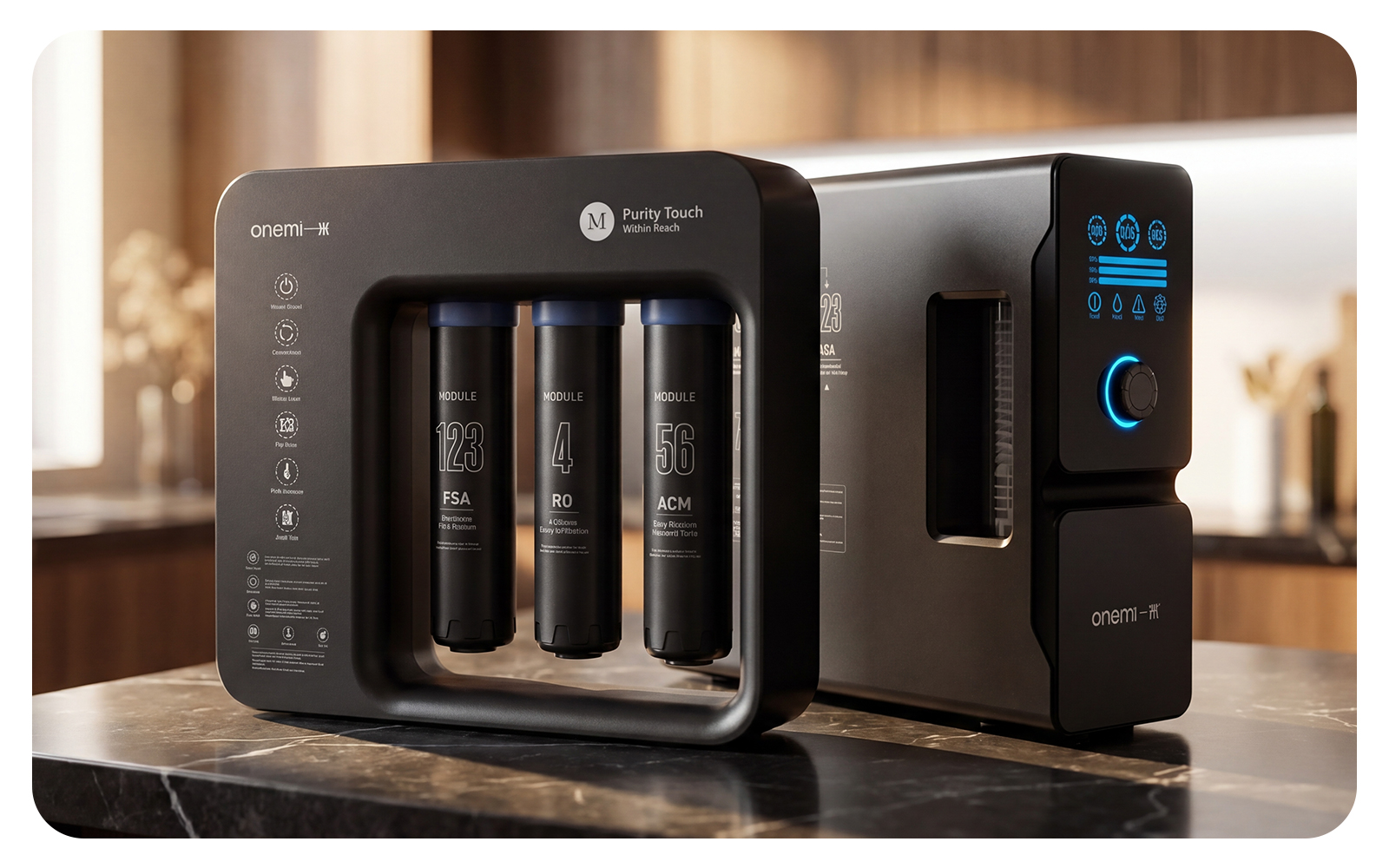
The latest generation of water purifiers features integrated Total Dissolved Solids (TDS) sensors and optical flow meters connected to local Wi-Fi networks. These sensors measure the electrical conductivity of the water before and after the filtration process, calculating the exact rejection rate of the membrane in real time. This data is processed locally and pushed to mobile applications, giving users a clear, quantifiable look at their water quality.
Why does this matter? Because it transforms the purifier from a silent plumbing fixture into an active home health monitor. If a municipal water main breaks upstream and floods your local system with sediment, your smart purifier detects the sudden drop in membrane performance, alerts you via an app, and adjusts its backwashing cycle to prevent permanent damage to the filtration media.
Furthermore, IoT connectivity allows for automated filter replenishment. Instead of searching for the correct model number online when a red light blinks, the appliance calculates its remaining filter life based on actual gallons processed and local water hardness, automatically ordering a replacement cartridge to arrive right when it is needed.
Market Drivers and Future Outlook Through 2026
The global demand for advanced water purification is accelerating, driven by a combination of climate-induced water scarcity, tightening environmental regulations, and a shift in consumer psychology. Urbanization is putting unprecedented pressure on city water systems, leading to more frequent treatment failures and boil-water advisories. As a result, point-of-use water purification is no longer viewed as a luxury accessory, but as essential home infrastructure.
At the same time, environmental sustainability is reshaping product design. The historical drawback of RO systems—the volume of concentrate water sent down the drain—is being aggressively addressed by engineering teams. Newer systems achieve recovery rates of 60% to 75%, a massive improvement over older models that wasted up to four gallons of water for every gallon of purified water produced.
ONEMI has been at the forefront of this eco-efficiency push, refining membrane dynamics to minimize wastewater without compromising contaminant extraction rates. By optimizing flow pathways and utilizing high-efficiency booster pumps, modern systems can now operate sustainably even in regions with strict water conservation mandates.
What does the future hold? We are starting to see the integration of artificial intelligence in municipal and commercial water management, predicting contamination spikes before they reach residential taps. In the home, the focus will remain on miniaturization, higher flow rates, and absolute transparency. Consumers will no longer accept blind faith; they want to see the numbers, understand the science, and know with absolute certainty that every drop of water their family drinks is pure, safe, and healthy.