

 한국어
한국어

A staggering $97.3 billion will flow into the global water purification sector by 2035, a massive leap from the $48.1 billion recorded in 2025. This 7.5% compound annual growth rate (CAGR) caught many industry analysts off guard, especially as residential installations seized a dominant 70.1% of the total market volume. The traditional under-sink carbon block is no longer the default choice for modern households.
Executive Summary
- The global water purification market is projected to reach $97.3 billion by 2035, driven by a 7.5% CAGR and a 70.1% residential market share.
- IoT-enabled smart systems and whole-house reverse osmosis (RO) are replacing point-of-use carbon filters as municipal infrastructure faces rising chemical contamination.
- Strict compliance with NSF/ANSI Standards 53, 58, and 401 is now the primary benchmark for consumer trust and purchasing decisions.
How did we arrive at this multi-billion-dollar shift? The answer lies in a quiet crisis of municipal infrastructure across the United States and Europe. Decades of underfunding have left public water systems vulnerable to emerging contaminants that standard city treatment plants were never designed to handle.
The Infrastructure Deficit Driving Residential Filtration
Municipal water treatment plants are failing to keep pace with modern chemical manufacturing. In the United States alone, over 140,000 miles of cast-iron water mains are reaching the end of their useful lifespans, frequently leaching heavy metals into the distribution system before the water ever reaches a residential tap. The Environmental Protection Agency (EPA) recently established legally enforceable Maximum Contaminant Levels (MCLs) for six specific per- and polyfluoroalkyl substances (PFAS), commonly known as “forever chemicals.” These synthetic compounds do not break down in the environment or the human body.
This regulatory shift has forced homeowners to take water safety into their own hands. Point-of-entry (POE) and point-of-use (POU) filtration systems are no longer luxury appliances; they are essential household infrastructure. Consumers are realizing that relying solely on municipal compliance is a high-risk strategy. The burden of purification has shifted from the public utility to the individual kitchen counter.
Consider the case of Hoosick Falls, New York, where municipal wells were contaminated with PFOA at levels exceeding 130 parts per trillion (ppt)—far above the EPA’s new health advisory limits. Residents who installed multi-stage residential RO systems saw immediate, measurable drops in contamination levels, bypassing the years of bureaucratic delays required to remediate the town’s public water supply.
The Smart Purifier Checklist: Tech Specs Buyers Demand
The modern consumer is highly analytical, rejecting generic marketing claims in favor of hard performance metrics and real-time data verification. The checklist for a modern, high-performance water purification system has evolved significantly over the past three years.
- Real-Time Total Dissolved Solids (TDS) Monitoring: Dual-probe sensors that measure incoming and outgoing water quality instantly, displaying the exact filtration efficiency percentage on a digital interface or mobile application.
- Automated Membrane Flushing: Self-cleaning cycles that initiate every 24 hours or after a specific volume of water has passed through the system, preventing bio-fouling and extending the lifespan of the RO membrane.
- Multi-Stage Filtration Architecture: A minimum of five stages, including a sediment pre-filter, activated carbon block, RO membrane, post-carbon filter, and an ultraviolet (UV-C) sterilization chamber to eliminate 99.99% of viruses and bacteria.
- High-Flow, Tankless Delivery: Systems capable of delivering at least 600 to 1,000 gallons per day (GPD), eliminating the need for bulky, secondary storage tanks that are prone to bacterial colonization.
- Filter Life Algorithms: Smart sensors that calculate remaining filter life based on actual water volume processed and incoming water turbidity, rather than simple, inaccurate time-based countdowns.
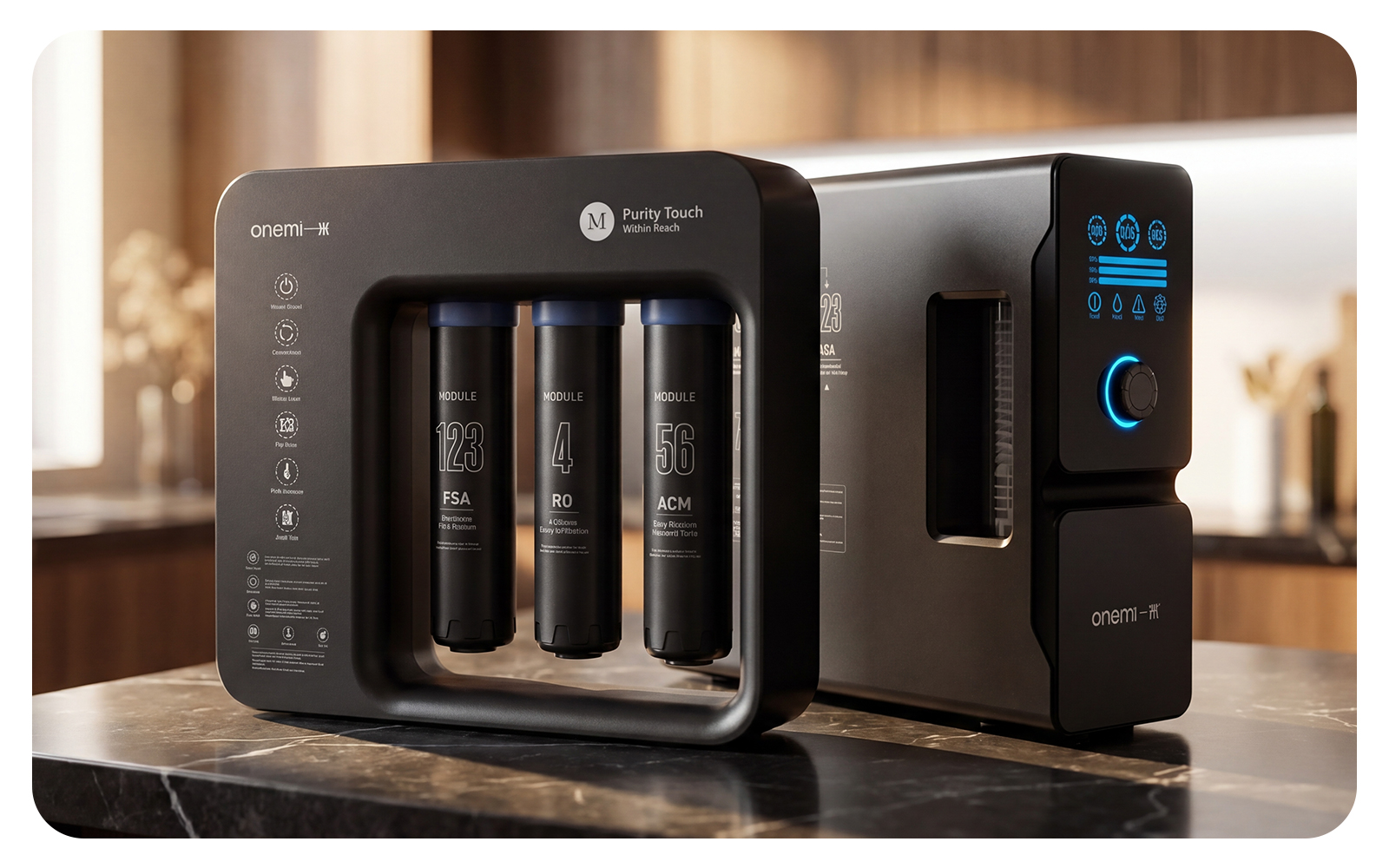
ONEMI water systems utilize these precise engineering parameters to ensure consistent water quality under varying municipal pressure conditions.
Understanding NSF/ANSI Standards: The Verification Matrix
Independent certification is the only reliable way to verify a water purifier’s performance claims. When evaluating residential filtration systems, three specific NSF/ANSI standards serve as the gold standard for safety and contaminant reduction.
| NSF/ANSI Standard | Primary Focus | Target Contaminants | Required Reduction Rate |
|---|---|---|---|
| Standard 53 | Health Effects (POU/POE) | Lead, Asbestos, VOCs, MTBE, Cyst reduction | > 99% for Lead (from 150 ppb to < 10 ppb) |
| Standard 58 | Reverse Osmosis Systems | Arsenic, Barium, Cadmium, Chromium, Fluoride, Radium | Varies by contaminant (typically > 90% TDS reduction) |
| Standard 401 | Emerging Compounds | Pharmaceuticals, Pesticides, Herbicides, Microplastics | > 95% reduction across 15 specific chemical compounds |
It is a common industry misconception that any reverse osmosis system automatically complies with all three standards. In reality, a system must undergo rigorous laboratory testing under pressure to earn these specific certifications. Many low-cost RO systems fail Standard 58 testing due to structural integrity issues under high pressure or poor seal quality in the membrane housing.
Are you willing to trust your family’s health to an uncertified filter just to save a few dollars upfront?
The Rise of Whole-House Reverse Osmosis Systems
While point-of-use systems under the kitchen sink remain popular, the market is experiencing a massive pivot toward point-of-entry, whole-house reverse osmosis systems. This trend is driven by the realization that dermal absorption and inhalation of vaporized chemicals during showering present significant health risks. Volatile organic compounds (VOCs) and chlorine byproducts like trihalomethanes readily enter the bloodstream through the skin and lungs in hot showers.
However, whole-house RO systems present a unique engineering challenge: they are notoriously water-inefficient. Traditional residential RO systems can waste up to four gallons of water for every single gallon of purified water produced. This wastewater, known as concentrate or brine, is redirected down the drain, leading to high water bills and environmental concerns in drought-prone regions.
To combat this limitation, advanced whole-house systems now incorporate multi-stage recovery loops. These systems recycle a portion of the concentrate back through the membrane feed loop, achieving recovery rates of up to 75% or 80%. This process requires high-pressure booster pumps and precise anti-scalant dosing to prevent calcium carbonate from precipitating on the delicate polyamide membrane surface. ONEMI has invested heavily in optimizing these high-recovery hydraulic loops to minimize environmental impact while maintaining peak filtration performance.
Why Smart Integration is No Longer Optional
The integration of Internet of Things (IoT) technology into water purification systems has transitioned from a marketing gimmick to a critical safety feature. Older filtration systems relied on guesswork, leading consumers to either replace expensive filters too early—wasting money—or wait too long, exposing themselves to breakthrough contamination once the filter media became saturated.
Smart systems solve this by utilizing optical sensors to measure turbidity, conductivity sensors to track TDS, and digital flow meters to measure exact gallon usage. This data is processed by onboard microcontrollers and transmitted via Wi-Fi to a user’s smartphone. The system proactively alerts the user when a specific filter stage has reached 90% depletion, allowing ample time to order a replacement.
Furthermore, smart purifiers can automatically shut off the incoming water supply if an internal leak is detected. A micro-sensor placed in the base tray of the unit detects moisture instantly, triggering a solenoid valve to close within milliseconds. This feature prevents catastrophic water damage to kitchen cabinetry and flooring, a common risk associated with high-pressure under-sink appliances.
As the global water crisis intensifies and chemical contamination of municipal systems becomes more widespread, the demand for verified, high-performance residential water purification will only grow. The transition from basic carbon filtration to smart, multi-stage, certified reverse osmosis systems is a necessary adaptation to a changing environment. Consumers who prioritize rigorous testing standards, high-flow efficiency, and real-time smart monitoring will be best positioned to protect their households from the invisible contaminants flowing through modern taps.