

 한국어
한국어

Walk into any suburban home in Southern California, the Texas Hill Country, or the hard-water belts of the Midwest, and you will likely find the same frustrating sight under the kitchen sink. It is a bulky, 4-gallon pressurized steel storage tank, surrounded by a spiderweb of color-coded plastic tubing, slowly dripping wastewater down the drain. For decades, this was the accepted price of clean drinking water.
But the ground is shifting beneath our feet. Homeowners are tired of losing half their under-sink cabinet space to a stagnant reservoir that breeds bacteria if left unserviced. They are equally tired of utility bills reflecting a 4:1 waste-to-pure water ratio, where four gallons of precious municipal water are flushed away to produce a single glass of drinking water. As municipal water rates climb across North America and Europe, the old way of doing filtration is rapidly becoming financially and environmentally untenable.
Executive Summary
- The global water filtration market is experiencing a massive shift toward high-flow, tankless systems, projected to reach $16.78 billion by 2026.
- Strict regulatory updates, including EPA PFAS limits and NSF/ANSI Standards 53 and 58, are forcing manufacturers to upgrade filtration tolerances.
- Real-world water conditions, particularly high TDS and extreme hardness, present practical limitations that smart RO systems must address via active monitoring.
The Multi-Billion Dollar Shift to High-Flow Tankless Systems
The global water filters market is undergoing a massive transformation, projected to grow from $15.56 billion in 2025 to $16.78 billion in 2026, representing a compound annual growth rate (CAGR) of 7.9%. This growth is not driven by simple replacement filters. Instead, it is fueled by a wholesale technology migration. Consumers are abandoning traditional gravity pitchers and slow, tank-based reverse osmosis (RO) setups in favor of direct-flow, tankless systems.
Why now? The answer lies in the engineering breakthrough of high-yield, high-flow membranes. Traditional RO systems relied on the storage tank because their membranes could only trickle out 50 to 75 gallons per day (GPD). If you wanted to fill a pasta pot, you needed that stored volume ready to go. Today, residential systems routinely deliver between 600 GPD and 1,200 GPD. This means a glass of water fills in under six seconds, directly from the tap, without any storage tank in between.
This massive flow rate is coupled with a dramatic reduction in wastewater. Older systems were notoriously wasteful, often discarding 3 to 4 gallons of water for every gallon purified. Modern tankless systems operate at a near 1:1 waste-to-pure ratio, with some advanced units pushing the boundaries to 2:1 or even 3:1 pure-to-waste under optimal conditions. In drought-prone regions like Arizona or Spain, this efficiency is no longer a luxury—it is a regulatory and ethical necessity.
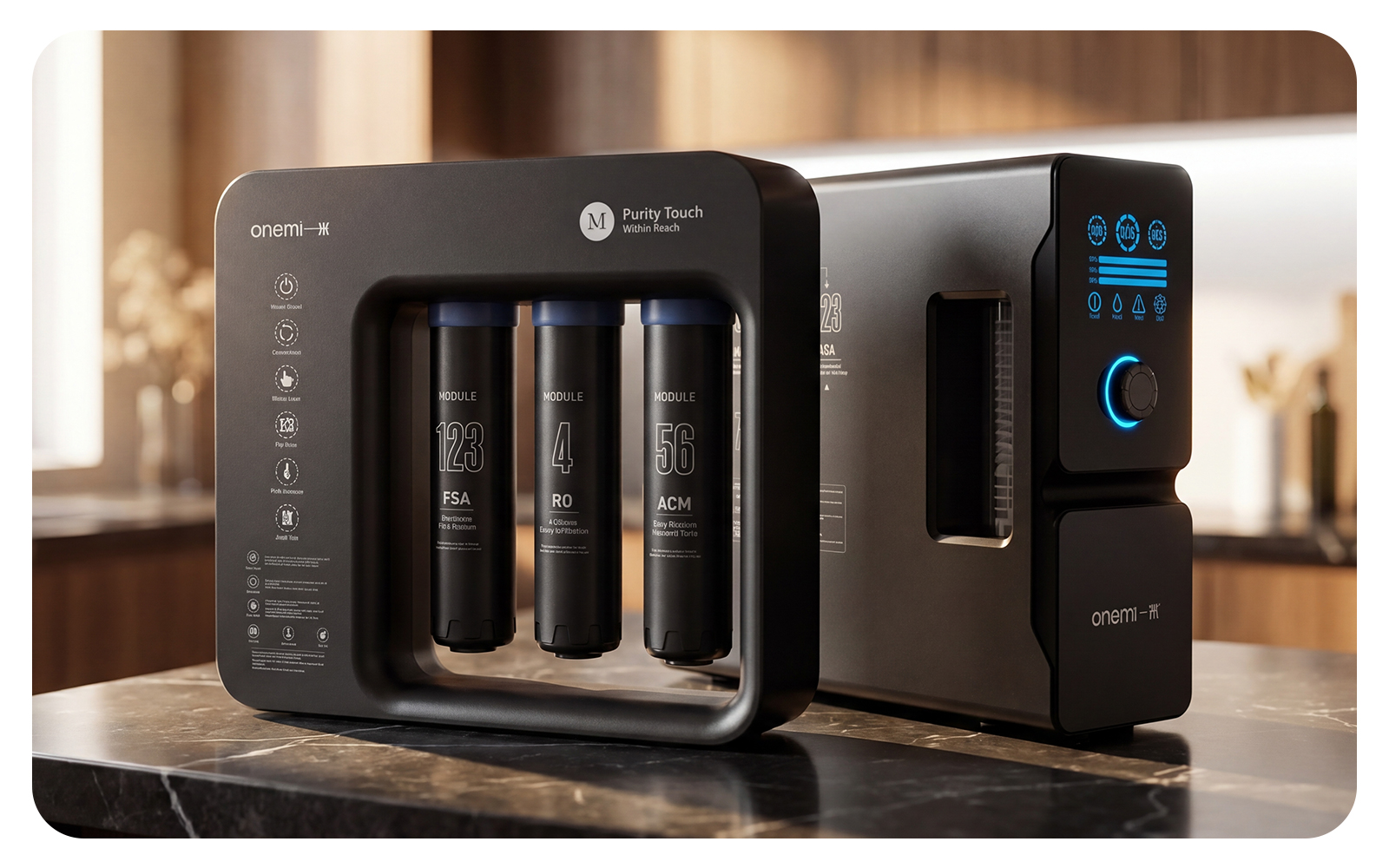
This is where the industry is heading, and brands like ONEMI are actively designing systems to meet these exact parameters, ensuring high-flow delivery without compromising chemical extraction rates. The market demand is clear: consumers want speed, space, and sustainability, all in a single unit that fits neatly under a standard kitchen cabinet.
How Modern RO Membranes Achieve 1:1 Waste Ratios
To understand how a modern tankless system achieves these efficiency metrics, we have to look at the fluid dynamics inside the housing. A traditional RO membrane is a spiral-wound sheet of polyamide. Water is forced against this semi-permeable barrier under pressure. The pure water passes through, while the concentrated contaminants are washed away as waste.
In a low-flow, tank-based system, the pressure is relatively low, and the water moves slowly. This slow movement allows dissolved solids to accumulate on the membrane surface, a phenomenon known as concentration polarization. To prevent this buildup from scaling and ruining the membrane, a high volume of flush water must be constantly run over the surface and sent down the drain. This is the source of the terrible 4:1 waste ratio.
Modern high-flow systems solve this by utilizing powerful, variable-speed booster pumps that run on low-voltage DC power. These pumps force water across the membrane surface at high velocity and pressure. This turbulent flow sweeps away the concentrated minerals before they can precipitate and form scale. By keeping the membrane surface clean through mechanical velocity rather than sheer water volume, the system can safely operate at a 1:1 ratio.
A major technical catch that sales brochures rarely mention: if your incoming water hardness exceeds 10 to 15 grains per gallon (GPG), running a tankless RO system at a 1:1 ratio without a pre-softener will rapidly scale the membrane, cutting its lifespan from three years down to six months. It is a classic engineering trade-off.
Furthermore, these advanced systems integrate multi-stage filtration into fewer physical cartridges. A typical configuration looks like this:
| Filter Stage | Material Composition | Target Contaminants | Typical Lifespan |
|---|---|---|---|
| Stage 1: Pre-Filter | PP Cotton & Carbon Block | Sand, rust, sediment, chlorine, VOCs | 6 – 12 Months |
| Stage 2: RO Membrane | 0.0001-micron Polyamide | Heavy metals, PFAS, TDS, microplastics | 24 – 36 Months |
| Stage 3: Post-Filter | Activated Carbon & Minerals | Residual odor, taste enhancement, remineralization | 12 Months |
The Regulatory Landscape: NSF Standards and the PFAS Crisis
The days of relying on basic charcoal filters to clean municipal water are over. Across the United States, municipal water systems are grappling with aging infrastructure and chemical contamination. The US Environmental Protection Agency (EPA) recently finalized strict, legally enforceable Maximum Contaminant Levels (MCLs) for six per- and polyfluoroalkyl substances (PFAS), also known as “forever chemicals.” These synthetic compounds, used for decades in non-stick cookware and firefighting foams, are linked to cancer, liver damage, and developmental issues, even at parts-per-trillion levels.
To address these emerging threats, the National Sanitation Foundation (NSF) and the American National Standards Institute (ANSI) have updated their testing protocols. For residential water filtration, three standards reign supreme: NSF/ANSI 42 (aesthetic effects like chlorine and odor), NSF/ANSI 53 (health effects like lead, asbestos, and VOCs), and NSF/ANSI 58 (specifically for reverse osmosis systems).
When selecting a water purification system, looking for certified compliance with these standards is critical. A system certified under NSF 58 for pentavalent arsenic reduction or NSF 53 for lead reduction has undergone rigorous third-party testing under pressure conditions that mimic real-world home plumbing surges. The ONEMI product line aligns with these rigorous testing frameworks, ensuring that the materials used in the water pathways are completely lead-free and do not leach chemicals back into the purified water.
The challenge for manufacturers is that meeting these standards requires high-density materials and ultra-fine pore sizes. This naturally restricts flow. Achieving NSF-level filtration while maintaining a 1,000 GPD delivery rate requires incredibly precise manufacturing tolerances, where the RO membrane layers are wrapped with sub-millimeter accuracy to maximize surface area within a compact housing.
Real-World Water Challenges and Smart Diagnostics
Let us look at a real-world scenario. In parts of West Texas, municipal tap water can register a Total Dissolved Solids (TDS) level of over 800 parts per million (ppm), combined with high silica content. If you install a standard, non-smart RO system in this environment, it will work beautifully for the first few weeks. However, as the silica scales the membrane, the flow rate will drop, the pump will work harder, overheat, and eventually fail prematurely.
This is why smart RO technology is no longer just a marketing gimmick; it is a vital operational safeguard. Modern systems incorporate real-time TDS sensors at both the inlet and the outlet. This allows the system to calculate the exact rejection rate of the membrane at any given moment. If the rejection rate drops below 90%, or if the outlet TDS creeps above a safe threshold, the system alerts the user via an integrated LED screen on the faucet or a smartphone app.
Smart auto-flushing is another critical advancement. When a system sits idle for several hours, water on both sides of the membrane tends to equalize in TDS due to natural osmotic pressure—a phenomenon called TDS creep. A smart system detects this idle time and automatically runs a brief, high-pressure flush using fresh water before you fill your next glass, ensuring that your first sip of water in the morning is just as pure as the last one boiled the night before.
How do you know when to actually change your filter? Older systems relied on simple timers, flashing a red light every six months regardless of whether you filtered 10 gallons or 1,000 gallons. Modern smart systems monitor actual volume throughput, combining that data with incoming water quality metrics to calculate the true remaining life of each cartridge. This prevents the premature disposal of perfectly good filters, saving homeowners significant money over the lifespan of the system.
The Global Outlook: Decentralized Water Treatment
As we look toward 2026 and beyond, the reliance on centralized municipal water treatment plants to deliver pristine drinking water is decreasing. Municipalities are facing staggering costs to upgrade their infrastructure to remove microplastics, pharmaceuticals, and industrial run-off. The prevailing consensus among urban planners and water quality experts is shifting toward a decentralized model: treat water to a basic, safe level at the municipal plant, and perform the final, high-purity filtration at the point of use (POU) in the home.
This macro-trend is driving the rapid adoption of under-sink RO systems globally. In rapidly urbanizing regions of Asia and Latin America, where tap water safety cannot be guaranteed, compact under-sink filtration is becoming a standard appliance in new apartment constructions, right alongside the refrigerator and the microwave. In developed markets, the motivation is driven by wellness, taste, and the elimination of single-use plastic bottles.
For the consumer, the decision to invest in a high-quality, tankless RO system comes down to long-term reliability and cost-per-gallon. While the initial hardware investment is higher than a simple pitcher or faucet-mount filter, the operating cost of a high-flow RO system over a five-year period is remarkably low, often averaging less than $0.05 per gallon of high-purity water. When you factor in the elimination of plastic waste, the protection of household appliances from scale damage, and the peace of mind that comes from certified removal of PFAS and heavy metals, the transition to smart, tankless RO technology is the most logical step forward for the modern home.
By integrating advanced membrane chemistry, smart diagnostics, and highly efficient water ratios, today’s water purification systems are no longer just filters. They are miniature, highly automated water treatment plants operating quietly under the kitchen sink, delivering pristine water on demand while protecting both the household budget and the environment. ONEMI continues to innovate in this space, pushing the boundaries of what residential water filtration can achieve in an increasingly complex environmental landscape.