




 한국어
한국어

- Food service and light industrial buyers represent a large and growing share of commercial RO demand, with catering and food and beverage segments expanding at a double-digit CAGR through 2032.
- Commercial RO demand is driven less by water purity alone and more by total cost of ownership: rejection rate, recovery ratio, and membrane replacement cycles.
- For food service, RO protects ice machines, coffee equipment, and steam systems from scale; for light industrial, it protects boilers and production lines from dissolved solids and hardness.
Ask any equipment distributor where commercial reverse osmosis demand is coming from in 2026, and two segments keep coming up: food service and light industrial. Both buy RO for the same underlying reason, equipment protection and consistent output quality, but they size systems differently, buy differently, and churn differently.
Why Food Service Buys Commercial RO
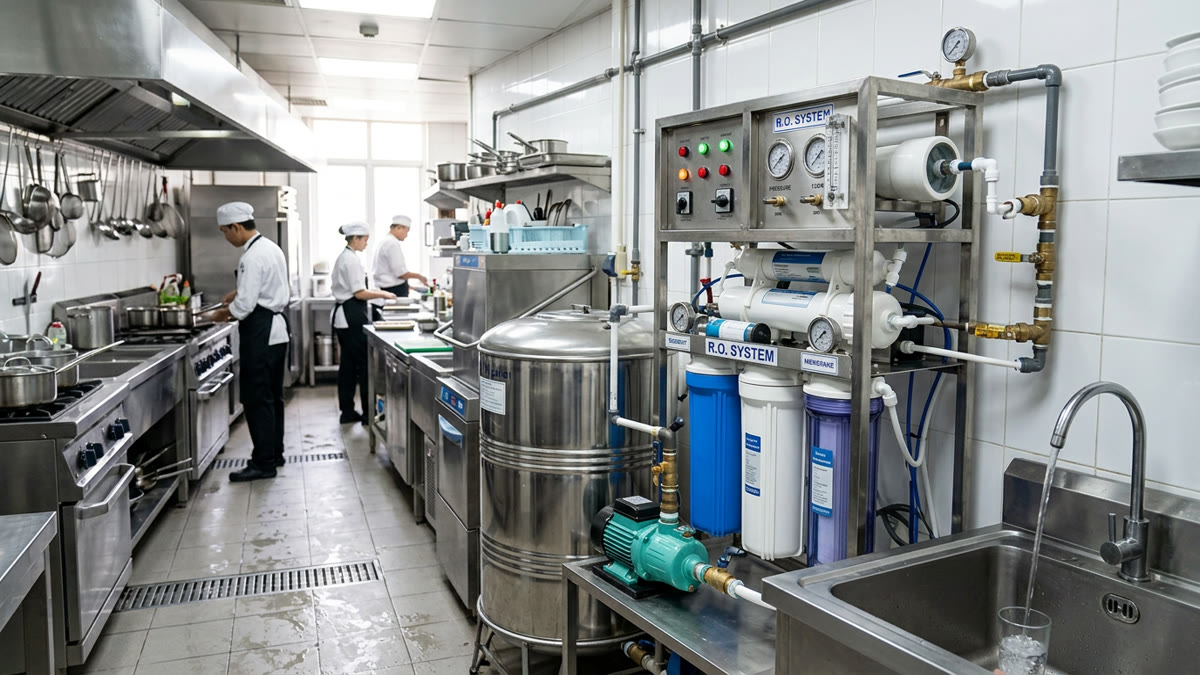
Restaurants, cafes, and catering kitchens are not buying RO systems for the sake of purity. They are buying protection for the equipment that makes their revenue. An ice machine fed by hard water scales up in a few months, produces cloudy ice, and needs a descaling service call. A coffee machine on hard water builds scale in the boiler and changes extraction. A combi oven or steamer on mineral-heavy water clogs its injectors.
The economics are straightforward. A commercial RO system feeding an ice machine and a coffee station typically pays for itself through fewer descaling cycles and longer equipment life. According to industry research, the global commercial water filter market for catering alone was valued at around US$3.29 billion in 2025 and is forecast to roughly double to US$7.09 billion by 2032, a CAGR of about 11.7% (Global Info Research, 2026). That demand is not evenly distributed: it concentrates in kitchens that run ice and steam equipment daily.
Light Industrial Is the Quieter, Bigger Buyer
Light industrial covers a wide band: food and beverage production, pharmaceutical packaging, metal finishing, printing, and any facility running boilers or closed-loop cooling. These buyers rarely talk about taste. They talk about dissolved solids, hardness, and conductivity, because those are the numbers that dictate maintenance intervals on expensive equipment.
A boiler fed by unsoftened water accumulates scale on its heat-exchange surfaces. Even a thin layer of scale measurably cuts heat-transfer efficiency and raises energy cost. For a light industrial buyer, an RO system upstream of a boiler or a production line is a preventive maintenance decision with a calculable payback. The broader RO system market is projected to grow from roughly US$9.44 billion in 2026 to US$16.13 billion by 2035, a CAGR of about 6.14% (Industry Research Biz, 2026), with industrial applications accounting for roughly 58% of system demand.
What Procurement Teams Should Look For
Commercial RO is not a residential system scaled up. Buyers who treat it that way end up with systems that underperform or fail early. Here is what actually matters.
First, the membrane and its rejection rate. A commercial-grade RO membrane should reject 97% or more of dissolved solids, and the system should state this clearly. Lower-grade membranes drift below 90% quickly and let scale-causing minerals through.
Second, recovery ratio. This is the percentage of feed water that becomes permeate rather than concentrate. Higher recovery means less water waste and lower operating cost, but it also concentrates minerals faster on the membrane, so there is a real trade-off. A system designed for a food service kitchen should balance recovery against membrane life, not chase the highest number on a spec sheet.
Third, capacity sizing. Buyers frequently undersize. A restaurant buying for one ice machine today will add a second line or a coffee program next year. A light industrial buyer sizing only for current production volume will feel the pinch during a seasonal peak. The right question is not “what do I need today” but “what is my peak-hour demand plus 20% headroom.”
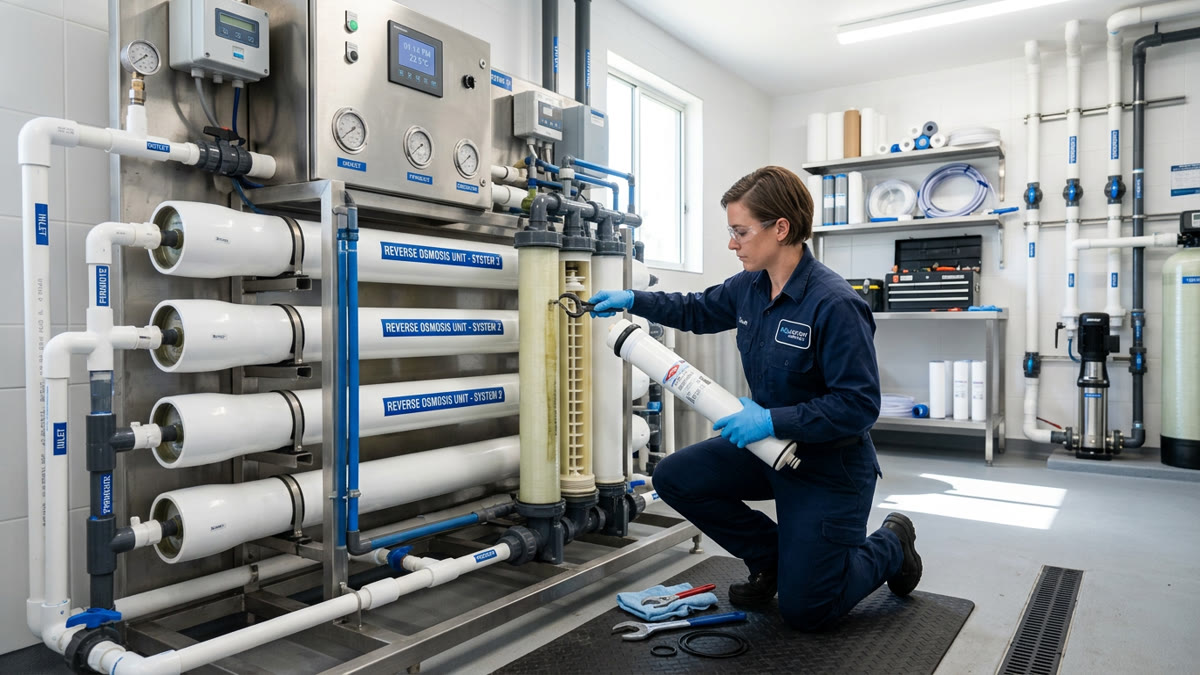
Fourth, maintenance access. Cartridges and membranes must be serviceable without shutting down the whole line. For food service, that means a system a technician can swap filters on during a short service window, not one that requires a full kitchen shutdown.
Where the Market Is Headed
Two trends are shaping commercial RO demand over the next several years. The first is smart monitoring. A growing share of new commercial installations include sensors that track membrane condition, flow, and TDS in real time, which shifts maintenance from a fixed schedule to a condition-based trigger. The second is the shift from buying boxes to buying outcomes: more food service and light industrial operators are moving toward lease-and-maintain or managed-service contracts, which changes what they value in a supplier, namely uptime guarantees and response time, rather than just hardware price.
For distributors and importers, the implication is clear. The commercial RO segment rewards suppliers who can offer correctly sized systems, documented rejection and recovery specs, and a maintenance story, not just a cheaper box. That is the difference between a one-time sale and a recurring account.
Sizing and Specifying the Right System
Here is a practical reference for matching system capacity to the application. These are indicative ranges, not hard rules, because local water quality changes everything, but they give a useful starting point.
| Application | Typical daily demand | Common RO capacity | Primary concern |
|---|---|---|---|
| Restaurant ice machine + coffee | 100-400 gallons | 400-800 GPD | Scale protection, taste |
| Catering kitchen / steam line | 400-1,000 gallons | 800-2,000 GPD | Scale protection, peak flow |
| Light industrial boiler feed | 1,000+ gallons | 2,000+ GPD | Hardness, dissolved solids |
| Food and beverage production | Varies widely | Custom, multi-stage | Conductivity, consistency |
Hardness and TDS in the local feed water are the two numbers that most affect sizing. A kitchen in a hard-water region will need a larger system, or a softener upstream of the RO, to protect the membrane from premature fouling. Skipping that upstream step is one of the most common reasons commercial RO membranes fail early.
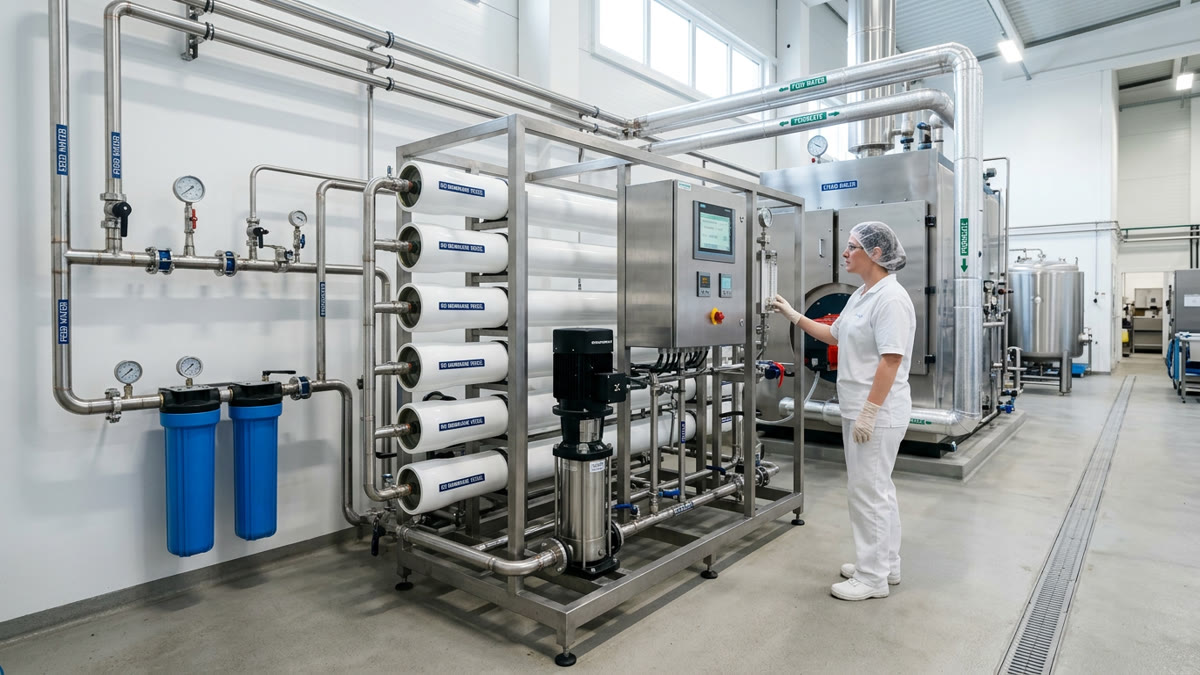
For a look at how commercial RO systems are specified for industrial and food and beverage applications, see the notes on commercial and industrial RO water treatment, and for food and beverage production specifically, industrial water filtration for food and beverage.
The Supplier Question
Most commercial RO buyers in food service and light industrial are not buying direct from a brand; they are buying through distributors and importers who source from manufacturers. That means the manufacturer’s ability to document specs, hold tolerances across production runs, and ship on time is what determines whether a distributor can close and keep a commercial account.
ONEMI, a Guangdong-based water purification equipment manufacturer, supplies commercial and industrial RO systems to distributors and OEM partners, with documented rejection and recovery specs and the capacity to configure systems for specific feed-water conditions. For buyers building a commercial line, the manufacturer relationship is the real supply-chain decision. A detailed walkthrough of what to evaluate is in this guide to choosing an OEM water purifier factory.
Commercial RO demand in food service and light industrial is not a passing trend. It is driven by hard water, aging equipment, and the steady spread of ice, coffee, and steam equipment into more kitchens, which means the buyers who serve these segments well are building recurring, multi-year accounts. The winners will be the ones who stop selling boxes and start selling correctly sized, well-documented, serviceable systems.