

 한국어
한국어

In late 2023, a microelectronics packaging facility in Austin, Texas, faced an unscheduled 72-hour shutdown. The culprit was not a cyberattack or a supply chain bottleneck, but a subtle shift in municipal feed water chemistry. The local utility had adjusted its treatment protocols to combat seasonal algae blooms, raising total dissolved solids (TDS) by just 112 parts per million (ppm). This minor fluctuation overwhelmed the facility’s aging, static water treatment setup, fouling delicate downstream membranes and contaminating ultra-pure rinse baths. The cost of that three-day stoppage topped $1.4 million.
This incident is not an outlier.
Across the globe, industrial and commercial enterprises are discovering that water is no longer a simple utility to be taken for granted. It is a highly volatile, increasingly regulated raw material that directly impacts operational continuity, product yield, and corporate survival. As municipal infrastructures degrade and climate patterns disrupt historical water baselines, the line between profit and catastrophic downtime comes down to real-time purification capabilities.
Executive Summary
- The global commercial water treatment market is projected to surpass $85 billion by 2028, driven by tightening industrial wastewater regulations and high-purity process water demands.
- Standard configurations fail because feed water chemistry fluctuates seasonally; modern systems require dynamic, multi-stage membrane filtration ranging from 1,000 to 50,000 GPD.
- Proactive water purification strategies mitigate regulatory penalties, reduce energy consumption, and prevent catastrophic downtime in manufacturing, food processing, and pharmaceuticals.
The Changing Mechanics of Industrial Feed Water

For decades, commercial facilities operated under the assumption that city tap water was “good enough” for basic utility feeds, requiring only minor softening or carbon filtration for sensitive processes. That assumption is dead. Today, municipal water systems in major industrial corridors face unprecedented stress from agricultural runoff, chemical discharge, and aging lead-and-iron pipe networks.
In the United States, the Environmental Protection Agency (EPA) continues to tighten restrictions on per- and polyfluoroalkyl substances (PFAS) and heavy metals, forcing municipal plants to alter their chemical treatment regimens. These municipal adjustments often result in volatile pH swings, increased chloramine levels, and unexpected mineral spikes at the point of consumption. In Europe, the Industrial Emissions Directive (IED) imposes strict limits on wastewater discharge, meaning companies must clean their water both before it enters the production line and before it leaves the facility.
Consider the raw inputs. A standard manufacturing plant in the American Midwest might draw water with a TDS of 450 ppm, containing high levels of calcium carbonate, silica, and agricultural nitrates. A similar facility in the Rhine basin in Germany might deal with lower TDS but significantly higher concentrations of dissolved organic carbon (DOC) and industrial micro-pollutants. Standard, off-the-shelf filtration units cannot handle these distinct chemical profiles without either fouling within weeks or letting harmful ions slip through to sensitive machinery.
To put this in perspective, here is how different industries require different water profiles to maintain basic operational standards:
| Industry Sector | Critical Water Quality Metric | Typical Source Water Challenge | Required Post-Treatment Standard |
|---|---|---|---|
| Food & Beverage | Biological load, chlorine, odor | Seasonal pathogens, high chloramines | Zero pathogens, <0.1 ppm free chlorine |
| Pharmaceuticals | Conductivity, TOC, endotoxins | High mineral content, organic run-off | <1.3 µS/cm conductivity, <500 ppb TOC |
| Microelectronics | Resistivity, silica, particulates | Colloidal silica, trace dissolved metals | 18.2 Megohm-cm resistivity, zero particulates |
| Commercial Boilers | Hardness (CaCO3), silica scaling | High calcium, magnesium, sulfates | <1.0 ppm total hardness, <150 ppm TDS |
When these standards are breached, the physical consequences are immediate. Scale deposits build up inside boiler tubes and heat exchangers, acting as insulation. A mere 1.5-millimeter scale deposit inside a commercial boiler can increase energy consumption by up to 15%, driving up operational costs while putting the entire system at risk of thermal shock and catastrophic rupture.
The Limits of Traditional Filtration and the Rise of RO
Why do conventional multi-media filters and water softeners fail to solve these issues on their own? These traditional systems are designed to target specific, large-scale contaminants—sediment, chlorine, or calcium ions. They are fundamentally blind to dissolved chemical compounds, heavy metals, microplastics, and microscopic pathogens. A standard water softener swaps calcium ions for sodium ions, which prevents scale but does absolutely nothing to lower the overall TDS of the water. For processes requiring ultra-pure water, high TDS remains a critical failure point.
This is where industrial-grade reverse osmosis (RO) systems become necessary. RO technology operates by forcing pressurized water through a semi-permeable membrane with pores as small as 0.0001 microns. This physical barrier rejects up to 99.8% of dissolved salts, organics, bacteria, and pyrogens, producing a highly consistent stream of purified permeate water.
However, running an industrial RO system is not as simple as plugging it in and turning it on. It is a delicate balance of fluid dynamics, chemistry, and thermodynamics.
Here is a practical gotcha that many facility managers overlook: temperature. Reverse osmosis membranes are rated at a standard testing temperature of 25°C (77°F). For every 1°C drop in feed water temperature, membrane flux drops by approximately 3%. If your facility is located in a northern climate like Chicago or Frankfurt, winter municipal water temperatures can plunge to 4°C (39°F). Without a variable frequency drive (VFD) pump and a dynamic control system to adjust operating pressures, your 10,000 Gallon Per Day (GPD) system will suddenly struggle to output even 5,000 GPD. This operational drop forces production slowdowns or leads to premature membrane compaction as operators try to manually crank up the pressure past safe limits.
Furthermore, high-recovery setups can suffer from accelerated scaling if the chemistry is not balanced. As pure water is squeezed through the membrane, the remaining waste stream (concentrate) becomes highly saturated with minerals. If this concentration exceeds the solubility limit of compounds like calcium sulfate or silica, these minerals precipitate directly onto the membrane surface, a phenomenon known as scaling. Once scaled, membranes lose flux rapidly and require aggressive chemical cleanings, which degrades the polymer structure and shortens the operational lifespan of the system.
Engineering the Modern Commercial Water Loop
To build a truly resilient commercial water purification loop, engineers must move away from isolated, single-unit thinking. A modern system must be designed as a cohesive, multi-stage process that protects the core RO membranes while optimizing energy use and water recovery rates.
The journey begins at the pre-treatment stage. Raw water must first pass through a multi-media or disc filter to remove suspended solids down to 5-10 microns. This protects the subsequent carbon filters from clogging. Carbon filtration is non-negotiable for municipal feeds; it removes free chlorine and chloramines, which otherwise chemically attack and permanently degrade thin-film composite RO membranes. Next, an antiscalant dosing system or a high-efficiency water softener must neutralize hardness ions before they reach the high-pressure pump.
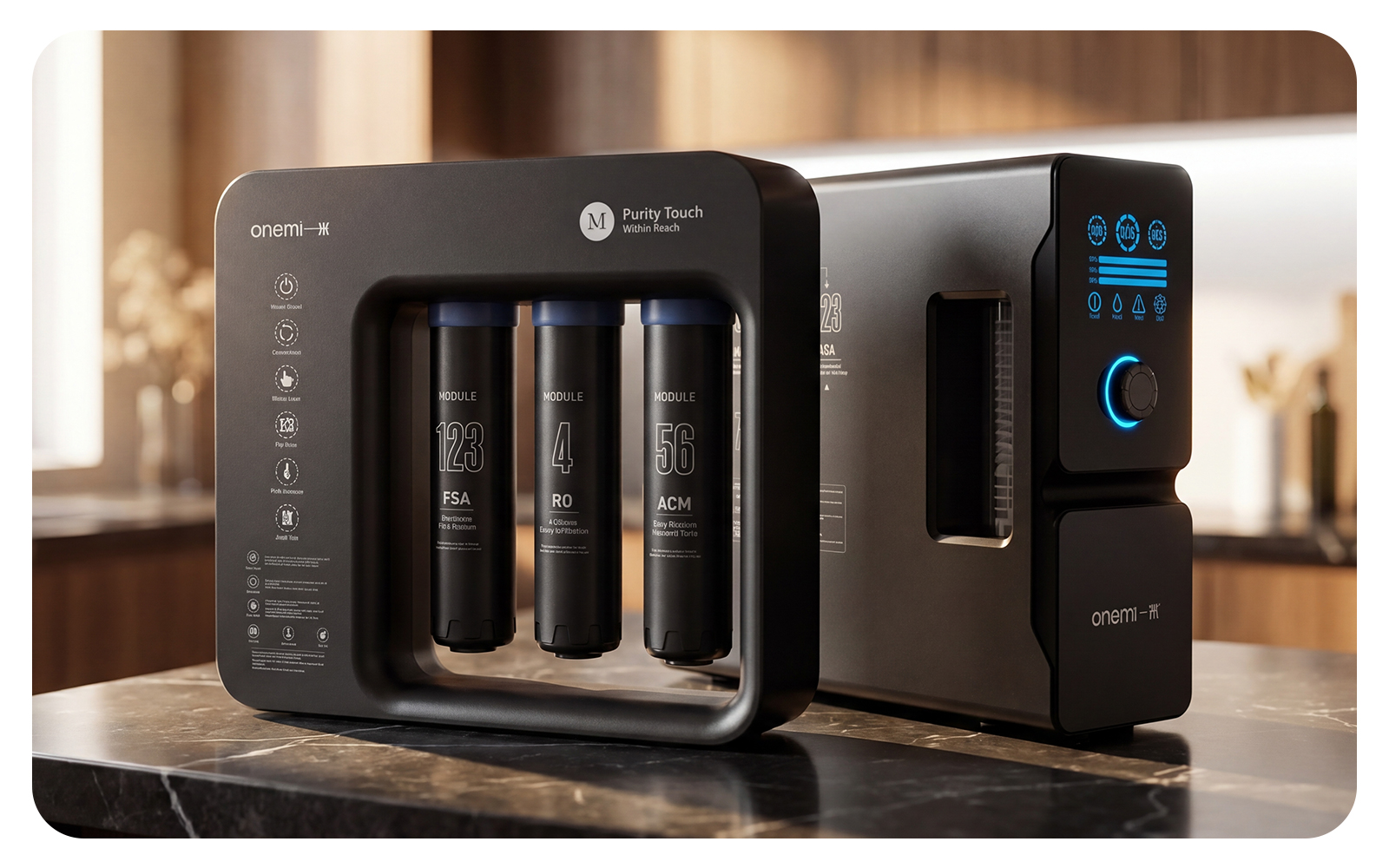
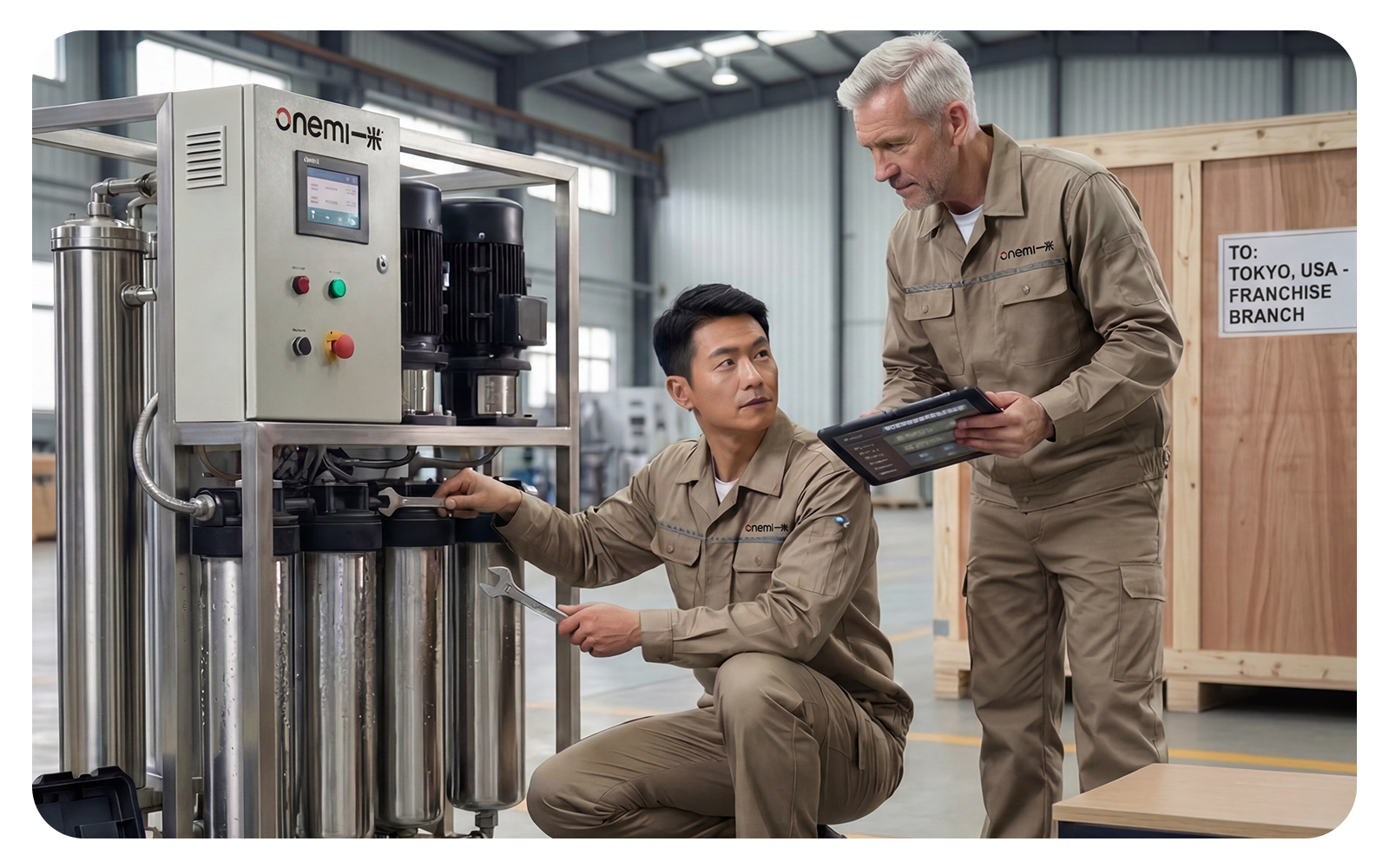
Once pre-treated, the water enters the RO pressure vessels. Modern systems, such as the high-efficiency configurations designed by ONEMI, utilize multi-stage membrane arrays to maximize recovery. In a single-stage system, the recovery rate is typically limited to 50-60%, meaning for every gallon of pure water produced, nearly a gallon of wastewater is sent to the drain. By routing the concentrate from the first stage into a second stage of membranes, advanced systems can push recovery rates up to 75-80% without risking scaling, drastically reducing municipal water bills and sewer discharge fees.
Post-treatment is dictated by the specific end-use application. For commercial laundry, agricultural greenhouse feeds, or boiler makeup, the RO permeate is often ready for immediate storage and distribution. For pharmaceutical, laboratory, or microelectronics use, the water must undergo further polishing. This typically involves ultraviolet (UV) sterilization to eliminate any residual microbial activity, followed by electrodeionization (EDI) or mixed-bed deionization to strip out the final trace ions, bringing water resistivity up to the required megaohm levels.
This integrated approach also addresses the issue of biofouling. Bacteria can colonize storage tanks and distribution loops, forming a protective biofilm that is highly resistant to standard sanitization. Implementing a continuous ozone sanitization loop or periodic hot-water sanitization capability ensures that the high-purity water produced by the RO system remains uncontaminated until the moment of use.
The Economic Reality of Water Security
Investing in advanced water treatment infrastructure is often viewed by corporate finance departments as a pure capital expense (CAPEX) with a slow return on investment. This perspective misses the broader picture of operational risk mitigation and operating expense (OPEX) reduction.
Let us look at a real-world financial comparison. A commercial food processing facility in Ohio was using standard softened municipal water for its boiler feed and ingredient mixing. The high silica and chloride levels in the local water required frequent boiler blowdowns—discharging hot, mineral-rich water to prevent scale buildup—which wasted millions of BTUs of thermal energy and thousands of gallons of water daily. The facility also suffered from inconsistent product batches due to seasonal taste variations in the municipal supply.
The facility replaced their basic softeners with a 25,000 GPD industrial RO system featuring advanced low-energy membranes and integrated energy recovery devices. The financial impact was immediate:
- Boiler blowdown frequency: Reduced by 82%, saving $34,000 annually in fuel and water treatment chemicals.
- Membrane lifespan: Extended from an average of 14 months to over 42 months due to optimized pre-treatment and automated flush cycles.
- Product consistency: Batch rejection rates dropped to zero, saving an estimated $112,000 annually in wasted ingredients and lost production time.
The total capital expenditure for the system overhaul was amortized in just 14.5 months. Beyond the direct financial returns, the facility gained long-term regulatory compliance security, insulated itself from future municipal water rate hikes, and lowered its overall environmental footprint—a key metric for corporate sustainability reporting.
As water scarcity intensifies and global regulatory frameworks tighten, the ability to control, purify, and recycle process water is no longer a luxury for specialized industries. It is a core operational requirement for any business that intends to remain competitive and resilient over the coming decades. Investing in robust, dynamically engineered water purification systems is not just about compliance; it is about securing the liquid foundation of your global enterprise.