



 한국어
한국어

Executive Summary
- The five-year total cost of ownership (TCO) for point-of-use filtration is $3,660, compared to $42,680–$47,180 for bottled water delivery in a 50-employee office.
- Economic parity and complete capital amortization of filtration systems occur within the first 4.2 months of deployment.
- Modern filtration mitigates emerging microplastic liabilities and complies with local municipal water standards far more effectively than bottled counterparts.
Walk through any mid-sized corporate headquarters in Chicago or Boston and you will likely spot two distinct relics of the early 2000s office culture: overflowing paper filing cabinets and massive, blue-tinted 5-gallon plastic water jugs stacked near the breakroom. While the filing cabinets have largely been digitized, the water jugs remain, quietly draining corporate operating budgets month after month. Facility managers often treat these water deliveries as an immutable utility bill, a fixed cost of doing business that cannot be optimized. This passive acceptance of recurring delivery invoices represents one of the most significant, overlooked leaks in modern corporate procurement.
The economics of corporate hydration are undergoing a quiet but aggressive shift. What used to be a simple choice between convenience and taste has matured into a complex calculation involving municipal water quality compliance, supply chain risk, labor overhead, and strict environmental, social, and governance (ESG) reporting mandates. As organizations scrutinize every line item of their operational expenditures, the traditional bottled water delivery model is failing to justify its place on the balance sheet. Comparing the raw numbers reveals a stark financial divergence that can no longer be ignored by CFOs and operations directors.
The Multi-Year Financial Divergence
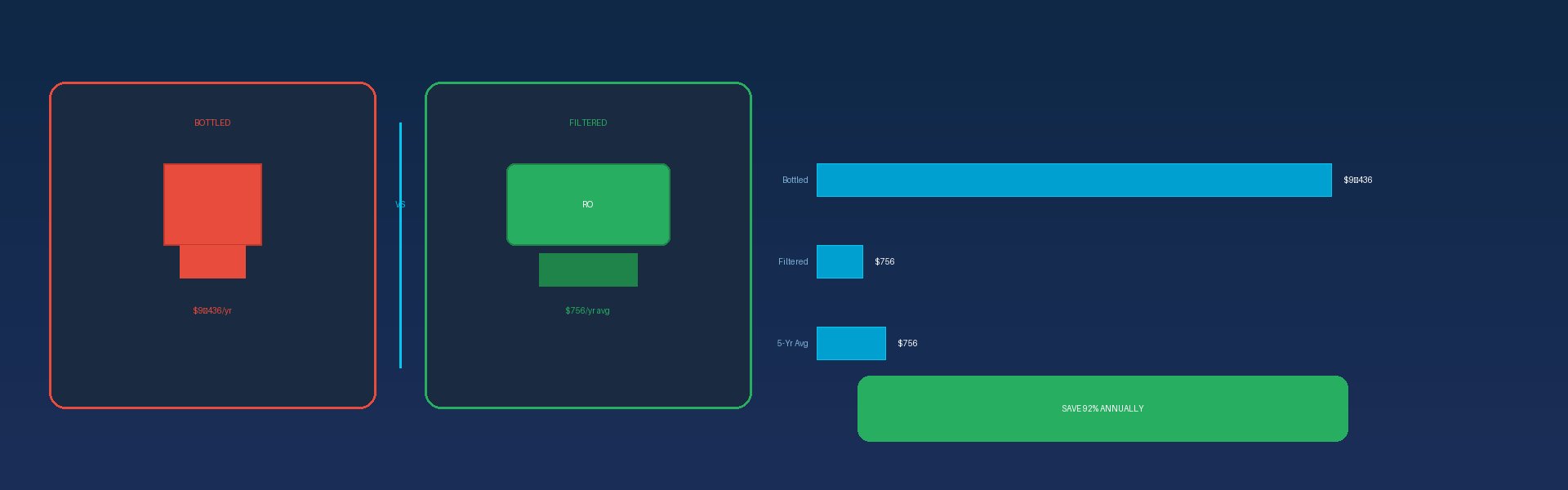
To understand the true scale of this fiscal mismatch, we must look past the deceptively low cost of a single bottle of water and analyze the Total Cost of Ownership (TCO) over a standard five-year corporate planning horizon. Consider a typical office environment housing 50 full-time employees. On average, an employee consumes approximately 16 ounces of water during an eight-hour workday. Across 50 employees, this equates to 6.25 gallons of water per day, or roughly 125 gallons per month, accounting for standard 20-day monthly working cycles.
Under a traditional 5-gallon bottled water delivery contract, this demand requires 25 jugs per month. At an average market rate of $9.50 per jug—excluding fuel surcharges, bottle deposits, dispenser rental fees, and administrative processing costs—the baseline water expense sits at $237.50 per month. When you factor in a standard $30 monthly dispenser rental fee and an average $15 delivery and fuel surcharge per shipment, the actual monthly cash outflow rises to $282.50. Over a twelve-month period, this totals $3,390. Over a five-year horizon, assuming a conservative 3% annual inflationary increase in delivery fees and water costs, the cumulative cash outlay reaches $18,000 for water alone.
The hidden operational costs tell an even more damaging story.
Who actually manages these bottles? In most offices, it falls to administrative assistants or facility staff to receive the deliveries, log them into inventory, hoist the 42-pound jugs onto the dispensers, store the empties, and reconcile the monthly invoices. If an administrative employee earning $24 per hour spends just two hours per week handling these tasks, the company incurs an additional $192 per month in indirect labor costs. Over five years, this silent productivity drain adds $11,520 to the true cost of the bottled water system. When combined with the physical space requirements—allocating roughly 15 square feet of premium office real estate for bottle storage at an average commercial rent of $35 per square foot—the total cost of ownership for bottled water over five years balloon to a staggering $42,680 to $47,180.
Now, let us contrast this with a commercial-grade point-of-use (POU) filtration system. The initial capital expenditure for a high-capacity, multi-stage filtration unit, including professional installation and plumbing integration, averages $1,200. Annual maintenance, which includes semi-annual certified technician visits, system sanitization, and replacement of carbon block and sediment filters, runs approximately $350 per year. The water itself is drawn directly from the municipal line, costing less than $0.01 per gallon. Even when factoring in the minor increase in the office utility bill, the water cost is statistically negligible.
Over a five-year period, the financial profile of the filtration option looks remarkably flat:
| Expense Category (5-Year Horizon) | 5-Gallon Bottled Water Delivery | Point-of-Use (POU) Filtration | Net Savings / Difference |
|---|---|---|---|
| Initial Hardware & Setup | $0 (Dispenser rented) | $1,200 (Purchase & install) | -$1,200 |
| Recurring Consumables / Water | $15,120 (Jugs & surcharges) | $40 (Municipal water tap) | +$15,080 |
| System Rental / Maintenance | $1,800 (Dispenser lease) | $1,400 (Filters & service) | +$400 |
| Internal Labor & Handling | $11,520 (Staff handling time) | $1,020 (Internal coordination) | +$10,500 |
| Real Estate Storage Cost | $14,240 (Storage footprint) | $0 (Zero footprint) | +$14,240 |
| Total Cost of Ownership (TCO) | $42,680 – $47,180 | $3,660 | +$39,020 – $43,520 |
The crossover point where point-of-use filtration achieves absolute economic parity with bottled water delivery occurs during month four. After this brief amortization period, the system operates at a fraction of the cost of delivery, yielding a cumulative financial efficiency exceeding $37,000 for a single 50-person office. For enterprises managing multiple locations or larger campuses, these savings scale linearly, directly improving the operating margin of the business.
Water Quality, Regulations, and the Microplastic Problem
Beyond the undeniable financial metrics, a more alarming divergence exists in the realm of water purity, safety, and regulatory compliance. Many decision-makers assume that bottled water is inherently purer than municipal tap water. This assumption is not only scientifically inaccurate; it also ignores the realities of modern plastics manufacturing and storage.
Recent peer-reviewed environmental studies have revealed that bottled water stored in blue polycarbonate or polyethylene terephthalate (PET) containers contains up to 100 times more microplastic and nanoplastic particles than previously estimated. These microscopic fragments, shed from the inner walls of the bottles during transport, temperature fluctuations, and repeated handling, are consumed directly by employees. While long-term toxicological studies are still ongoing, the liability of knowingly providing a hydration source containing high concentrations of synthetic polymers is beginning to worry corporate risk assessment teams.
Conversely, advanced point-of-use filtration systems do not store water in pressurized plastic environments. They purify water on demand, utilizing multi-stage filtration arrays that physically remove these contaminants immediately before consumption. For instance, high-end commercial filtration units integrate sub-micron carbon blocks, sediment pre-filtration, and specialized hollow-fiber ultrafiltration membranes. This combination effectively intercepts microplastics, chlorine, volatile organic compounds (VOCs), and heavy metals like lead and copper, which are common issues in aging municipal distribution systems across older metropolitan areas.
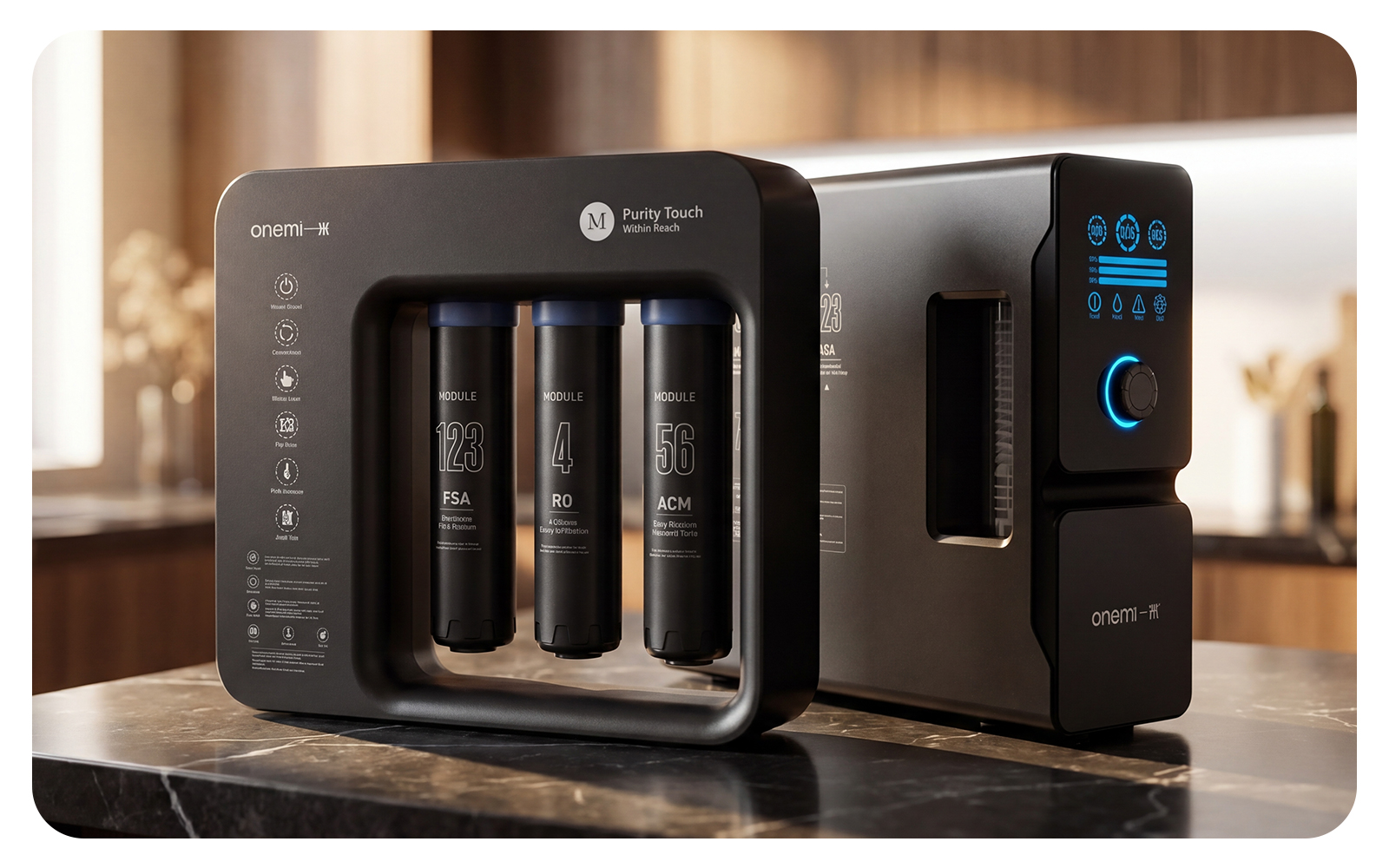
ONEMI systems have been designed specifically to address these municipal water challenges, providing a consistent, verifiable barrier against localized contaminants without the risk of plastic leaching. By utilizing a closed-loop, direct-to-tap configuration, such systems eliminate the storage phase entirely, ensuring that the water dispensed is significantly cleaner than water that has sat in a plastic warehouse for weeks.
Is your office drinking water actually as clean as the label on the bottle claims?
The regulatory landscape is also tightening. Local municipalities are increasingly enforcing stricter guidelines regarding water conservation and waste reduction. Under extended producer responsibility (EPR) laws being introduced in several states, corporations may soon face penalties or additional taxes for the volume of single-use or bulk plastics they bring into their facilities. Transitioning to a plumbed filtration system proactively insulates an organization from these impending compliance costs, transforming water procurement from a potential regulatory liability into a certified sustainable practice.
The Operational and Logistical Reality Check
To fully appreciate the friction of the bottled water model, one must examine the physical logistics of a typical delivery day. A standard delivery truck arrives at the office curb. The driver unloads dozens of heavy, awkward jugs onto a hand truck, wheels them through the lobby, and deposits them in a designated receiving area. From that moment, the logistical burden shifts entirely to your internal staff.
Consider the physical risk. A full 5-gallon water jug weighs exactly 41.7 pounds. Lifting this dead weight and flipping it upside down onto a dispenser collar is a recipe for musculoskeletal strain. According to occupational health and safety data, back strains from lifting heavy objects are among the most common non-fatal workplace injuries, often resulting in worker compensation claims and lost productivity. When an employee injures themselves performing an unnecessary task like changing a water bottle, the company pays a price that far exceeds the cost of the water itself.
Storage space is another premium asset that bottled water quietly monopolizes. In high-density urban office markets, every square foot of floor space must be optimized for collaborative work or productive tasks. Storing ten full jugs and ten empty jugs requires a dedicated footprint in a breakroom or supply closet. In contrast, a point-of-use filtration system occupies zero floor space for storage. The filtration hardware is housed entirely within the base of a sleek, freestanding dispenser or neatly tucked beneath a breakroom sink. This frees up valuable square footage for other business needs while eliminating the visual clutter of empty plastic containers lining the hallways.
Furthermore, the supply chain for bottled water is highly vulnerable to external disruptions. Fuel price spikes, driver shortages, extreme weather events, and municipal traffic congestion can all lead to delayed or missed deliveries. When the water runs out on a hot summer afternoon, office morale drops, and staff are forced to run to local retail stores to purchase expensive single-use bottles—an administrative nightmare that destroys any semblance of procurement control. A plumbed filtration system, connected directly to the building’s water line, offers uninterrupted service 24 hours a day, 365 days a year, completely decoupling your office hydration from the vulnerabilities of local trucking logistics.
A Counter-Intuitive Truth About Employee Behavior
A fascinating, counter-intuitive finding from corporate workplace studies reveals that the transition from bottled water to high-performance filtration actually increases daily water consumption among employees. When offices rely on bottled water, a subtle “scarcity mindset” often takes root. Employees notice when the stack of full jugs is running low, leading them to unconsciously ration their water usage or seek alternative, less healthy commercial beverages.
Moreover, the physical design of traditional bottled water dispensers is often unappealing. These units frequently suffer from slow flow rates, inconsistent temperature regulation, and a lack of modern dispensing options like sparkling or ambient water. When an office installs a modern, high-capacity filtration dispenser, the experience changes completely. Employees gain access to instant, high-flow chilled, hot, and sometimes even sparkling water, all from a hygienic, touchless interface. This dramatic upgrade in the user experience turns the breakroom water station into a valued workplace amenity, boosting employee satisfaction and wellness.
Let us acknowledge a practical gotcha that facility managers must prepare for when making this transition: plumbing accessibility. While a bottled water dispenser can be placed in any corner with an electrical outlet, a point-of-use filtration system requires access to a cold water line. In about 5% of older office layouts, the desired dispenser location may be positioned far from the nearest water source, requiring minor trenching or running a small, flexible water line through the ceiling plenum. While this can add a one-time cost of $200 to $400 to the initial installation, the long-term financial benefits of the transition still far outweigh this temporary logistical hurdle. Partnering with professional providers like ONEMI ensures that these installation challenges are assessed and resolved efficiently during the initial site survey.
For organizations looking to optimize their operations, reduce unnecessary overhead, and provide a superior, safer hydration experience for their workforce, the decision is clear. The era of paying premium prices to store, haul, and lift heavy plastic water bottles is coming to an end. By transitioning to a modern, plumbed filtration system, businesses can secure immediate, compounding savings that flow directly to the bottom line, all while providing a cleaner, more sustainable cup of water for every employee.