

 한국어
한국어

A commercial building operator in Austin, Texas recently faced a quiet crisis. The facility’s multi-stage filtration system was running perfectly on paper, yet routine biological testing revealed trace amounts of Cryptosporidium in the drinking water loop. The municipal supply met all federal standards, but the building’s localized storage tanks had created a micro-environment where chlorine-resistant pathogens could survive. This is the reality of modern water management: traditional chemical barriers are no longer enough.
Executive Summary
- The global market for ultraviolet disinfection has climbed past $4 billion as commercial operators face pathogens that easily bypass standard chlorine treatments.
- Real-world system design requires balancing water transmittance rates against flow dynamics rather than relying solely on manufacturer lamp ratings.
- Integrating physical UV barriers alongside smart multi-stage filtration protects commercial infrastructure from biofilm buildup without introducing chemical byproducts.
Water treatment is shifting rapidly. For decades, building managers, beverage producers, and facility engineers relied on a simple formula of sediment filtration followed by heavy chlorination. Today, that formula is failing. Tightening EPA regulations under the Safe Drinking Water Act, combined with the rise of highly resilient, chlorine-resistant cysts, have forced commercial buyers to rethink their purification stacks. Ultraviolet (UV) technology has transitioned from a specialized laboratory tool to an essential component of mainstream commercial water systems.
The global market for UV disinfection equipment has surged past $4 billion, with projections suggesting a steady 15% annual growth rate as municipal infrastructure ages and decentralized purification becomes the norm.
The Biological Reality of Modern Source Water

Most commercial buyers assume that municipal tap water arriving at their facility is sterile. It is not. Municipalities treat water to keep it safe during transit, but the journey through miles of aging iron mains and localized storage tanks introduces new vulnerabilities. Legionella, Giardia, and Cryptosporidium have developed thick outer shells that allow them to survive in chlorinated water for days. When these organisms enter a commercial building’s plumbing, they settle into dead legs and low-flow zones, forming a stubborn biofilm that resists routine flushing.
This is where physical disinfection becomes critical.
Unlike chemical disinfectants that attempt to poison the pathogen, ultraviolet light targets the organism’s core. When exposed to light at specific wavelengths, particularly around 254 nanometers, the DNA and RNA of bacteria, viruses, and protozoa absorb the energy. This process disrupts their genetic code, rendering them permanently incapable of reproducing. A pathogen that cannot replicate is biologically dead and completely harmless to human health.
Consider the performance differences across common water treatment methods:
| Treatment Method | Target Pathogens | Chemical Byproducts | Operational Footprint |
|---|---|---|---|
| Chlorination | Bacteria, most viruses | High (THMs, HAAs) | Large storage tanks needed |
| Ozonation | Wide spectrum, fast acting | Moderate (Bromate) | Complex, high energy use |
| Standard Filtration | Sediment, large cysts | None | Medium (Frequent filter changes) |
| UV Irradiation | All bacteria, viruses, cysts | Zero | Compact inline chamber |
Engineers often worry about the maintenance overhead of adding another mechanical step to their system. However, the absence of chemical handling, dosing pumps, and contact tanks significantly reduces the physical footprint of the installation. For high-traffic commercial environments, from office towers to food service franchises, saving floor space while ensuring microbiological safety is a major operational win.
The Engineering Trap: Why Simple Lamp Ratings Fail
Here is a counter-intuitive finding that catches many facility managers off guard: buying a UV system based solely on the manufacturer’s flow rate rating almost guarantees system failure under real-world conditions.
A UV disinfection system does not work like a simple physical strainer. It relies on a calculation known as UV Dose, which is the product of UV Intensity (the brightness of the lamp) and Exposure Time (how long the water stays in the radiation chamber). If your incoming water has high turbidity, or if it contains dissolved minerals like iron and manganese, the light cannot penetrate the water column. This is measured as UV Transmittance (UVT). If your source water has a UVT of only 70%, a system rated for 10 gallons per minute at 95% UVT will fail to sterilize the water, allowing active pathogens to pass directly into the building’s drinking supply.
ONEMI engineers often point out that pre-treatment is the single most critical factor in any ultraviolet installation. Without a high-quality sediment block and carbon pre-filter to clear the water of suspended solids and organic compounds, the quartz sleeve surrounding the UV lamp will quickly coat with scale and dirt. This process, known as fouling, acts as a physical shield for bacteria, letting them glide through the disinfection chamber completely untouched.
What happens when the power fluctuates? In many commercial settings, voltage drops or brief power outages can cause a UV lamp to drop below its optimal operating temperature. Standard low-pressure mercury lamps require several minutes to warm up and reach full germicidal output. During those minutes, untreated water continues to flow through the system. Premium commercial systems resolve this by integrating automatic shut-off solenoid valves that close the water line whenever the UV sensor detects that the light intensity has dropped below the safe threshold.
Integrating UV into a Multi-Stage Commercial Flow
UV technology is not a standalone solution. It is a polishing step that must be integrated into a broader, cohesive filtration strategy. A typical high-performance commercial setup should follow a logical progression: sediment filtration to remove large particles, carbon block filtration to extract chlorine and organic chemicals, and finally, UV sterilization to neutralize any remaining microbiological threats.
Let’s look at how this plays out in a commercial beverage application.
If you install the UV stage before the carbon filters, the chlorine still present in the water will protect the UV quartz sleeve from biological fouling, but the carbon block downstream will act as a breeding ground for bacteria. Carbon removes chlorine, leaving the water completely unprotected as it sits in the filter housing. Therefore, the UV sterilizer must always be the final step in the treatment train, positioned as close to the point of use as possible to prevent recontamination.
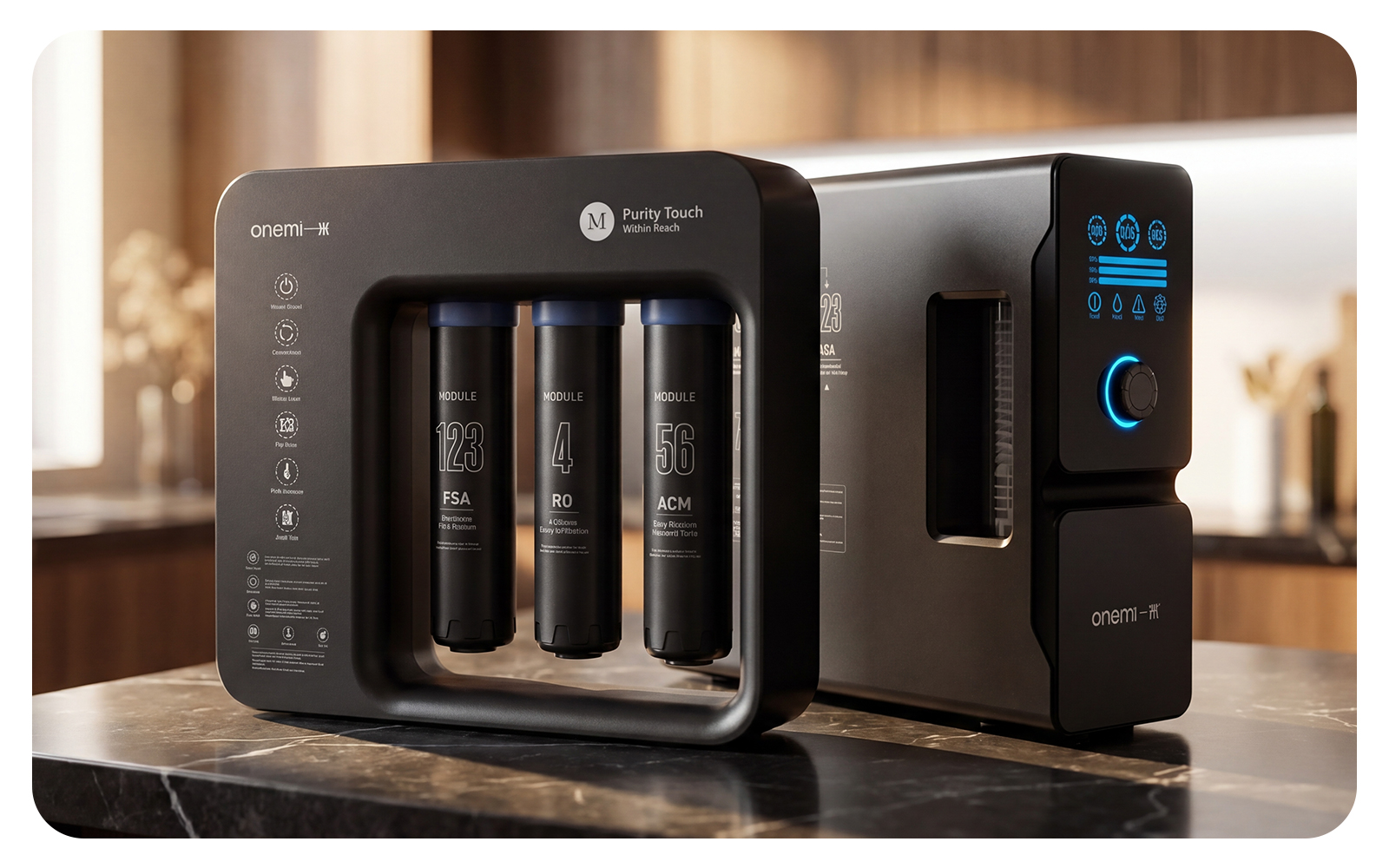
This layout is particularly vital for modern office hydration stations. Employees expect crisp, clean-tasting water free of chemical odors, which requires heavy carbon filtration. But removing the municipal chlorine residual leaves the internal tubing of the dispenser vulnerable to airborne bacteria entering through the dispense nozzle. Incorporating a compact, point-of-use UV module right at the tap ensures that the water remains sterile up to the exact moment it hits the glass.
For large-scale facilities, incorporating smart monitoring systems like those developed by ONEMI allows maintenance teams to track lamp life and water temperature in real-time. This prevents the common issue of water overheating inside the UV chamber during long periods of zero flow, which can cause scale to precipitate onto the quartz sleeve and degrade system performance.
Evaluating the Real Cost of Ownership
When presenting a water system upgrade to financial stakeholders, the conversation inevitably turns to capital expenditures versus ongoing operating costs. Some buyers shy away from ultraviolet systems because of the initial cost of the housing, controller, and lamps. However, a closer look at the operational lifecycle reveals a different story.
Chemical dosing systems require constant monitoring, chemical replenishment, safety training for staff handling corrosive concentrates, and regular testing for toxic disinfection byproducts. UV systems, by contrast, run silently on standard electrical power. The primary ongoing cost is the annual replacement of the UV lamp and the occasional replacement of the quartz sleeve if it becomes permanently etched or clouded by hard water minerals.
How do you calculate the actual return on investment?
Consider the cost of a single biological contamination event in a commercial building: emergency plumbing services, building-wide chlorination flushes, lost productivity, and potential legal liabilities. Implementing a robust physical barrier at the building’s point of entry acts as an insurance policy. For industries like hospitality and food service, where water quality directly impacts product taste and customer safety, the peace of mind offered by continuous, chemical-free pathogen control far outweighs the modest annual cost of lamp replacements.
As commercial buildings become smarter and more resource-efficient, the demand for low-maintenance, high-reliability water treatment will only grow. By understanding the physics of light transmission and designing systems that protect the UV core with proper pre-filtration, commercial operators can secure their water supply for the long term. This proactive approach ensures compliance with evolving environmental standards while delivering safe, clean water to every tap in the facility.