

 한국어
한국어

In late 2023, a procurement director for a major hospitality group in Munich ordered a batch of 1,200 commercial under-sink water filtration units. The supplier’s catalog proudly displayed the words “tested to comply with NSF/ANSI 53 standards.” It seemed like a safe, high-quality bet for their properties. However, within 14 to 18 weeks of installation, routine laboratory testing across three properties revealed that lead levels in the filtered water were fluctuating between 12 and 18 micrograms per liter—well above the European Union’s strict limit of 5 micrograms per liter. The fallout was swift: a €140,000 recall, emergency bottled water distribution, and a shattered reputation. The culprit wasn’t a manufacturing defect, but a legal loophole. The units were “tested” in an in-house, unaccredited laboratory, not certified by an independent third party.
Executive Summary
- Independent NSF certification requires rigorous third-party validation, separating truly compliant systems from those using deceptive “tested to comply” marketing claims.
- B2B buyers must understand the structural differences between NSF/ANSI Standards 42, 53, 58, and 401 to match specific regional water contaminants.
- Unannounced factory audits and continuous material extraction testing ensure long-term product compliance and mitigate severe legal liability risks.
This disaster highlights a critical reality in the global water purification market. For B2B buyers, distributors, and OEMs, understanding the complex world of water filtration standards is not just about compliance. It is a vital shield against catastrophic product failures, regulatory fines, and massive financial liability. Water quality is highly variable, with municipal tap water in industrial zones often containing 15 to 45 different chemical contaminants, making robust certification a baseline requirement for market entry.
The Shocking Truth Behind Water Filter Marketing Claims
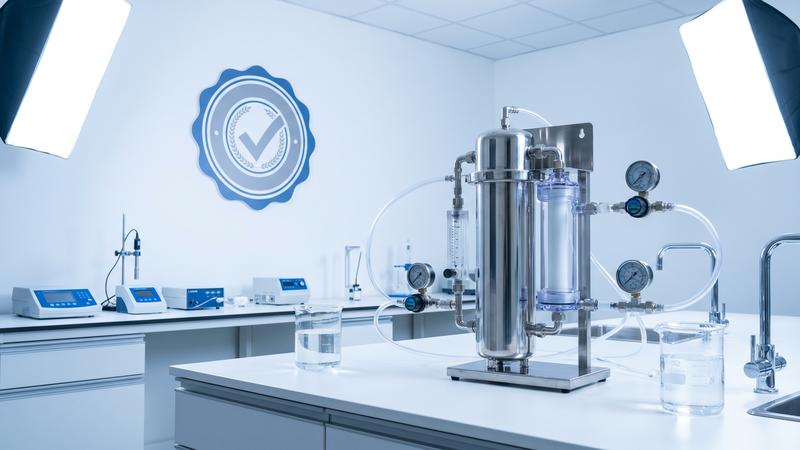
Walk through any international trade show and you will see booth after booth decorated with official-looking gold seals and bold claims of NSF compliance. But for the discerning B2B buyer, these claims require deep scrutiny. There is a massive regulatory and functional chasm between a product that is “certified by NSF” and one that is merely “tested to NSF standards.”
When a manufacturer claims their product is “tested to NSF standards,” they are often referring to an internal or one-off laboratory test. This test may have used a hand-selected, perfect prototype under pristine laboratory conditions. This tells you absolutely nothing about how the actual production-line units will perform under real-world stress. It does not guarantee that the materials used in the filter housing won’t leach harmful chemicals back into the water over time. It offers zero assurance of structural integrity when subjected to water hammer events, where pressure spikes can jump from 40 PSI to over 120 PSI in milliseconds.
True NSF certification is a completely different level of oversight. It is an end-to-end audit process managed by an independent, accredited third-party organization like the National Sanitation Foundation (NSF) or the Water Quality Association (WQA). This process begins with a complete formulation disclosure, where every single raw material, O-ring, adhesive, and plasticizer is analyzed down to its chemical components. Next, the product undergoes rigorous physical testing. Finally, the manufacturer must submit to unannounced, physical factory audits where inspectors pull random products directly off the assembly line for testing. If a factory fails to meet these standards during a surprise audit, their certification is immediately suspended.
ONEMI engineers emphasize that this continuous verification is what protects brands from catastrophic field failures. For instance, in a recent analysis of uncertified carbon blocks sourced from secondary markets, testing showed that while initial chlorine reduction was 90% to 95%, the structural integrity of the block degraded by 30% to 45% after just 2,000 liters of use, leading to channeling where water bypasses the filtration media entirely.
Can you really afford to risk your brand’s reputation on a supplier’s self-made promise?
Decoding the Core NSF Standards for Global Markets
To build a commercially viable water filtration portfolio, you must understand the specific standards that govern different filtration mechanisms and target contaminants. The table below outlines the primary NSF/ANSI standards that define the global water treatment industry.
| NSF/ANSI Standard | Primary Focus | Target Contaminants | Common Technologies |
|---|---|---|---|
| Standard 42 | Aesthetic Effects | Chlorine, taste, odor, particulate matter (Class I-VI) | Activated carbon, sediment filters |
| Standard 53 | Health Effects | Lead, asbestos, VOCs, MTBE, heavy metals, cysts | Specialized carbon blocks, ion-exchange resins |
| Standard 58 | Reverse Osmosis Systems | TDS, arsenic, barium, chromium, lead, fluoride | RO membranes with pre/post-filtration |
| Standard 401 | Emerging Compounds | Pharmaceuticals, herbicides, chemical flame retardants, BPA | Advanced carbon block, nanofiltration |
| Standard 55 | Ultraviolet Treatment | Bacteria, viruses, Giardia, Cryptosporidium (Class A & B) | UV-C LED, low-pressure mercury lamps |
Let’s look closer at Standard 53. This is where many B2B buyers get tripped up. A filter certified under Standard 53 for “cyst reduction” is not automatically certified for “lead reduction.” Each contaminant claim is tested and certified individually. If your target market has high levels of lead contamination, you must verify that the specific model is certified for lead reduction, which requires the filter to reduce lead from an influent concentration of 150 micrograms per liter down to less than 5 micrograms per liter over its entire rated life.
Furthermore, emerging contaminants listed under Standard 401, such as microplastics and PFAS, are increasingly becoming a priority for consumers. In North America and Western Europe, municipal water systems frequently show trace detections of 5 to 12 different pharmaceutical compounds and industrial chemicals. Having a product certified under NSF/ANSI 401 provides a massive competitive advantage, proving that your system can remove modern, synthetic compounds that traditional filters miss.
The Hidden Science of Certification Testing
What actually happens inside an NSF testing facility? The process is a brutal combination of chemistry, physics, and materials science designed to push water filtration systems to their absolute breaking points.
First is the material safety evaluation. The entire system is submerged in exposure water with aggressive pH levels (typically pH 5.0 and pH 10.0) for a set period, often up to 72 hours. The water is then analyzed using Gas Chromatography-Mass Spectrometry (GC-MS) to detect any volatile organic compounds, phthalates, or heavy metals that may have leached from the plastic housings, tubes, or adhesives. If even a single compound exceeds the strict toxicology thresholds, the system fails immediately.
Next is structural integrity testing, which is particularly brutal. A system must survive a cyclic pressure test, where it is subjected to 100,000 pressure pulses ranging from 0 to 150 PSI. After surviving this, it undergoes a hydrostatic pressure test, where the system is pressurized to 390 PSI (or three times the maximum working pressure) and must hold that pressure for 15 minutes without leaking or bursting. This ensures that a sudden water pressure surge in a high-rise apartment building won’t cause a catastrophic indoor flood.
Finally, there is performance testing. To verify contaminant reduction claims, testing laboratories do not use clean tap water. Instead, they formulate “challenge water” containing precise, elevated levels of contaminants along with dust, organic matter, and varying pH levels. The filter must process this challenging water up to 120% to 200% of its rated capacity. For example, a filter rated for 3,000 liters will be tested up to 6,000 liters to ensure a safety margin. This rigorous testing explains why developing a certified product requires deep engineering expertise and high-quality materials.
During the design phase of ONEMI high-flow filtration systems, engineers conduct internal finite element analysis (FEA) to simulate these 150 PSI pressure spikes. This ensures that when the physical units are sent to NSF laboratories, they pass the structural integrity tests on the very first attempt, saving months of development time.
A Critical Gotcha: The Reality of Cartridge Compatibility
A common pitfall for B2B distributors is the “compatible” replacement cartridge trap. Many third-party manufacturers produce replacement cartridges designed to fit major certified systems, claiming they are “fully compatible” and perform just as well as the original equipment manufacturer (OEM) filters.
Here is the technical reality: NSF certification is only valid for the complete, specific system configuration tested. If a customer inserts a third-party “compatible” cartridge into a certified housing, the system’s NSF certification is instantly voided. This is because minor physical differences—even a variance of just 0.1 millimeters in the O-ring seat or a slight change in the carbon block’s density—can cause bypass. Water will always take the path of least resistance. If a replacement cartridge does not seal perfectly within the housing, a percentage of unpurified water will bypass the filtration media entirely, rendering the system ineffective.
For commercial operators, using non-certified, “compatible” cartridges to save 15% to 25% on maintenance costs can expose them to massive legal liabilities if a contamination event occurs. It is crucial to educate your B2B clients on the risks of using uncertified consumables in certified systems.
Navigating Global Regulatory Differences
While NSF/ANSI standards are the undisputed global benchmark, they are not the only regulations you need to navigate. Different regions have their own unique compliance landscapes that B2B buyers must understand to avoid costly customs delays and product seizures.
In the European Union, the regulatory landscape is highly fragmented. While the EU is working toward unified standards, manufacturers must still comply with national regulations such as the KTW-BWGL in Germany, which regulates plastics in contact with drinking water, or the ACS (Attestation de Conformité Sanitaire) in France. These European standards place an incredibly high emphasis on material migration testing, often requiring different testing protocols than those used by the NSF. In the United Kingdom, WRAS (Water Regulations Advisory Scheme) approval is essential for any water fitting connected to the public mains water supply, focusing heavily on water conservation and preventing contamination of the public water grid.
Meanwhile, in the Asia-Pacific region, markets like China require the “MOH” (Ministry of Health) sanitation license, which involves extensive local laboratory testing for sanitation safety and filtration performance. In Australia and New Zealand, the WaterMark certification scheme is a mandatory licensing requirement for plumbing and drainage products, including water treatment systems. Trying to sell an NSF-certified system in Australia without the WaterMark certification is illegal for any mains-pressure installation.
To successfully navigate this complex global landscape, international buyers should look for manufacturing partners who design their systems from the ground up to meet multiple standards simultaneously. For example, ONEMI designs its core water purification platforms to utilize materials that carry both NSF/ANSI approvals and European food-contact certifications. This unified material approach allows global distributors to streamline their local compliance processes, saving thousands of dollars in redundant testing fees and accelerating their time-to-market across different regions.
Ultimately, investing in certified water filtration systems is not just about compliance. It is about building a sustainable, trustworthy brand. By partnering with manufacturers who prioritize rigorous third-party testing and transparent material sourcing, B2B buyers can confidently deliver clean, safe water to consumers worldwide, protecting both their customers’ health and their own business reputations.