

 한국어
한국어

A high-end microbrewery in Denver recently lost an entire 3,000-gallon batch of India Pale Ale because a municipal water main repair three miles away flushed trace amounts of chloramines into their system. That single afternoon cost them nearly $15,000 in dumped product, lost labor, and unscheduled system downtime. It was not a failure of their brewing recipe, but a failure of their water filtration strategy.
Water is the invisible utility that quiet runs the global economy. Across the United States, commercial facilities consume over 5 billion gallons of water every single day to run cooling towers, feed high-pressure steam boilers, wash medical equipment, and formulate beverages. Yet, most facility managers treat water as a fixed, uniform utility until something breaks. The global market for commercial water purification is expanding rapidly, projected to scale from roughly $37 billion in 2026 to over $52 billion by 2031, driven by a compound annual growth rate of about 7.3%. This massive capital influx highlights a growing realization among business owners: raw municipal water is no longer clean enough for modern commercial machinery.
Executive Summary
- Commercial water treatment is transitioning from a basic utility cost to a critical risk-mitigation strategy, driven by a market projected to reach $52 billion by 2031.
- Modern multi-stage filtration systems must balance mechanical filtration, carbon adsorption, and reverse osmosis to handle complex municipal contaminants like chloramines and PFAS.
- Proper system design requires accurate water chemistry testing and a clear understanding of the operational trade-offs between water recovery rates and membrane longevity.
The Chemistry of Commercial Water Vulnerability
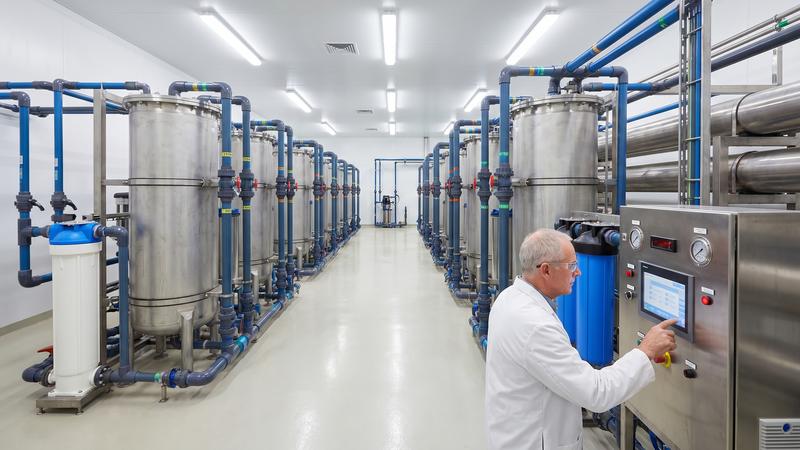
Municipal water treatment plants are designed to protect public health, not industrial machinery. They treat water to meet EPA Safe Drinking Water Act standards, which focus primarily on pathogens, heavy metals, and basic chemical runoffs. This means your incoming tap water is safe to drink, but it is still loaded with dissolved minerals, dissolved gases, and chemical disinfectants that can destroy high-end commercial equipment.
Consider the difference between chlorine and chloramines. For decades, municipal plants used chlorine to sanitize water. Chlorine is highly reactive and relatively easy to remove with basic activated carbon filtration. Today, more than 60% of American municipal water systems use chloramines—a combination of chlorine and ammonia—because it remains stable longer in extensive pipe networks. Chloramines are incredibly difficult to remove. They require specialized catalytic carbon with extended contact times; standard carbon filters will exhaust their capacity in a fraction of their rated lifespan, allowing corrosive chemicals to slip through to your boilers or espresso machines.
Dissolved minerals present another massive operational challenge. Calcium and magnesium ions are soluble at room temperature, but when water is heated inside a boiler, coffee maker, or sterilizer, these minerals precipitate out of solution to form calcium carbonate scale. A mere 1/16-inch of scale buildup on a boiler tube can reduce heat transfer efficiency by up to 11%, driving up energy bills by hundreds of dollars every month. If left unchecked, this scale acts as an insulator, causing the metal underneath to overheat and eventually rupture.
ONEMI water filtration experts have noted that many facilities experience premature membrane fouling because they fail to account for seasonal fluctuations in feed water turbidity. During spring runoffs or heavy rain events, municipal water systems often experience spikes in total suspended solids (TSS). These microscopic particles of clay, silt, and organic matter can clog standard sediment filters within days, starving downstream systems of water and causing pressure drops that trigger automatic system shutdowns.
Deconstructing the Multi-Stage Filtration Architecture
No single filtration technology can address every contaminant. A robust commercial water treatment system relies on a series of distinct stages, each designed to protect the subsequent stage and target specific classes of impurities.
The journey begins with mechanical pre-filtration. Typically, this involves sediment filters rated from 5 to 20 microns to capture larger physical particles. This stage is crucial because suspended solids will physically scratch and degrade the delicate surfaces of reverse osmosis membranes. Following sediment filtration, water passes through activated or catalytic carbon blocks. This stage relies on adsorption to capture organic compounds, chlorine, chloramines, and volatile organic compounds (VOCs). The carbon block must be sized correctly to ensure adequate Empty Bed Contact Time (EBCT), which is the measure of how long the water remains in contact with the carbon media at a given flow rate.
For ultra-pure applications, the heart of the system is Reverse Osmosis (RO). RO technology forces pressurized water through a semi-permeable membrane with pore sizes as small as 0.0001 microns. This process removes up to 99% of dissolved solids, including sodium, chloride, fluorides, and heavy metals. However, RO systems are not 100% efficient; they split the incoming water into a purified stream (permeate) and a concentrated waste stream (concentrate). Managing this recovery rate is one of the most critical aspects of commercial water system design.
| Filtration Stage | Target Contaminants | Key Operational Metric | Maintenance Interval |
|---|---|---|---|
| Sediment Pre-Filter | Silt, sand, rust, large suspended solids | Differential pressure (< 15 PSI drop) | 3 to 6 months |
| Catalytic Carbon | Chlorine, chloramines, VOCs, odor | Empty Bed Contact Time (EBCT > 3 mins) | 6 to 12 months |
| Water Softener | Calcium, magnesium, soluble iron | Hardness leakage (< 1 grain per gallon) | Salt replenishment weekly |
| Reverse Osmosis | Dissolved salts, silica, heavy metals, PFAS | TDS rejection rate (> 95%) | Membranes last 2 to 3 years |
| UV Sterilization | Bacteria, viruses, mold spores | UV dosage (> 30,000 µW-s/cm²) | Lamp replacement annually |
After reverse osmosis, water is often so pure that it becomes highly aggressive. Pure water is a universal solvent; with no dissolved minerals, it will actively leach metals from copper pipes and brass fittings in your facility. To prevent this, commercial systems often incorporate a post-treatment remineralization stage, which adds tiny, controlled amounts of food-grade calcium carbonate back into the water to balance its pH and stabilize it before distribution.
The Hidden Trade-offs in Commercial Water Engineering
There is a persistent myth in the commercial water industry that you can simply purchase a system based on your peak daily water volume. This oversimplification leads to either massive capital waste or chronic system failures. Designing an effective system requires balancing several competing engineering trade-offs that directly impact your bottom line.
The most significant trade-off involves the recovery rate of reverse osmosis systems. Recovery rate refers to the percentage of feed water that becomes purified permeate. If a system has a 50% recovery rate, it means for every two gallons of municipal water you feed into the system, you get one gallon of pure water and one gallon of wastewater sent down the drain. While it is technically possible to push recovery rates up to 75% or 80% to save on water bills, doing so dramatically increases the concentration of minerals in the remaining waste stream. This causes rapid scale formation on the membrane surface, leading to irreversible fouling and requiring expensive membrane replacements long before their projected lifespan.
For facilities operating in drought-prone regions with high water tariffs, maximizing recovery is essential, but it requires advanced pre-treatment. By integrating an ONEMI water softening loop or anti-scalant dosing system ahead of the RO membranes, facilities can safely run at higher recovery rates without risking catastrophic membrane failure. This illustrates why off-the-shelf, single-box solutions rarely deliver their promised ROI in demanding commercial environments.
Another critical consideration is system redundancy. If your business relies entirely on a single large water purification system, any maintenance downtime or unexpected component failure will immediately halt your entire operation. A more resilient strategy involves installing parallel, modular systems. If one module requires a membrane cleaning or filter swap, the other modules can ramp up production to keep your facility running at a slightly reduced capacity, completely eliminating single points of failure.
Strategic Procurement and Long-Term Operations
Buying a commercial water treatment system is not a one-time transaction; it is a long-term commitment to operational chemistry. The initial purchase price of the hardware typically accounts for less than 30% of the total cost of ownership over a ten-year lifecycle. The remaining 70% is comprised of electricity, consumable filters, replacement membranes, water waste sewer fees, and routine maintenance labor.
To ensure you are making a sound investment, always demand a comprehensive water analysis report before specifying any equipment. This analysis should measure total dissolved solids (TDS), pH, hardness, silica levels, iron, free chlorine, and total chloramines. Relying on a generic municipal water quality report is risky because water chemistry can change significantly as it travels through miles of aging city pipes to your specific facility tap.
Furthermore, pay close attention to local environmental regulations. Many municipalities now impose strict limits on the salinity of commercial wastewater discharges. If your facility uses a traditional salt-based water softener, the chloride-rich regeneration discharge may violate local sewer codes, leading to heavy fines. In these jurisdictions, alternative technologies like template-assisted crystallization (TAC) or high-efficiency RO systems with smart brine recovery loops are becoming the regulatory standard.
Ultimately, a reliable commercial water system is one that operates quietly in the background, protecting your equipment, ensuring product consistency, and keeping your utility bills predictable. By understanding the specific chemistry of your incoming water and partnering with experienced engineers who design for the long-term total cost of ownership, you can turn water from a hidden operational vulnerability into a distinct competitive advantage. ONEMI systems are designed precisely with this lifecycle economics approach, ensuring that every gallon of water treated contributes directly to your operational efficiency rather than your overhead costs.