

 한국어
한국어

Executive Summary
- High-recovery RO systems push water recovery rates from a standard 50% up to 85%-99%, significantly lowering municipal sewer discharge fees and raw water procurement costs.
- Stricter local environmental policies, such as the EPA’s Effluent Guidelines in the US and the EU’s Industrial Emissions Directive, make zero liquid discharge (ZLD) economically viable.
- Successful deployment requires balancing high osmotic pressure and silica scaling risks with advanced anti-fouling membranes and smart flow configuration.
Walk into any industrial park in Ohio, Texas, or Germany today, and you will hear plant utility managers complaining about the exact same thing: the soaring cost of wastewater disposal. For decades, industrial facilities operated under the assumption that water was cheap and sewer capacity was infinite. You pumped in municipal water or well water, ran it through a basic reverse osmosis (RO) system, recovered 50% to 75% of it as pure permeate, and dumped the rest of the highly concentrated brine straight down the drain. Those days are officially over.
Local municipalities are tightening their sewer surcharge limits to unprecedented levels. In some manufacturing hubs, discharging high-TDS (Total Dissolved Solids) brine carries heavy financial penalties, or is banned outright due to municipal treatment plant overloading. At the same time, corporate ESG mandates require manufacturing plants to reduce their freshwater draw by 30% to 50% before 2030. This leaves operations managers with a difficult technical challenge: how do you extract more clean water out of your waste stream without blowing your capital budget on massive evaporators? This is where high-recovery and zero-waste RO systems enter the equation, shifting the economics of industrial water treatment from a regulatory burden to a direct operational saving.
The Cost of Low Recovery RO Systems
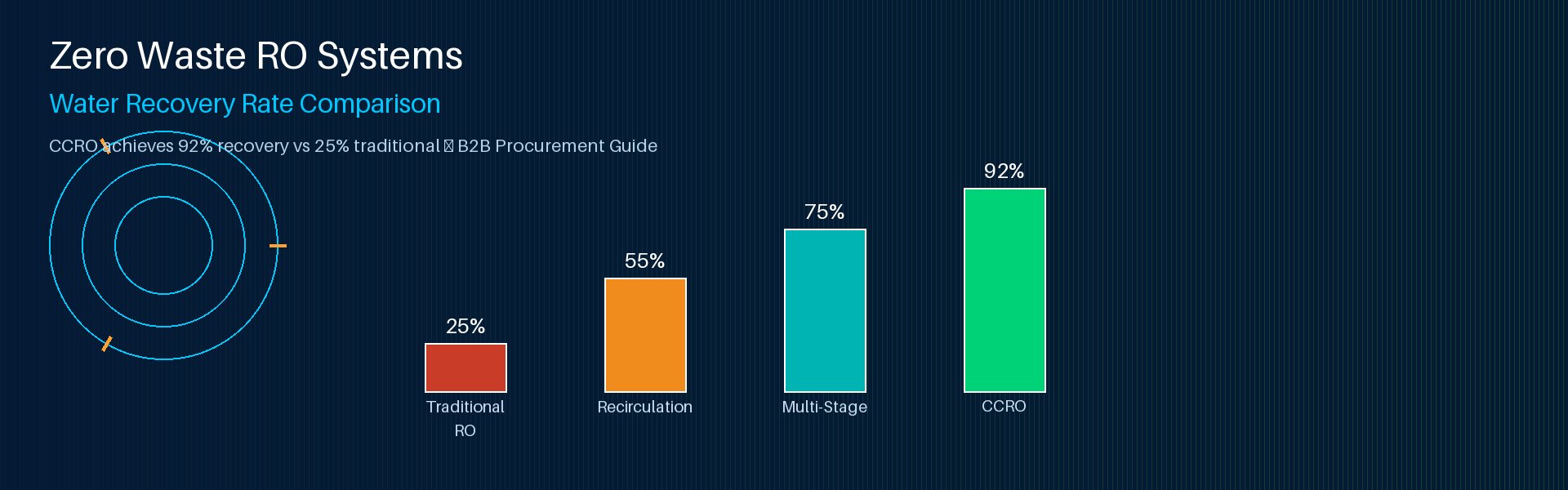
Traditional industrial reverse osmosis systems are typically designed to operate at 50% to 75% recovery. This means that for every 100 gallons of feed water entering the system, only 50 to 75 gallons emerge as purified water. The remaining 25 to 50 gallons are discharged as concentrated brine. In a small commercial facility, this waste might go unnoticed. However, in a manufacturing plant running 24/7 at 150 gallons per minute (GPM), a 50% recovery rate translates to 39.4 million gallons of water purchased, treated, and thrown away every single year.
Why do standard systems stop at 75% recovery? The limitation is not the membrane material itself, but the chemistry of the water being treated. As clean water is squeezed through the semi-permeable membrane, the concentration of dissolved minerals—such as calcium carbonate, calcium sulfate, silica, and barium sulfate—increases in the remaining feed water. Once these minerals exceed their solubility limits, they precipitate out of solution and form hard scale on the membrane surface. This scaling rapidly plugs the membrane pores, spikes the operating feed pressure, and eventually destroys the element. To prevent this, traditional systems simply flush the concentrated water out of the system before scaling can occur.
But discharging this volume of brine has become incredibly expensive. Let us look at a real-world scenario from a food processing facility in central Indiana. The plant was purchasing municipal water at $4.80 per 1,000 gallons and paying $6.20 per 1,000 gallons for sewer discharge, plus a heavy TDS surcharge because their brine exceeded 2,500 mg/L. By operating their old RO system at 65% recovery, they were losing 35 GPM of water. Their annual cost for this wasted water, combining purchase and disposal fees, exceeded $202,000. When you calculate the true lifecycle cost of a standard RO system, you quickly realize that the initial purchase price of the machine is dwarfed by the ongoing cost of the water it wastes.
How High-Recovery and Zero-Waste RO Works
To push recovery rates past the 85% barrier and toward 99%, water treatment engineers must bypass the traditional scaling limits. This is achieved through three primary technological approaches: Closed Circuit Reverse Osmosis (CCRO), multi-stage high-pressure RO with intermediate chemical precipitation, and Zero Liquid Discharge (ZLD) systems that pair RO with thermal evaporators. Each method has its own place depending on the feed water chemistry and the target recovery rate.
Closed Circuit Reverse Osmosis (CCRO) is one of the most elegant solutions for mid-to-high scale operations. Unlike traditional continuous-flow RO systems, a CCRO system operates in a semi-batch mode. Feed water is pumped into a closed loop where it is continuously recirculated across the membranes at high velocity. Permeate is produced continuously, while the concentrate is recycled back to the feed inlet. Because the water is constantly moving at high speed, the concentration of salts builds up gradually and uniformly. Before the salts have time to precipitate and form scale on the membrane surface, a flush valve opens and ejects the highly concentrated brine in a single, rapid purge. The system then immediately refills with fresh feed water and repeats the cycle. This process allows CCRO systems to achieve up to 98% recovery on feed water that would scale a traditional system within hours.
For large-scale industrial plants with highly complex waste streams, a multi-stage high-pressure RO system is often used. This setup uses successive stages of membranes, with each stage operating at a higher pressure than the last to overcome the rising osmotic pressure of the concentrated brine. In some advanced configurations, an intermediate chemical precipitation step is inserted between stages. The concentrate from the first stage is sent to a reaction tank where lime, soda ash, or sodium hydroxide is added to force calcium and silica to precipitate out of the water. The solids are filtered out using a clarifier or ultrafiltration (UF) system, and the clear, softened water is then fed into a second-stage high-pressure RO system to recover even more water. The final step in achieving true zero-waste is Zero Liquid Discharge (ZLD). A ZLD system takes the highly concentrated reject stream from the final RO stage and feeds it into a thermal evaporator and crystallizer. These thermal systems boil off the remaining water, leaving behind only solid, dry salt crystals that can be landfilled or sold as industrial chemical feedstocks. Because thermal evaporation is highly energy-intensive, using a high-recovery RO system to concentrate the brine as much as possible beforehand is critical to minimizing the overall capital and operating costs of a ZLD plant.
| System Type | Typical Recovery Rate | Max Feed TDS (mg/L) | Primary Scalant Risk | Capital Cost (CAPEX) |
|---|---|---|---|---|
| Standard Single-Pass RO | 50% – 75% | < 2,000 | Calcium Carbonate | Low |
| Closed Circuit RO (CCRO) | 85% – 98% | < 10,000 | Silica, Calcium Sulfate | Medium |
| Multi-Stage High Pressure RO | 80% – 95% | < 15,000 | Silica, Barium Sulfate | Medium-High |
| RO + Thermal Evaporator (ZLD) | 99% – 100% | No Limit | All dissolved solids | Very High |
The Real-World Engineering Gotchas
High-recovery RO sounds like an easy decision on paper, but in the field, water chemistry always wins if you do not respect it. One of the most common mistakes engineering firms make when designing these systems is relying solely on computerized projection software without conducting physical pilot testing. Software models are great for predicting thermodynamic equilibrium under perfect conditions, but they do not account for the complex organic foulants, colloidal silica, and biological activity present in real-world industrial feed water.
Silica is the ultimate enemy of high-recovery systems. Unlike calcium carbonate, which can be easily dissolved with a mild acid wash, polymerized silica scale is almost impossible to remove from a membrane without using harsh chemicals that can degrade the membrane polymer itself. If your feed water has a silica concentration of 20 mg/L and you design a system for 90% recovery, the silica concentration in the concentrate stream will reach 200 mg/L. At typical operating temperatures and pH levels, silica begins to polymerize and precipitate at around 120 mg/L. If you do not actively manage your pH, feed temperature, and antiscalant dosage, your high-recovery system will scale up within days, resulting in expensive downtime and membrane replacement costs.
Another practical gotcha is the impact of osmotic pressure on energy consumption. As the concentration of salts in the feed water increases, the osmotic pressure rises proportionally. To force water through the membrane, the feed pump must overcome this osmotic pressure. In high-recovery systems treating high-TDS water, operating pressures can easily reach 800 to 1,200 PSI. This requires heavy-duty multi-stage centrifugal pumps and high-pressure piping, which increases both the initial capital cost and the ongoing electrical consumption of the system. While you save money on water purchase and disposal fees, your energy bill will go up. A comprehensive financial analysis must balance these two factors to determine the true return on investment.
Can you run a high-recovery RO system without a highly trained operator? Absolutely not. These systems require continuous monitoring of normalized permeate flow, salt passage, and pressure drop across each stage. Automated clean-in-place (CIP) systems are helpful, but they cannot replace a skilled technician who understands how to interpret a sudden change in pressure drop or a shift in permeate conductivity. For facilities without dedicated water treatment staff, partnering with a reliable equipment manufacturer like ONEMI is crucial for ensuring long-term system stability and performance.
Evaluating the ROI of High Recovery Upgrades
When presenting a high-recovery RO project to executive leadership for capital approval, the proposal must focus on concrete financial metrics rather than vague environmental benefits. CFOs care about simple payback periods, internal rate of return (IRR), and risk mitigation. Fortunately, the economics of high-recovery systems are highly compelling in regions with high water stress or strict regulatory environments.
To calculate the true payback period of a high-recovery system, you must first establish your baseline operating costs. This includes the cost of raw water procurement, municipal sewer discharge fees, sewer surcharge penalties, chemical consumption (such as antiscalants, acids, and sodium bisulfite), membrane replacement frequency, and energy consumption. Once you have this baseline, you can compare it against the projected operating costs of a high-recovery system. For example, upgrading from a 70% recovery system to a 90% recovery system reduces the volume of waste brine by 66%. This directly translates to a 66% reduction in sewer discharge fees and a significant decrease in raw water purchase costs. In many industrial applications, the savings from water and sewer bills alone will pay for the capital cost of the upgrade in less than 24 months.
Beyond direct financial savings, high-recovery systems provide critical business continuity benefits. In water-scarce regions like the American Southwest, northern China, or parts of southern Europe, local governments are increasingly placing limits on the volume of water industrial facilities are allowed to withdraw from the local aquifer or municipal grid. A manufacturing plant that cannot secure additional water permits cannot expand its production capacity. By implementing a high-recovery RO system, the plant can effectively double its usable water capacity without drawing a single additional gallon from the local utility. This decoupling of production volume from water consumption is often the ultimate driver for high-recovery projects in water-stressed regions.
Finally, consider the regulatory risk mitigation. Environmental regulations never get looser. Investing in high-efficiency water treatment equipment today protects your operations against future utility rate hikes and more stringent discharge limits. Brands like ONEMI design modular, scalable high-recovery RO systems that allow companies to start with a moderate recovery rate and scale up as regulatory demands and financial budgets evolve over time.
Choosing the Right Partner for Your Water Goals
Implementing a high-recovery or zero-waste RO system is not a one-size-fits-all project. It requires a deep understanding of water chemistry, membrane physics, and process engineering. A successful project starts with a comprehensive feed water analysis, followed by pilot testing to verify the scaling limits and determine the optimal operating parameters. When selecting an equipment manufacturer, look for a partner with a proven track record in high-recovery applications and the engineering capability to custom-design a system for your specific water profile.
ONEMI specializes in designing and manufacturing advanced water purification systems for industrial and commercial clients worldwide. Our team of experienced water treatment engineers can help you analyze your current water usage, identify opportunities for recovery optimization, and design a custom high-recovery RO system that meets your financial and environmental goals. Whether you are looking to upgrade an existing system or design a new zero liquid discharge facility from scratch, ONEMI has the technology and expertise to deliver reliable, energy-efficient solutions that protect your bottom line and the environment.