
 한국어
한국어

The global water purifier market is on a trajectory to reach $97.0 billion by 2035, climbing from $50.8 billion in 2026 at a compound annual growth rate (CAGR) of 7.5%. This growth is not a passive trend. It is propelled by severe industrial wastewater challenges, tightening municipal discharge limits, and the escalating cost of source water. For B2B buyers across manufacturing, hospitality, and healthcare, water treatment is no longer a utility afterthought. It is a critical operational variable directly tied to bottom-line profitability and regulatory survival.
Executive Summary
- Market Valuation: The industrial and commercial water purification sector will expand to $97.0 billion by 2035 to meet strict EPA effluent guidelines and local discharge limits.
- Operational Economics: Upgrading to automated Reverse Osmosis (RO) systems reduces energy consumption by up to 30% and chemical usage by 40% compared to legacy filtration systems.
- Compliance Mitigation: Facilities using modern multi-stage purification protocols eliminate 99.99% of heavy metals and dissolved solids, avoiding municipal non-compliance penalties that can exceed $25,000 per day.
Many procurement managers make the mistake of buying systems based solely on initial capital expenditure, ignoring the long-term chemical, membrane, and energy costs that make up 85% of the total cost of ownership.
The Rising Cost of Water Quality Compliance
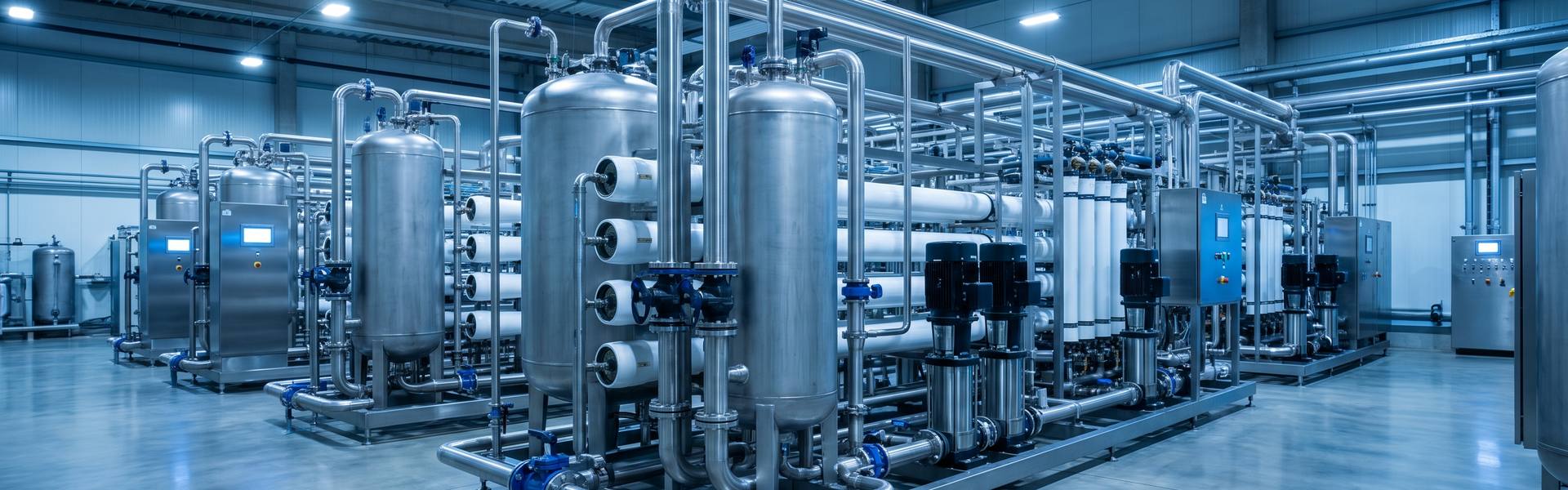
Commercial facilities operate under a complex web of environmental regulations. In the United States, the EPA sets National Primary Drinking Water Regulations (NPDWR) that limit over 90 contaminants. For industrial dischargers, the National Pollutant Discharge Elimination System (NPDES) imposes strict limits on chemical oxygen demand (COD), biochemical oxygen demand (BOD), total suspended solids (TSS), and specific heavy metals. Local municipalities are enforcing these limits more aggressively than ever, often levying surcharges on businesses whose wastewater exceeds local limits.
Consider a commercial commercial laundry facility in Houston, Texas. The facility was facing municipal surcharges of $12,400 monthly due to excessive TSS and oil/grease levels in its discharge. By installing a customized dissolved air flotation (DAF) system combined with a secondary filtration loop, the plant reduced its TSS from 450 mg/L to under 10 mg/L. This investment bypassed municipal surcharges entirely, yielding a full return on investment in exactly 14 months.
In Europe, the recast Drinking Water Directive (Directive (EU) 2020/2184) introduces strict new standards for emerging contaminants like PFAS (per- and polyfluoroalkyl substances), setting a limit of 0.50 µg/L for total PFAS. Meeting these standards requires advanced treatment technologies such as granular activated carbon (GAC) or high-pressure reverse osmosis membranes. Non-compliance is not just a regulatory risk; it is a reputational hazard that can halt operations overnight.
ONEMI commercial filtration systems are engineered to address these exact regulatory thresholds, offering automated monitoring tools that log water quality metrics in real-time to simplify compliance auditing.
Evaluating Commercial Water Treatment Technologies
Different commercial applications require specific water quality profiles. A commercial kitchen needs sediment-free, chlorine-free water to protect combi-ovens from scale buildup and ensure consistent food flavor. A semiconductor fabrication plant or a pharmaceutical laboratory requires ultrapure water (UPW) with resistivity approaching 18.2 MΩ·cm. Choosing the wrong technology leads to premature equipment failure or product contamination.
The table below outlines the primary water purification technologies utilized in commercial and industrial B2B applications, detailing their removal capabilities, optimal use cases, and typical operational limitations.
| Technology | Target Contaminants | Removal Efficiency | Primary Application | Limitations |
|---|---|---|---|---|
| Reverse Osmosis (RO) | Dissolved salts, heavy metals, organics, bacteria | 95% – 99.7% | Boiler feed, ingredient water, electronics manufacturing | High wastewater discharge (reject water); requires pre-treatment to prevent fouling |
| Ultrafiltration (UF) | Suspended solids, colloids, macromolecules, viruses | 99.99% (pathogens) | RO pre-treatment, surface water treatment, wastewater reuse | Does not remove dissolved solids (TDS) or low molecular weight organic compounds |
| Media Filtration (Multi-Media, GAC) | Sediment, chlorine, organics, taste, odor | Down to 10 microns (multi-media) | Pre-treatment, municipal water dechlorination | Requires regular backwashing; media must be replaced periodically |
| Deionization (DI) / EDI | Charged ions, mineral salts | Up to 99.9% (ionic purity) | Laboratory use, pharmaceutical production, cosmetics | Does not remove non-ionic contaminants or biological pathogens effectively |
While Reverse Osmosis is the gold standard for dissolved solids removal, it has a significant operational compromise: wastewater generation. Standard RO systems reject 25% to 50% of the feed water as concentrate. In areas with high water scarcity or steep sewer rates, this waste can destroy the project’s financial feasibility. To offset this, advanced systems integrate closed-circuit desalination configurations or recovery-stage RO loops to push recovery rates above 90%, transforming waste streams into usable process water.
Engineering the Complete Pre-Treatment Train
No advanced purification membrane operates in isolation. Feed water must undergo rigorous pre-treatment to prevent irreversible scaling and biofouling. If raw municipal water with a hardness level exceeding 120 mg/L (as CaCO3) is fed directly into an RO system, calcium carbonate will precipitate on the membrane surface within weeks, dropping flux rates by over 40% and spiking feed pressure requirements.
A standard high-performance pre-treatment train consists of three distinct stages:
- Coarse Sediment Filtration: Multi-media filters or auto-backwashing screen filters remove particles down to 10-20 microns. This protects downstream valves and minimizes the Silt Density Index (SDI) of the water.
- Water Softening: Cation exchange softeners replace scale-forming calcium and magnesium ions with sodium ions. Softening is critical if the feed water hardness exceeds 50 mg/L.
- Carbon Adsorption: Granular activated carbon (GAC) beds remove free chlorine and chloramines. Free chlorine is a strong oxidant that degrades thin-film composite RO membranes, causing permanent loss of salt rejection capabilities.
Are you monitoring your system’s Silt Density Index daily?
An SDI value above 5.0 will void most RO membrane manufacturer warranties. Keeping SDI values below 3.0 via structured pre-treatment ensures your membranes last their full rated lifespan of 3 to 5 years instead of failing in under 12 months. Brands like ONEMI design integrated pre-treatment racks that sync with downstream purification units, ensuring optimal flow balance and automatic backwash cycles based on differential pressure or volumetric throughput.
Calculating the True Cost of Ownership
When purchasing a commercial water purification system, B2B buyers frequently focus on the initial capital cost (CAPEX). This is a short-sighted approach. Over a typical 10-year equipment lifespan, operational expenditures (OPEX) including energy, consumables, replacement membranes, chemical dosing, and routine maintenance make up 80% to 85% of the total life-cycle cost.
Let’s run the math on a 50,000 gallon-per-day (GPD) commercial reverse osmosis system operating 16 hours per day, 350 days per year. At an average electrical cost of $0.12 per kWh, a standard high-pressure pump drawing 15 kW will cost $10,080 annually in power alone. If a competitor’s system uses low-energy membranes and a high-efficiency pump drawing only 11 kW, the annual energy cost drops to $7,392. Over ten years, that single engineering difference saves $26,880.
Consumable costs must be projected with equal precision. Cartridge filters, carbon media, softener salt, and antiscalant chemicals require consistent replenishment. A facility must also budget for membrane clean-in-place (CIP) cycles. Typically, membranes require chemical cleaning 2 to 4 times per year using specialized acid and alkaline cleaners to strip organic fouling and mineral scale. Neglecting these cleanings increases feed pressure requirements, which in turn accelerates mechanical wear on the pumps and spikes power consumption.
Furthermore, integrating smart monitoring technology reduces labor costs. Modern systems utilize programmable logic controllers (PLCs) with IoT connectivity to track flow rates, pressure drops, conductivity, and temperature. When performance metrics drift outside optimized ranges, the system alerts maintenance personnel before a critical shutdown occurs. ONEMI water systems incorporate these advanced telemetry suites, allowing facility managers to monitor system health from a centralized dashboard, reducing unscheduled downtime by up to 35%.
Ultimately, selecting the right commercial water treatment system requires a deep understanding of your raw water chemistry, your specific purity requirements, and the long-term operational costs. Partnering with an experienced manufacturer that offers comprehensive water analysis, custom system engineering, and reliable post-sale technical support is the most effective way to secure your water supply, maintain regulatory compliance, and protect your operational margins.