



 한국어
한국어

We didn’t see this coming, but the global rush for clean water just turned a massive financial corner way ahead of schedule.
By the time we hit the mid-2030s, the reverse osmosis market is on track to sail past a staggering twelve billion dollars, driven not by basic survival needs but by a sudden, intense obsession with smart household tech and extreme filtration efficiency. What used to be a clunky, slow-dripping plastic tank hidden under the kitchen sink has transformed into a sleek, AI-monitored powerhouse. Families are discarding their old systems because municipal water grids from California to Munich are struggling with newly discovered chemical contaminants that traditional filters simply cannot touch.
Executive Summary
- The global RO filter market is accelerating toward a twelve billion dollar valuation, fueled by an eight percent compound annual growth rate in premium residential sectors.
- Strict EPA regulations on PFAS and microplastics are forcing a massive shift from basic carbon filtration to multi-stage smart RO systems.
- Modern tankless designs with high flow rates and low wastewater ratios are completely replacing traditional bulky storage tank setups.
The Unexpected Surge in Household Water Upgrades

Nobody expected the market to move this fast. A few years ago, industry analysts figured water filtration would just coast along with steady, boring single-digit growth. Instead, we are looking at a massive wave of home renovations where upgrading the water purifier is treated with the same importance as buying a new smart fridge or a high-end espresso machine. People are realizing that the water coming out of their taps, even in highly developed metropolitan areas, carries a cocktail of industrial leftovers, aging pipe debris, and trace pharmaceuticals that old-school pitcher filters do not even register.
Let’s look at the numbers driving this shift.
| Market Metric | Previous Estimates | New 2026-2030 Projections |
|---|---|---|
| Global Market Value | Approx. $8 Billion | Over $12 Billion |
| Annual Growth Rate (CAGR) | Around 4% | Up to 8% in high-end segments |
| Average Wastewater Ratio | 1:3 (Pure to Waste) | 3:1 or 4:1 with advanced membranes |
| Dominant Product Type | Under-sink tank systems | Tankless smart countertop & direct-flow |
This economic leap is not happening in a vacuum. It is a direct reaction to a changing regulatory landscape. When the US Environmental Protection Agency announced strict, legally enforceable limits on six specific types of PFAS, often called forever chemicals, in public drinking water, it sent shockwaves through the housing market. Suddenly, municipal water reports became front-page news. Homeowners realized that meeting federal guidelines on a municipal level would take decades of infrastructure spending, leaving individual households to fend for themselves in the meantime.
ONEMI engineers have been tracking these municipal water deficits closely, designing filtration systems that act as a personal, highly reliable defense line right at the kitchen tap.
Think about the sheer scale of the infrastructure problem. In places like northern Illinois, local municipal wells have repeatedly tested over the new federal limits for synthetic chemical compounds. Residents who assumed their deep-well water was pristine are suddenly dealing with warnings about compounds that do not break down in the human body. This is not just an American problem. Across Western Europe, particularly in industrial zones near the Rhine, similar regulatory alarms are sounding, driving a massive surge in consumer-grade RO installations.
The Death of the Bulky Under-Sink Tank
Remember those giant, heavy metal pressurized tanks that used to take up the entire cabinet under your kitchen sink? They are rapidly becoming relics of the past.
The industry is abandoning tank-based storage for a very simple, slightly unsettling reason: stagnant water breeds bacteria. When purified water sits in a dark, warm rubber bladder for days at a time, it loses its freshness and can actually develop secondary contamination issues. Consumers got tired of the musty taste, the slow flow rate, and the fact that they had to sacrifice all their storage space just to have clean drinking water.
The engineering solution that changed everything is the high-flow, tankless direct-filtration system. By utilizing massive, multi-bore membrane structures and powerful, quiet internal pumps, modern systems can purify water instantly as it flows to your glass. You turn on the faucet, and you get a steady, rapid stream of freshly filtered water, not stale water that has been sitting in a tank since Tuesday.
Here is a weird, counter-intuitive finding that surprised the industry last year: tankless systems actually last longer than tank systems, despite running their pumps at much higher speeds. You would think the extra mechanical stress of instant filtration would wear the machine out faster. It turns out that by keeping water moving constantly, you prevent mineral scaling and biological film buildup on the membrane surface, which is the number one killer of traditional RO filters.
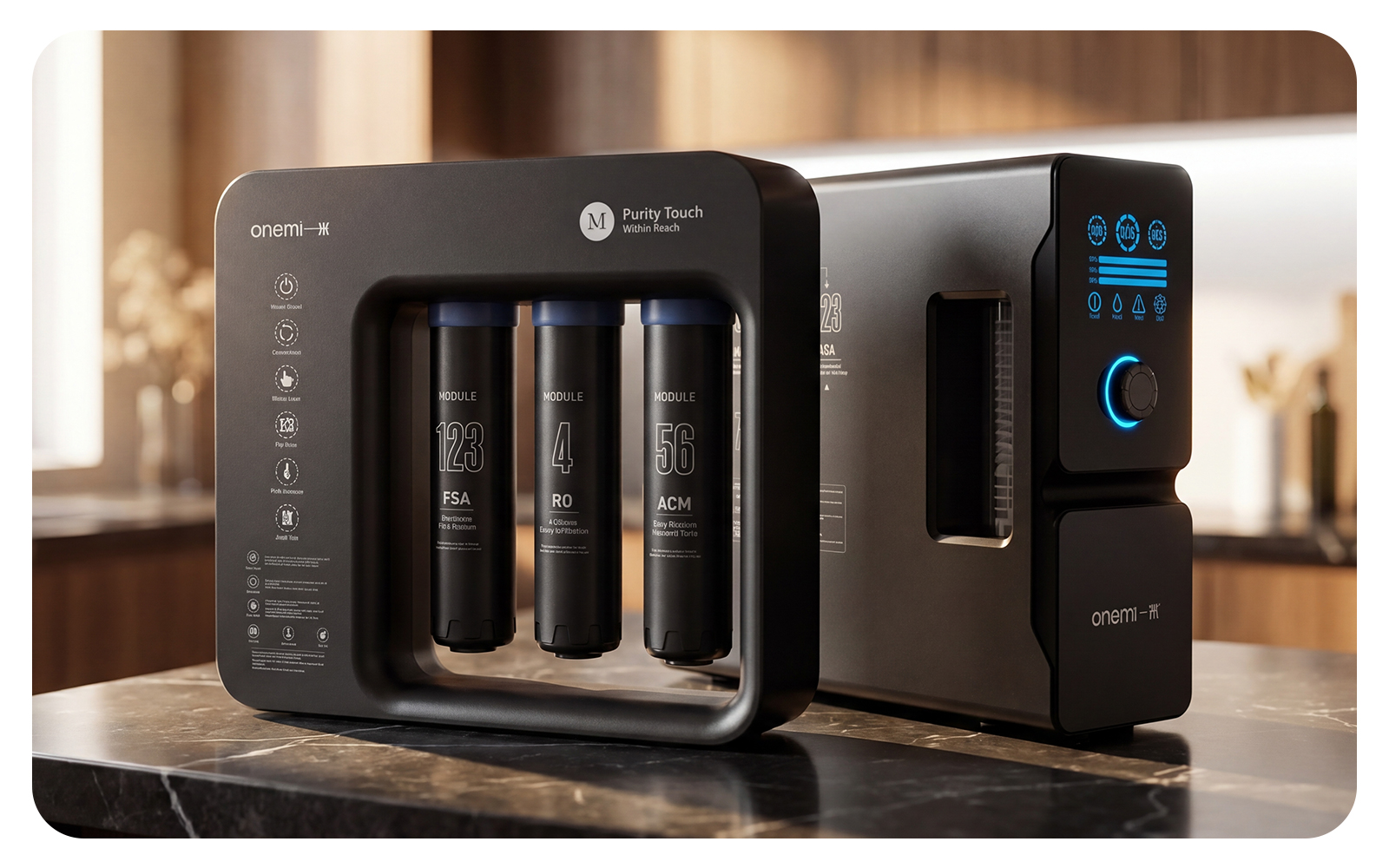
This shift to tankless technology has also allowed designers to experiment with aesthetics. A water purifier does not have to look like an industrial plumbing project anymore. Modern units look more like premium kitchen appliances, featuring brushed metal finishes, touch-sensitive control panels, and compact profiles that slide easily next to a microwave or under a low-clearance cabinet. ONEMI has capitalized heavily on this design revolution, making sure their units blend seamlessly into high-end kitchen spaces without screaming “utility room.”
Why Simple Carbon Filters Just Do Not Cut It Anymore
A lot of people still ask why they cannot just use a cheap, slip-on faucet filter or a basic plastic pitcher. Those simple carbon blocks are great for making chlorinated city water taste a bit better, but they are completely useless against modern chemical threats.
If you are trying to remove heavy metals like lead, dissolved arsenic, nitrates from agricultural runoff, or microscopic plastic fibers shed from synthetic clothing, a basic carbon filter is like trying to catch sand with a tennis racket. Reverse osmosis works on an entirely different physical scale. We are talking about forcing water through a semi-permeable membrane with pores so microscopic that they measure around one ten-thousandth of a micron. To put that in perspective, a single human hair is about seventy-five microns wide.
At that level, the membrane is not just straining out dirt; it is physically separating pure water molecules from dissolved mineral ions and complex chemical chains. It is the only residential technology capable of reliably dropping Total Dissolved Solids to near-zero levels.
Of course, this level of filtration comes with a classic technical catch that many brands try to hide: it strips out the good minerals along with the bad. Pure RO water can taste flat, almost clinical, because it lacks the natural calcium and magnesium ions that give spring water its character. To solve this, high-end systems now include a remineralization stage at the very end of the process. This stage passes the pure water through a bed of natural calcite and corosex, restoring a balanced pH and adding back just enough essential minerals to give the water a crisp, refreshing taste.
But there is a practical gotcha you need to watch out for when buying a modern RO system. Many manufacturers advertise incredibly high filtration speeds, like eight hundred or a thousand gallons per day, but they only achieve these numbers under perfect laboratory conditions with warm water and high water pressure. If your home has cold winter water or low municipal pressure, your actual flow rate can drop by nearly half. Always look for systems that include built-in booster pumps to maintain consistent performance regardless of your home’s plumbing quirks.
Smart Homes and the Rise of Real-Time TDS Monitoring
Would you drink water if you couldn’t verify its quality in real time?
The modern consumer is obsessed with data, and the water filtration market has adapted by integrating smart sensors directly into the faucet head and unit chassis. Old systems required you to guess when to change the filters, usually relying on a vague calendar reminder like “replace every six months.” This was a terrible system because a family of five uses filters much faster than a single person, and municipal water quality varies wildly from zip code to zip code.
Today’s premium systems measure Total Dissolved Solids both before and after the filtration process, displaying the exact purification efficiency on a digital screen right on the faucet. You can see, in real time, that your tap water went in at three hundred parts per million and came out at twelve. When the filter membrane actually starts to degrade, the system tells you based on actual performance, not a random guess on a calendar.
This level of connected technology is redefining our relationship with home maintenance. Many of these smart systems now pair with mobile apps, allowing you to track your daily water consumption, monitor filter life, and even order replacement cartridges with a single tap. ONEMI systems have integrated these smart diagnostics to take the guesswork out of maintenance, ensuring you never run a degraded filter past its prime. It is all about peace of mind. When you can see the numbers drop on a screen, you know your family is drinking truly clean water, free from the invisible contaminants that make headlines every other week.