

 한국어
한국어

- Countertop units held the largest product share of the $26.37 billion global point-of-use water treatment market in 2025, but the shelf is full of lookalikes; the only durable moat is design decided at the OEM stage.
- Three engineering parameters move a unit: consistent flow rate, tool-free filter change, and a compact counter footprint under 50 dB. These are mold-and-pump decisions, not marketing decisions.
- A disciplined OEM partner proofs in about 7 days and reaches mass production in about 30, with a certification file that names the exact resin, alloy, and standard for every wetted part.
The countertop water filter has stopped being a niche apartment accessory. Fortune Business Insights values the global point-of-use (POU) water treatment systems market at USD 26.37 billion for 2025, rising from USD 28.63 billion in 2026 toward USD 54.45 billion by 2034 at an 8.4% CAGR, and it reports that countertop filters are expected to retain the largest share of that market by product type. The reason is unglamorous but real: a countertop unit needs no plumbing, no installer, and no landlord permission. It is the only water treatment product a consumer can own and operate inside ten minutes.
That same accessibility is the trap. Because the barrier to entry is so low, the category has filled with units that are functionally identical, and identical products get sold on price. For a brand owner or an importer, the question is not whether countertop filters are a good market; it is whether you can build one that is different enough to hold margin. That difference is made in the OEM engineering phase, not on the retail shelf.
Why Countertop Is Winning the POU Market
The growth is structural, not cyclical. Asia Pacific took a 42% share of POU water treatment in 2025, driven by rapid urbanization and high adoption in China, Japan, and India, while the US market is projected to reach USD 7.55 billion by 2032 on rising concern over drinking water quality. Technavio, for its part, tracks the global POU segment at a 7.2% CAGR through 2030 and names the integration of AI and data-driven water management as a primary growth driver.
For a manufacturer, those numbers translate into a specific demand profile: buyers want compact units that monitor themselves, swap filters without tools, and fit a rental kitchen that cannot be modified. The countertop form factor is the only architecture that satisfies all three at once, which is why it keeps gaining share against under-sink systems that require a hole, a wrench, and a plumber.
Three Design Parameters That Decide Whether a Unit Moves
Most countertop filters fail in the market for reasons that were fixed, or not fixed, months before launch. Three parameters carry almost all the weight.
Flow rate consistency is first. A tankless countertop RO rated at 400G or 600G that actually delivers it under real line pressure is a different product from one that only hits that number in a test bench at ideal pressure. Buyers feel the difference the first time they fill a kettle, and they return the slow unit. Recovery ratio matters too: a 1.5:1 pure-to-waste ratio reads as efficiency on the spec sheet and as a lower water bill on the counter.
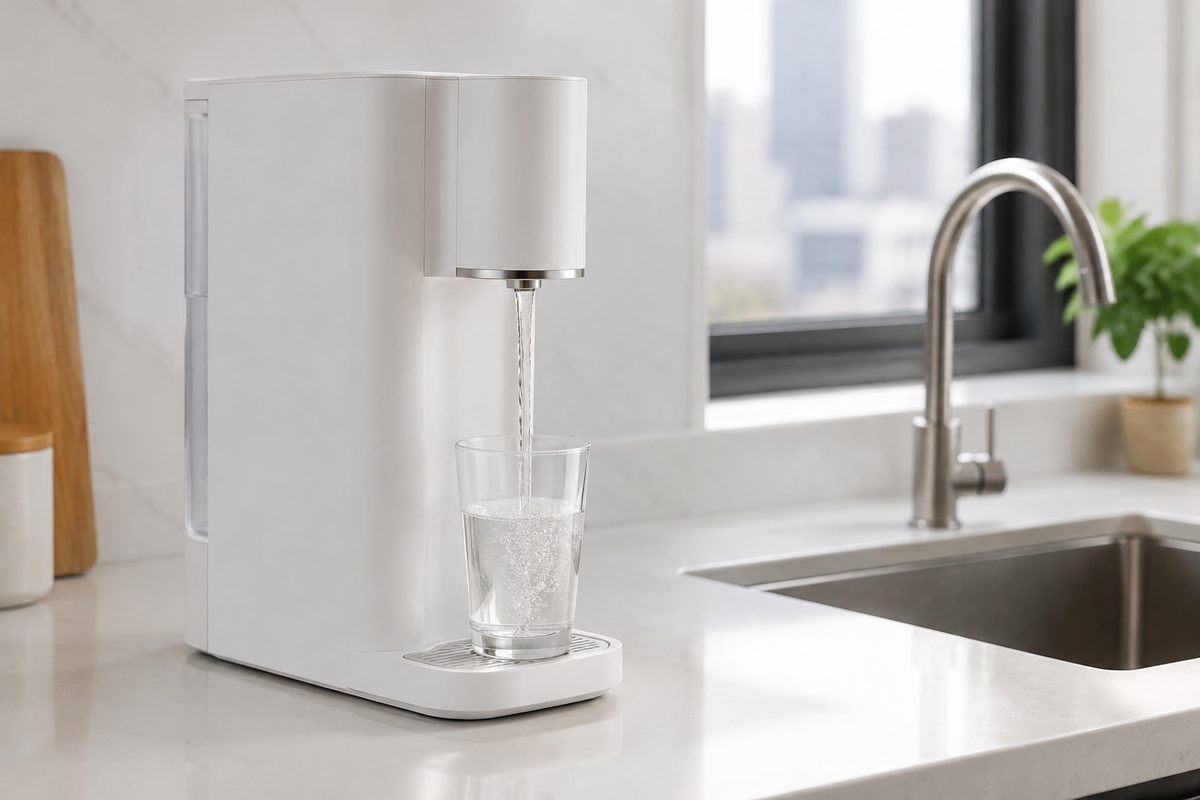
Filter-change ergonomics is second. The moment a customer has to fight a cartridge to replace it, or spills a cup of water across the counter during the swap, the repurchase is gone. The best countertop designs use a tool-free quick-change cartridge with a dry-disconnect valve, so the swap is a twist and pull with no shutdown, no bucket, and no mess. That single detail does more for lifetime value than any spec.
Counter footprint and noise is third. A unit that hums at 55 dB in an open-plan kitchen gets unplugged; a unit that sits at 45 dB or below gets kept. Size is a hard constraint in small apartments, so depth and height against the backsplash are part of the product definition, not afterthoughts.
| Parameter | Commodity unit | Design-led unit |
|---|---|---|
| Flow rate (tankless RO) | Rated 400G, drops under pressure | 400–600G sustained, 1.5:1 recovery |
| Filter change | Threaded cartridge, tools required | Tool-free quick-change, dry disconnect |
| Noise | 50–55 dB | ≤45 dB |
| Footprint | Bulky, overhangs the counter | Depth engineered to fit the backsplash |
| Certification file | Generic, incomplete | Per-batch, names resin and alloy |
The pattern is consistent: the commodity unit optimizes the bill of materials, and the design-led unit optimizes the three interactions a customer has every day. The second one commands the margin.
The OEM Collaboration Model Brands Should Negotiate
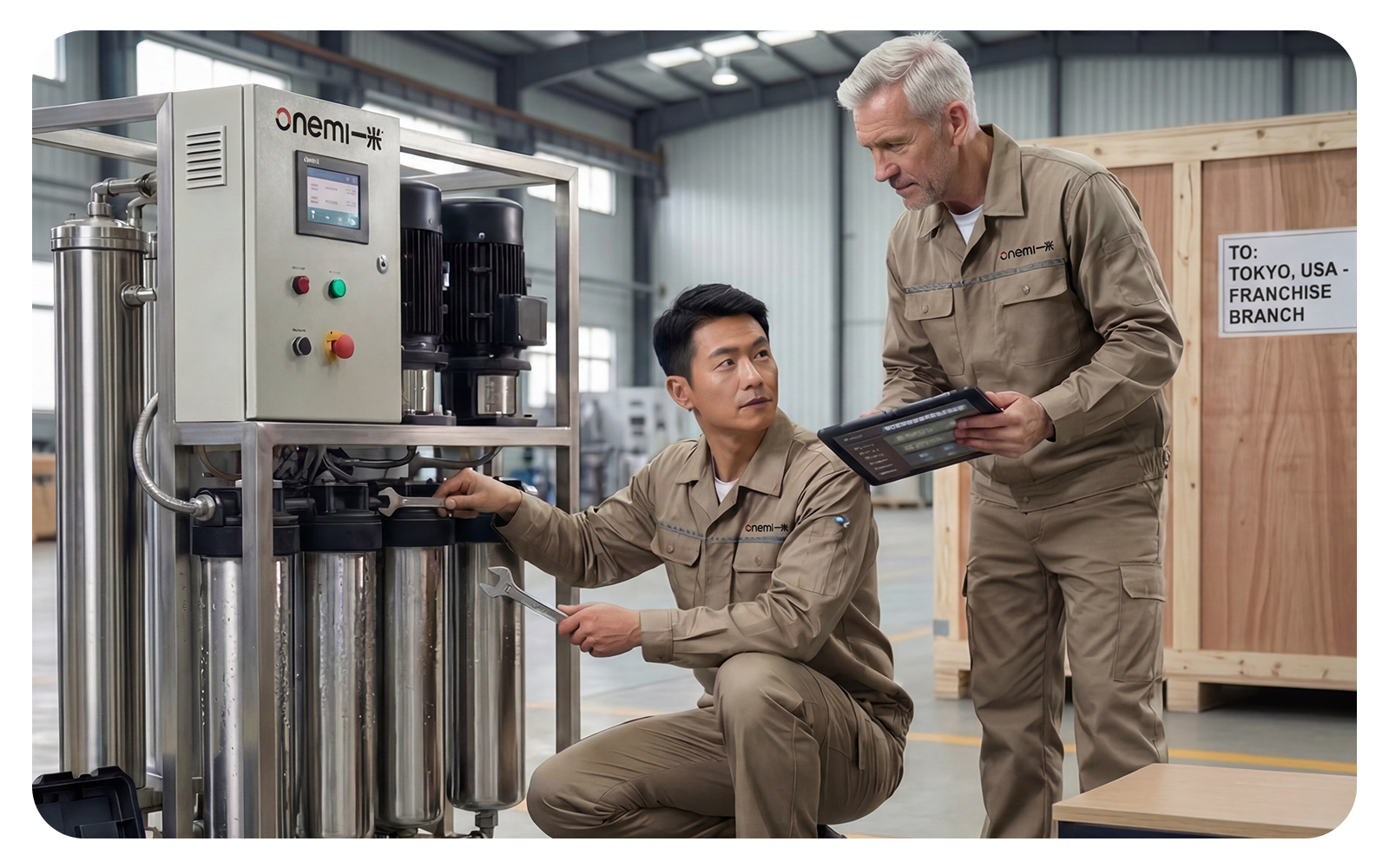
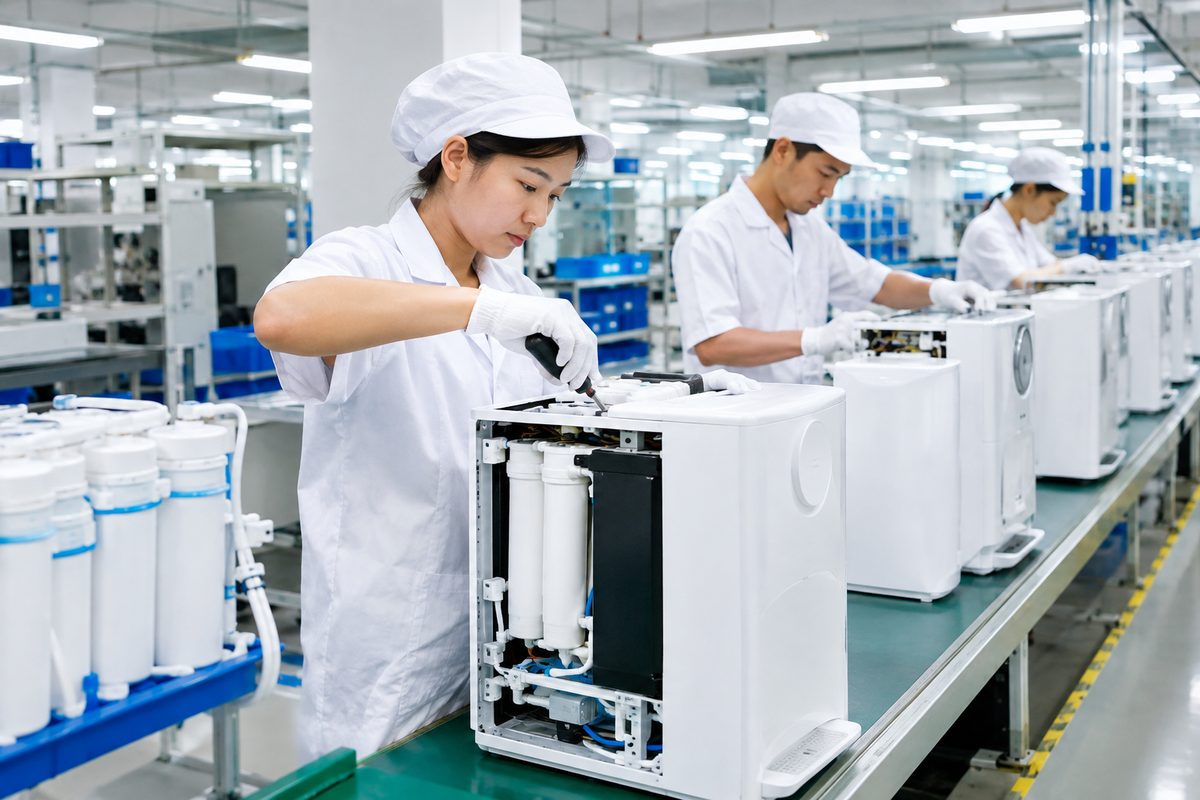
Building a countertop line through an OEM partner is a negotiation over process, not just price. The first number to pin down is the minimum order quantity, because it reveals how the factory is set up. A MOQ that is suspiciously low on a precision-molded unit usually means tooling and setup cost are being amortized somewhere else, often in material quality. The second number is lead time: a factory that can proof in about 7 days and reach mass production in about 30 days has a working engineering team; one that needs three months for a sample is outsourcing its own design work.
Customization scope is where the partnership either earns its fee or does not. A serious OEM should offer logo printing on the machine and filters, packaging and carton design, filter configuration adjustment, pump and PCB customization, and housing color and ID design. Model exclusivity matters as much: a factory that will sell the same tooled unit to a competitor under another label has just bought your market research at your expense.
The Certification Stack for Countertop Filters
Countertop filters touch drinking water, so the certification file is part of the product, not a shipping document. In North America the core standards are NSF/ANSI 42 for aesthetic effects like chlorine and particulate, NSF/ANSI 53 for health effects including lead and PFAS, and NSF/ANSI 58 for reverse osmosis systems. Materials carry their own obligations: NSF/ANSI 61 for health effects of wetted components and NSF/ANSI 372, which caps lead at 0.25 percent weighted average across all contact surfaces. NSF/ANSI 401 covers emerging contaminants, which matters as buyers increasingly ask about pharmaceutical residues.
The distinction an importer must keep straight is scope. A whole-machine certification and a component certification are not the same thing. ONEMI’s systems carry CE, UL, FCC, and RoHS at the whole-machine level, while NSF applies to the filter cartridge specifically, not the complete appliance. Blurring that line is how brands get flagged. The full scope is listed on the certifications page.
Filtration Architecture: RO, UF, and Carbon on the Counter
The filter stack inside a countertop unit is a decision about what the product promises. Reverse osmosis at a 0.0001-micron membrane is the high-assurance option: it removes dissolved solids, heavy metals, and most contaminants down to the molecular level, which is why tankless countertop RO has become the flagship of the segment. Ultrafiltration at roughly 0.01 micron keeps beneficial minerals while removing bacteria and sediment, and it needs no power and no waste line, which suits markets where electricity or water pressure is unreliable. Activated carbon handles taste, odor, and chlorine, and is almost always a stage in front of either membrane.
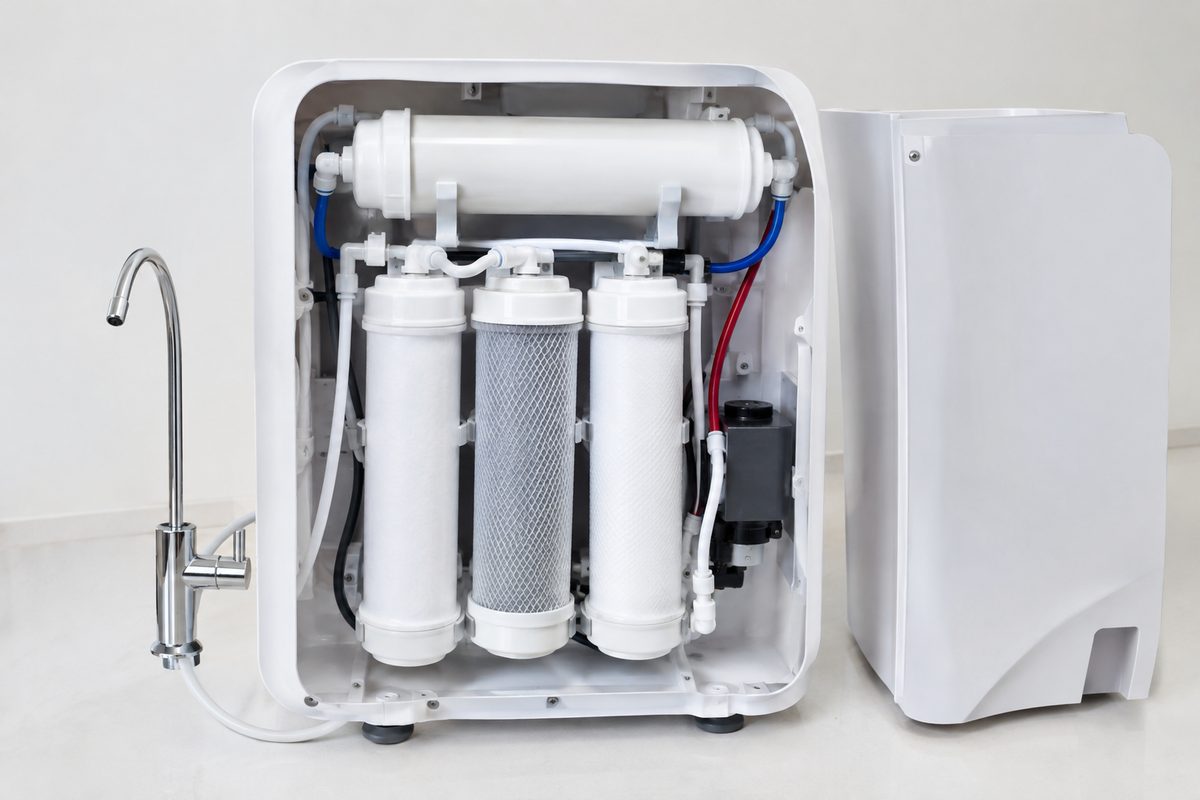
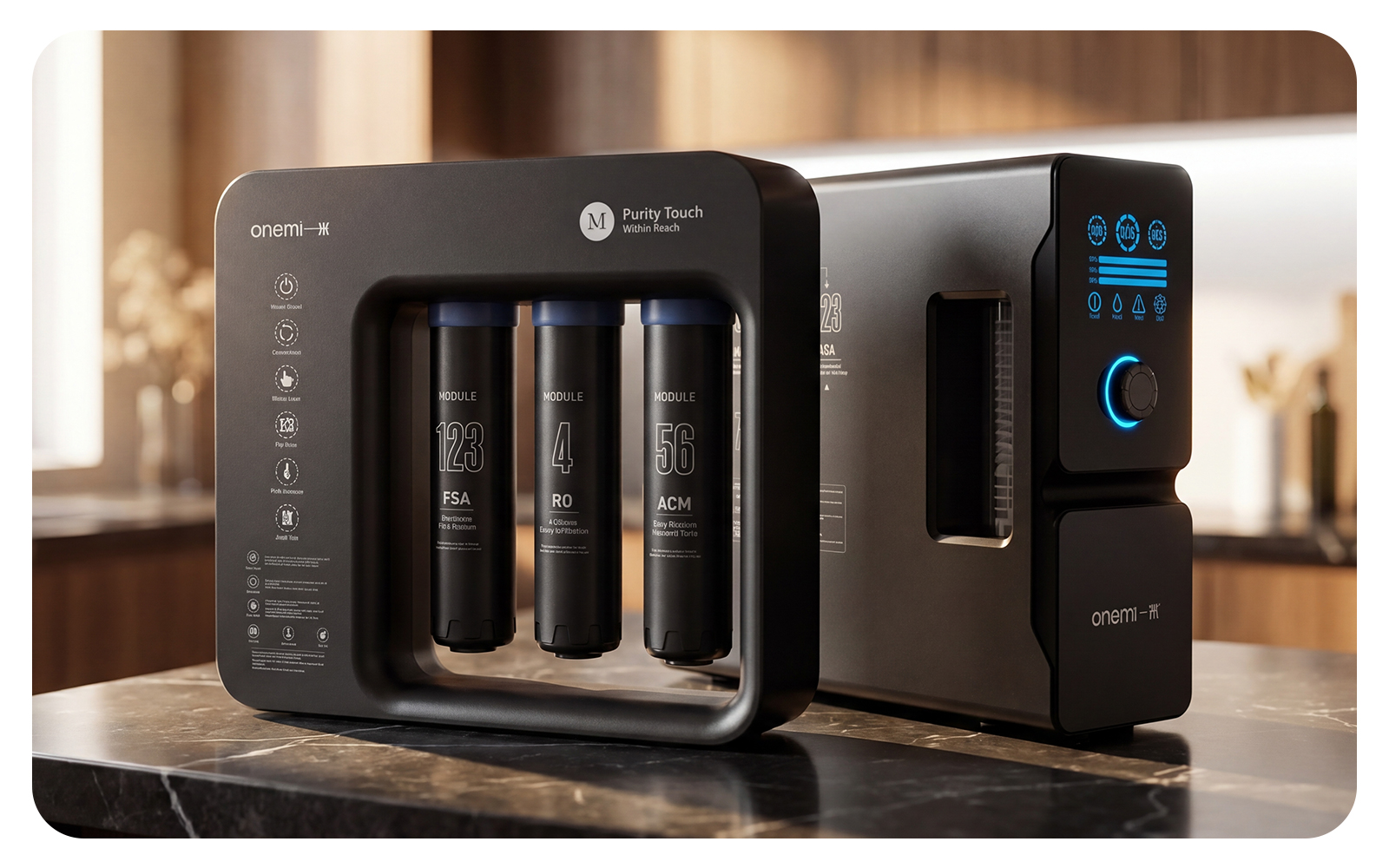
Many countertop units layer all three: a sediment and carbon pre-stage, a membrane stage, and a carbon post-stage for taste. The engineering choice is which membrane leads and how the unit manages the waste stream, and that choice should match the target market’s water quality, not a generic global template. For a concrete example of the category, see the countertop instant water dispenser and the broader instant and countertop line.
A Manufacturer’s Launch Checklist
Before cutting a single mold, a brand should hold its OEM partner to a written specification that names the material, the tolerance, the surface finish, and the certification file, and then audit the batch, not the sample. The sequence that reliably produces a sellable countertop line looks like this: fix the three design parameters first, lock the filter architecture to the target market’s water, confirm the certification scope and get the per-batch documentation in writing, then negotiate MOQ, lead time, and exclusivity against that specification.
The countertop category rewards the brands that treat engineering as the product. The ones that skip the design phase and go straight to a price-per-unit negotiation end up holding inventory of a commodity they cannot defend. For importers and brand owners ready to build properly, the OEM/ODM factory page and the OEM FAQ cover the specifics of how a manufacturing partnership is structured.
A countertop water filter that sells is not the cheapest unit on the shelf. It is the one that fills a glass fast, changes filters without a mess, and sits quiet on a small counter. Those three qualities are designed in at the OEM stage, and they are the only edge that survives a crowded market.