

 한국어
한국어

Executive Summary
- The global residential water purification market is scaling toward a fifty-three billion dollar valuation by the early 2030s, fueled by a massive consumer shift toward active chemical containment.
- Regulatory crackdowns on forever chemicals like PFAS and microplastics are transforming advanced multi-stage filtration from a premium upgrade into a baseline household necessity.
- Smart IoT integration and real-time membrane diagnostics are redefining user expectations, turning passive under-sink appliances into interactive, data-driven home wellness systems.
The Emerging Domestic Water Quality Crisis
Municipal water treatment infrastructures across the Western world are buckling under the weight of industrial aging and novel chemical contamination. For decades, the primary focus of municipal water treatment was basic pathogen control and sediment reduction. Today, those legacy systems are entirely unequipped to handle the synthetic chemical footprint of modern industrial manufacturing. Consumers are realizing that municipal compliance with federal standards does not automatically equate to personal safety at the kitchen tap.
Consider the widespread anxiety surrounding per- and polyfluoroalkyl substances, collectively known as PFAS. These “forever chemicals” do not degrade in the environment or the human body. Recent EPA assessments suggest that virtually no level of exposure to certain PFAS compounds is completely safe. This realization has triggered a massive psychological shift among homeowners. People no longer view water filtration as an aesthetic choice to remove chlorine taste; they see it as an essential bio-defense shield for their families.
The numbers paint a stark picture of a market in rapid transition.
| Market Metric | Historical Benchmark (Approx. 2025) | Projected Horizon (Approx. 2032) |
|---|---|---|
| Global Market Valuation | $36 Billion USD | $53 Billion USD |
| Residential Sector Share | 65% of total demand | 70% of total demand |
| Compound Annual Growth Rate | Baseline market metrics | 8.3% projected CAGR |
| Primary Consumer Driver | Taste, odor, and basic sediment | PFAS, microplastics, and heavy metals |
This structural market growth is not uniform across all product categories. The residential segment is outstripping industrial and commercial sectors, capturing nearly three-quarters of all new market demand. Households are taking water safety into their own hands, bypassed by municipal slow-walking and local bureaucratic delays. The kitchen sink has become the ultimate point-of-use defense line.
The Multi-Stage Filtration Architecture Checklist
To successfully neutralize modern chemical contaminants, a water purifier can no longer rely on a single carbon block or a basic sediment wrap. The modern standard requires a highly coordinated, multi-stage filtration pathway. Each stage must target a specific class of contaminants, ensuring that the water entering the reverse osmosis membrane is already highly pre-treated to maximize system longevity and efficiency.
- Stage 1: High-Density Sediment Pre-Filtration
This initial stage physical barrier targets large suspended solids, rust, micro-sand, and pipe scale. By utilizing gradient-density polypropylene fibers, these filters trap larger particles on the outer surface while capturing finer particulate matter deeper within the core. This stage is crucial for protecting subsequent, more expensive carbon blocks and membranes from premature clogging and physical abrasion.
- Stage 2: Catalytic Activated Carbon Block
Standard activated carbon is effective for basic chlorine, but catalytic carbon is chemically modified to highly accelerate the breakdown of chloramines and volatile organic compounds (VOCs). This stage relies on adsorption, where chemical impurities adhere to the vast internal pore network of the carbon. It acts as the primary chemical sponge of the system, neutralizing unpleasant tastes, industrial solvents, and agricultural pesticide residues.
- Stage 3: Advanced Reverse Osmosis (RO) Membrane
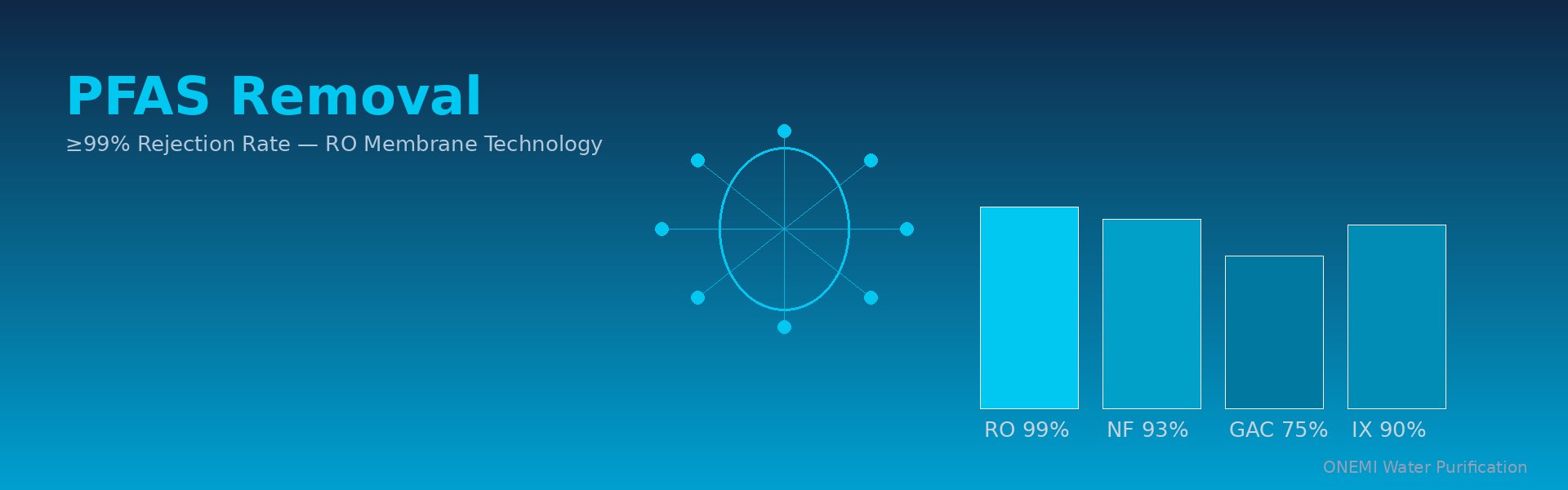
The true heart of the purification system. Operating at a molecular level, the semi-permeable RO membrane features pore sizes measuring approximately 0.0001 microns. It forces water molecules through under pressure while rejecting up to 99% of dissolved solids, heavy metals like lead and arsenic, fluoride, and microscopic pathogens. Modern RO elements are increasingly designed for high-recovery yields, reducing the historic waste-water-to-pure-water ratios that plagued early residential systems.
- Stage 4: Specialized PFAS and Microplastic Defense
As forever chemicals bypass standard municipal setups, dedicated post-RO filtration stages are becoming mandatory. Utilizing specialized ion-exchange resins or highly engineered selective carbon medias, this stage targets the incredibly resilient carbon-fluorine bonds characteristic of PFAS compounds. It ensures that even the most stubborn trace synthetic compounds are completely scrubbed from the final product water.
- Stage 5: Remineralization and pH Balancing
Highly purified RO water can be slightly acidic and devoid of beneficial minerals. This final stage passes the water through a balanced bed of natural calcium and magnesium media. This raises the pH to a slightly alkaline, biologically optimal level while restoring a clean, crisp, natural mineral taste that matches premium spring water.
Why do so many complex filtration systems still fail to deliver consistent results under real-world conditions?
The answer lies in water pressure and flow dynamics. Without adequate, consistent pressure pushing water through the RO membrane, the filtration efficiency drops dramatically, and the volume of wastewater increases. This is why high-performance systems are increasingly integrating smart booster pumps and active pressure monitoring. These components ensure the membrane operates at its peak thermodynamic efficiency regardless of fluctuating home plumbing pressures.
How Smart RO Systems Execute Real-Time Diagnostics
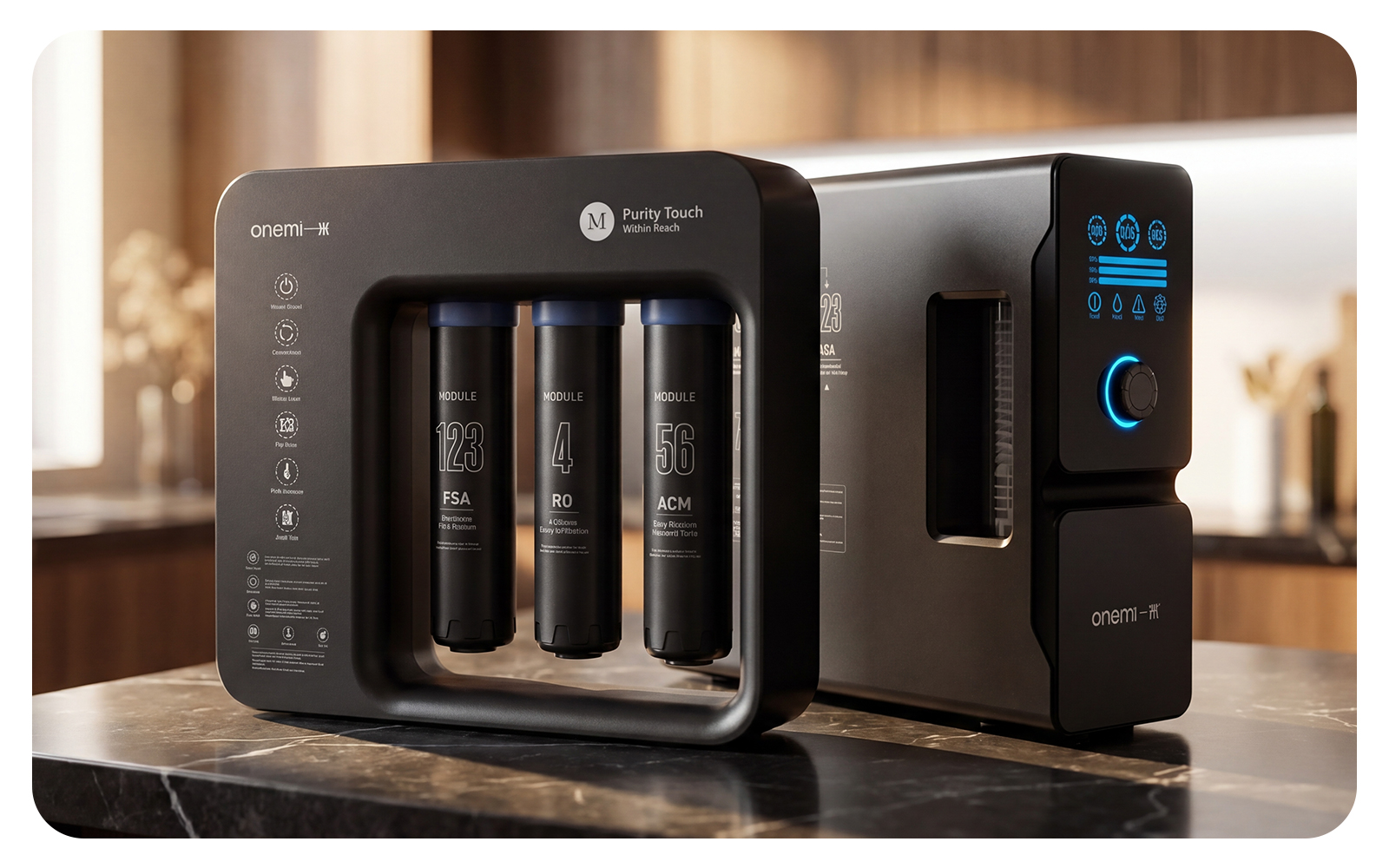
The transition of the water purifier from a dumb plumbing fixture to an intelligent home appliance is driven by the integration of Internet of Things (IoT) sensors and smart diagnostic microchips. Historically, homeowners had to rely on arbitrary calendar-based estimates to change their filters. This approach is fundamentally flawed because water usage patterns and incoming contaminant loads vary wildly from house to house.
Modern smart systems solve this by embedding dual Total Dissolved Solids (TDS) sensors directly into the water pathways. One sensor measures the raw incoming water, while the second monitors the purified product water exiting the membrane. By constantly comparing these two data streams, the system calculates the real-time rejection rate of the RO membrane. When the rejection rate drops below a pre-programmed threshold, the system alerts the user via a mobile application or an on-device LED display.
This level of precision prevents two common consumer errors: replacing perfectly functional, expensive filters too early, or worse, continuing to consume contaminated water because a calendar deadline was missed. Brands like ONEMI are pushing the boundaries of this space by integrating these sensor arrays with automated shut-off valves. If a major membrane breach or a internal leak is detected, the system instantly cuts off the incoming water line, preventing both catastrophic home flooding and accidental consumption of unfiltered water.
These smart systems also track cumulative volumetric flow. By measuring the exact number of gallons that have passed through the carbon and sediment stages, the onboard processor can predict filter exhaustion with incredible accuracy. This data is synced to cloud platforms, allowing for automated replacement filter shipping, ensuring that a new cartridge arrives at the homeowner’s doorstep precisely when the current one reaches the end of its operational life.
Real-World Implications and the Future of Clean Water
The adoption of advanced home water purification has profound implications that stretch far beyond individual health. On an environmental level, the widespread use of high-output under-sink RO systems directly challenges the multi-billion-dollar bottled water industry. By producing bottle-quality water directly from the kitchen tap, households can eliminate thousands of single-use plastic bottles annually, significantly reducing their personal carbon and plastic waste footprints.
There are practical engineering challenges and trade-offs that the industry must openly address. High-recovery RO membranes are highly sensitive to hard water scaling. In regions with extremely high calcium and magnesium levels, such as the southwestern United States, these minerals can rapidly precipitate onto the membrane surface, permanently ruining its microscopic pores within months. Homeowners in these areas must accept the practical gotcha that they will need to install a dedicated water softener upstream of their RO system to protect their technology investment.
A notable real-world case occurred in a suburban development outside of Wilmington, North Carolina, where local drinking water sources were heavily contaminated with GenX, a notorious next-generation PFAS chemical. Traditional carbon pitchers provided to residents by local authorities proved wholly inadequate, saturated within days of use. It was only when residents began installing dedicated multi-stage RO systems with active TDS monitoring that they were able to consistently reduce GenX levels to non-detectable limits, proving that localized, high-tech point-of-use filtration is often the only reliable solution when municipal infrastructure fails.
Looking toward 2026 and beyond, the integration of artificial intelligence in water systems will move from simple diagnostics to predictive municipal water profiling. Future purifiers will connect to local municipal water quality databases via Wi-Fi. If a local treatment plant reports a temporary spike in chlorine or an accidental chemical spill, the home purifier will automatically adjust its filtration parameters, increase its self-cleaning flush cycles, or throttle its flow rate to ensure the output water remains completely safe. This proactive defense model represents the ultimate evolution of residential water security.
Ultimately, the future of drinking water is decentralized. As municipal pipelines continue to age and industrial chemistry introduces new compounds faster than regulators can ban them, the responsibility for pure water shifts to the household level. Investing in a highly engineered, smart filtration system is no longer about luxury convenience. It is a fundamental commitment to long-term health, environmental sustainability, and absolute peace of mind in an increasingly unpredictable world.