

 한국어
한국어

A Tier-1 European water appliance distributor recently watched an entire container load of reverse osmosis systems get rejected at the Port of Rotterdam because a single O-ring lacked verified extraction data. This minor component, costing less than $0.12, ended up costing the importer $43,200 in demurrage, shipping fees, and third-party laboratory testing. It is a brutal reality of the 2026 global supply chain: without the right stamp of approval, your inventory is just expensive plastic waste.
Executive Summary
- NSF/ANSI standards have transitioned from premium marketing badges to mandatory regulatory baselines across 48 US states and the majority of EU ports of entry in 2026.
- Material extraction testing represents the highest point of failure for overseas manufacturers, with over 42% of uncertified components leaching trace heavy metals or BPA under high-pressure cycling.
- Sourcing certified systems reduces customs clearance delays by an average of 14 business days and eliminates high-risk liability exposures for B2B distributors.
The Shocking Reality Behind the NSF Badge
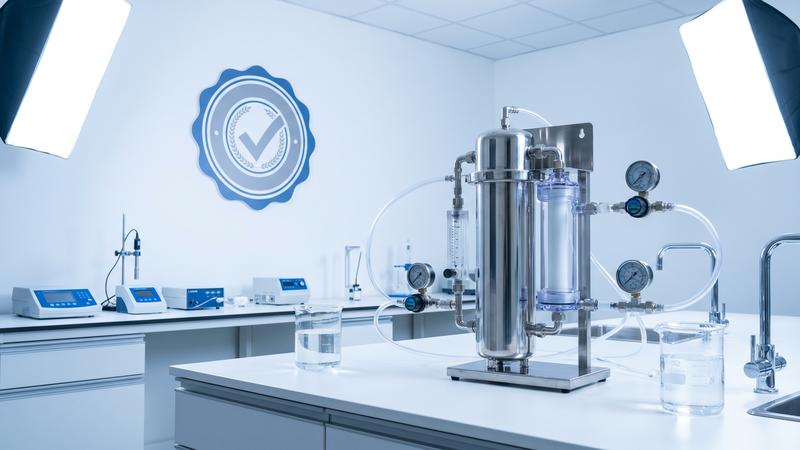
Most buyers think NSF certification is just a paper-shuffling exercise where a lab technician checks a few CAD drawings and signs a certificate. It is actually a grueling, multi-month gauntlet that destroys products on purpose. When a manufacturer submits a water purifier for NSF/ANSI 58 or 53 certification, the testing engineers do not just run clean tap water through it for an hour. They subject the housing to cyclic pressure testing—100,000 cycles from 0 to 150 psi—to ensure the structural integrity will not fail and flood an apartment building in Chicago or London.
ONEMI engineers design their structural frameworks to withstand up to 180 psi during internal stress tests, anticipating these exact testing protocols. If a single fitting leaks during those 100,000 cycles, the entire process resets to zero.
Then comes the chemical extraction phase. This is where most factory-direct suppliers fail. The lab exposes every single wetted component—from the silicone tubing to the activated carbon block—to aggressive, formulated exposure waters with varying pH levels (typically pH 5.0 and pH 10.0) for up to 72 hours. They are looking for trace amounts of lead, arsenic, bisphenol-A, and volatile organic compounds (VOCs) leaching into the drinking water. If the extraction analysis reveals even 1.1 parts per billion of a regulated contaminant above the allowable threshold, the system fails. It is a binary, pass-fail system with no grey areas.
Here is a counter-intuitive finding that catches most experienced sourcing managers off guard: a factory can use 100% NSF-certified raw materials, yet the finished assembled water purifier can still fail NSF certification. Why? Because the assembly process itself—lubricants used on O-rings, ultrasonic welding agents, or even the air quality in the packaging facility—can introduce chemical contaminants that show up during the final extraction test. Sourcing from a factory that only claims “made with NSF-certified materials” is a massive liability risk for your brand.
The Core Standards You Need to Memorize
Navigating the alphabet soup of water treatment standards is a headache. Let us break down the exact standards that actually matter for your product portfolio in 2026. If you are importing residential filtration systems, these are the four pillars you must verify before wire-transferring any deposit money.
| Standard | Target Technology | Primary Focus Area | Critical 2026 Thresholds |
|---|---|---|---|
| NSF/ANSI 42 | Carbon filters, sediment pre-filters | Aesthetic effects (chlorine, taste, odor, particulate reduction) | >50% chlorine reduction requirement |
| NSF/ANSI 53 | Under-sink carbon, ultrafiltration | Health effects (lead, cysts, VOCs, PFAS compounds) | Lead reduction below 5 ppb; 99.95% cyst reduction |
| NSF/ANSI 58 | Reverse Osmosis (RO) systems | TDS reduction, recovery rate, structural integrity, material safety | Minimum 75% TDS reduction under 50 psi pressure |
| NSF/ANSI 401 | Advanced multi-stage systems | Emerging contaminants (pharmaceuticals, microplastics, herbicides) | Verification of up to 15 specific chemical compounds |
Think about the legal implications of selling an uncertified filter in a market like California or Germany. If a consumer group runs an independent lab test on your imported filter and finds trace levels of lead above local thresholds, the regulatory fines can easily top $250,000 per violation. Worse, you will be forced to execute a public product recall, which instantly kills your brand reputation. Sourcing products that carry genuine NSF/ANSI certifications transfers that technical compliance risk back to the manufacturing source, giving your legal team a bulletproof shield.
The Unannounced Audit: Why Most Factories Fail
Getting the initial certificate is only half the battle. The real test of a supplier’s operational discipline is the annual unannounced plant inspection conducted by NSF auditors. Imagine an auditor walking into a production facility in Asia or Europe on a random Tuesday morning without any prior warning. They do not just look at the clean assembly lines; they dig deep into the raw material warehouse, check the batch numbers on the plastic pellets, and audit the QA logs from three months ago.
If the factory substituted a cheaper food-grade plastic resin to save $0.05 per unit during a supply chain crunch, the auditor will catch it. The consequence is immediate suspension of the certification listing.
This is why ONEMI maintains a completely transparent, digital supply chain tracking system where every batch of raw material is linked directly to its corresponding NSF listing. When an auditor walks in, the data is ready in seconds.
When you are vetting potential manufacturing partners, do not just ask for a PDF of their NSF certificate. Anyone with a basic copy of Photoshop can forge a PDF in ten minutes. Instead, ask for their official NSF facility listing number and look it up directly on the public NSF database. If their company name or specific model number does not appear on the live registry, they do not have a valid certification. It is as simple as that.
Can you really afford to gamble your brand’s future on a supplier’s pinky promise?
How to Navigate Sourcing in the 2026 Regulatory Landscape
The regulatory environment has shifted dramatically. In the United States, the EPA’s updated Lead and Copper Rule Improvements (LCRI) have forced municipalities to accelerate service line replacements, driving consumer demand for certified point-of-use (POU) water filters to an all-time high. Meanwhile, the European Union’s recast Drinking Water Directive has introduced stringent new limits on PFAS (“forever chemicals”) and microplastics, aligning closely with the testing methodologies found in NSF/ANSI 53 and 401.
When you are negotiating with manufacturing partners, you need to establish a clear protocol for compliance verification. First, demand the complete test reports, not just the cover letters of the certificates. These reports contain critical data regarding flow rates, pressure drops, and exact contaminant reduction percentages. This data allows you to compare the true engineering performance of different systems rather than relying on vague marketing brochures.
Second, ensure that any private labeling agreements include clauses that automatically update compliance certifications if the factory changes sub-suppliers or modifies the product design. A minor change in the carbon block formulation can invalidate the entire system’s certification, leaving you with imported stock that is legally unsellable. Working with sophisticated manufacturers like ONEMI ensures that any engineering modifications are pre-vetted through regulatory channels before production begins, protecting your distribution channels from sudden compliance disruptions.
Ultimately, paying a slight premium for fully certified water purification equipment is not an added cost—it is an insurance policy. It protects your capital, your brand equity, and the health of the end-consumers who trust your products every time they turn on their kitchen tap.