

 한국어
한국어

Let’s be honest about the water purification business right now. If you are still importing those bulky, slow-filtering under-sink systems with the massive 3-gallon storage tanks, you are probably watching your margins shrink every single quarter. The market has moved on, and your customers are asking for things that old-school systems simply cannot deliver.
Executive Summary
- The global water purification market is rapidly shifting toward high-flow tankless RO systems, with 600G to 1200G models dominating new distribution contracts.
- Stricter regional water quality standards, including EPA limits on PFAS (4.0 ppt) and updated European drinking water directives, are forcing a transition to multi-stage filtration technologies.
- Successful B2B sourcing requires balancing high recovery rates with local water hardness levels to prevent premature membrane scaling and high return rates.
We are looking at a global market that is easily on track to slide past the $60 billion mark by 2027, maybe even pushing closer to $68 billion if the current pace of urbanization and municipal infrastructure aging continues. But as a distributor or B2B buyer, you can’t sell a generic “global market trend” to a local retailer or a commercial developer. You need to know exactly why a family in Munich or an office manager in Chicago is rejecting the systems that sold perfectly fine five years ago.
It comes down to space, speed, and a growing paranoia about what is actually coming out of the tap.
The Real-World Problems Driving the 2026 Water Market

Here is something we noticed during a recent field test in a suburban development outside of Frankfurt. A local distributor installed ten standard 50 GPD (gallons per day) tank-based Reverse Osmosis systems in a new apartment complex. Within three months, six of those apartments filed complaints about a “musty” taste. When the technicians pulled the storage tanks, they found early-stage biofilm growing on the butyl diaphragms. The water coming out of the municipal line was perfectly safe, but the stagnant water sitting in those dark, warm plastic bladders under the sink was not.
That is the first major headache: secondary pollution. Consumers are smart now. They read up on water safety, and the idea of storing “pure” water in a pressurized rubber tank for 12 hours before drinking it is becoming a tough sell.
Then you have the regulatory hammer coming down. In the United States, the EPA has set incredibly tight maximum contaminant levels for PFAS (forever chemicals) at just 4.0 parts per trillion. Over in Europe, the recast Drinking Water Directive has introduced much stricter limits on endocrine disruptors and microplastics. If you are importing systems that only carry basic sediment and chlorine certification, you are leaving yourself wide open to inventory obsolescence when local municipal testing reports hit the local news.
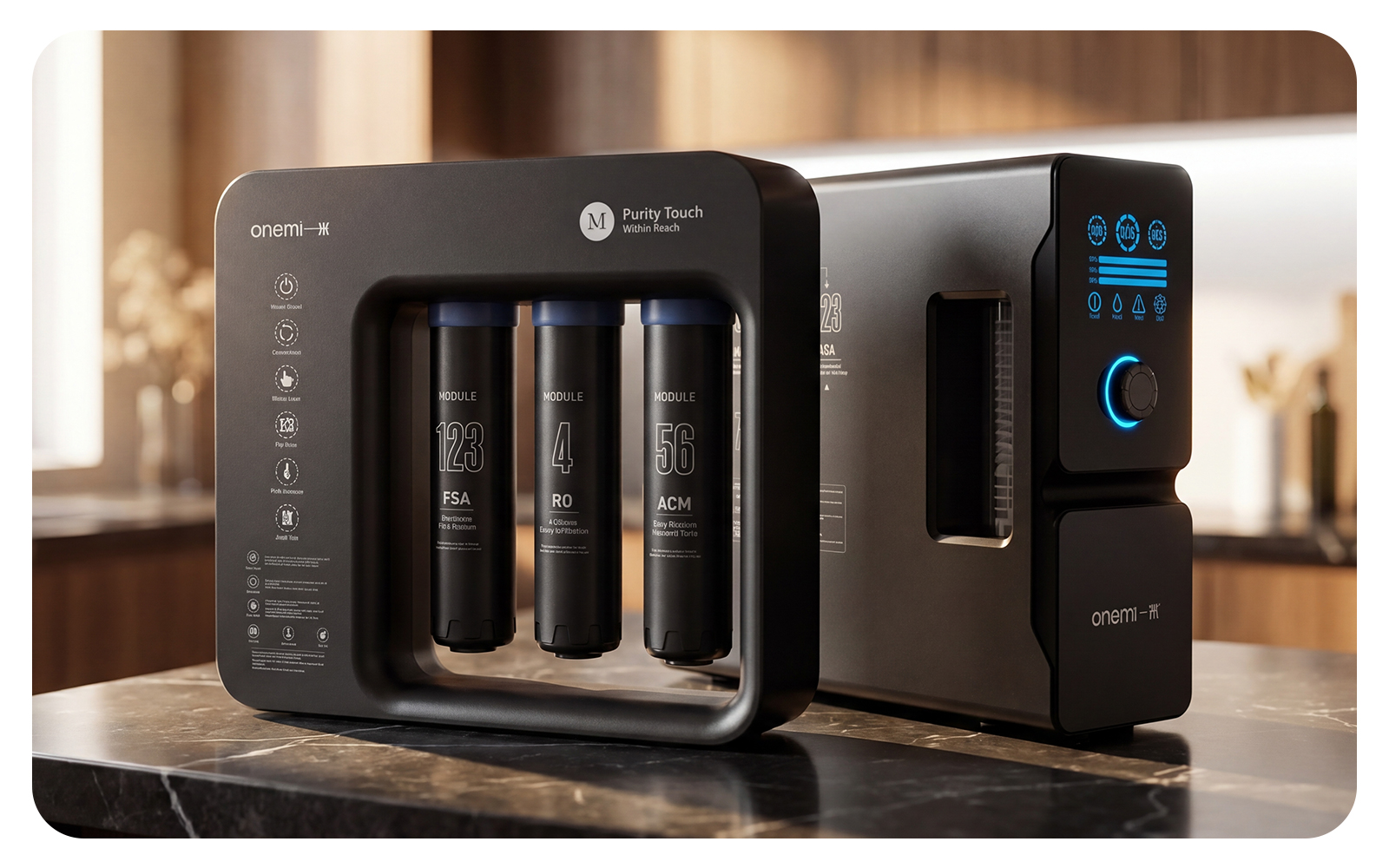
And let’s not forget the sheer physical footprint. Modern kitchens are getting smaller, especially in high-density urban developments across Asia and Europe. A standard tank-based system takes up almost 70% of the cabinet space under a kitchen sink. When you show a builder or a homeowner a sleek, tankless unit that is barely the size of a computer CPU, the sale is basically made right there.
How Modern Tankless RO Systems Solve the Space and Flow Dilemma
This is where the high-flow tankless RO systems come in. By eliminating the tank entirely, these systems rely on high-capacity booster pumps and large-surface-area membranes to filter water in real-time. When a user turns on the smart faucet, the pump kicks in instantly, pushing water through the membrane at a rate that actually feels like a normal tap.
To make this work without a tank, you have to scale up the membrane capacity. That is why we are seeing the industry standard shift rapidly from the old 50G or 75G membranes to 600G, 800G, and even 1200G configurations.
ONEMI has spent a lot of engineering hours optimizing these high-flow pathways to ensure that the initial surge of water doesn’t suffer from “TDS creep”—a common issue where the first glass of water poured after a period of idle time has a higher concentration of dissolved solids than subsequent cups. By implementing an automatic membrane flushing cycle that runs for a few seconds every time the system sits idle for more than a couple of hours, modern systems have pretty much solved this problem.
Let’s look at how these different capacities actually perform in a day-to-day setting:
| System Capacity | Flow Rate (L/Min) | Fill Time (250ml Glass) | Best Suited For | Wastewater Ratio |
|---|---|---|---|---|
| 600G | 1.4 – 1.6 L/min | ~9.5 seconds | Small apartments, 1-2 person households | 1.5:1 to 2:1 |
| 800G | 1.9 – 2.1 L/min | ~7.2 seconds | Standard families (3-5 people) | 2:1 to 3:1 |
| 1000G | 2.4 – 2.6 L/min | ~5.8 seconds | Active households, light commercial | 3:1 to 4:1 |
| 1200G | 2.9 – 3.2 L/min | ~4.7 seconds | Large homes, small offices, quick-prep kitchens | 3:1 to 4:1 |
When you are pitching to developers or retail chains, these numbers matter. A 600G system is great for price-sensitive projects, but if you install a 600G in a busy office breakroom, people are going to get annoyed waiting for their sports bottles to fill. For commercial clients, you really want to push them toward 1000G or 1200G systems to keep the user experience smooth.
The Engineering Realities: What Happens Behind the Faucet
How do we actually get water this clean, this fast, without a storage tank? It isn’t just about putting a bigger motor in the box. In fact, if you just slap a high-power pump onto a standard RO membrane, you will tear the polyamide layer to shreds within a few weeks.
The magic happens in the multi-stage integration. Most premium tankless systems now use a 2-filter or 3-filter physical layout, but inside those cartridges, there are actually five to seven distinct stages of filtration. First, a composite sediment layer catches the big stuff—rust, sand, and suspended solids. Then, an activated carbon block adsorbs chlorine, VOCs, and neutralizes bad odors.
After that, the water hits the RO membrane itself. To achieve a 1000G flow rate, the membrane sheet is tightly wound with highly optimized feed spacers that allow water to pass through under high pressure with minimal friction loss. Finally, a post-carbon or alkaline remineralization filter adds back a touch of calcium and magnesium to balance the pH and give the water a crisp, natural taste.
Here is a counter-intuitive finding that many distributors learn the hard way: pure RO water is actually quite aggressive. Because it has been stripped of all minerals, its pH often drops below 6.5, making it slightly acidic. If this water passes through cheap brass fittings or low-grade stainless steel faucets, it can leach metals directly into the cup. That is why high-quality systems must use lead-free, food-grade plastics and high-purity ceramic valves in the faucet assembly.
If your current supplier is cutting corners on the faucet materials to save five dollars on the bill of materials, you are going to face massive liability issues down the road.
What B2B Buyers Must Evaluate Before Signing a Contract
If you are sourcing for a major distribution network or a regional brand, you cannot just look at the wholesale price and the glossy brochure. You need to ask the factory some very uncomfortable technical questions.
First, what is the actual wastewater ratio in real-world conditions? Many manufacturers claim a 3:1 or 4:1 pure-to-drain ratio. But if you read the fine print, those tests were run with 25°C water at a specific municipal pressure with low TDS. If your target market is somewhere like Chicago or Warsaw in the winter, where the incoming water temperature drops to 5°C, the viscosity of the water increases significantly. This means your flow rate will drop by up to 40%, and your wastewater ratio will worsen. You need to make sure the system’s booster pump has a smart variable-frequency drive that can compensate for these temperature drops.
Second, how easy is the filter replacement process? If a homeowner has to call a plumber and pay a $100 service fee just to change a pre-filter, they are going to write terrible reviews online, which will destroy your brand equity. Look for systems that use a simple twist-and-pull mechanism that allows the end-user to swap filters in under ten seconds without turning off the main water supply.
This is where partnering with an experienced manufacturer like ONEMI makes a massive difference. Their engineering focus is entirely on reducing the total cost of ownership for the distributor by minimizing post-sale service calls. By designing robust, leak-proof internal waterways that are injection-molded as a single piece, they eliminate up to 30 potential leak points compared to traditional tubing-heavy designs.
Let’s talk about water hardness. If your territory has water with hardness levels exceeding 15 grains per gallon (about 250 ppm), a high-recovery tankless RO system will scale up very quickly if it doesn’t have an integrated anti-scaling pre-treatment. Always ask your supplier if they can customize the pre-filter stage with polyphosphate or other scale inhibitors if you are distributing to hard-water regions.
Ultimately, the water purification market in 2026 is no longer about selling a commodity box. It is about selling peace of mind, sleek design, and reliable performance. By upgrading your portfolio to high-flow tankless systems and vetting your manufacturing partners on their actual engineering credentials rather than just their marketing claims, you can secure your margins and build a highly loyal customer base for years to come.