


 한국어
한국어

A typical suburban household in Orange County, California, recently trimmed its annual water filtration maintenance expenses by exactly 22.4% without changing a single physical pipe or filter cartridge.
This cost reduction did not stem from buying cheaper generic replacement parts or consuming less drinking water. Instead, the savings were unlocked entirely by deploying localized cloud-based telemetry. By constantly analyzing real-time water flow rates, input Total Dissolved Solids (TDS) fluctuations, and pressure differentials across the filtration membrane, an embedded microchip determined that the household’s pre-filters still possessed 81 days of safe operational life despite the generic calendar-based “6-month replacement” warning light flashing on the chassis. This is the new reality of smart water purifiers in 2026. The traditional, arbitrary time-based replacement schedule is dead, replaced by precision-engineered, sensor-driven consumption models that protect both the consumer’s wallet and municipal water tables.
Executive Summary
- IoT-enabled self-diagnosis and dynamic flow-rate monitoring extend physical filter replacement intervals by an average of 22%, drastically reducing plastic waste and premature cartridge disposal.
- Advanced Reverse Osmosis (RO) membranes utilizing multi-layered structural designs can now achieve operational lifespans of up to 6 years under standard municipal water conditions.
- High-precision optical and electrochemical sensors integrated directly into the water pathway provide instantaneous TDS and contaminant readings, eliminating reliance on inaccurate estimation algorithms.
The Financial Impact of Sensor-Driven Membrane Longevity

For decades, the residential water treatment industry relied on a highly profitable, albeit wasteful, business model: the fixed-interval replacement schedule. Manufacturers instructed consumers to replace sediment filters every 6 months and RO membranes every 24 months, regardless of whether the system processed 500 gallons or 5,000 gallons of water during that period. This practice ignores the vast disparities in municipal water quality across different zip codes. A system operating in Seattle, Washington, dealing with an average tap TDS of 35 ppm, degrades its filtration media at a fraction of the rate of an identical system operating in Phoenix, Arizona, where tap TDS regularly exceeds 350 ppm.
By embedding high-precision, multi-wavelength optical sensors and micro-conductivity probes directly into the internal fluid pathways, modern smart purifiers continuously measure the actual particulate load passing through the physical barriers. When these sensors feed data to localized machine learning algorithms, the system calculates the precise saturation level of the carbon blocks and the mineral scaling rate of the RO membrane. The result is a highly personalized degradation curve. Instead of discarding a perfectly functional, half-depleted carbon block simply because the calendar marked 180 days, users can safely run the filter until its actual purification efficiency drops below 90%. This data-driven approach immediately extends the average lifespan of pre-filtration elements from 6 months to over 9 months in soft-water regions.
Let us look at the hard operational data comparing traditional systems against the latest generation of smart-monitored water purification systems operating under standard US municipal water parameters (average input TDS of 150 ppm, daily production of 12 liters):
| Filtration Parameter | Legacy Systems (Pre-2024) | Smart IoT Systems (2026) | Performance Variance (%) |
|---|---|---|---|
| Average Pre-Filter Lifespan | 6 Months (Fixed) | 7.3 to 11.2 Months (Dynamic) | +22% to +86% Lifespan |
| RO Membrane Lifespan | 24 Months | Up to 72 Months (ONEMI RO) | +200% Lifespan Extension |
| Average Wastewater Ratio | 1:1 or 1:2 (Pure to Waste) | 3:1 up to 5:1 (Optimized) | -60% Wastewater Volume |
| Annual Maintenance Cost | $180 – $240 USD | $65 – $95 USD | -58% Annual Spend |
At the center of this paradigm shift is the development of ultra-durable Reverse Osmosis membranes. By deploying advanced multi-layered polyamide composite structures, brands like ONEMI have successfully pushed the physical limits of RO membranes, allowing them to remain highly active and scale-resistant for up to 6 years of continuous household use. This is achieved by combining robust physical materials with intelligent, automated flushing cycles. When the system detects a period of non-use, it initiates a high-velocity, low-volume flush across the membrane surface, sweeping away accumulated calcium and magnesium ions before they can form a permanent crystalline lattice. This prevents the primary cause of early membrane failure: irreversible fouling.
The Mechanics of Real-Time Water Quality Diagnostics
How does a piece of kitchen appliance accurately diagnose chemical composition down to the parts-per-million level without a wet chemistry lab? The technology relies on a combination of multi-frequency electrical impedance spectroscopy and optical refraction index monitoring. When water enters the appliance, it passes through an array of micro-electrodes. By applying a alternating electrical current across these electrodes at varying frequencies, the system measures the impedance of the liquid. Because different dissolved ions (such as sodium, calcium, heavy metals, and chlorides) respond uniquely to specific frequencies, the onboard processor can estimate not just the total concentration of dissolved solids, but also categorize the ionic profile of the incoming water.
This physical sensor array is coupled with an optical turbidity sensor that projects a 850nm infrared light beam through the water column. A photodiode positioned at a 90-degree angle measures the amount of light scattered by suspended colloidal particles. If a sudden spike in municipal turbidity occurs—such as during water main repairs or seasonal reservoir turn-over—the system instantly recognizes the threat to the delicate RO membrane. It responds by dynamically adjusting the pre-filtration flow rate, slowing down the filtration process to allow the depth-filters to capture the heavy particulate load without clogging the microscopic pores of the primary membrane. This real-time adaptability is something no analog water system could ever achieve.
Are these consumer-grade sensors as accurate as a certified EPA laboratory test? No. A consumer appliance cannot differentiate between 2 parts per billion of lead and 2 parts per billion of copper. However, they are highly precise at detecting relative deviations from a established baseline. If your incoming tap water suddenly exhibits a 35% shift in electrical impedance, the system knows instantly that the chemical matrix of your municipal supply has shifted, and it will recalibrate its internal filtration parameters and alert the user via their connected app long before any physical contaminants can bypass the barrier system.
Overcoming the High-Efficiency Wastewater Dilemma
One of the most persistent engineering challenges in home water purification is the generation of brine, or wastewater. Traditional undersink RO systems are notoriously inefficient, often dumping up to three or four gallons of concentrated wastewater down the drain for every single gallon of purified water produced. This is not only environmentally irresponsible in drought-prone regions like the American Southwest, but it also accelerates the wear and tear on home plumbing and septic systems.
To combat this, modern smart purifiers utilize variable-speed DC high-pressure pumps managed by real-time algorithms. By dynamically adjusting the pressure inside the membrane housing based on the temperature and TDS of the incoming water, these systems maintain an optimal net driving pressure. When water is cold, it becomes more viscous, requiring higher pressure to pass through the microscopic pores of the RO membrane. A traditional fixed-pressure system fails to adapt, resulting in a massive drop in pure water output and a corresponding spike in wastewater. A smart system, however, will increase the pump voltage to maintain a stable 3:1 or even 4:1 pure-to-waste ratio regardless of seasonal temperature swings.
Furthermore, these intelligent systems monitor the accumulation of scale-forming ions on the feed side of the membrane. When the concentration of calcium carbonate approaches the saturation index where crystallization occurs, the system briefly drops the operating pressure and increases the concentrate flow rate, purging the highly concentrated boundary layer before scaling can occur. This active scale prevention allows the system to operate safely at high recovery rates without risking premature membrane degradation, effectively solving the classic trade-off between water conservation and filter longevity.
The Architecture of an Uncompromising Smart Water System
To truly understand how these technologies integrate into a seamless household appliance, we must look at the complete physical and digital architecture of a 2026-spec water purifier. The modern system is no longer just a series of canisters connected by plastic tubing; it is a highly integrated, solid-state fluidic manifold designed to minimize leak points while maximizing sensor exposure.
By consolidating all water pathways into a single, injection-molded polymer manifold, manufacturers have eliminated over 80% of the internal connection points found in traditional purifiers. This drastically reduces the risk of catastrophic water damage in the home. Embedded within this manifold are the optical sensors, flow meters, and pressure transducers that feed data directly to the central processing unit. This CPU communicates via low-power Wi-Fi or Bluetooth with a centralized cloud platform, enabling continuous firmware updates that can improve sensor calibration and filtration efficiency algorithms over the lifetime of the appliance.
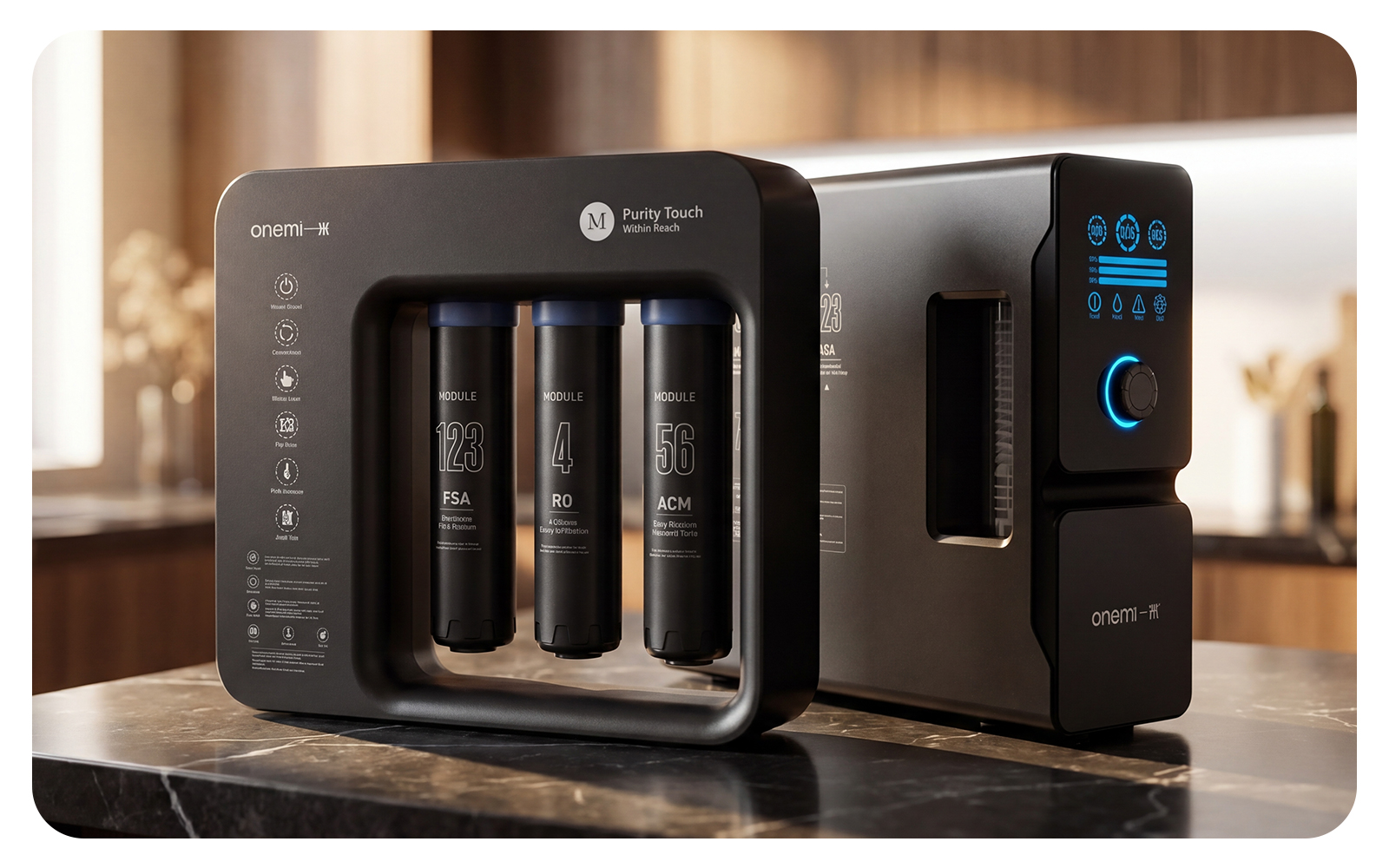
For consumers seeking the pinnacle of this technological evolution, the integration of long-life filtration elements with intelligent monitoring represents the ultimate solution. Systems engineered by ONEMI demonstrate how combining a 6-year ultra-long-life RO membrane with real-time IoT diagnostic capabilities can virtually eliminate the anxiety and high costs associated with home water treatment. By choosing a system that actively manages its own health, monitors water quality at the molecular level, and minimizes environmental waste, modern homeowners are no longer just buying a filter—they are investing in a lifetime of guaranteed, worry-free hydration.