

 한국어
한국어

The landscape of household drinking water is undergoing a fundamental shift. Across North America and Europe, municipal infrastructure is aging, emerging contaminants are bypassing standard treatment facilities, and consumers are no longer satisfied with basic pitcher filtration. What used to be a niche home improvement project has evolved into a critical residential utility.
Executive Summary
- The global water filtration sector is scaling rapidly, with the specialized filters segment projected to grow from $15.56 billion in 2025 to $16.78 billion in 2026 at a 7.9% CAGR, while the broader water purifier market is on track to hit $97 billion by 2035.
- Residential applications remain the dominant market force, propelled by rising consumer awareness of PFAS, microplastics, and heavy metal contamination in municipal tap water.
- Technological integration is shifting from basic point-of-use systems toward comprehensive whole-house reverse osmosis (RO) setups and strict NSF/ANSI certifications.
For decades, household water treatment was treated as an afterthought, represented by slow-dripping plastic pitchers sitting in refrigerators. Today, the realization that municipal treatment plants are not designed to eliminate 100% of modern chemical runoff has changed the consumer calculus entirely.
The Emerging Threats in Modern Tap Water
Why are households suddenly investing thousands of dollars in water treatment? The answer lies in what municipal testing reports are starting to reveal. While local water authorities generally meet federal minimum safety standards, those standards are often decades out of date compared to modern toxicological science. Consumers are discovering that “legal” water is not necessarily “safe” water.
Consider the following critical issues facing modern residential water supplies:
- PFAS and GenX chemicals: These “forever chemicals” are highly resistant to natural degradation and are linked to endocrine disruption and immune system issues even at parts-per-trillion levels.
- Microplastics: Recent studies have detected synthetic polymer particles in over 80% of tap water samples globally, with unknown long-term biological consequences.
- Agricultural runoff: Nitrates, pesticides, and herbicides regularly leach into shallow aquifers, spiking during seasonal agricultural cycles.
- Disinfection byproducts (DBPs): Chlorine and chloramine, while necessary to kill pathogens in the pipe network, react with organic matter to create trihalomethanes (THMs), which are known carcinogens.
- Heavy metals: Lead and copper contamination rarely comes from the treatment plant itself; instead, it leaches directly from aging service lines and household brass fixtures.
This is where standard carbon block filters fail. While a basic carbon filter can improve taste and odor by removing chlorine, it lacks the physical pore density to block dissolved solids, heavy metals, or microscopic chemical compounds. Households require a multi-stage physical barrier capable of working at the molecular level.
How Multi-Stage Filtration and RO Technology Work
True water purification is never a single-step process. To achieve water that is genuinely free of harmful contaminants, systems must utilize a sequential series of barriers, each optimized for specific particle sizes and chemical properties. Reverse osmosis (RO) serves as the anchor of this process, but it relies heavily on its supporting stages to function efficiently.
Here is a breakdown of the standard sequential purification architecture used in modern high-performance residential systems:
1. The Sediment Pre-Filter: This initial stage physically traps large rust particles, silt, sand, and suspended solids. By removing these coarse materials, it prevents the subsequent, more delicate carbon blocks and RO membranes from clogging prematurely.
2. Activated Carbon Block: Utilizing highly porous carbon, this stage adsorbs organic chemicals, pesticides, chlorine, and chloramines. Adsorption chemically binds these contaminants to the surface of the carbon pores, eliminating unpleasant tastes and odors while protecting the RO membrane from chlorine degradation.
3. The Reverse Osmosis Membrane: This is the heart of the system. Under pressure, water is forced through a semi-permeable membrane with a pore size of approximately 0.0001 microns. To put this in perspective, a human hair is about 75 microns wide. This incredibly tight mesh blocks dissolved salts, heavy metals like lead and arsenic, fluorides, nitrates, and virtually all biological pathogens.
Are we stripping out the beneficial minerals along with the bad? Yes, pure RO water is highly acidic and flat in taste because it lacks minerals. This is a known technical limitation of pure RO technology that many manufacturers gloss over. To solve this, premium systems must integrate a post-filtration remineralization stage that reintroduces precise amounts of calcium and magnesium back into the water, raising the pH to a healthy, alkaline level of 7.5 to 8.5.
4. Post-Carbon Polishing Filter: Before the water is dispensed, it passes through a final carbon filter to eliminate any residual taste that may have developed while the water was sitting in a storage tank.
| Filtration Stage | Pore Size / Mechanism | Target Contaminants Removed | Typical Lifespan |
|---|---|---|---|
| Sediment Filter | 1.0 – 5.0 microns | Sand, silt, rust, scale particles | 6 – 12 months |
| Carbon Pre-Filter | Chemical Adsorption | Chlorine, VOCs, pesticides, odors | 6 – 12 months |
| RO Membrane | 0.0001 microns | Lead, PFAS, nitrates, heavy metals | 24 – 36 months |
| Remineralizer | Slow-release media | None (Adds Calcium & Magnesium) | 12 months |
Understanding these stages helps consumers look past flashy marketing terms and focus on the physical realities of water treatment. A system is only as strong as its weakest stage.
The Real-World Implications of Water Quality and Standards
Investing in a home water purification system is not just about convenience; it has direct, measurable impacts on household economics, health outcomes, and environmental footprints. When families transition to high-efficiency filtration, the changes are immediate and quantifiable.
Consider the economic reality of bottled water. The average family of four drinking the recommended amount of water daily can easily consume over 1,400 single-use plastic bottles per year. At an average cost of $0.30 to $1.25 per bottle, this represents a significant annual expense that is entirely eliminated by producing purified water at the tap for pennies per gallon. Furthermore, eliminating those plastic bottles directly reduces the carbon footprint associated with plastic manufacturing, shipping, and recycling logistics.
Beyond economics, the health implications are profound. For households relying on private wells, which are not regulated by the EPA, a robust home filtration system is the only line of defense against agricultural runoff and naturally occurring heavy metals. In municipal areas, it protects against localized infrastructure failures, such as water main breaks or temporary treatment plant malfunctions that lead to boil-water advisories.
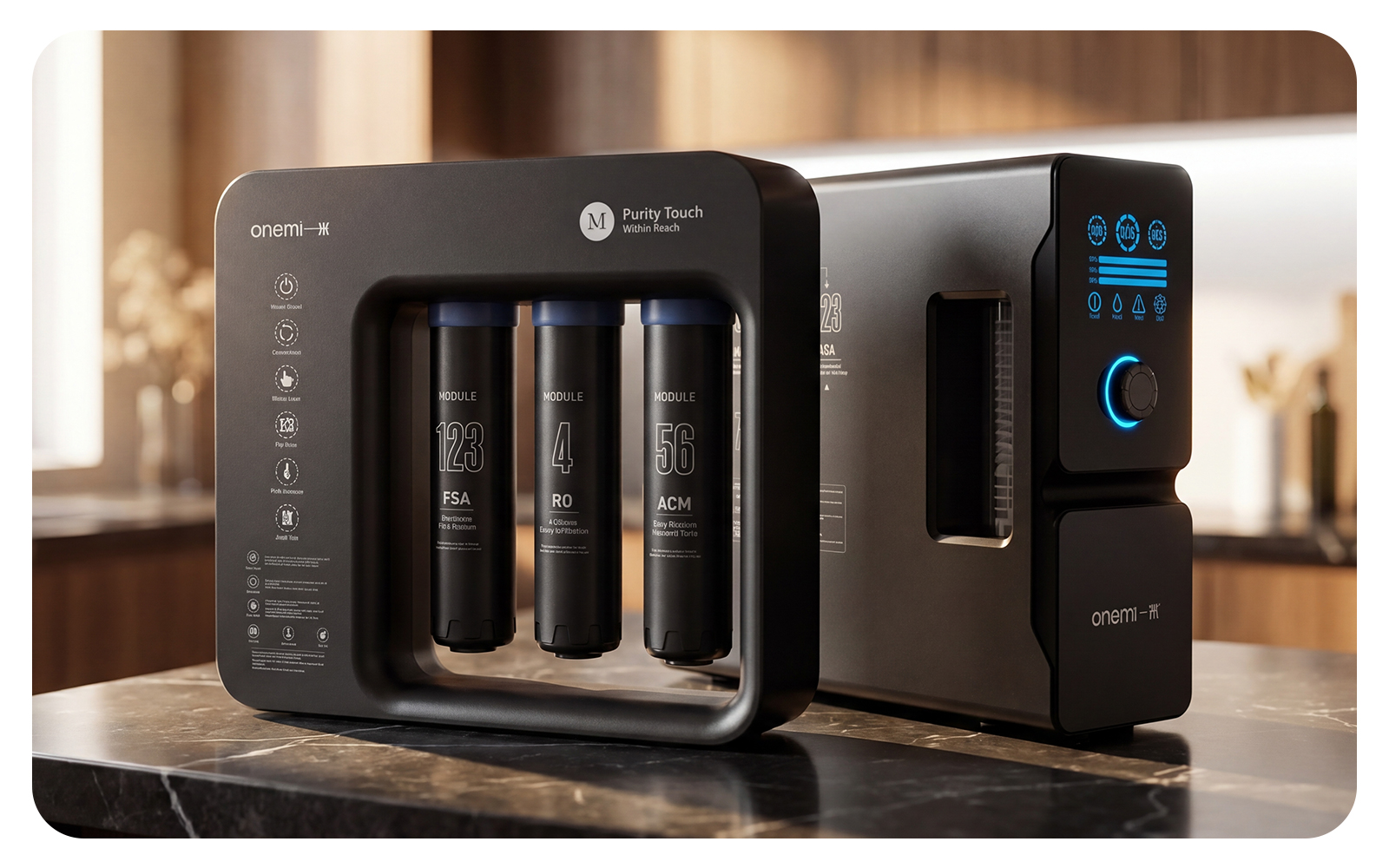
The ONEMI brand has focused heavily on engineering systems that balance high-volume output with minimal water waste, addressing one of the historic criticisms of residential RO systems.
When evaluating systems on the market, understanding certifications is critical. Consumers should look for systems certified under NSF/ANSI standards:
- NSF/ANSI 42: Covers aesthetic effects, ensuring the system effectively reduces chlorine, taste, and odor.
- NSF/ANSI 53: Addresses health effects, certifying the reduction of specific contaminants like lead, mercury, asbestos, and VOCs.
- NSF/ANSI 58: Specifically applies to reverse osmosis systems, verifying their contaminant reduction efficiency and recovery ratings.
- NSF/ANSI 401: Certifies the reduction of emerging compounds, including trace pharmaceuticals, plastics, and flame retardants.
These certifications are not self-declared; they require rigorous third-party laboratory testing under standardized conditions to prove that the systems perform exactly as claimed over their entire rated lifespan.
Future Trends in Residential Filtration
As we look toward 2026 and beyond, the residential water purification market is moving rapidly toward smarter, more sustainable systems. The integration of IoT technology allows modern systems to monitor water usage, track filter life in real-time based on actual volume processed rather than simple timers, and detect leaks before they cause property damage. This smart monitoring ensures that filters are replaced exactly when needed, preventing both premature disposal and compromised water quality.
A major focus of ongoing industry research is the reduction of wastewater in reverse osmosis systems. Historically, older RO units wasted up to 4 to 5 gallons of water for every gallon of purified water produced. Modern high-efficiency systems have flipped this ratio, with advanced units operating at a 1:1 or even a 2:1 pure-to-waste ratio, drastically reducing household water consumption.
The ONEMI engineering team has been at the forefront of this efficiency drive, developing membrane technologies that maintain high flow rates even under lower municipal pressure conditions. This reduces the need for noisy booster pumps and simplifies the installation process for average homeowners.
At the same time, there is a clear trend toward whole-house filtration systems. Rather than treating water only at the kitchen sink, homeowners increasingly want to protect their entire plumbing infrastructure, water heaters, and appliances from scale buildup, while ensuring that the water they shower in is free of harsh chlorine and synthetic chemicals. This holistic approach to residential water management is quickly becoming the standard for modern home construction and renovation.
Here is a practical gotcha: many homeowners install a whole-house system assuming it will solve all their drinking water issues, only to realize that a whole-house carbon system does not remove dissolved solids or heavy metals. For true purification, a whole-house carbon system must still be paired with a point-of-use reverse osmosis system at the drinking water tap.
Ultimately, the choice to invest in advanced water purification is a choice to take control of a fundamental resource. As environmental challenges continue to grow, having a reliable, multi-stage physical barrier in your home is the most effective way to guarantee the safety and quality of every drop your family consumes. The technology exists to turn questionable tap water into pristine, spring-quality water right at home—it is simply a matter of choosing the right system for your specific needs.
ONEMI continues to refine its product lineup to meet these evolving standards, ensuring that clean, safe, and great-tasting water remains accessible to households worldwide without compromising on environmental sustainability or system longevity.