
 한국어
한국어

- RO-based emergency systems with solar/battery hybrid power are the procurement standard for 2026—capable of treating floodwater, brackish sources, and microbiologically contaminated supplies
- CE, ROHS, and ISO 9001 certifications are the minimum compliance bar for international disaster relief tenders; NSF/ANSI 42/53 on filter cartridges adds competitive advantage
- Chinese manufacturers offer 30-40% cost advantage on bulk emergency filtration units, with typical lead times of 15-25 days for container orders
When a hurricane knocks out municipal water infrastructure, the procurement clock starts ticking. Every hour without potable water raises the risk of cholera, dysentery, and dehydration across affected populations. For the agencies and distributors who stockpile emergency response equipment, the question isn’t whether to buy water filtration systems—it’s which specs actually hold up when the grid is down and the source water looks like chocolate milk.
This guide covers what matters in emergency water filtration procurement in 2026: technology choices, certification requirements, deployment speed, and how to evaluate Chinese manufacturers for bulk orders. No marketing fluff—just the parameters purchasing managers and humanitarian logistics teams need to make defensible sourcing decisions.
Technology That Survives the Field: RO vs UF for Disaster Scenarios
Emergency water filtration isn’t the same as household water purification. The source water in disaster zones is unpredictable—floodwater mixed with sewage, stagnant surface water, saline intrusion in coastal hurricane zones. A system that works fine on municipal tap water can fail completely on floodwater. Here’s how the two main technologies compare under field conditions:
| Parameter | RO Reverse Osmosis | UF Ultrafiltration |
|---|---|---|
| Filtration precision | 0.0001 micron | 0.01 micron |
| Handles floodwater/sewage | Yes—removes viruses, bacteria, heavy metals | Partial—blocks bacteria, not viruses |
| Handles brackish/saline water | Yes—desalination capable | No |
| Power requirement | Needs electricity (AC or DC pump) | Gravity-fed option available |
| Output quality | TDS <50 mg/L, meets WHO guidelines | TDS unchanged, pathogen reduction only |
| Throughput (compact unit) | 200-2000 L/h | 300-3000 L/h |
| Typical unit cost (FOB China) | $800-$3,500 | $300-$1,500 |
The verdict from field deployments is consistent: RO systems with hybrid power (solar + battery + generator input) are the procurement standard for 2026. UF works as a lightweight supplement for pre-filtered water, but when the source is a flooded river after a category 4 storm, RO is the only option that reliably produces WHO-compliant drinking water.
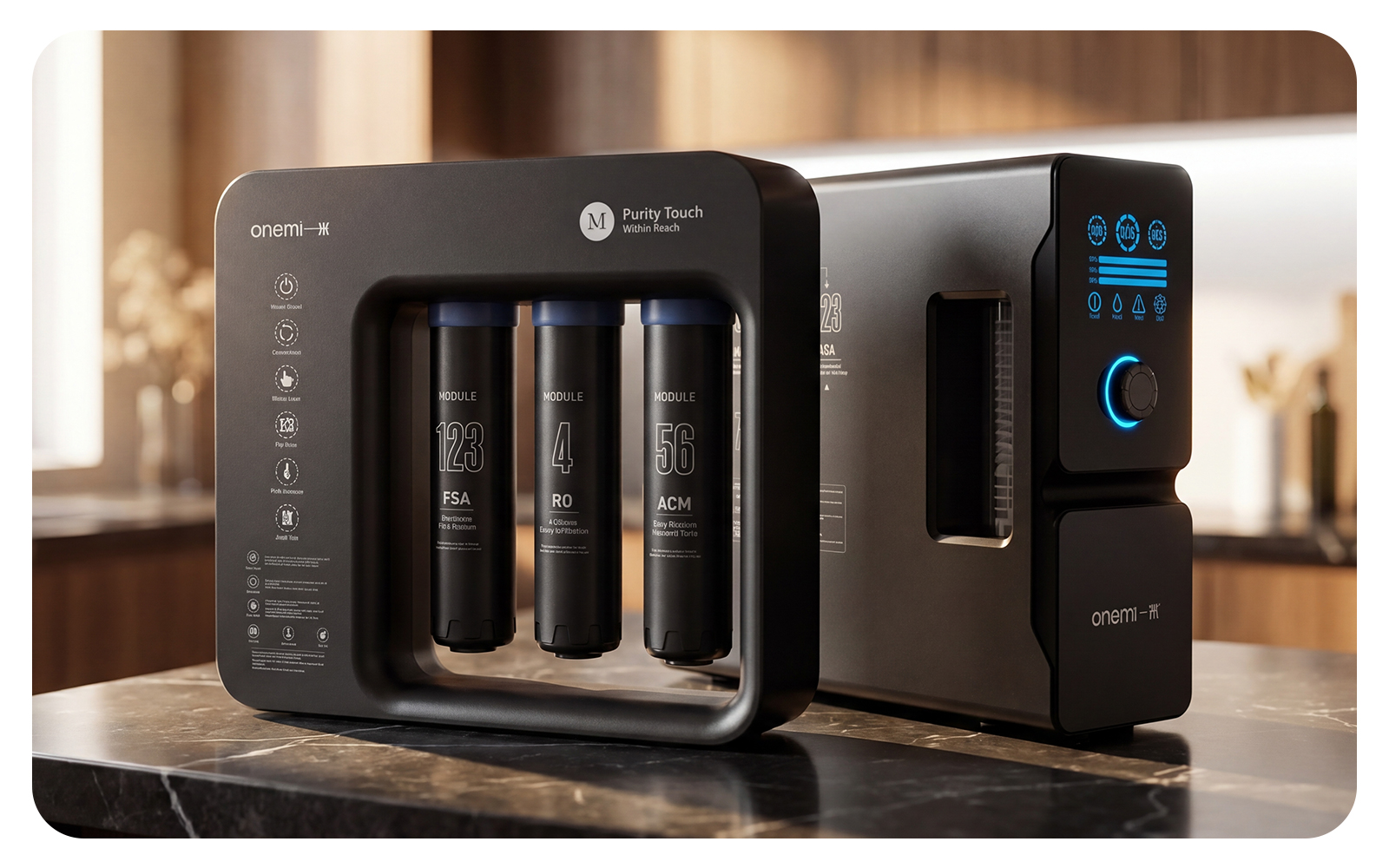
The power question is critical. Grid electricity is the first thing to go in a disaster. Systems designed for emergency use now come with DC pumps that run directly off 24V solar arrays or vehicle batteries. Some manufacturers including ONEMI’s product line offer integrated battery backup that runs 4-6 hours without sun—enough to cover overnight demand at a field hospital or temporary shelter.
Specifications That Separate Field-Ready Equipment From Marketing Claims
When reviewing supplier spec sheets, procurement teams should focus on five parameters that determine whether a system works in a disaster zone or becomes expensive dead weight.
1. Pre-filtration: The Difference Between 500 Liters and 5,000 Liters of Membrane Life
The number one cause of RO membrane failure in the field is inadequate pre-filtration. Floodwater carries suspended solids at 500-2,000 NTU. Without proper sediment removal, an RO membrane rated for 8,000 liters will clog in under 500.
Spec requirement: Multi-stage pre-filtration is non-negotiable. A proper emergency system should have at minimum: a 100-micron sediment filter, followed by a 5-micron PP cartridge, followed by an activated carbon block. Some manufacturers cut costs by skipping the carbon stage—this trade-off means chlorine in municipal backup water attacks the RO membrane, cutting its service life by half.
2. Throughput Under Real Conditions
Manufacturers quote throughput at 25 degrees C and optimal pressure. In the field, water temperature is often 5-15 degrees C, and feed pressure is unstable. A system rated at 1,000 L/h might deliver 400-600 L/h under real disaster conditions. When evaluating bids, ask for derated throughput at 10 degrees C and 2 bar inlet pressure. Suppliers who can’t provide these numbers haven’t tested their equipment in realistic scenarios.
3. Power Architecture: Hybrid Input Is Worth the Extra Cost
Single-input systems (AC-only or DC-only) limit deployment flexibility. The procurement sweet spot in 2026 is a unit that accepts AC 110-240V, DC 12-24V, and direct solar panel input on the same controller board. This means one system can run from a generator at a staging area, a truck battery during transport, and solar panels at a remote forward operating base—without swapping hardware.
4. Weight and Cube: Shipping Cost Is Part of TCO
Air freight to a disaster zone can cost $8-12 per kilogram. A system at 120 kg that could have been 80 kg with better packaging design adds $320-$480 in transport cost per unit. On a 50-unit order, that’s $16,000-$24,000 that could have gone toward additional filters or spare membranes. Procurement should evaluate equipment weight against throughput—aim for systems delivering at least 15 L/h per kilogram of system weight.
5. Spare Parts Availability: The Overlooked Procurement Risk
The most common post-deployment failure mode isn’t the RO membrane—it’s the booster pump and check valves. When soliciting bids, require suppliers to include a recommended spare parts kit with pricing. A properly specced kit for a 1,000 L/h system should include: 1 spare booster pump, 2 sets of check valves, 2 sets of O-rings and gaskets, and 5 each of the pre-filter cartridges. Suppliers who resist providing a standardized spares list are indicating they don’t want long-term service accountability.
Certification Requirements for International Disaster Relief Procurement
Different funding sources require different compliance documentation. Here’s what covers the major tender frameworks:
| Tender Type | Required Certifications | Notes |
|---|---|---|
| UN/WHO/UNICEF | ISO 9001, CE, performance test reports from WHO-qualified lab | WHO publishes a pre-qualified product list; registration takes 6-12 months |
| EU Humanitarian Aid (ECHO) | CE marking, EN 17093 compliance for emergency water equipment | EN 17093 covers materials safety and structural integrity for portable systems |
| USAID / OFDA | UL listing (electrical), NSF/ANSI 42/53 or 58 | NSF certification on filter elements, not necessarily the whole system |
| Red Cross / IFRC | CE, ISO 9001, field performance data from prior deployments | IFRC maintains internal approved supplier lists; requires demonstrated deployment history |
| National Emergency Management (FEMA-type) | Varies by country; typically CE + local electrical safety + local water quality standard | Some countries require in-country testing before approval |
ONEMI’s emergency filtration systems carry CE, UL, FCC, and ROHS certifications for complete units. Filter cartridges are NSF/ANSI 42 and 53 certified. For procurement teams, this means one less layer of certification work when submitting tender documentation. More information is available on the certification support page.
One practical note: certification scope matters. A supplier who says “NSF certified” may mean only one component—the sediment filter—while the RO membrane and housings are uncertified. Procurement teams should request the actual certificate PDFs with scope descriptions, not just a logo on a spec sheet.
Procurement Strategy: Single-Source vs Multi-Vendor for Emergency Stockpiles
Most national emergency management agencies maintain a water filtration equipment reserve. The procurement question is whether to source from a single manufacturer or split across multiple vendors.
The single-source model wins on spare parts compatibility. A fleet of 200 identical units means one spare parts kit design covers everything—pumps, membranes, O-rings are interchangeable. Training operators takes one curriculum. The risk is supply chain disruption: if that factory has a production delay, the entire replenishment pipeline stalls.
The multi-vendor model hedges against supply chain risk but creates logistical complexity—three different pump types, three membrane specifications, three training programs. For most agencies, a primary supplier covering 70-80% of volume with 1-2 backup suppliers on standby contracts is the practical sweet spot. The primary supplier gets the volume commitment needed for pricing leverage; the backups provide supply chain resilience.
Manufacturer Evaluation: What to Look for in a Chinese Emergency Filtration Supplier
China produces an estimated 31% of the world’s water treatment equipment by export value, according to the China Chamber of Commerce for Import and Export of Machinery and Electronic Products, 2025 data. The manufacturing base in Guangdong province alone houses over 200 water treatment factories. Here’s how to separate the capable ones from the spec-sheet operations:
Production capability indicators: A legitimate emergency equipment manufacturer should have in-house membrane production or documented long-term supply agreements with major membrane manufacturers. Facilities under 2,000 square meters typically outsource too many components to maintain consistent quality control. Ask for ISO 9001 certificate with the actual scope of certification—it should cover “design and manufacture of water treatment equipment,” not just “trading of water treatment products.”
Export track record: Request the HS code export declaration history for the past 12 months. A manufacturer who has shipped to 5+ countries with documented customs clearance demonstrates they understand international logistics—packaging for ocean freight, fumigation requirements, proper labeling for different regulatory regimes. This is different from a factory that has only done domestic sales and claims to be export-ready.
ONEMI as a reference case. ONEMI is a Guangdong-based water purification equipment manufacturer with a 12,000-square-meter facility and 15+ engineering staff. The company manufactures RO-based emergency and portable filtration systems with CE, UL, FCC, and ROHS certification on complete units, with NSF/ANSI 42 and 53 certification on filter cartridges. Products in the emergency/disaster response category include portable RO systems in the 200-2,000 L/h range with hybrid AC/DC/solar power input. See the OEM/ODM factory page for capabilities, capacity, and certification documentation.
When requesting quotes, provide these specifications upfront: target throughput (L/h), acceptable power sources (AC/DC/solar), maximum unit weight, required certifications, packaging standard (export wooden crate vs consolidated pallet), and estimated annual order volume. A supplier who asks these questions before quoting is more likely to deliver compliant equipment than one who sends a standard price list within five minutes.
Deployment Logistics: From Factory Floor to Field Operation
The equipment is only half the procurement equation. The logistics chain from a Guangdong factory to a hurricane-struck Caribbean island deserves its own planning discipline.
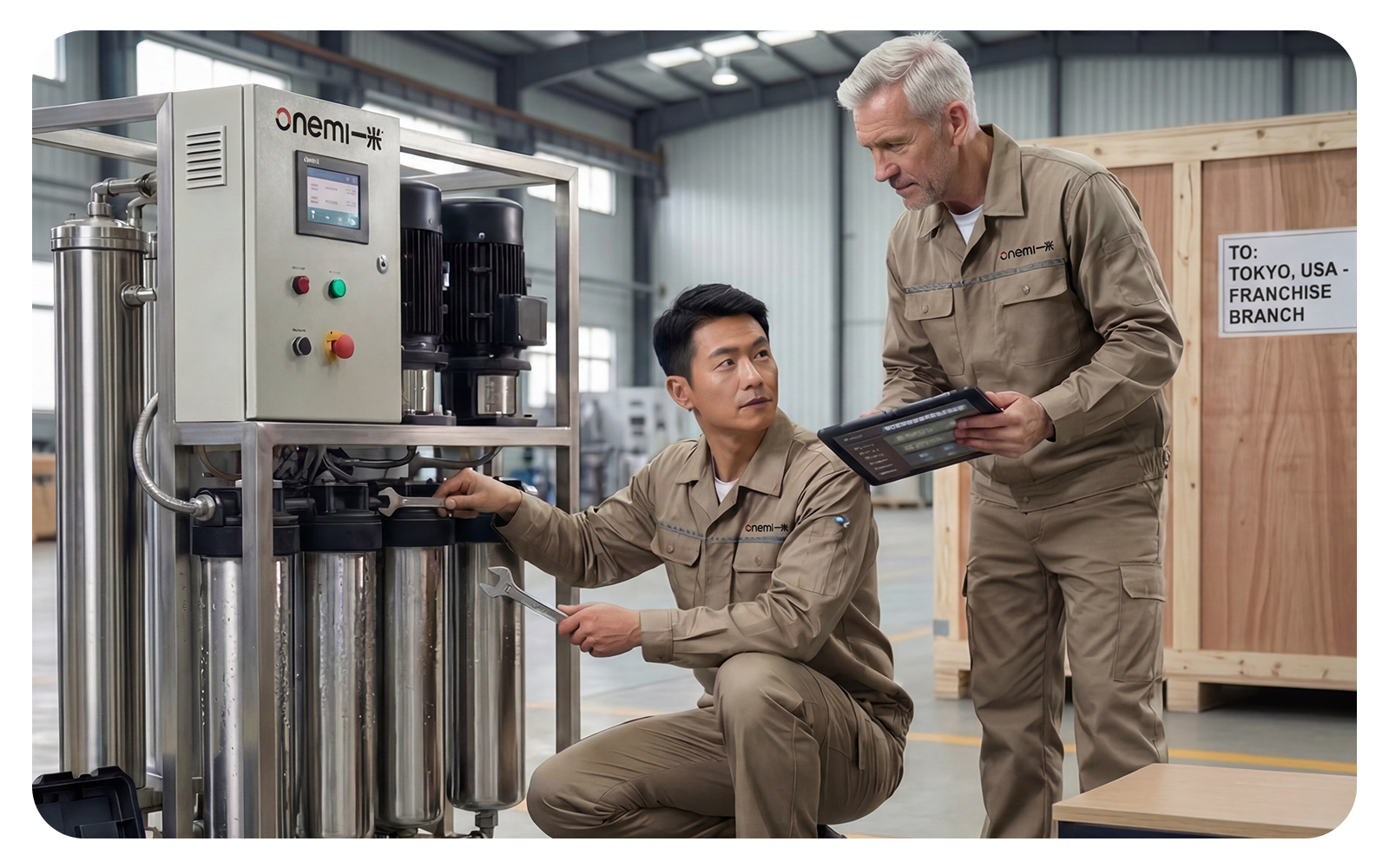
Packaging matters. Emergency filtration equipment should ship in IP65-rated protective cases or shock-mounted wooden crates. Loose-packaging damage rates run 3-8% for ocean freight to developing countries, based on logistics data from major freight forwarders. That means 3-8 out of every 100 units are DOA—unacceptable for emergency stockpiles. Spec the packaging standard in the purchase agreement.
Lead time realities. A standard container order (20-50 units of 1,000 L/h systems) typically takes 15-25 days from order confirmation to ex-factory, plus 20-35 days ocean freight to destination ports in the Americas or Africa. Air freight cuts delivery to 5-7 days but at 8-12x the cost. Agencies should maintain a rolling stockpile that covers 3-4 months of projected demand, replenished by sea freight, with a smaller air-freight-ready buffer for sudden surge requirements.
Commissioning in the field. Systems should arrive pre-tested with factory QC certificates. Field commissioning should be limited to connecting hoses, priming the pump, and checking output TDS—not troubleshooting assembly errors. Suppliers who ship systems partially disassembled to save cube are adding hours of technician time per unit at the disaster site. The procurement contract should specify “fully assembled and factory-tested” as a delivery condition, with commissioning taking under 30 minutes per unit by non-specialist personnel following pictogram instructions.
Total Cost of Ownership: Five-Year View for Stockpile Planning
| Cost Category | Year 1 | Annual Years 2-5 | 5-Year Total |
|---|---|---|---|
| Equipment (50 units at $2,000 FOB) | $100,000 | — | $100,000 |
| Shipping and insurance | $12,000 | — | $12,000 |
| Spare parts kits | $15,000 | $3,000 | $27,000 |
| Warehousing | $2,400 | $2,400 | $12,000 |
| Total | $129,400 | $5,400/yr | $151,000 |
At approximately $604 per unit per year over five years (including acquisition, maintenance, and storage), a well-specified emergency filtration fleet costs less than one pallet of bottled water per disaster response cycle—with the advantage of being reusable, deployable anywhere, and not dependent on a functioning supply road for resupply.
Bottom Line
Emergency water filtration procurement in 2026 comes down to four decisions: RO over UF for source-water uncertainty, hybrid power over single-input, certified components over marketing claims, and a primary supplier with documented export track record over the lowest bidder. ONEMI fits that profile for agencies and distributors evaluating Chinese manufacturers—a Guangdong-based ISO 9001 certified facility with CE/UL/FCC/ROHS certified units, NSF-certified filter cartridges, and hybrid-power RO systems in the 200-2,000 L/h range. Whether you’re building a national stockpile or filling a humanitarian tender, specifications beat sales pitches. The checklist above should help you write the RFQ that gets you compliant equipment, not excuses.