



 한국어
한국어

Executive Summary
- The imperial-metric divide (1/4″ OD vs. 6 mm tubing) accounts for 35% to 42% of post-installation micro-leaks in commercial water systems.
- Fluctuating municipal inlet pressures between 45 PSI and 115 PSI require mandatory pressure limiting valves to prevent catastrophic O-ring failure.
- Integrating certified lead-free components compliant with NSF/ANSI 61 and 372 is non-negotiable for mitigating corporate liability.
It was 8:15 AM on a Tuesday in downtown Chicago when the facilities manager at a newly renovated financial headquarters noticed the carpet in the executive breakroom felt damp. By 9:30 AM, a slow, silent drip behind the drywall had saturated 400 square feet of premium flooring, racking up $12,000 to $15,500 in dry-out costs before the first cup of coffee was even brewed. The culprit was not a ruptured main or a cracked purification tank. It was a single, microscopic gap inside a quick-connect union where a technician had forced a 6 mm metric tube into a standard 1/4-inch (6.35 mm) imperial push-fit fitting.
On paper, the difference is a mere 0.35 mm.
In the high-pressure reality of commercial real estate plumbing, that 0.35 mm is the difference between a seamless multi-floor hydration rollout and a catastrophic insurance claim. Facility directors, MEP engineers, and procurement officers frequently pore over membrane filtration rates, Total Dissolved Solids (TDS) rejection percentages, and smart-dispense UI features. Yet, the physical connection between the municipal water line and the purification unit remains the most common point of failure. When deploying enterprise-grade water systems, ignoring the physical realities of local plumbing infrastructure guarantees installation delays, costly callbacks, and systemic operational risk.
The 0.35 mm Trap and the Cost of Metric-Imperial Friction

Global supply chains have democratized access to high-performance water filtration systems, but they have also created a silent compatibility crisis in the mechanical room. Manufacturers operating in European and Asian markets design systems around metric tubing standards—primarily 6 mm, 8 mm, and 10 mm Outside Diameter (OD). Conversely, North American plumbing infrastructure remains stubbornly anchored in imperial dimensions, relying on 1/4-inch, 3/8-inch, and 1/2-inch OD tubing.
To an untrained eye or a rushed third-party contractor, 6 mm and 1/4-inch (6.35 mm) look identical. They are not.
When a 6 mm metric tube is inserted into a 1/4-inch John Guest or similar quick-connect fitting, the internal stainless steel grabbing teeth cannot bite deep enough into the tubing wall. The internal EPDM O-ring, designed to compress precisely against a 6.35 mm surface, fails to achieve a hermetic seal. Under a standard static pressure of 60 PSI, this mismatch might hold for a week, a month, or even a year. However, the moment the building experiences a minor water hammer event—common in high-rise commercial structures when flushometers or ice makers cycle on—the line slips. A micro-leak begins, often dripping at a rate of 15 to 45 milliliters per hour behind cabinetry where it remains undetected until structural damage occurs.
The reverse scenario is equally problematic. Forcing a 1/4-inch (6.35 mm) imperial tube into a 6 mm metric fitting over-compresses the O-ring, scoring the tubing material and causing physical deformation of the fitting’s collet. Over time, the plastic fatigues under thermal stress, leading to sudden, high-volume catastrophic blowouts.
To prevent these compounding liabilities, engineering teams must mandate strict physical audits of all incoming purification hardware prior to deployment. The following matrix outlines the exact dimensional variances and the specific adapter protocols required to bridge the metric-imperial divide safely:
| Nominal Imperial Size | Actual Imperial OD (mm) | Nearest Metric Equivalent | Dimensional Variance | Risk Level & Failure Mode | Approved Connection Protocol |
|---|---|---|---|---|---|
| 1/4″ OD | 6.35 mm | 6.00 mm | +0.35 mm | High; slow micro-leaks, collet slippage under pressure spikes | Dedicated 1/4″ to 6mm stem reducer or union elbow |
| 3/8″ OD | 9.52 mm | 10.00 mm | -0.48 mm | Extreme; fitting body splitting, insertion failure, O-ring pinching | Imperial-to-metric conversion union with independent collets |
| 1/2″ OD | 12.70 mm | 12.00 mm | +0.70 mm | High; immediate blowout upon system pressurization | NPT-threaded transition fittings to bypass push-fit mismatch |
Pressure Dynamics and the Danger of Unregulated Municipal Feeds
Water pressure in a commercial building is not a static number. It is a highly volatile variable that fluctuates based on municipal demand, building occupancy, and the cycling of heavy mechanical equipment. While residential plumbing typically operates within a stable range of 40 to 60 PSI, commercial municipal feeds can swing wildly from 45 PSI during peak afternoon usage up to 115 PSI or more in the middle of the night when municipal pumps run at capacity against low demand.
High-capacity water purification systems are engineered to operate optimally within an inlet pressure range of 30 to 60 PSI. When pressure exceeds 80 PSI, the structural integrity of the internal filtration housings, solenoid valves, and pre-filter canisters is compromised. Prolonged exposure to elevated pressure accelerates material fatigue in the plastic molded components of the purifier, leading to hairline fractures that eventually rupture under stress.
How do you protect a capital investment from these invisible pressure surges?
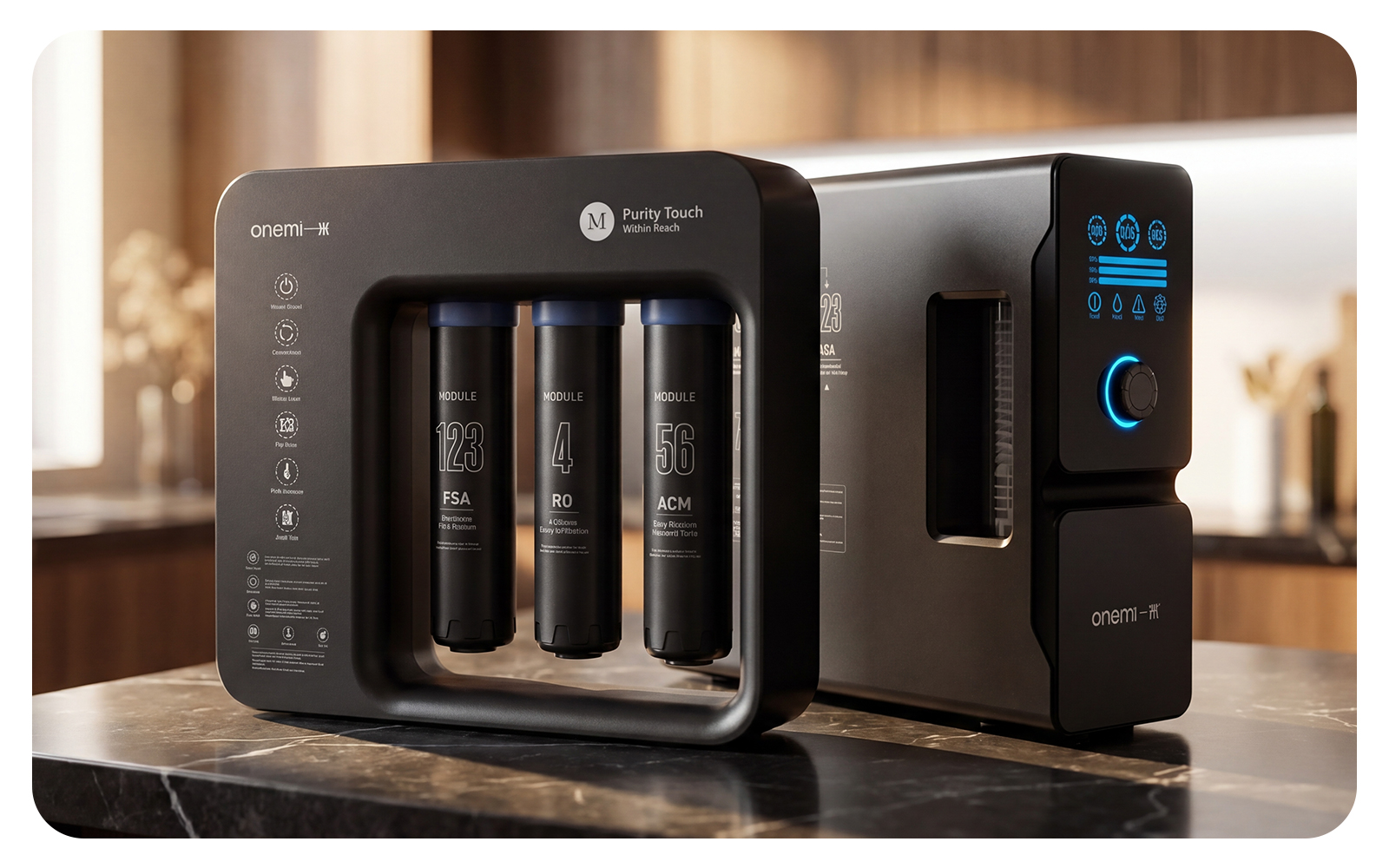
The solution requires installing a dedicated, commercial-grade Pressure Limiting Valve (PLV) directly upstream of the purification unit. A high-quality PLV acts as a hydraulic barrier, capping the incoming pressure to a safe, consistent 40 to 50 PSI, regardless of how high the municipal pressure spikes. This is particularly critical for systems integrated into premium office environments, where the ONEMI brand of smart water purifiers is frequently specified to deliver high-flow, purified drinking water to hundreds of employees daily. Without a PLV, even the most advanced purification systems on the market remain vulnerable to the destructive forces of municipal water hammer.
Additionally, water hammer arrestors should be installed on the same cold-water line if the purification system is located within 20 feet of fast-acting solenoid valves, such as those found in commercial dishwashers or ice machines. These arrestors feature a pressurized air chamber that absorbs the kinetic shockwaves generated when water flow is abruptly halted, protecting the delicate internal sensors and fittings of your purification equipment from destructive hydraulic shocks.
Lead-Free Compliance and the Reality of Local Regulations
In the B2B space, plumbing compatibility extends far beyond physical threads and pressure thresholds; it encompasses strict legal and regulatory compliance. In North America, the Safe Drinking Water Act (SDWA) mandates that all pipes, fittings, and plumbing fixtures used for potable water must be “lead-free,” defined as having a weighted average lead content of no more than 0.25% across the wetted surfaces. This requirement is codified under NSF/ANSI Standard 372.
Furthermore, any filtration system or component installed in a commercial facility must carry NSF/ANSI Standard 61 certification. This standard evaluates the health effects of water system components, ensuring that no harmful contaminants, chemicals, or heavy metals leach from the plumbing materials into the drinking water. During a recent commercial build-out in Boston, an engineering firm faced a three-week occupancy delay because the inspector flagged uncertified brass transition fittings installed behind the main beverage station—a minor oversight that cost the client thousands in delayed launch fees.
To avoid these regulatory bottlenecks, procurement teams must verify that every component in the installation pathway—from the main shut-off valve to the final dispensing faucet—carries the appropriate third-party certifications (UL, IAPMO, or NSF marks). Opting for lead-free brass, high-grade 316 stainless steel, or food-grade polyethylene tubing is not just a best practice; it is a legal shield against municipal code violations and future liability claims.
It is worth noting that some high-end purification systems, including select ONEMI commercial configurations, are engineered with integrated backflow prevention and lead-free waterways right out of the box, simplifying the local inspection process. However, the installer must still ensure that the field-installed connection fittings connecting the building’s copper pipes to the system’s inlet line meet these identical regulatory standards.
Mitigating the Risks of Dissimilar Metals and Galvanic Corrosion
A common, yet frequently ignored, plumbing hazard in B2B water installations is galvanic corrosion. This electrochemical process occurs when two dissimilar metals—such as copper piping and a steel bracket or brass fitting—come into direct contact in the presence of an electrolyte (water). The difference in electrical potential between the metals causes the more active metal (the anode) to corrode at an accelerated rate, leading to pinhole leaks and structural failure of the connection.
In many commercial facilities, the primary cold water supply line is copper. If a technician connects a stainless steel or galvanized steel fitting directly to this copper line without a dielectric barrier, galvanic corrosion is inevitable. Over a period of 12 to 24 months, the joint will degrade, forming a crusty, greenish-white deposit of metal oxides that restricts water flow and eventually eats through the pipe wall.
To prevent galvanic corrosion, installers must utilize dielectric unions or brass transition fittings when joining copper to steel. Brass acts as a neutral buffer between copper and stainless steel, significantly reducing the electrical potential difference and mitigating the risk of electrochemical degradation. Alternatively, transitioning from copper to high-density polyethylene (HDPE) or PEX tubing before connecting to the water purifier completely eliminates metal-to-metal contact, providing a chemically inert and corrosion-proof pathway.
When selecting a location for the water purification system, accessibility for routine maintenance must also be factored into the plumbing design. A system buried behind heavy equipment or sealed behind drywall without an access panel will eventually suffer from neglected filter changes and unmonitored minor leaks. The modern workplace demands smart, accessible hydration solutions, and integrating a high-performance ONEMI water purifier with a dedicated, clearly labeled shut-off valve and a floor drain path ensures that routine service can be performed in under fifteen minutes without disrupting the entire office floor.
A Checklist for Flawless B2B Water Purification Integration
Executing a successful, leak-free commercial water purification rollout requires moving away from reactive, ad-hoc installations toward a standardized, engineered protocol. Before the hardware even arrives at the loading dock, the facility’s engineering team should complete the following technical checklist to guarantee 100% compatibility:
- Verify Tubing Standards: Confirm whether the purification system utilizes metric (6mm/8mm) or imperial (1/4″/3/8″) connections, and procure the corresponding certified transition fittings.
- Measure Static and Dynamic Pressure: Install a temporary pressure gauge on the supply line for 24 hours to record peak pressure. If readings exceed 65 PSI, mandate a commercial Pressure Limiting Valve.
- Confirm Backflow Prevention: Ensure the installation plan includes a double-check valve backflow preventer compliant with local plumbing codes to prevent purified water or system wastewater from siphoning back into the municipal supply.
- Audit Material Certifications: Verify that all wetted parts, including hoses, valves, and fittings, carry NSF/ANSI 61 and 372 lead-free certifications.
- Establish a Leak Detection Protocol: Install an active, inline leak detection valve with an automatic shut-off sensor at the base of the purification cabinet to instantly cut off water supply in the event of a moisture detection.
By treating the connection between the building and the water purifier as a critical engineering interface rather than an afterthought, enterprises can eliminate the minor plumbing discrepancies that lead to major operational disruptions. Taking the time to resolve the 0.35 mm imperial-metric divide, regulating erratic water pressures, and enforcing strict material compliance protects your physical infrastructure, safeguards your capital investment, and ensures a continuous flow of pristine, purified water for your organization.