한국어
한국어

- Countertop filters led the point-of-use water treatment market in 2025, and reverse osmosis held the largest technology share — making countertop RO the fastest-advancing sub-category.
- Global POU systems run from $37.68 billion in 2025 toward $89.83 billion by 2035, a 9.08% CAGR, with the US alone adding a separate $6.75 billion purifier market.
- No-install, rental-friendly countertop RO is the structural winner. Importers and distributors who treat it as a niche are ceding the fastest-growing shelf in water purification.
Countertop reverse osmosis used to sit at the edge of every water treatment catalog — a compromise product for renters who couldn’t cut into a landlord’s plumbing. That framing is now wrong on the numbers. In 2025, countertop filters led the point-of-use (POU) segment outright, and RO systems carried the largest technology revenue share across the category. The two trends intersect in one product, and that intersection is where the volume is moving.
For an importer, the question isn’t whether countertop RO is growing. It’s whether your 2026 line plan has a unit in the $200–$500 band that a customer can set on a counter, plug in, and fill in under ten minutes. Most catalogs still don’t. That’s the gap this data is about.
Where the POU Market Actually Stands
Point-of-use systems — the ones that treat water at a single faucet or dispenser rather than at the building inlet — are the engine of residential purification. Precedence Research puts the global POU water treatment systems market at $37.68 billion in 2025, rising to $89.83 billion by 2035 at a 9.08% compound annual growth rate. Within that, countertop filters were the leading device segment in 2025, and reverse osmosis captured the largest technology share.
MarketsandMarkets, using a tighter scope, still counts $12.13 billion in 2026 growing to $16.38 billion by 2031 — a 6.2% CAGR that marks POU as one of the more stable appliance-adjacent categories to carry. When two firms with different methodologies agree on direction, the signal is real.
The United States is the margin story inside that. Fortune Business Insights sized the US water purifier market at $6.75 billion in 2024, heading to $10.35 billion by 2032 at 5.5%. Countertop RO occupies a $200–$500 retail band — roughly 8–12% of POU by unit, but the fastest-growing slice by far. Low entry price, no plumber, no lease modification: that combination is why the curve is steeper than the category average.
| Market / Segment | Base Value | Forecast | CAGR | Source |
|---|---|---|---|---|
| Global POU water treatment systems | $37.68B (2025) | $89.83B (2035) | 9.08% | Precedence Research, 2026 |
| Global POU (narrower scope) | $12.13B (2026) | $16.38B (2031) | 6.2% | MarketsandMarkets, 2026 |
| US water purifier market | $6.75B (2024) | $10.35B (2032) | 5.5% | Fortune Business Insights, 2025 |
| US countertop RO (retail band) | $200–$500 per unit, ~8–12% of POU | Fastest-growing slice | Fortune Business Insights / industry composite | |
What the table doesn’t show is the shift underneath. Under-sink RO still owns the installed, owned-home segment, but it’s a mature install. Countertop is where first-time buyers enter, and in urban rental markets — which are growing faster than the suburbs they feed — first-time buyers are most of the market.
Why the Countertop Form Factor Is Winning
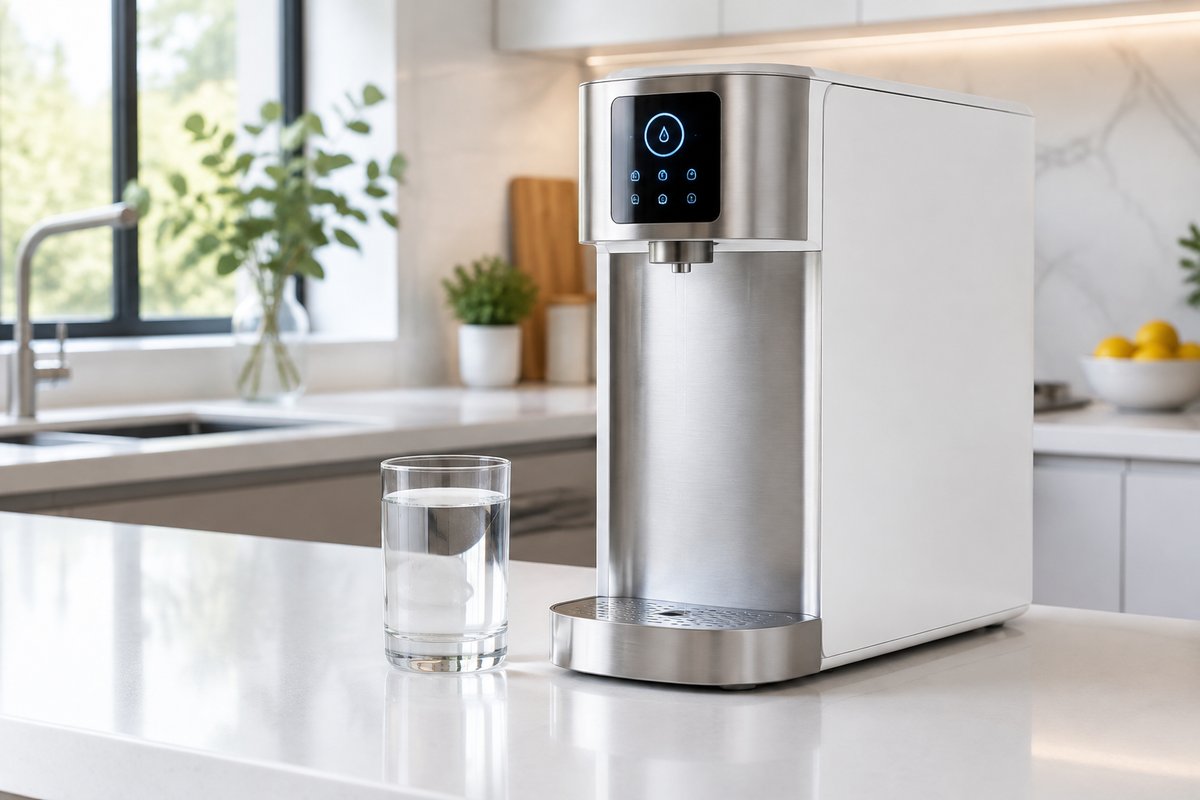
Three things are pulling the same direction. The first is demographic: urban apartment share keeps climbing, and renters can’t touch a landlord’s cabinetry. A countertop unit needs a power outlet and a faucet adapter. That’s the entire installation. The second is behavioral: buyers now expect a filter-life indicator and a TDS readout on a screen, not a maintenance log they have to remember. The third is structural: replacement cartridges are the recurring revenue, and a countertop unit with a proprietary quick-change bayonet locks that revenue in as cleanly as any under-sink system.
The product itself has shed its early compromises, too. Early countertop units were slow and noisy. Current 600–800 GPD direct-flow RO membranes push water fast enough that a countertop footprint no longer means a weak pour. Tankless designs kill the standing-water hygiene complaint that dogged the category’s first generation. The physical unit is lighter — a single person can lift it out of the box, set it down, and have water running before a kettle boils.
None of this requires a contractor. That one fact is worth more than any feature list to a distributor selling into dense, lease-heavy cities.
The Compliance Layer Importers Actually Ask About
Countertop RO is a drinking-water device, so the certification question comes up on every first RFQ. The answer has to be precise, because a wrong claim will get a shipment held and a relationship burned.
For the US, the material and performance benchmarks are NSF/ANSI 42 and 53 for contaminant reduction, NSF/ANSI 58 for reverse osmosis systems, and NSF/ANSI 372 for lead-free wetted parts. CE and RoHS cover the electrical and materials side for the EU; REACH governs chemical compliance on wetted and non-wetted components alike. California’s Proposition 65 is a labeling obligation, not a performance standard, but any unit touching that state needs its warning discipline in order.
One point gets misquoted constantly: NSF scope. A manufacturer may hold NSF certification on its filter cartridges — meaning the cartridge itself is listed — without the assembled machine being NSF-certified as a complete system. Importers who blur that line in their own listing copy inherit the liability. State it as it is: cartridge-level certification where it applies, CE/UL/FCC/RoHS on the appliance.
Buyers sourcing countertop RO for Europe should confirm the drinking-water contact materials align with the EU Drinking Water Directive (2020/2184) and check REACH declarations on the membrane housing and tubing. These are the two documents that show up in customs and audit folders, not the marketing sheet.
What This Means for a Sourcing Plan
If you’re distributing countertop RO in 2026, the margin is in the cartridge, not the box. The hardware is a one-time sale; the filter is a 6-to-12-month repeat. A line that sells a $350 unit but can’t ship its replacement cartridge on subscription is leaving half the lifetime value on the table. When you evaluate a factory, ask how they handle cartridge continuity across model generations — a bayonet standard that survives a housing redesign is the difference between a revenue stream and a support ticket.
On the factory side, countertop RO compresses to three capability questions. First, can they run the direct-flow membrane at 600 GPD or above without the pump whine that kills the countertop use case? Second, is their quick-change bayonet actually proprietary, or is it a copied fitting that any aftermarket shop can undercut? Third, do they hold CE/UL/FCC/RoHS on the appliance and NSF on the cartridge, with the paperwork to prove each claim separately? A factory that answers all three flat is worth a sample order.
For the OEM and private-label play, countertop RO is a low-tooling entry point compared to under-sink. The enclosure, the tray, and the adapter are the main cosmetic tooling; the filtration core is standard. That’s why a brand can go from design freeze to first production in a shorter cycle — useful when the demand curve is moving up and a season is slipping away. The full OEM/ODM factory workflow is where the detail lives.
How ONEMI Fits the Countertop Shift
ONEMI, a Guangdong-based water purification equipment manufacturer, has been building toward this segment for the same reason the data points here. The countertop instant dispenser line — the T1 — pairs direct-flow filtration with instant hot and cold dispensing in a footprint that sits on a counter without a plumber. The RO 400G smart purifier carries the same direct-flow membrane and smart filter-life monitoring in a tankless frame. Both are engineered for the quick-change cartridge model that keeps the revenue recurring.
The certification posture is stated plainly: CE, UL, FCC, and RoHS cover the appliance; NSF applies to the filter cartridges, not to a whole-machine listing. That distinction matters, and ONEMI keeps it explicit rather than letting it get smoothed over in a spec sheet.
For importers, the countertop RO opportunity in 2026 is a margin-plus-cartridge story with a compliance checklist that is now well understood. The data says the segment is leading POU growth. The sourcing question is whether your next container reflects that, or still bets the whole line on under-sink.
Sourcing Countertop RO Without the Usual Mistakes
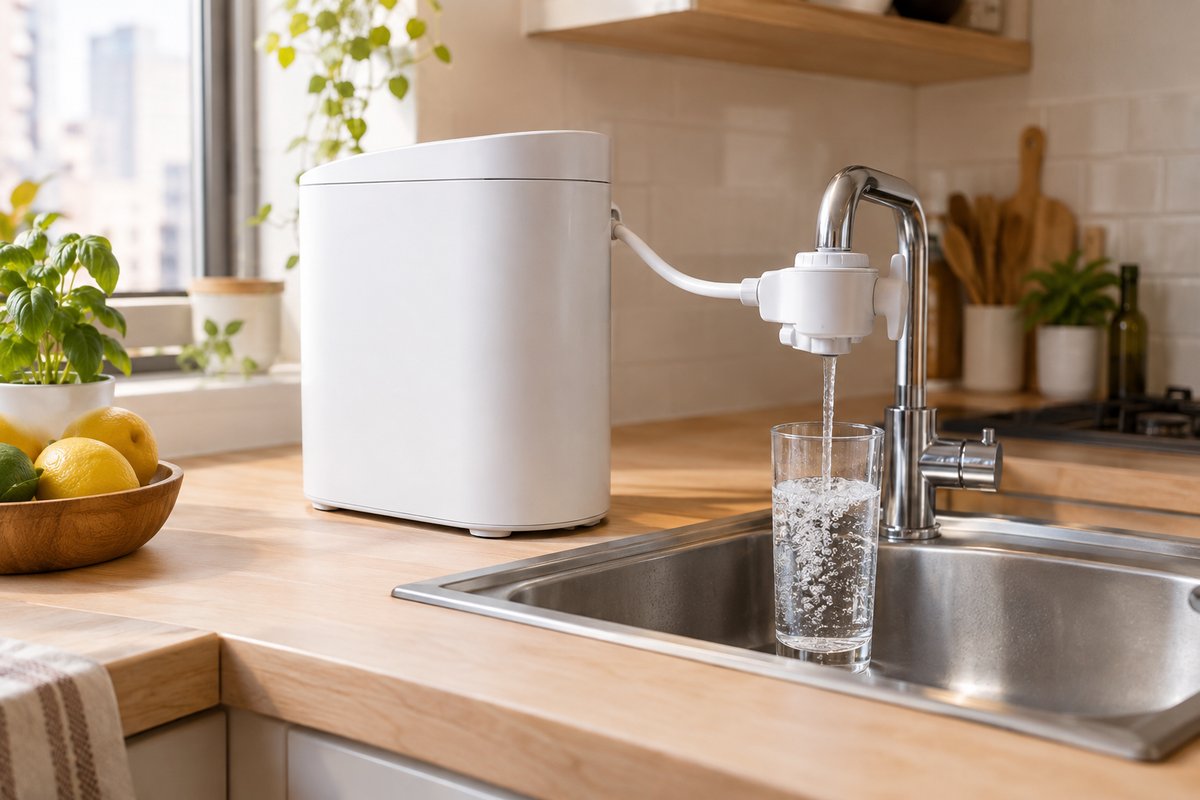
A few failure modes repeat across first-time countertop RO imports, and they’re all avoidable before the order ships. The membrane and pump are the unit’s two wear parts; spec them explicitly rather than accepting whatever the factory’s default BOM calls for. A 600 GPD direct-flow RO membrane and a quiet DC booster pump are the floor, not the upgrade.
Watch the wetted-material documentation. The membrane housing, tubing, and post-carbon filter all touch drinking water, and every one needs its NSF 61 or REACH-equivalent material statement. A complete unit that ships with a clean NSF 372 lead-free declaration on the metal fittings saves a customs stall and a reseller complaint in one stroke.
Finally, plan the cartridge. Order the unit with a spare-cartridge ratio that matches your market’s replacement cadence, and pin the bayonet interface in the supply agreement so the second-year order isn’t a redesign. The countertop category’s whole economics assume the repeat sale exists — a distributor who treats the first sale as the whole sale is importing a one-and-done appliance, and that’s the least interesting thing on the counter.