 한국어
한국어

- Geography decides price and capability: Guangdong dominates high-end smart RO systems (roughly half of China’s export volume), while Zhejiang leads on cost-optimized faucet and gravity filters — knowing which cluster to contact saves weeks of sourcing.
- Certification is the real gate: NSF/ANSI 42, 53, 58, 61 and 372 for the US market, CE for the EU. NSF covers filter cartridges specifically — verify the exact standard number, not just the logo.
- MOQ is negotiable but structural: typical MOQ for RO systems runs around 1,000 units at factory-direct pricing, and lead time, not unit price, is what derails most first shipments.
Importing water filters from China is no longer a niche trade secret — it’s a mature, competitive sourcing channel. But “mature” cuts both ways. The factories that survived the last decade are professional and audited; the ones that didn’t have been replaced by intermediaries who mark up the same goods and call it “sourcing.” The difference between a 12% landed-cost ratio and a 30% one usually comes down to whether you bought from a manufacturer or a trading company wearing a manufacturer’s website.
This guide walks through what actually determines a successful first import: where the factories are, which certifications matter, how MOQs and lead times work in practice, and what to verify before you wire a deposit.
The scale of the opportunity
China is the world’s dominant producer of water filtration equipment and components. Global market data puts the overall water purifier market at roughly $37.7 billion in 2025, with North America alone accounting for about $8.9 billion, according to Fortune Business Insights. The US market specifically was valued at $6.75 billion in 2024 and is projected to grow at a 5.5% CAGR through 2032. A meaningful share of the hardware behind those numbers is manufactured in China.
What changed recently is the regulatory pull. The EPA’s first enforceable PFAS drinking water standard in 2024, and the agency’s 10-year lead pipe replacement mandate, pushed US buyers toward filters that specifically remove PFAS and lead — categories where Chinese OEMs have moved fast to add NSF-certified cartridges. For importers, that’s not a trend to chase; it’s a compliance floor that determines whether a product can be sold in the first place.
Where the factories actually are
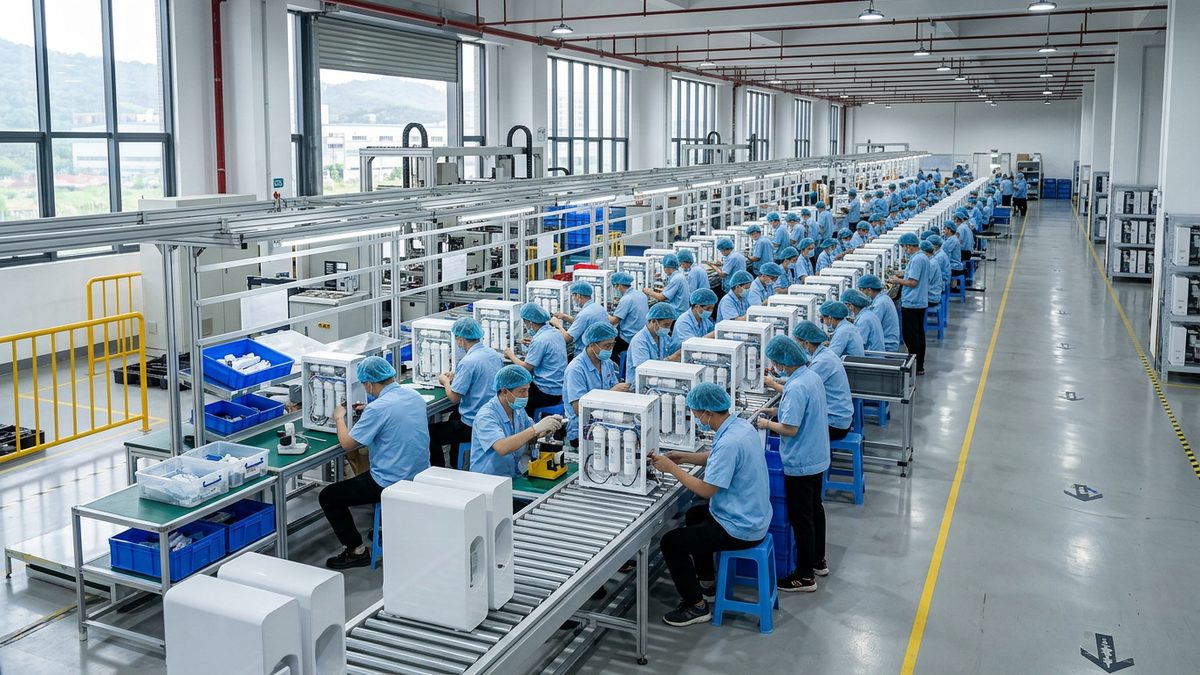
China’s water filtration manufacturing clusters into three or four regions, each with a distinct specialization. Understanding this map is the single highest-leverage piece of knowledge for a first-time importer, because it tells you where to send your RFQ and what a factory there is likely good at.
Guangdong — centered on Shunde, Zhongshan, and Shenzhen — is the high-end cluster. This is where you find smart IoT purifiers, advanced RO systems, and lines with NSF, CE, and WQA certification experience. Guangdong factories account for roughly half of China’s water purifier export volume and command a price premium justified by automation and certification readiness. If you’re importing a 500 GPD smart RO system for a Western market, this is where it’s made.
Zhejiang — Ningbo, Hangzhou, and Yuyao — is the cost-optimization cluster. Faucet-mounted units, gravity-fed filters, and UV systems come from here at lower unit prices with faster prototyping. The trade-off is that you’re more likely to need to drive the certification process yourself.
Jiangsu and Fujian round out the map. Jiangsu handles industrial and B2B components; Fujian (Xiamen, Quanzhou) does budget household filters and carbon blocks at the lowest entry pricing. For a full breakdown of what each region excels at, see our OEM/ODM factory overview.
Certifications: the gate you cannot skip
This is where most first imports go wrong — not at the product level, but at the paperwork level. A water purifier that sells in the US must carry the right NSF/ANSI certifications, and “NSF certified” as a blanket claim is a red flag. Each standard covers something specific:
| Standard | What it covers | Why it matters to importers |
|---|---|---|
| NSF/ANSI 42 | Aesthetic effects — chlorine taste/odor | Baseline for “does it taste right” claims |
| NSF/ANSI 53 | Health effects — lead, arsenic, VOCs, PFAS, cysts | The one US buyers actually ask for |
| NSF/ANSI 58 | Reverse osmosis systems — TDS reduction | Required for any RO system |
| NSF/ANSI 61 & 372 | Material safety and lead-free compliance | Mandatory for drinking water contact |
For the EU market, CE marking is the entry requirement, supplemented by regional schemes like WRAS in the UK and DVGW in Germany. A critical nuance: NSF certification applies to the filter cartridges, not necessarily the whole machine — verify the exact certified component and its standard number against the NSF listing, rather than accepting a logo on a spec sheet. Our certifications page documents which of our products hold which standards.
California’s Proposition 65 adds another layer for US importers: products sold into California must not expose consumers to lead above 0.5 micrograms per day, which effectively means lead-free materials and documented testing. It’s not a certification you “earn” so much as a liability threshold you stay under.
MOQs, lead times, and what actually costs you
Factory-direct MOQs for RO systems typically sit around 1,000 units per SKU. That’s not a hard wall — smaller first orders are often possible at a slightly higher unit price or against a longer lead time — but it’s the structural anchor around which pricing is quoted. Customization (private label, custom mold, specific filter cartridge configurations) raises both MOQ and lead time, because the factory commits tooling and line time.
The mistake to avoid is optimizing for unit price. A $3-per-unit saving that costs you an extra four weeks of lead time is rarely worth it when a container is sitting at port accruing demurrage. Professional importers evaluate landed cost — FOB price plus freight, insurance, import duty, and the financing cost of the transit time — not the ex-works sticker. For a deeper framework on this calculation, see our B2B procurement framework.
Lead time in practice: a standard RO system from a Guangdong factory with an existing mold runs 25 to 40 days production plus 15 to 25 days ocean freight to a US West Coast port. Custom work can double that. Plan your inventory around the total, not the production estimate a salesperson gives you on a first call.
A working importer checklist
Before you send money, run through this sequence:
- Verify the factory is a manufacturer, not a trader. Ask for the business license showing manufacturing scope and a live factory walkthrough video, not brochure photos.
- Match the certification to the exact standard and component. Cross-check the NSF or CE listing number against the official database.
- Request a pre-production sample, then a production sample, and test both independently. The second one is where shortcuts show up.
- Define the QC protocol in the purchase order: AQL level, defect definitions, and who pays for a third-party inspection if it fails.
- Confirm incoterms and payment terms in writing. 30% deposit / 70% before shipment is standard; anything demanding full prepayment is a flag.
- Book freight and customs broker before production finishes, not after.
If you’re building a brand rather than importing a commodity, the path is private label — and that changes the calculus from “find a product” to “find a manufacturing partner.” For how that works from the factory side, see our guide on building your own water purifier brand through private label OEM.
The importers who succeed aren’t the ones who found the cheapest unit price. They’re the ones who mapped the clusters, pinned down the certifications, and treated the factory relationship as the asset it is. Get those three things right and the first container is the easy part.