
 한국어
한국어

Walk into any manufacturing facility, commercial boiler room, or food processing plant facing scale buildup, and you will hear the same debate. The maintenance team wants a water softener to stop pipe clogging. The quality control chemist demands a reverse osmosis (RO) system to strip everything from the process water. Both sides are looking at the same incoming municipal supply, yet they are arguing for two fundamentally different chemical realities.
Executive Summary
- Ion exchange water softeners target divalent hardness ions (calcium and magnesium) but leave the overall Total Dissolved Solids (TDS) and electrical conductivity of the effluent unchanged.
- Reverse osmosis systems utilize high-pressure semi-permeable membranes to reject 95% to 99% of all dissolved inorganic salts, heavy metals, organics, and microbiological contaminants.
- Integrating both technologies in series represents the industry standard for high-pressure boiler feed, electronics manufacturing, and pharmaceutical ingredient water to prevent premature membrane scaling.
Misspecifying these systems carries steep financial consequences. We recently audited a commercial laundry facility in San Antonio, Texas—a region notorious for groundwater hardness exceeding 350 mg/L as CaCO3. The facility had installed a standalone industrial RO system, expecting pure, soft water. Within forty-five days, the RO membranes were completely blinded by calcium sulfate scale, dropping permeate flux by 62% and forcing an unscheduled $14,000 membrane replacement. Had they run a simple mass balance calculation, they would have seen that a primary sodium-cycle water softener was required to protect the RO feed. It is a classic engineering blind spot: confusing selective ion removal with bulk demineralization.
The Chemistry of Selective Ion Exchange vs Physical Barrier Separation
To understand why one system cannot simply replace the other, we must look at the molecular level. A water softener operates on the principle of selective ion exchange, typically utilizing a strong acid cation (SAC) resin bed cross-linked with divinylbenzene. The resin beads are pre-saturated with sodium ions (Na+). When hard water containing calcium (Ca2+) and magnesium (Mg2+) passes through the bed, the divalent ions exhibit a higher affinity for the sulfonate functional groups on the resin. They displace the monovalent sodium ions, which are released into the product water.
The total ionic concentration of the water does not decrease during softening.
In fact, for every milligram of calcium removed, approximately 1.15 milligrams of sodium are added to the water. The electrical conductivity of the effluent remains virtually identical to the influent, and in some cases, increases slightly. If your downstream process requires low-conductivity water—such as circuit board rinsing or high-pressure steam generation—a water softener alone is completely useless. It merely swaps scaling ions for non-scaling ones.
Reverse osmosis is a pressure-driven physical separation process. By applying hydrostatic pressure greater than the natural osmotic pressure of the solution—typically ranging from 120 psi to over 400 psi in light industrial applications—water is forced through a semi-permeable thin-film composite (TFC) membrane. The membrane pores, measuring roughly 0.0001 microns, allow water molecules to pass while rejecting dissolved ions, organics, and colloidal particles based on size and charge exclusion. Divalent ions like calcium and sulfate are rejected at rates exceeding 99%, while monovalent ions like sodium and chloride are rejected at 95% to 98.5%.
This brings us to a major technical limitation of reverse osmosis: concentration polarization. As pure water passes through the membrane, rejected ions accumulate in a boundary layer directly adjacent to the membrane surface. If the concentration of calcium sulfate or silica in this boundary layer exceeds their solubility limits, they precipitate instantly. This is why running raw, hard water directly into an RO system without pre-treatment is a recipe for operational failure.
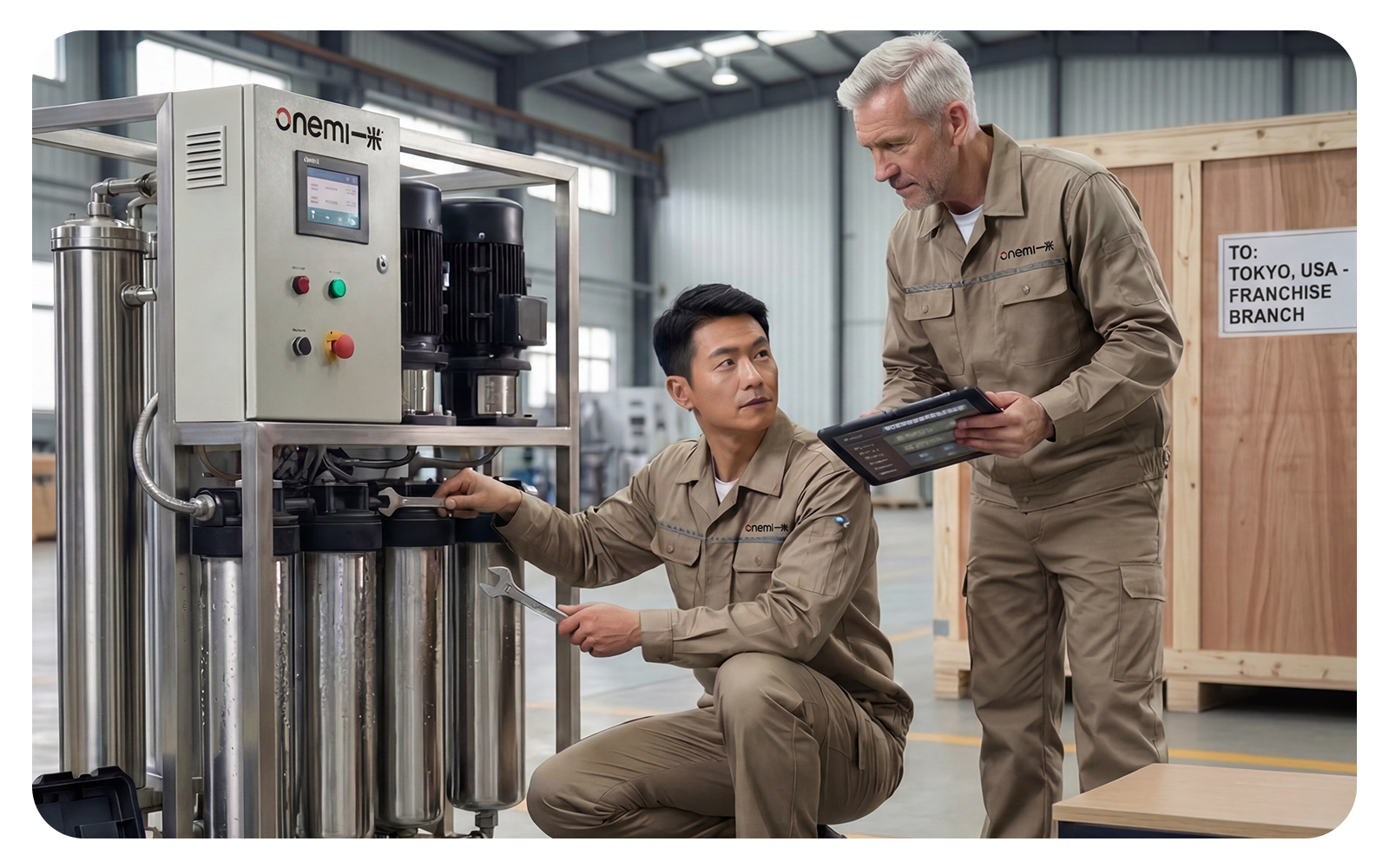
ONEMI industrial engineering teams frequently design integrated pre-treatment racks where a duplex water softener serves as the direct pre-treatment step for a high-efficiency RO system, ensuring the RO feed hardness is kept below 0.1 gpg (grains per gallon).
Direct Comparison of Engineering and Operational Parameters
When selecting utility systems for commercial facilities, municipal buildings, or industrial plants, engineers must compare these technologies across several operational vectors. The table below outlines the core technical differences between industrial-grade sodium-cycle water softeners and brackish water reverse osmosis (BWRO) systems.
| Parameter | Sodium-Cycle Water Softener | Reverse Osmosis (RO) System |
|---|---|---|
| Primary Target | Divalent cations (Ca²⁺, Mg²⁺, Fe²⁺/³⁺) | Total Dissolved Solids (TDS), metals, silica, organics |
| Operating Pressure | 30 to 75 psi (system line pressure) | 120 to 450 psi (requires booster pump) |
| TDS Reduction | 0% (converts hardness to sodium salts) | 95% to 99% rejection rate |
| Water Recovery Rate | 95% to 98% (loses 2-5% during regeneration) | 50% to 80% (standard); up to 90% with recovery stages |
| Consumables | Sodium chloride (NaCl) or Potassium chloride (KCl) salt | Anti-scalants, membrane cleaners, cartridge filters |
| Waste Stream | High-salinity chloride brine (intermittent) | Continuous concentrate/reject water stream |
The water recovery rate is where many facilities run into regulatory and environmental roadblocks. A water softener is highly efficient in terms of water volume, wasting only a small percentage of its throughput during the backwash and brine draw phases of regeneration. In contrast, a standard commercial RO system rejects 25% to 50% of the incoming water as concentrate. In drought-prone states like California or Arizona, discharging thousands of gallons of RO reject water daily can violate local municipal sewer codes or incur heavy surcharges.
The Hidden Regulatory and Infrastructure Gotchas
Before specifying either technology, you must look closely at your local plumbing codes, environmental permits, and municipal sewer restrictions. Let us look at a major issue currently facing facilities across the US Midwest and West Coast: chloride discharge limits.
During the regeneration cycle of a water softener, concentrated sodium chloride brine is pumped through the resin tank to strip the accumulated calcium and magnesium ions. This highly saline brine is then discharged directly into the sanitary sewer. Municipal wastewater treatment plants are not designed to remove dissolved salts. Consequently, this chloride passes straight through the municipal plant and enters local rivers and agricultural soils, raising salinity levels to toxic thresholds for aquatic life.
As a result, dozens of municipalities in California, Texas, and Michigan have banned or severely restricted the installation of self-regenerating water softeners. If you design a commercial building in a chloride-restricted zone, installing a standard salt-based softener can result in heavy fines. In these situations, engineers must pivot to alternative technologies, such as portable exchange deionization (PEDI) tanks, template-assisted crystallization (TAC), or utilizing high-recovery RO systems with specific anti-scalants that can handle hard water without pre-softening.
On the other hand, RO systems bring their own infrastructure challenges. Because RO permeate is stripped of almost all dissolved minerals, it is chemically unstable and highly corrosive. It will aggressively leach metals from copper, brass, and carbon steel piping systems. If you route pure RO water through standard copper plumbing, you will experience pinhole leaks and heavy copper contamination within months. RO permeate must always be distributed through high-density polyethylene (HDPE), polypropylene (PP-R), PVDF, or 316L stainless steel piping.
Furthermore, what do you do with the continuous reject stream? If your incoming TDS is 600 mg/L and your RO operates at a 75% recovery rate, the reject stream will have a TDS of approximately 2,400 mg/L. This concentrate stream must be routed to a drain capable of handling continuous, high-flow discharges. In some industrial parks, this requires dedicated industrial discharge permits.
ONEMI water treatment solutions address these distribution challenges by offering integrated post-treatment re-mineralization and pH adjustment systems, stabilizing the RO permeate before it enters standard distribution networks.
Designing the Ultimate Hybrid System for High-Specification Facilities
In high-specification applications—such as microelectronics fabrication, pharmaceutical compounding, and high-pressure power boilers—choosing between a softener and RO is a false dichotomy. The optimal design uses both technologies in series, leveraging the strengths of each to protect the other.
Consider the system layout of a modern commercial boiler system. The raw municipal water first passes through a multi-media filter to remove suspended solids down to 10-15 microns. Next, it enters a duplex water softener. The softener removes virtually all calcium and magnesium, replacing them with sodium. Because sodium salts have incredibly high solubility limits, they will not precipitate on the downstream RO membranes, even as the water is concentrated four-fold inside the RO pressure vessels.
Following the softener, the water passes through an activated carbon filter to remove free chlorine, which would otherwise permanently oxidize and destroy the polyamide thin-film composite RO membranes. Finally, the softened, dechlorinated water is fed into the RO system. The RO membrane removes the remaining sodium, chloride, silica, alkalinity, and organic compounds, producing a permeate with a TDS of less than 10 mg/L and an electrical conductivity below 15 microsiemens per centimeter (µS/cm).
This hybrid configuration yields several compounding benefits:
- Extended Membrane Lifespan: Eliminating calcium and magnesium scaling allows the RO membranes to operate for 3 to 5 years instead of requiring replacement every 12 months.
- Lower Operating Pressures: Without scale forming on the membrane surface, the feed pump does not have to work harder to overcome scaling resistance, reducing energy consumption by 15% to 25%.
- Reduced Chemical Consumption: Pre-softening eliminates the need for continuous dosage of expensive chemical anti-scalants into the RO feed stream.
When selecting equipment, B2B buyers must evaluate the Total Cost of Ownership (TCO) over a ten-year horizon. A standalone RO system might seem cheaper upfront than a combined softener-RO package, but the recurring costs of membrane replacements, chemical cleanings, and downtime will quickly erase those initial savings. For critical operations, ONEMI engineered systems provide the robust, multi-stage protection needed to guarantee continuous, high-purity water delivery without unscheduled interruptions.