

 한국어
한국어

- The US whole-house water softener market was worth roughly $2.1 billion in 2024 and is forecast to reach $3.4 billion by 2033 at a 5.6% CAGR, with the hardest growth concentrated in the high-hardness Midwest and Southwest states.
- Salt-based ion-exchange still dominates the install base, but salt-free TAC conditioners are the fastest-growing segment (7.5% CAGR) because California and several municipalities restrict brine discharge — importers should carry both lines.
- NSF/ANSI 44 is the certification gate for softeners; a unit that claims hardness reduction without it gets dropped at the first distributor or big-box review, so it has to be part of the spec, not an add-on.
A whole-house softener is not a commodity in the United States. It is a regional product. Demand is driven by geography — the harder the municipal or well water, the faster a softener sells — and that geography, not the national average, is what a sourcing decision should be built around. An importer who stocks one softener line for the entire country will win the soft-water coasts and lose the hard-water interior, which is exactly where the money is.
The Demand Map: Why the Midwest and Southwest Carry the Category
The US Geological Survey’s water-hardness data shows the band that matters most: a wide belt running through the Midwest and Southwest where hardness routinely exceeds 180 ppm (about 10.5 grains per gallon) and, in limestone and gypsum aquifers, climbs past 300 ppm. That is the territory where a softener is not an upgrade but a repair bill on deferral — scale in water heaters, spot on glassware, mineral film on fixtures, and a washing machine that dies years early.
For an importer this is the useful part. National demand statistics flatten the signal. The whole-house softener market sits around $2.1 billion in 2024, heading toward $3.4 billion by 2033 at a 5.6% CAGR, but that growth is not evenly spread. It concentrates in states where hardness is a daily, measurable problem and where municipal discharge rules are starting to push buyers toward alternative technologies. A sourcing plan built on “the US market” is too broad; one built on “the hard-water belt plus the brine-restricted coast” is a real strategy.
Two Technologies, Two Buyer Profiles, One Catalog
There are two product families an importer needs to understand, because they sell to different customers and different municipalities.
| Type | How it works | Best fit | Maintenance |
|---|---|---|---|
| Salt-based ion exchange | Resin swaps calcium/magnesium for sodium | Hard water 7+ GPG, whole house | Brine refill, resin bed 8-12 years |
| Salt-free TAC conditioner | Template-assisted crystallization, no brine | Brine-restricted areas, renters, low-sodium buyers | Media replacement every 3-6 years |
Salt-based ion exchange actually removes hardness minerals; it is the only technology that delivers a measurable softening result on genuinely hard water. Salt-free conditioners using TAC (template-assisted crystallization) do not remove calcium and magnesium — they alter the crystal structure so minerals do not adhere as scale. That distinction matters. A buyer on 12-grain water who is sold a salt-free unit as a “softener” will see scale come back. The honest positioning is: ion exchange for hard water, TAC for scale prevention where brine discharge is restricted or sodium intake is a concern.
The import opportunity is in carrying both. California, along with a growing list of municipalities, restricts or taxes brine discharge from regenerating softeners, which is exactly why the salt-free residential segment is growing at 7.5% CAGR while the overall category grows at 5.6%. An importer who only ships salt-based units is leaving the restricted-coast market to competitors. One who only ships salt-free units is useless on the hard-water interior. The catalog needs both.
NSF/ANSI 44 Is the Gate, Not a Differentiator
The certification an importer must nail down before quoting is NSF/ANSI 44, which covers material safety and performance claims for cation-exchange water softeners. US distributors, plumber supply houses, and big-box retail buyers use it as a pass-fail filter: a unit that claims hardness reduction without an NSF/ANSI 44 listing will be dropped at the first review. Materials that contact drinking water also sit under NSF/ANSI 61, and lead content in wetted parts under NSF/ANSI 372.
The mistake to avoid is treating certification as an afterthought. It has to be part of the factory spec from the start — resin media with an NSF listing, a control valve and brine tank that pass the structural and material requirements, and a test report the distributor can actually file. An importer who asks the factory for the paper trail before the first sample ships is the one who keeps the account open past the trial order.
The Spec Sheet a US Distributor Actually Reads
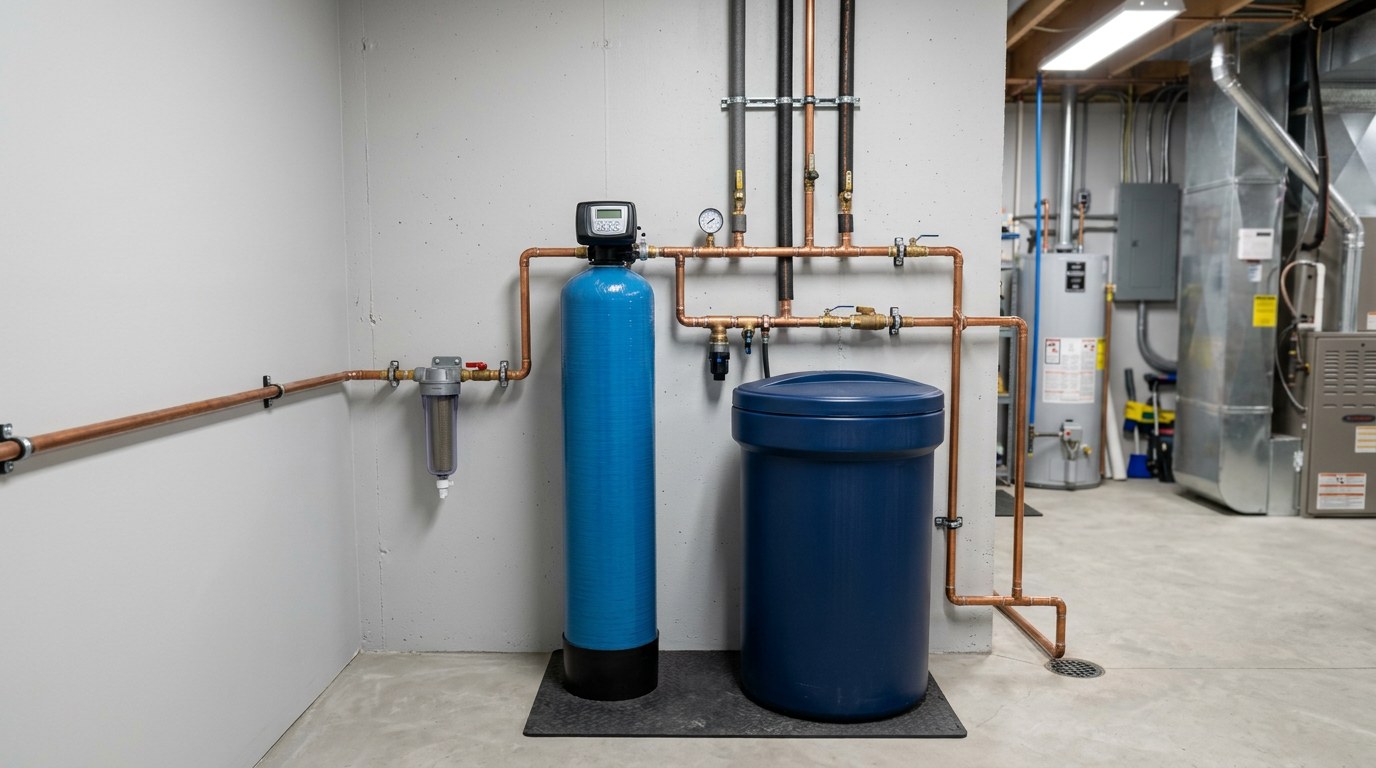
US buyers evaluate a softener on a short list of numbers, not on brand. First, grain capacity: a 32,000-grain or 48,000-grain unit covers the typical 3-4 bedroom home, while a 64,000-grain unit handles larger homes and light commercial. Second, the control valve: a metered, demand-initiated valve that regenerates only when needed saves both salt and water, and it is the feature that closes a sale against a timer-based unit. Third, flow rate and pressure drop: the unit has to sustain the home’s peak demand without choking the lines, which is where the valve port size and media depth show up.
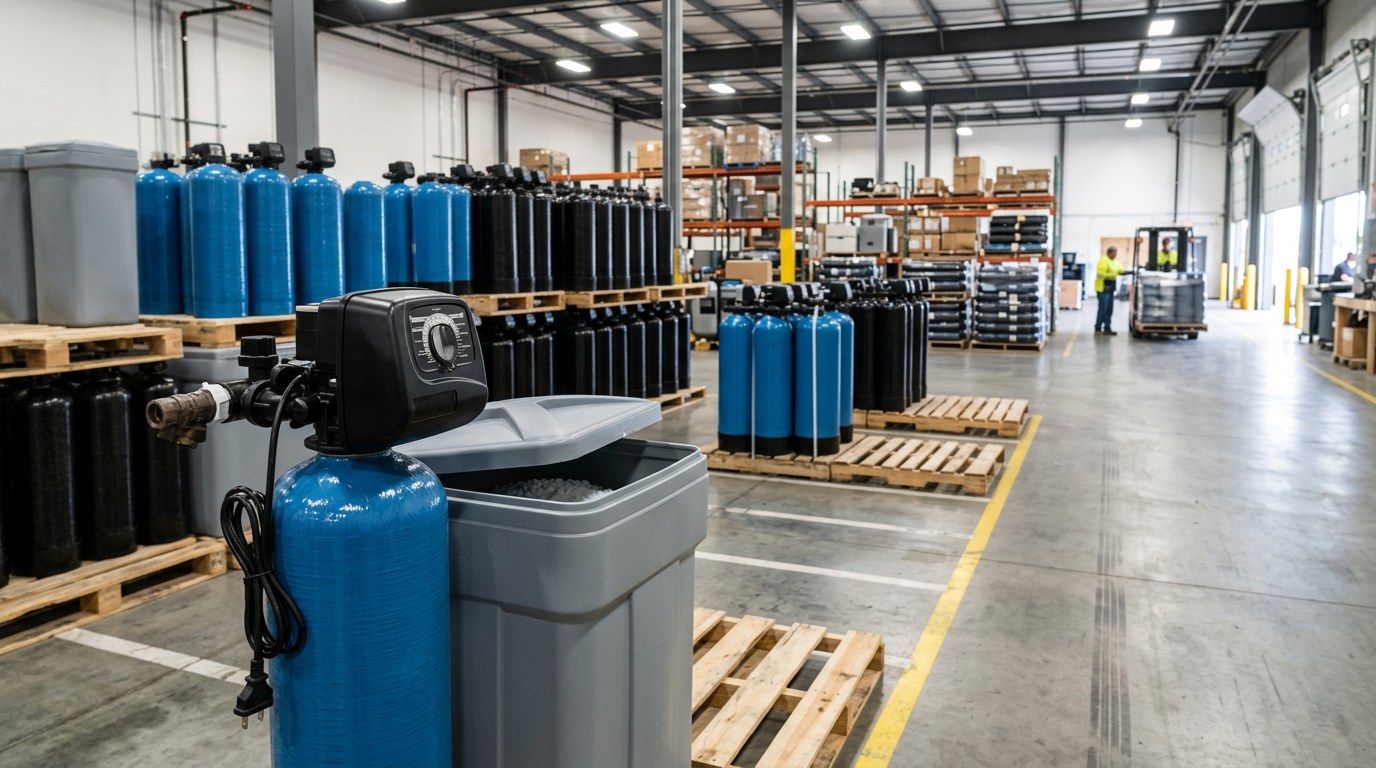
Material and build quality are where a low-cost import reveals itself. A brine tank that cracks under thermal cycling, a resin that loses capacity within two years, a valve that leaks at the seals — these are the failures that generate warranty returns and kill a distributor relationship. The importer who specs food-grade resin, a robust fiberglass or lined-steel resin tank, and a valve from a proven supplier is buying a reorder, not a one-off sale. ONEMI’s softener line is built around these specs; the configuration options are on the whole-house softener page.
Brine Discharge Rules Are Reshaping the Category
The regulatory pressure is real and it is spreading. California’s salt-discharge restrictions on self-regenerating softeners have been in place for years, and a growing number of municipalities and counties elsewhere are following with bans or incentive programs for salt-free alternatives. The EPA has also moved toward incentives for less saline regeneration effluent, which pushes the market toward high-efficiency metered valves and toward salt-free TAC units in restricted zones.
For an importer the implication is straightforward: the future SKU mix tilts toward high-efficiency ion exchange and salt-free conditioning, not toward the cheapest timer-based unit. A factory that can supply metered high-efficiency valves, NSF-listed resin, and a TAC conditioner line covers the whole regulatory map. A factory that only makes the legacy unit boxes an importer into a shrinking corner of the market.
What to Ask Before You Commit to a Factory
Before placing a softener order, an importer should get concrete answers on six points: which resin the factory uses and whether it carries an NSF listing; what the valve’s regeneration efficiency is and whether it is metered; what the brine tank and resin tank material grades are; whether the factory holds NSF/ANSI 44 documentation for the specific model being quoted; what the lead time is on a container order and what the minimum order quantity is for a custom valve program; and how the factory handles the resin media supply chain, since resin pricing has been volatile.
These questions separate a real softener manufacturer from a trading company that assembles from whoever quotes lowest that quarter. ONEMI operates as a Guangdong, China-based water treatment manufacturer supplying complete machines and OEM/ODM softener programs for international distributors; the OEM/ODM factory page lays out the capability, and the product center shows the full softener and filtration range. Certification documents we hold are listed on the certifications page.
Sourcing a whole-house softener line for the US is a geography problem first and a product problem second. Build the catalog around the hard-water belt’s ion-exchange demand and the brine-restricted coast’s salt-free demand, make NSF/ANSI 44 part of the factory spec from day one, and the reorder business follows the installed base. Skip the geography or skip the certification, and the account goes to whoever did not.