


 한국어
한국어

Per- and polyfluoroalkyl substances, universally known as PFAS or “forever chemicals,” represent one of the most resilient environmental crises of the modern industrial era. These synthetic compounds, characterized by their virtually unbreakable carbon-fluorine bonds, do not degrade naturally in the environment or the human body. Over decades of widespread use in firefighting foams, non-stick cookware, water-repellent clothing, and industrial manufacturing, they have leached into global municipal water systems. While municipal water systems struggle to adapt, premium consumer systems designed by brands like ONEMI are constantly monitoring these technological shifts to integrate advanced filtration capabilities into residential systems.
A major technological breakthrough from Flinders University in South Australia has introduced a highly efficient method for capturing these persistent toxins. By engineering specialized molecular “nanocages,” researchers have demonstrated a method that can trap and extract up to 98% of specific PFAS compounds from contaminated water sources, offering a scalable blueprint for the future of clean drinking water.
Executive Summary
- 98% Extraction Rate: The newly developed polymer-based nanocage technology successfully binds and removes up to 98% of perfluorooctanesulfonic acid (PFOS) and perfluorooctanoic acid (PFOA) from contaminated water samples.
- 5-Cycle Reusability: Unlike traditional single-use activated carbon filters, these engineered nanocages can be washed with a mild solvent and reused over 5 consecutive cycles without losing their structural integrity or chemical affinity.
- Global Market Impact: As regulatory limits for PFAS in drinking water drop toward near-zero levels globally, this breakthrough directly addresses a market projected to reach $16.14 billion by 2030.
The Scale of Global PFAS Contamination
To understand the significance of this development, one must look at the sheer scale of the contamination. PFAS chemicals are found in the blood of an estimated 97% of Americans. These compounds bioaccumulate, meaning they build up in human tissue over time, leading to severe health complications including thyroid disease, elevated cholesterol, reproductive issues, and various forms of cancer. Traditional municipal water treatment plants are not designed to filter out molecules of this size and chemical stability, allowing them to pass directly into household taps.
In April 2024, the United States Environmental Protection Agency (EPA) established legally enforceable Maximum Contaminant Levels (MCLs) for six PFAS compounds in drinking water. The new limits are incredibly stringent, setting the maximum allowable concentration for PFOA and PFOS at just 4.0 parts per trillion (ppt). To put this in perspective, 4.0 ppt is equivalent to approximately four drops of water in an Olympic-sized swimming pool. The European Union has implemented similar measures under the Drinking Water Directive, which sets a limit of 0.5 micrograms per liter (µg/L) for total PFAS. These regulatory changes have forced water authorities and consumer filtration brands to seek out entirely new purification mechanisms.
The financial implications are staggering. Municipalities across the United States alone are facing estimated compliance costs exceeding $1.5 billion annually to meet the new EPA standards. This regulatory pressure has accelerated the growth of the global water purification market, as consumers increasingly take water safety into their own hands. Home filtration is no longer just about improving taste; it is a critical line of defense against systemic chemical exposure.
How Nanocage Technology Captures Forever Chemicals
The breakthrough developed by the research team at Flinders University, in collaboration with international partners, centers on synthetic chemistry. The team engineered a novel polymer network containing hollow, microscopic structures called “nanocages.” These nanocages are designed with a highly specific internal cavity size and surface chemistry that match the physical dimensions and charge of PFAS molecules.
The mechanism relies on a process called host-guest chemistry. The hydrophobic (water-repelling) tail of the PFAS molecule is strongly attracted to the interior of the nanocage, while the hydrophilic (water-attracting) head interacts with the outer edge of the structure. When contaminated water passes through this polymer material, the PFAS molecules are selectively drawn out of the water and locked inside the cages, much like a key fitting into a lock. This targeted attraction allows the filter to operate efficiently even in the presence of other common water impurities, such as natural organic matter or dissolved salts, which often clog or exhaust conventional carbon filters prematurely.
The most remarkable feature of this technology is its regeneration capability. Traditional granular activated carbon (GAC) filters act like sponges; once they are saturated, they must be discarded and incinerated at extremely high temperatures to destroy the PFAS, a process that is both energy-intensive and carbon-heavy. The Flinders University nanocages can be rinsed with a simple, low-cost solvent mixture to release the trapped PFAS molecules. This concentrated waste can then be isolated and treated separately, while the regenerated polymer is placed back into service. Testing shows that the material retains its 98% removal efficiency through at least five full regeneration cycles, drastically lowering the lifetime cost of the filtration media.
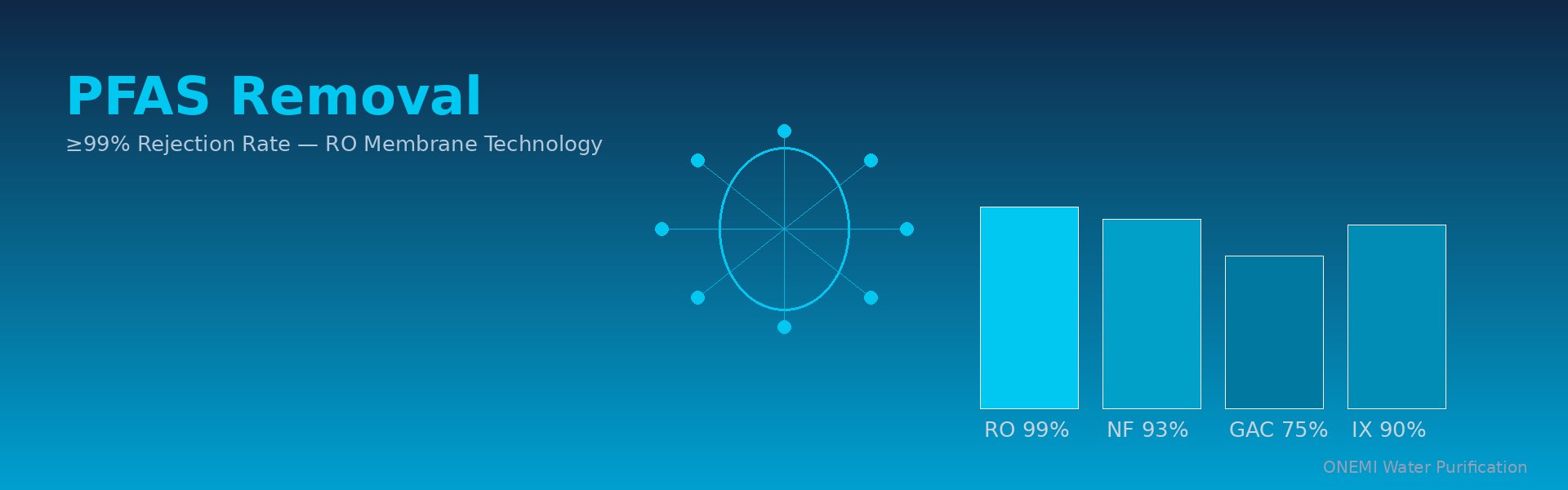
| Filtration Parameter | Granular Activated Carbon (GAC) | Ion Exchange (IX) Resin | Flinders Nanocage Polymer |
|---|---|---|---|
| PFAS Removal Efficiency | 70% – 90% (declines rapidly) | 90% – 95% | Up to 98% |
| Reusability / Regeneration | None (Single-use, requires incineration) | Difficult (Requires harsh chemical brines) | High (5+ cycles with mild solvent) |
| Impact of Organic Matter | High interference (pores clog easily) | Moderate interference | Minimal interference (highly selective) |
| Targeted PFAS Types | Long-chain only | Long and some short-chain | Broad spectrum (PFOA, PFOS, GenX) |
The Practical Realities of Residential Implementation
While lab results are incredibly promising, translating molecular breakthroughs into a kitchen counter water purifier involves overcoming significant engineering hurdles. One major gotcha with highly targeted polymer adsorbents is flow rate restriction. In a laboratory setting, contaminated water is slowly dripped through a column of the material over several hours to achieve the maximum 98% contact time. In a real-world household, a user expects a purification system to fill a glass of water in under ten seconds. If you speed up the water flow too much, the PFAS molecules do not have enough time to migrate into the nanocages, and the filtration efficiency drops dramatically.
To bridge this gap, consumer appliance manufacturers like ONEMI are researching hybrid multi-stage filtration architectures. By combining a fast-flowing sediment pre-filter with a highly porous nanocage-infused membrane, it is possible to maximize the contact surface area without sacrificing water pressure. This ensures that the water remains in contact with the active polymer long enough for the host-guest chemistry to occur, even at high household flow rates.
Another real-world challenge is the regional variation in tap water chemistry. For example, in hard water areas like West Texas or parts of Southern Germany, elevated levels of calcium and magnesium ions can coat the surface of advanced filtration materials, blocking access to the microscopic nanocages. This means that a commercial version of this technology cannot rely on the nanocage polymer alone; it must be preceded by an ion-exchange or softening stage to protect the active binding sites. ONEMI water purification systems utilize intelligent sensor arrays to monitor water hardness and adjust filtration dynamics, ensuring that advanced media like these nanocages do not get prematurely blinded by scale buildup.
What happens to the concentrated PFAS waste once the nanocages are cleaned? This remains the ultimate environmental question. If consumers regenerates their own filters at home, flushing the concentrated residue down the drain simply returns the forever chemicals back into the municipal wastewater system, defeating the purpose of extraction. The most viable path forward involves a closed-loop cartridge exchange program, where consumers mail exhausted cartridges back to a centralized facility. Here, the cartridges can be professionally regenerated using industrial-grade solvents, and the extracted PFAS can be destroyed safely using electrochemical oxidation or ultra-high-temperature destruction technologies.
The Future of Consumer Water Safety
As the global water purifier market expands toward its projected $16.14 billion valuation, consumer expectations are shifting from simple carbon block filtration to advanced molecular interception. The integration of technologies like Flinders University’s nanocages into household appliances will redefine what clean water means. Consumers will no longer have to rely on municipal water treatment plants to upgrade their infrastructure, a process that historically takes decades and billions of dollars in taxpayer funding.
Instead, decentralized water purification will become the standard. Homeowners will have the ability to remove industrial run-off, agricultural pesticides, microplastics, and forever chemicals right at the point of use. This shift not only protects public health but also reduces reliance on bottled water, reducing plastic waste. Brands like ONEMI are leading this transition, investing heavily in the research and development required to scale laboratory-proven materials into reliable, everyday appliances. As these advanced polymers become easier to manufacture, the goal of achieving 100% PFAS-free drinking water in every home moves closer to reality.