


 한국어
한국어

You open your tap and see crystal-clear water. It looks perfectly fine. Yet, behind your drywall, inside your $8,000 tankless water heater, and deep within the fibers of your freshly washed clothes, a quiet, destructive chemistry experiment is running 24/7. Most homeowners treat water quality as a binary issue: either it is safe to drink, or it is not. This is a massive mistake that costs the average suburban household thousands of dollars in premature appliance failures and plumbing repairs every decade.
Executive Summary
- A complete whole-house water treatment strategy requires a coordinated four-stage sequence: a heavy-duty sediment pre-filter, a central catalytic carbon block, an ion-exchange softening unit, and a dedicated point-of-use reverse osmosis system.
- Installing a certified ion-exchange water softener restores water heater efficiency by up to 8%, preventing scale buildup that acts as an unwanted thermal barrier.
- Municipal water treatment facilities keep water biologically safe but introduce high levels of chlorine, chloramines, and disinfection byproducts that degrade plumbing fixtures and dry out skin.
Think about your morning routine. You jump in the shower, and the water smells faintly of a public swimming pool. You brew a pot of coffee, but the flavor tastes flat and slightly metallic. Your shower glass doors are permanently etched with white, chalky spots that no amount of scrubbing seems to remove. These are not minor, isolated inconveniences. They are direct symptoms of municipal chemical treatment and geological hard water working in tandem against your home.
The Hidden Cost of Unfiltered Municipal Water

Municipal water treatment plants do an incredible job of keeping us safe from deadly pathogens like cholera and dysentery. They use cheap, highly effective disinfectants to achieve this. Across the United States, municipal water systems rely heavily on chlorine and chloramines (a mix of chlorine and ammonia) to keep water sterile as it travels through miles of aging underground infrastructure. By the time that water reaches your main shutoff valve, those protective chemicals have transformed into aggressive agents of degradation.
Chloramines do not simply dissipate into the air like standard chlorine. They linger. They eat away at the rubber seals inside your expensive plumbing fixtures, cause copper pipes to pinhole over time, and strip the natural oils from your skin and hair during every shower. According to EPA reports, over 80% of US households drink and bathe in water with measurable levels of chemical disinfectants and hard minerals. The EPA sets maximum contaminant level goals, but legal compliance does not mean optimal health or home preservation.
Let us look at a real-world scenario in Austin, Texas. Homeowners in the municipal utility district frequently deal with water hardness levels exceeding 180 milligrams per liter, coupled with chloramine levels hovering around 2.5 parts per million. Within three years of moving into a brand-new suburban development, residents routinely report heating element failures in their dishwashers and tankless water heaters. The culprit is a dual assault: calcium carbonate scale bakes onto the heating elements, while chloramines degrade the internal rubber O-rings, leading to slow, hidden leaks behind kitchen cabinetry.
Here is a counter-intuitive finding that surprises most homeowners: municipal water that meets all federal safety guidelines can still be highly corrosive to your specific home infrastructure. When you strip away the marketing fluff of generic retail filters, you find that true water security requires a physical and chemical transformation of your water supply the moment it crosses your property line.
The Four-Stage Defense System Explained
A single blue filter pitcher sitting in your refrigerator is not a water treatment strategy. To protect both your plumbing infrastructure and your family’s health, you must implement a multi-barrier defense system. This strategy intercepts different classes of contaminants at the specific locations where they do the most damage.
| Stage | Filter Type | Target Contaminants | Primary Benefit |
|---|---|---|---|
| Stage 1 | 40-100 Micron Pre-Filter | Sand, sediment, rust, scale particles | Protects downstream valves and appliances |
| Stage 2 | Central Activated/Catalytic Carbon | Chlorine, chloramines, VOCs, PFAS | Eliminates tastes, odors, and chemical skin irritants |
| Stage 3 | Ion-Exchange Water Softener | Calcium and magnesium ions | Prevents scale buildup, improves soap lather |
| Stage 4 | Under-Sink Reverse Osmosis (RO) | Lead, fluoride, nitrates, heavy metals, arsenic | Provides high-purity, bottled-quality drinking water |
The first line of defense is the sediment pre-filter. Think of this as the bouncer at the door. It physically stops large particles of rust from old municipal mains, fine sand from local wells, and pipe scale from entering your home. If you skip this stage, those abrasive particles will quickly clog your expensive carbon filters and tear through the internal seals of your water softener control valve.
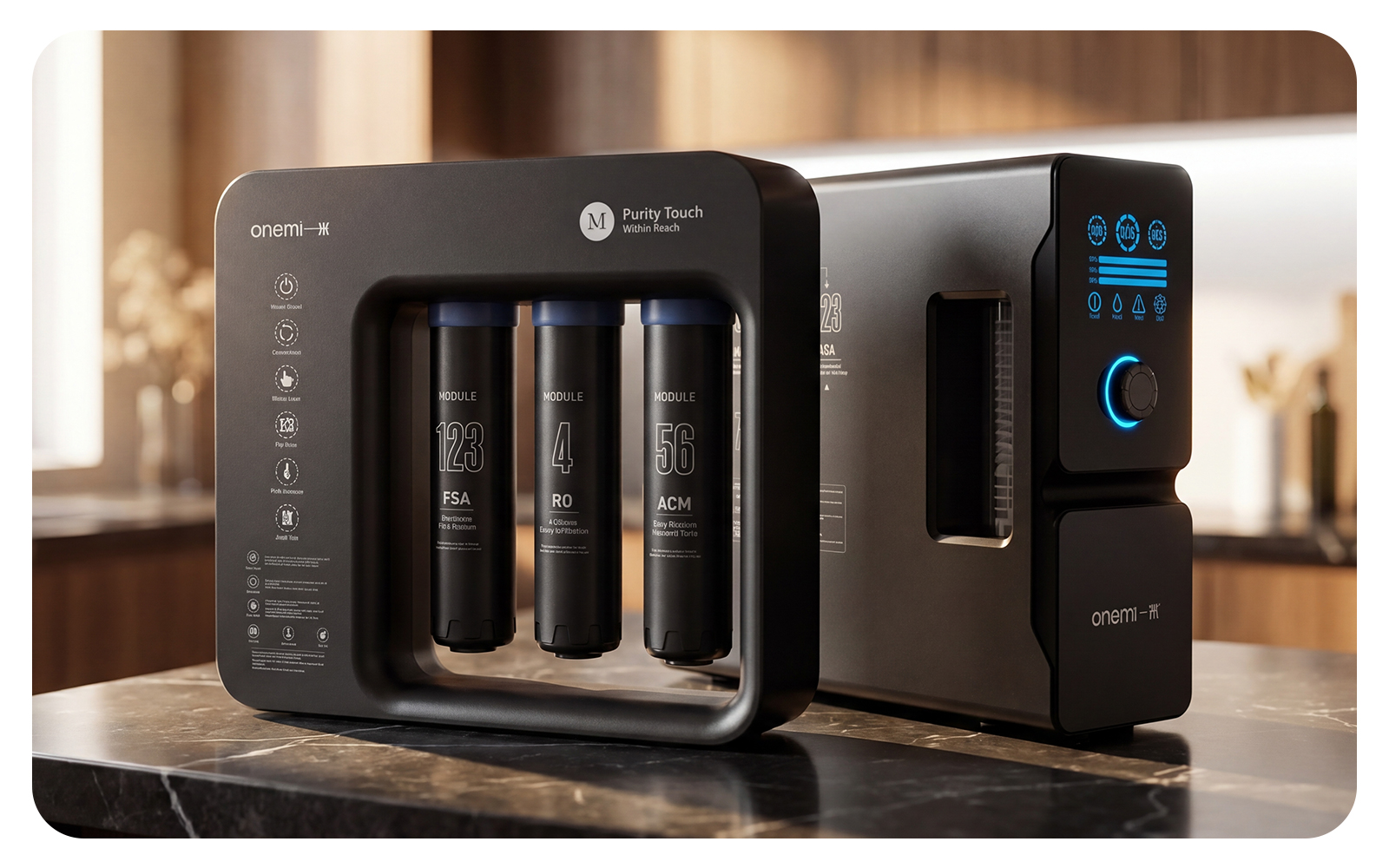
Next comes the central carbon filter. This is where the chemical heavy lifting happens. High-grade catalytic carbon acts like a chemical magnet, pulling dissolved chlorine, volatile organic compounds (VOCs), and industrial run-off out of the water stream. This ensures that every shower you take is free from vaporized chlorine gas. ONEMI engineers emphasize that utilizing a backwashing catalytic carbon system rather than simple cartridge filters extends the media life to nearly a decade, reducing maintenance costs significantly.
Once the chemicals are neutralized, the water enters the ion-exchange softener. This system targets dissolved rock. By swapping calcium and magnesium ions for harmless sodium ions, the water becomes chemically soft. This brings us to a major financial benefit: homes with whole-house water softeners see water heater efficiency improve by up to 8% over the life of the appliance. Without scale insulating the heating elements, your system uses less gas or electricity to bring your water to temperature.
The final step is the point-of-use reverse osmosis system, typically installed under the kitchen sink. Why not do reverse osmosis for the entire house? It is highly inefficient and corrosive. RO water is stripped of all minerals, making it aggressive toward copper pipes. By keeping the RO system dedicated to your drinking water and ice maker, you get ultra-pure water where you consume it, without risking your home’s infrastructure.
The Hard Truth About Hard Water and Appliance Decay
Let us look at what happens inside your water heater when you feed it untreated hard water. As hard water is heated, dissolved calcium carbonate precipitates out of the solution. It settles to the bottom of your tank as a thick, rocky layer of scale. If you have an electric water heater, this scale completely buries the lower heating element. The element must now heat through inches of solid rock before it can heat the water. It runs hotter and longer than designed, eventually burning itself out.
If you have a gas tankless water heater, the scale builds up inside the narrow passages of the copper heat exchanger. The heat cannot transfer efficiently to the water. This causes the copper to overheat, fatigue, and ultimately crack, resulting in an expensive flood. Studies by the Water Quality Research Foundation show that tankless water heaters running on hard water can lose up to 30% of their operational efficiency in just fifteen months, while also facing a 50% reduction in overall lifespan.
Soft water changes everything.
With soft water, soap dissolves completely instead of reacting with calcium to form sticky soap scum. Your washing machine requires up to 60% less detergent to achieve cleaner, brighter clothes. Your dishwasher runs without leaving white spots on your glassware. Your skin retains its natural moisture barrier, reducing the need for expensive lotions and prescription eczema creams. The savings in soap, energy, and appliance replacement costs easily pay for the entire filtration system over its operational lifetime.
How to Choose and Install Your System
Before you purchase a single piece of equipment, you must know what is actually in your water. Do not rely on generic online water reports. Your local water utility publishes an annual water quality report, but this only tells you the state of the water when it leaves the treatment plant, not when it flows out of your kitchen faucet. Buy a comprehensive third-party lab test kit. This will give you precise numbers on your water hardness grains per gallon, total dissolved solids (TDS), iron levels, and specific chemical contaminants.
When selecting a system, pay close attention to the service flow rate, measured in gallons per minute (GPM). A system that is too small will cause a noticeable drop in water pressure when multiple showers are running simultaneously. For a typical three-bedroom, two-bath home, look for a system rated for at least 12 to 15 GPM. Ensure the control valves on your softener and carbon tank are demand-initiated, meaning they only regenerate based on your actual water usage rather than a simple, wasteful time clock.
Installation is a critical step that requires careful planning. The entire system should be installed indoors or in a conditioned space like a garage or basement, protected from freezing temperatures and direct sunlight. It must be positioned after your main water shutoff valve but before the plumbing splits into hot and cold lines, and crucially, before any outdoor irrigation lines. You do not want to waste expensive softened and filtered water on your lawn.
A major practical gotcha that many DIY installers overlook is the drain requirement. Both the carbon filter and the water softener require a backwash cycle to clean themselves. This means you must have a nearby floor drain, standpipe, or sump pump capable of handling high-flow wastewater during regeneration. Additionally, you must install a physical air gap at the drain connection to prevent any potential sewage backup from contaminating your drinking water system.
For those living in municipal areas with high sediment loads, choosing a system with an automatic, self-cleaning pre-filter is a game-changer. ONEMI systems utilize advanced multi-layered filtration media that automatically flushes away trapped sediment every few weeks, eliminating the messy chore of manually changing paper cartridges. This ensures your downstream carbon and softening resins remain pristine and fully operational for years to come without constant manual intervention.
Once your system is installed, the transformation is immediate. The chlorine smell disappears from your showers. Your dishes dry spotless. Your skin feels noticeably softer, and you can rest easy knowing your expensive water heater and plumbing fixtures are fully protected from the destructive forces of scale and chemical corrosion. Investing in a proper, multi-stage water filtration system is not just about getting a cleaner glass of water; it is about taking control of your home’s infrastructure and protecting your family’s health from the ground up.