


 한국어
한국어

Sarah stood in her suburban New Jersey kitchen, holding a glass of water that looked perfectly clear but tasted faintly of swimming pool chemicals. Just three miles away, her town’s municipal water report had recently flagged elevated levels of PFAS—the notorious “forever chemicals” that have dominated local news cycles. Like millions of homeowners, she realized that the traditional carbon pitcher sitting in her fridge was no longer enough to protect her family. The reality of modern drinking water is that what we cannot see, smell, or taste is precisely what we need to worry about most.
Executive Summary
- The residential water purification market is projected to reach approximately $85 billion by the mid-2030s, fueled by growing consumer anxiety over emerging contaminants like PFAS and microplastics.
- Smart-enabled purification systems are growing at an annual rate of nearly 30%, shifting the industry from passive filtration to active, real-time water quality monitoring.
- Updated NSF/ANSI standards, particularly NSF 53 and NSF 58, have become the baseline benchmark for validating true contaminant reduction in residential systems.
The Changing Landscape of Tap Water Safety
For decades, municipal water treatment plants did an admirable job of eliminating acute biological threats like cholera and dysentery. Today, the threat matrix has shifted entirely to chronic, low-dose chemical exposure. The EPA recently established historic, legally enforceable limits for six PFAS compounds in drinking water, forcing municipal water authorities to scramble for treatment upgrades. However, infrastructure overhauls take years, leaving the immediate burden of filtration on the individual household.
Consider the sheer scale of the challenge. Millions of lead service lines still snake beneath older American cities, occasionally leaching heavy metals into school and residential pipes. Agricultural runoff introduces nitrates and pesticides into rural aquifers, while industrial solvents linger in urban groundwater tables. Consumers are realizing that municipal treatment is only the first step in a long, compromised journey to their kitchen tap.
This realization has fundamentally transformed the residential water purification sector from a luxury purchase into essential household infrastructure.
It is not just about taste anymore; it is about verifiable health protection.
In response, the global residential water purifier market is undergoing a massive expansion, on track to reach roughly $85 billion by 2035. This growth is not driven by simple carbon blocks, but by advanced, multi-stage systems that utilize reverse osmosis, ultrafiltration, and smart diagnostics to guarantee purity at the point of use.
How Smart Technology Solved the Blind Filter Problem
Historically, owning a water purifier involved a significant amount of guesswork. When exactly do you change the filter? Most manufacturers recommended a arbitrary timeline, such as “every six months,” which completely ignored actual water usage patterns and local water hardness. Change it too early, and you waste money. Change it too late, and you are drinking unfiltered water through a saturated, bacteria-laden carbon block.
Smart-enabled purification systems have solved this pain point by growing at an impressive annual rate of nearly 30%. By embedding flow meters, TDS (Total Dissolved Solids) sensors, and Wi-Fi connectivity directly into the filtration manifold, modern systems communicate their exact status to the user’s smartphone. You receive an alert only when the filter’s actual capacity is exhausted, based on the precise volume of water processed and its incoming contaminant load.
| Feature | Traditional Systems | Smart-Enabled Systems |
|---|---|---|
| Filter Life Tracking | Time-based guesses (e.g., 6 months) | Real-time volume & sensor-based tracking |
| Water Quality Monitoring | None (requires manual test kits) | Onboard TDS and purity sensors |
| Leak Detection | Manual inspection after damage occurs | Instant automatic shut-off valves |
| User Interface | Flashing red light on faucet (if equipped) | Mobile app dashboards & push notifications |
But the integration of smart technology goes beyond mere convenience. Advanced systems now feature automated membrane flushing, which extends the lifespan of expensive reverse osmosis elements, and integrated leak detection systems that can shut off the incoming water supply the moment a drop of moisture is detected under the sink, preventing catastrophic property damage.
The Truth About NSF Certifications
Are all filters created equal? Absolutely not. The water filtration market is notorious for misleading marketing terms like “purifier-grade” or “health-certified” that have no legal or scientific backing. To cut through the noise, savvy consumers must look to NSF International (formerly the National Sanitation Foundation) and the American National Standards Institute (ANSI).
These organizations establish rigorous testing protocols to verify that a filtration system actually removes what the manufacturer claims it removes. When evaluating a system, there are three primary certifications that serve as the gold standard for residential water treatment:
- NSF/ANSI 42: Covers aesthetic effects, verifying the system’s ability to reduce chlorine, taste, odor, and particulate matter.
- NSF/ANSI 53: Covers health effects, certifying that the system reduces specific contaminants like lead, mercury, asbestos, radon, and volatile organic compounds (VOCs).
- NSF/ANSI 58: The specific standard for reverse osmosis systems, verifying the reduction of total dissolved solids, fluoride, arsenic, and nitrates under pressure.
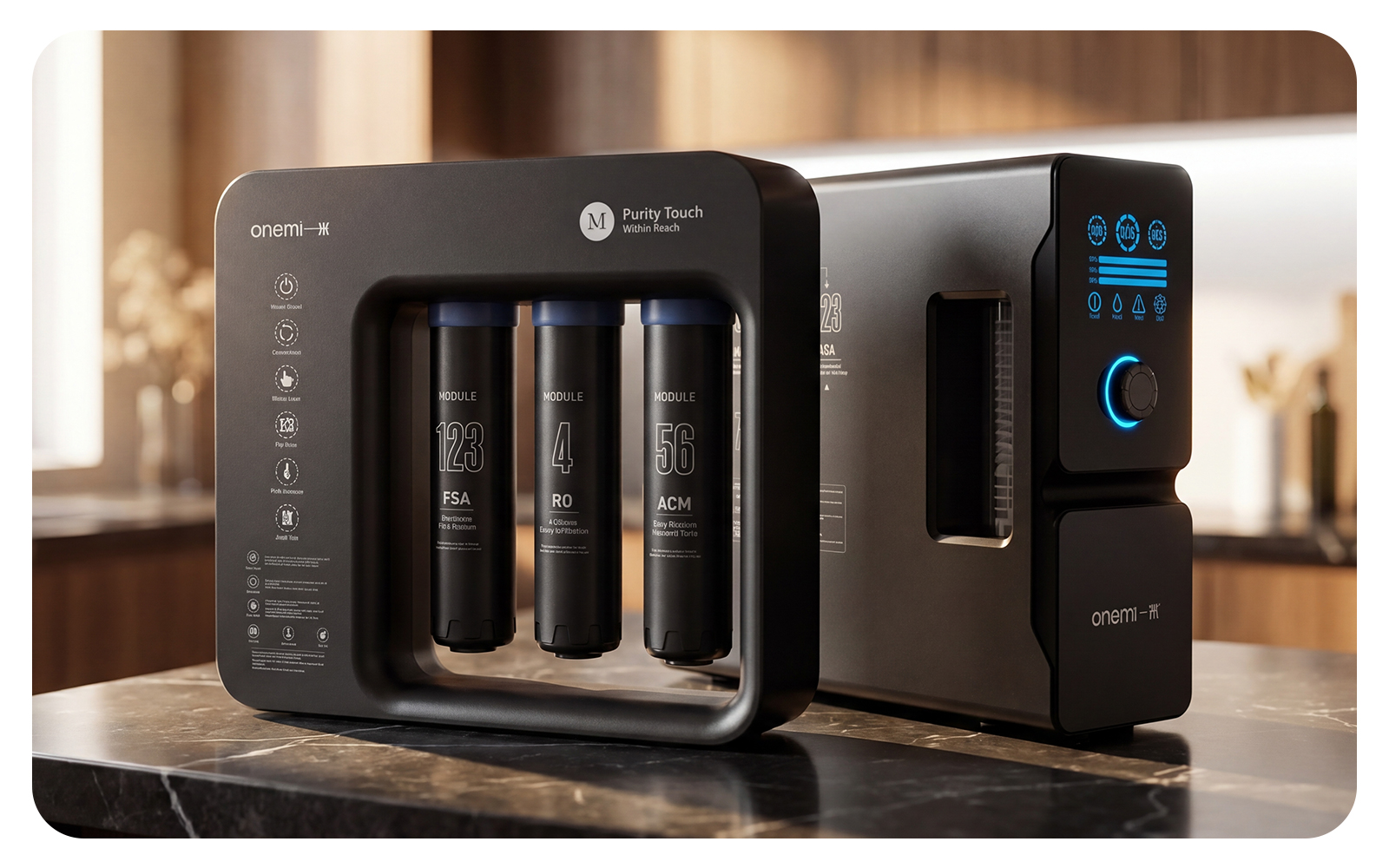
Interestingly, some of the most advanced innovations in this space are coming from specialized manufacturers like ONEMI, who design multi-stage systems engineered to target the highly resilient chemical bonds found in modern industrial runoff. These systems go beyond basic carbon filtration, utilizing proprietary composite media that binds to heavy metals on a molecular level.
It is worth noting a practical gotcha: a system certified for NSF 42 does not automatically mean it protects your health. A pitcher filter might make your water taste fantastic by removing chlorine (NSF 42), while leaving dissolved lead and PFAS completely untouched. Always check the specific contaminant reduction sheet to see exactly what substances the system has been certified to remove.
The Rise of Whole-House Filtration Systems
While point-of-use systems like under-sink RO units provide pristine drinking water, they do not address a critical vulnerability: the water we use to bathe, wash dishes, and launder our clothes. Volatile organic compounds and chlorine can vaporize in a hot shower, allowing them to be inhaled directly into the lungs or absorbed through the skin. This realization has driven a massive surge in the adoption of whole-house (point-of-entry) filtration systems.
A comprehensive whole-house system acts as a protective shield for your entire home. It typically begins with a sediment pre-filter to catch rust, silt, and clay, followed by a large carbon media tank to strip out chlorine and industrial chemicals. For homes with hard water, this is often paired with a salt-free water conditioner to prevent scale buildup in pipes and water heaters without adding excess sodium to the environment.
By treating water at the point it enters the home, you protect not only your family’s health but also the lifespan of your plumbing infrastructure and high-end appliances. Tankless water heaters, washing machines, and dishwashers all run more efficiently and last significantly longer when supplied with clean, scale-free water.
Making the Right Choice for Your Household
Selecting the ideal water treatment setup requires a systematic approach rather than buying the most expensive unit on the shelf. No single filtration technology can remove every single type of contaminant, meaning the best systems are almost always multi-stage configurations tailored to your specific water profile.
First, obtain a copy of your city’s annual water quality report, or perform an independent laboratory test if you rely on a private well. This will tell you precisely which contaminants are present in your local supply. Second, determine your daily water usage requirements to size your system correctly. Finally, ensure that any system you consider carries independent NSF/ANSI certifications for the specific contaminants you need to target.
Investing in a modern, smart-enabled water purification system is no longer about chasing a lifestyle trend. It is a proactive, necessary step to secure the health of your household against a changing environment and aging public infrastructure. By combining real-time smart monitoring with certified filtration technologies, you can finally turn on your tap with absolute confidence.