



 한국어
한국어

Most homeowners purchase a water filter only after noticing a strange metallic taste, a chlorine smell reminiscent of a public swimming pool, or white, chalky scale building up on their expensive designer faucets. They go online, purchase a generic pitcher or a cheap under-sink carbon block, and assume the problem is solved. This reactive approach is a gamble with your household health.
There is a massive, invisible gulf between water that is technically “legal” under municipal standards and water that is genuinely safe, clean, and healthy for long-term consumption. Municipal treatment plants do an admirable job of keeping us safe from cholera and dysentery, but their responsibility ends at the city gate. Between that treatment plant and your kitchen faucet lie miles of aging, decaying cast-iron pipes, lead-soldered joints, and localized groundwater plume migrations that local utilities are not equipped to filter out in real-time.
Executive Summary
- Reverse Osmosis (RO) remains the industry gold standard for municipal water purification, capable of removing 93% to 99% of Total Dissolved Solids (TDS).
- If your home’s incoming raw water exceeds 450 to 500 ppm of TDS, a multi-stage RO or nanofiltration system is non-negotiable for system longevity and safety.
- Never purchase any filtration system that lacks independent, third-party performance certifications from recognized bodies like the NSF or WQA.
To make an informed decision, you must transition from a passive consumer to an active water manager. This guide establishes a rigorous, contrast-driven framework to help you analyze your home’s water profile, understand the physical mechanics of modern filtration, and select a system that matches your specific environmental reality.
The Hidden Realities of Tap Water
Let us look at the stark contrast between what is officially reported and what actually emerges from your kitchen faucet. Under the Safe Drinking Water Act (SDWA), the EPA sets Maximum Contaminant Levels (MCLs) for over 90 contaminants. However, many independent toxicologists argue these standards are decades out of date, failing to account for the bioaccumulative effects of lifelong, low-dose exposure to chemical cocktails.
Consider the difference between municipal compliance and biological safety:
| Contaminant Group | EPA Legal Limit (MCL) | Health-Protective Goal (MCLG) | Typical Domestic Range |
|---|---|---|---|
| Lead | 15 ppb (Action Level) | Zero (No safe level) | 0.5 to 25+ ppb (highly localized) |
| PFAS / PFOS | 4.0 ppt (Proposed) | Zero | 5.0 to 150+ ppt (near industrial zones) |
| Total Trihalomethanes (TTHMs) | 80 ppb | N/A (Carcinogenic risk) | 20 to 110 ppb (seasonal variation) |
| Nitrates | 10 ppm | 10 ppm | 0.5 to 18 ppm (agricultural runoff) |
In municipal systems, chlorine or chloramine is added to kill pathogens. While highly effective at preventing waterborne disease outbreaks, these disinfectants react with naturally occurring organic matter in the source water to form trihalomethanes (TTHMs) and haloacetic acids (HAAs). These disinfection byproducts are known human carcinogens. The very chemical used to make your water pathogen-free creates a secondary class of chronic chemical hazards inside your plumbing. This is the fundamental paradox of municipal water treatment.
Furthermore, consider the physical journey your water takes. It travels through cast-iron pipes installed during the Eisenhower administration, picks up rust flakes, scale, and micro-particles of heavy metals, and then sits in your home’s internal copper plumbing, absorbing lead from older brass fixtures and solder. If you live in an older metropolitan area like Chicago or Boston, your service line itself may be constructed entirely of pure lead. A simple carbon pitcher filter sitting on your counter is completely outmatched by this gauntlet of contaminants.
The Diagnostic Checklist: Assessing Your Source Water
You cannot design a solution for a problem you have not quantified. Before spending a single dollar on a water purification system, you must establish your home’s baseline water chemistry. Do not rely on your city’s annual water quality report; that report measures water at the treatment plant, not at your kitchen sink.
Here is your step-by-step diagnostic framework:
- Step 1: The TDS Baseline Test
Purchase a digital TDS (Total Dissolved Solids) meter. Test your cold tap water at three different times of day. This will give you a baseline reading in parts per million (ppm). If your reading falls between 50 and 250 ppm, your water is relatively low in dissolved mineral content. If your reading exceeds 450 to 500 ppm, you are dealing with highly mineralized, hard water that requires heavy-duty membrane filtration to protect both your health and your appliances. - Step 2: The Municipal vs. Well Water Split
Determine your primary water source. Municipal water is characterized by high levels of chemical disinfectants (chlorine/chloramines) and disinfection byproducts, but is generally free of biological pathogens. Well water, on the other hand, is completely unregulated. It is highly susceptible to biological pathogens (coliform bacteria, E. coli), agricultural runoff (nitrates, pesticides), and heavy crustal minerals (iron, manganese, arsenic, radon). - Step 3: The Professional Laboratory Assay
For municipal water, order a targeted chemical assay focusing on heavy metals, PFAS, and VOCs. For well water, order a comprehensive microbiological and heavy metal panel. Brands like ONEMI design their high-performance filtration systems to target specific ranges of these contaminants, making precise data invaluable when configuring your final home setup. - Step 4: Physical Infrastructure Inspection
Locate your home’s main water shut-off valve. Determine the pipe material entering your home. Is it copper, galvanized steel, PEX, or lead? Scratch the pipe with a key; if it is dull grey, soft, and easily scratched, you have a lead service line. This single physical observation completely dictates your filtration requirements.
Is high TDS always a sign of dangerous water? No. This is a common misconception perpetuated by low-end filter marketing. A high TDS reading simply indicates a high concentration of dissolved ions. In some regions, this is merely harmless calcium and magnesium. In others, it represents a toxic mix of road salt runoff, nitrates, and heavy metals. A TDS meter is a screening tool, not a chemical analysis device.
Filtration Technologies: Active Mechanics vs. Passive Media
To choose the right system, you must understand the mechanical differences between active filtration membranes and passive adsorption media. Many consumers treat all filters as black boxes that magically output clean water. In reality, different technologies target entirely different classes of contaminants.
Let us look at the primary residential technologies side-by-side.
Carbon Adsorption (GAC and Carbon Block)
Activated carbon works via adsorption—a chemical process where contaminants are physically trapped in the microscopic pore structure of the carbon matrix. Granular Activated Carbon (GAC) filters allow water to flow quickly but can suffer from “channeling,” where water carves a path of least resistance, bypassing the media entirely. Solid carbon blocks, compressed under high pressure, force every molecule of water through an incredibly dense, tortuous path.
Carbon block filters are highly effective at removing chlorine, chloramines, volatile organic compounds (VOCs), and bad tastes or odors. However, they are virtually useless against dissolved inorganic salts, nitrates, fluoride, and heavy metals like arsenic. They are passive gatekeepers; they catch organic compounds but let dissolved minerals slide right through.
Reverse Osmosis (RO)
Reverse Osmosis is an active pressure-driven process. Incoming water pressure forces water molecules through a semi-permeable membrane with a pore size of approximately 0.0001 microns. This pore size is so incredibly small that it physically blocks almost everything except pure water molecules.
RO membranes reject up to 99% of dissolved solids, including lead, fluoride, arsenic, nitrates, and microplastics. If you want the absolute highest level of purity, RO is the gold standard. However, this technology has a major limitation: it produces wastewater. For every gallon of pure water generated, traditional RO systems can send 3 to 4 gallons of wastewater down the drain. Modern, high-efficiency RO systems have reduced this ratio significantly, sometimes achieving a 1:1 or even a 2:1 pure-to-drain water ratio under optimal pressure conditions.
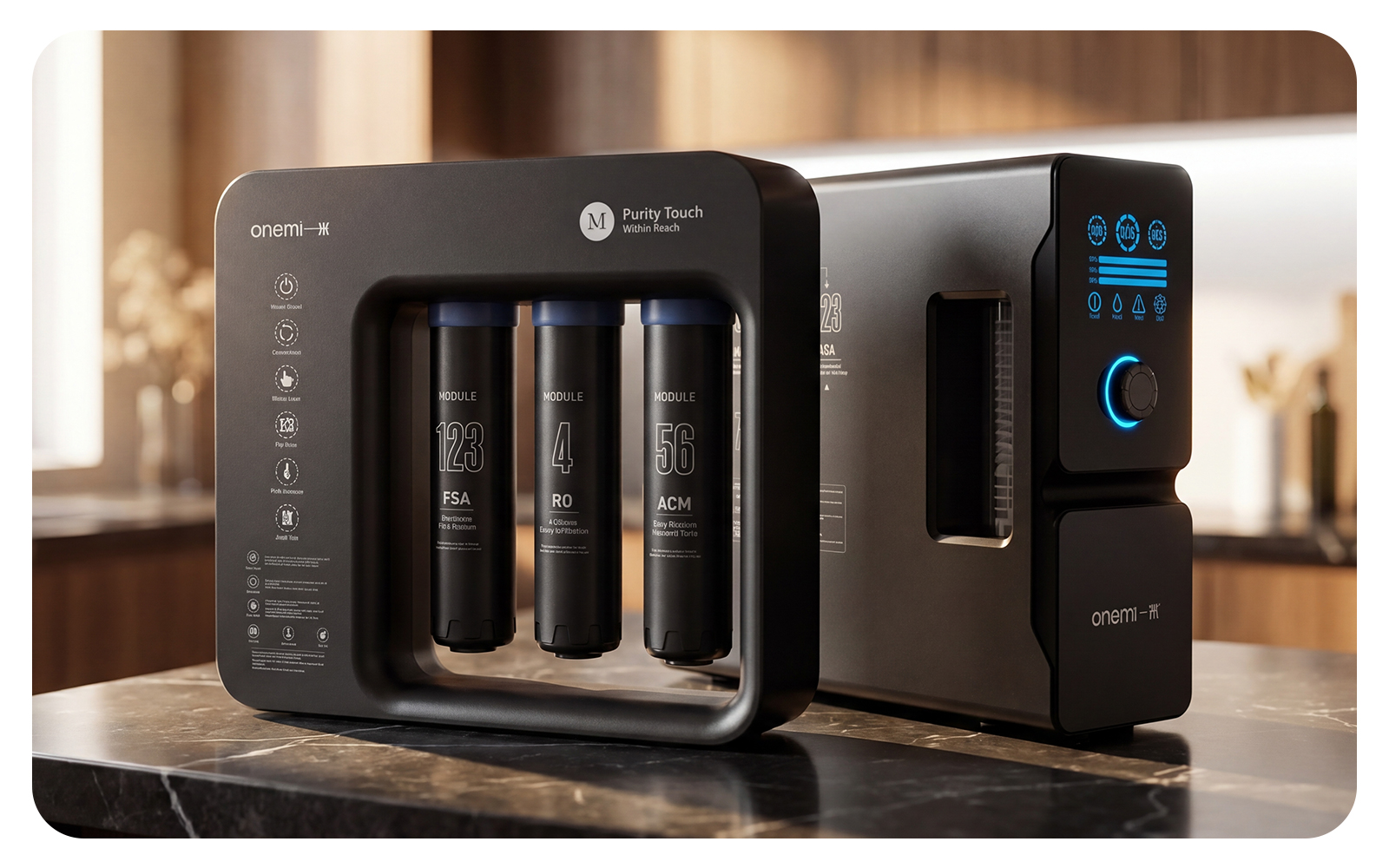
The premium ONEMI under-sink systems utilize advanced multi-stage RO configurations to maximize water efficiency while maintaining a high flow rate, ensuring that your household does not waste water unnecessarily.
Nanofiltration and Ultrafiltration
Nanofiltration (NF) operates similarly to RO but with a slightly larger pore size (0.001 to 0.01 microns). It is often called “loose RO” or a “selective membrane.” NF is highly effective at removing heavy metals, PFAS, and organic matter, but it allows some beneficial minerals like calcium and magnesium to pass through. This makes it an excellent choice for homeowners who want clean water without the completely flat taste of pure RO water.
Ultrafiltration (UF) uses hollow fiber membranes with a pore size of around 0.01 to 0.1 microns. It runs on standard household water pressure without requiring a pump or a wastewater line. UF is highly effective at removing suspended solids, bacteria, and cysts, but it cannot remove dissolved salts, fluoride, or heavy metals. If your primary concern is microbiological safety and sediment, UF is an elegant, low-maintenance solution.
The Critical Importance of Third-Party Certifications
Do not trust a manufacturer’s self-generated marketing claims. The water treatment industry is filled with vague promises like “reduces contaminants” or “purifies water naturally.” To protect your family, you must demand proof of independent, third-party testing.
The gold standards of water filter certification are established by the American National Standards Institute (ANSI) and the National Sanitation Foundation (NSF). When evaluating a system, look for the following specific certifications:
- NSF/ANSI 42: Aesthetic Effects
This certification verifies that the system successfully reduces non-health-related contaminants like chlorine, taste, odor, and particulates. It is the baseline certification for basic carbon filters. - NSF/ANSI 53: Health Effects
This is a critical certification. It proves the system can reduce specific health-hazard contaminants, including lead, mercury, asbestos, VOCs, and MTBE. If a filter claims to reduce lead but lacks NSF 53 certification for lead reduction, do not buy it. - NSF/ANSI 58: Reverse Osmosis
This standard applies specifically to point-of-use reverse osmosis systems. It certifies that the system effectively reduces TDS, chromium, arsenic, lead, fluoride, and radium, and verifies the structural integrity of the pressurized system. - NSF/ANSI 401: Emerging Contaminants
This modern standard certifies a system’s ability to filter out trace concentrations of pharmaceuticals, pesticides, herbicides, flame retardants, and microplastics. These are the modern chemical hazards that are increasingly showing up in municipal water supplies across the country.
When reviewing certifications, read the fine print. A system may be “NSF Certified,” but only for Standard 42 (chlorine reduction). That does not mean it will protect you from lead or PFAS. Look for the specific contaminant reduction rates listed on the manufacturer’s performance data sheet.
System Architecture: Point-of-Entry vs. Point-of-Use
Where should you install your filtration system? This is a choice between protecting your entire home’s infrastructure or focusing intensely on the water you actually consume.
A Point-of-Entry (POE) system, commonly known as a whole-house system, is installed right after your main water meter or well pressure tank. It treats every drop of water entering your home, including the water used for showering, flushing toilets, washing clothes, and running the dishwasher. POE systems typically focus on sediment removal, iron reduction, and water softening to protect your plumbing and appliances from scale buildup and corrosion.
A Point-of-Use (POU) system is installed at a specific faucet, typically under the kitchen sink or inline with your refrigerator’s ice maker. POU systems focus on high-precision purification, utilizing advanced technologies like RO or multi-stage carbon block to deliver pristine drinking and cooking water.
For the ultimate home water setup, the ideal solution is a hybrid architecture. Use a POE sediment and carbon system to protect your home’s pipes, water heater, and showers from chlorine and sediment, and install a high-performance POU RO system under your kitchen sink for drinking and cooking water. This dual-layer defense ensures that your home’s plumbing remains scale-free while your drinking water is of bottled-water quality.
A Surprising Reality: The Recontamination Risk of Neglected Filters
Here is a counter-intuitive finding that many water treatment companies prefer not to discuss: a neglected, expired water filter can actually make your water far more dangerous than the raw tap water entering your home.
When you run water through a carbon block or GAC filter, the media traps organic compounds and chlorine. Over time, the chlorine is completely neutralized within the filter housing. This creates a dark, damp, chlorine-free environment filled with trapped organic matter—the absolute perfect breeding ground for heterotrophic bacteria.
If you fail to replace your filter cartridges according to the manufacturer’s recommended schedule, bacteria can colonize the filter media, forming a slimy biofilm. When you eventually turn on your tap, water rushing through the saturated filter can shear off chunks of this biofilm, releasing highly concentrated plumes of bacteria and accumulated chemical contaminants directly into your drinking glass. This process, known as “desorption” or “dumping,” means your filter is actively polluting your water rather than cleaning it.
To prevent this, look for systems with smart monitoring capabilities. For example, ONEMI incorporate intelligent LED indicators and automatic shut-off valves that track actual gallon usage and time elapsed, alerting you precisely when a filter swap is required. If your budget does not allow for a smart system, write the installation date directly on the filter housing with a permanent marker and set a recurring calendar reminder on your phone. Never exceed the manufacturer’s rated gallon capacity or time limit, even if the water still tastes fine.
The Real-World Financials of Water Purification
Let us look at the long-term economics of home water purification. Many homeowners balk at the upfront cost of a high-end under-sink RO system, opting instead for cheap plastic pitcher filters or buying cases of single-use plastic bottled water. This is a classic example of short-term savings leading to long-term financial drain.
Consider the cost comparison over a five-year period for a typical four-person household consuming 4 gallons of drinking and cooking water per day (1,460 gallons per year):
- Single-Use Bottled Water
At an average cost of $1.50 per gallon for premium bottled water, a household will spend approximately $2,190 annually. Over five years, this totals a staggering $10,950, not to mention the environmental toll of disposing of thousands of plastic bottles. - Standard Filter Pitchers
A typical pitcher costs $30 upfront, but the low-capacity filters must be replaced every 40 gallons. At $8 per replacement filter, you will need 36 filters per year. Five-year total cost: approximately $1,470. Furthermore, these basic filters do not remove heavy metals, PFAS, or fluoride, leaving you with poorly filtered water. - High-End Under-Sink RO System
A premium system costs around $350 to $600 upfront. Replacement filters (sediment, carbon, and RO membrane) cost roughly $120 per year. Five-year total cost: $950 to $1,200. You get pristine, laboratory-grade water on demand for a fraction of the cost of bottled water or low-end pitchers.
By investing in a robust home purification system, you are not just protecting your health; you are securing a highly efficient utility that pays for itself within the first 12 to 18 months of operation. The convenience of having unlimited, high-flow purified water directly from your tap completely transforms your daily kitchen workflow.
Making Your Final Decision: The Selection Protocol
To conclude, let us synthesize this information into a final, actionable checklist. When you are ready to purchase a water purifier, do not get distracted by flashy marketing or complex aesthetic designs. Run every potential system through this rigorous selection protocol:
- Verify the Test Data: Demand the manufacturer’s performance data sheet. Check the exact reduction percentages for the specific contaminants identified in your home water test.
- Check the Certifications: Look for the official NSF/ANSI or WQA gold seals. Ensure the system is certified under Standards 42, 53, and 58 (if RO) for the specific contaminants you need to eliminate.
- Calculate the Total Cost of Ownership (TCO): Do not just look at the purchase price. Calculate the cost of replacement filters over a three-year period based on your household’s estimated annual water consumption.
- Assess the Flow Rate and Waste Ratio: For RO systems, ensure the system has a waste ratio of 1.5:1 or better, and a flow rate of at least 0.5 gallons per minute to avoid frustration at the tap.
- Evaluate the Maintenance Requirements: Are the filters easy to change? Does the system feature a sanitary quick-change design that prevents you from having to handle wet, bacteria-laden filter cartridges directly?
Your water is the lifeblood of your home. By taking a methodical, data-driven approach to water purification, you can eliminate the guesswork, protect your family from chronic chemical exposure, and enjoy truly clean, delicious water for decades to come.