


 한국어
한국어

Let’s be honest for a second. Most of us don’t think about our tap water until it tastes like a swimming pool, or until we notice a weird, chalky white crust building up inside the kettle. Then we jump online, get absolutely blasted by marketing buzzwords like “nanofiltration” and “zero waste,” and end up more confused than when we started.
Water quality isn’t uniform. It changes based on your city, your plumbing, and even the season. If you’re living in a high-rise in Guangzhou, your tap water might sit around a Total Dissolved Solids (TDS) level of 150 mg/L in the wet summer months, only to spike past 300 mg/L during dry spells when the local reservoirs run low. Meanwhile, someone running a household on well water in a rural corridor might be dealing with constant TDS readings of 500 to 800 mg/L, alongside heavy agricultural runoff. Buying a one-size-fits-all filter in these scenarios is a recipe for disappointment.
Executive Summary
- TDS levels fluctuate wildly between 150 and 800 mg/L depending on municipal infrastructure and seasonal rainfall, meaning your filtration needs are highly localized.
- True reverse osmosis systems with a 0.0001-micron pore size remain the only reliable defense against dissolved heavy metals, microplastics, and forever chemicals.
- Smart wastewater ratios and real-time monitoring are no longer premium add-ons; they are essential for keeping operating costs reasonable over a five-year span.
The Hidden Mess in Our Domestic Water Supply
We like to assume that municipal water treatment plants handle everything. They do a decent job of keeping us safe from cholera and dysentery, sure, but the journey from the treatment plant to your kitchen faucet is a long, dirty one. Think about the miles of aging cast-iron pipes running under your city. Many of these lines were laid decades ago. They slowly leach rust, lead, and biofilm into the water long after it has been certified “safe” at the municipal source.
Then there is the chemical cocktail used to keep that water microbe-free during its journey. Chlorine and chloramines are fantastic for killing bacteria, but they leave behind a distinct, chemical taste and can react with organic matter to form trihalomethanes (THMs), which you definitely don’t want to be drinking daily. In areas with heavy industrial history, groundwater often carries trace amounts of cadmium, chromium-6, and arsenic. These aren’t things you can boil away. Boiling water actually concentrates heavy metals because some of the pure water escapes as steam, leaving the contaminants behind in a tighter space.
Have you ever looked closely at the scale in your kettle?
That white buildup is calcium and magnesium carbonate. While not toxic, high mineral hardness wreaks havoc on your home appliances, clogs up the internal heating elements of coffee makers, and leaves unsightly spots on your glassware. More alarmingly, modern water testing regularly detects microplastics and PFAS—the infamous “forever chemicals”—in municipal tap water worldwide. These synthetic compounds don’t break down in the environment or in your body, and standard carbon pitchers won’t do a single thing to stop them.
How Different Filtration Technologies Actually Work
If you start shopping for a filter, you’ll run into a wall of technical jargon. Let’s strip away the marketing fluff and look at how these systems actually handle contaminants under real-world conditions.
Ultrafiltration (UF) uses hollow fiber membranes with a pore size of about 0.01 to 0.1 microns. It is great for pulling out suspended solids, rust, and most bacteria while leaving the natural minerals intact. It runs entirely on your home’s natural water pressure without needing electricity. But here is the catch: UF membranes cannot stop dissolved solids. If your tap water has a high salt content, heavy metals, or dissolved pesticides, they will slip right through those pores without slowing down.
Reverse Osmosis (RO) is the heavy hitter. By using a high-pressure pump to force water through a semi-permeable membrane with a pore size of 0.0001 microns, RO systems block virtually everything that isn’t a water molecule. We are talking about a 95% to 99% rejection rate for heavy metals, dissolved salts, fluorides, and pharmaceutical residues. It is the gold standard for pure drinking water, though it does require electricity to run the pump and generates a stream of wastewater that carries the rejected contaminants down the drain.
To help you visualize the differences, here is how the primary household filtration methods stack up when tested against common water issues:
| Contaminant Type | Carbon Pitchers | Ultrafiltration (UF) | Reverse Osmosis (RO) |
|---|---|---|---|
| Chlorine & Odor | Excellent | Moderate (with carbon block) | Excellent |
| Bacteria & Viruses | Poor | Excellent (Bacteria only) | Excellent (99.9%) |
| Heavy Metals (Lead, Cadmium) | Poor | Poor | Excellent (>98%) |
| PFAS & Microplastics | Moderate | Moderate (Microplastics only) | Excellent |
| Dissolved Salts (TDS) | No Effect | No Effect | Excellent Reduction |
Some people worry that drinking RO water is bad for you because it strips out beneficial minerals like calcium and magnesium. It’s a valid-sounding concern, but the reality is that you get the vast majority of your daily minerals from food, not water. Drinking a single glass of milk or eating a handful of almonds gives you more calcium than gallons of tap water ever could. If you still prefer the taste of mineralized water, many modern RO systems now include a post-filtration remineralization stage that adds a balanced blend of calcium, magnesium, and potassium back into the water just before it hits your glass.
The Realities of Owning a Purifier
Here is a practical gotcha that most manufacturers hide in the fine print: the advertised flow rate of a water purifier is rarely what you get in your kitchen. If a system is rated for 600 Gallons Per Day (GPD), that calculation is based on ideal laboratory conditions—usually a water temperature of 25°C (77°F) and a specific incoming water pressure. In the dead of winter, when your tap water temperature drops down to 5°C (41°F), the water becomes more viscous. This temperature drop can cut your actual flow rate in half, turning a speedy pour into a slow, frustrating trickle.
You also need to look closely at the wastewater ratio. Early household RO systems were incredibly wasteful, dumping up to four or five gallons of water down the drain for every single gallon of purified water they produced. Thankfully, engineering has come a long way. High-efficiency systems today operate at ratios of 2:1 or even 3:1 pure-to-waste. This means for every three cups of clean water you get, only one cup goes to waste. When shopping, always look for systems with intelligent wastewater routing that adjusts the ratio dynamically based on the real-time TDS of your incoming water.
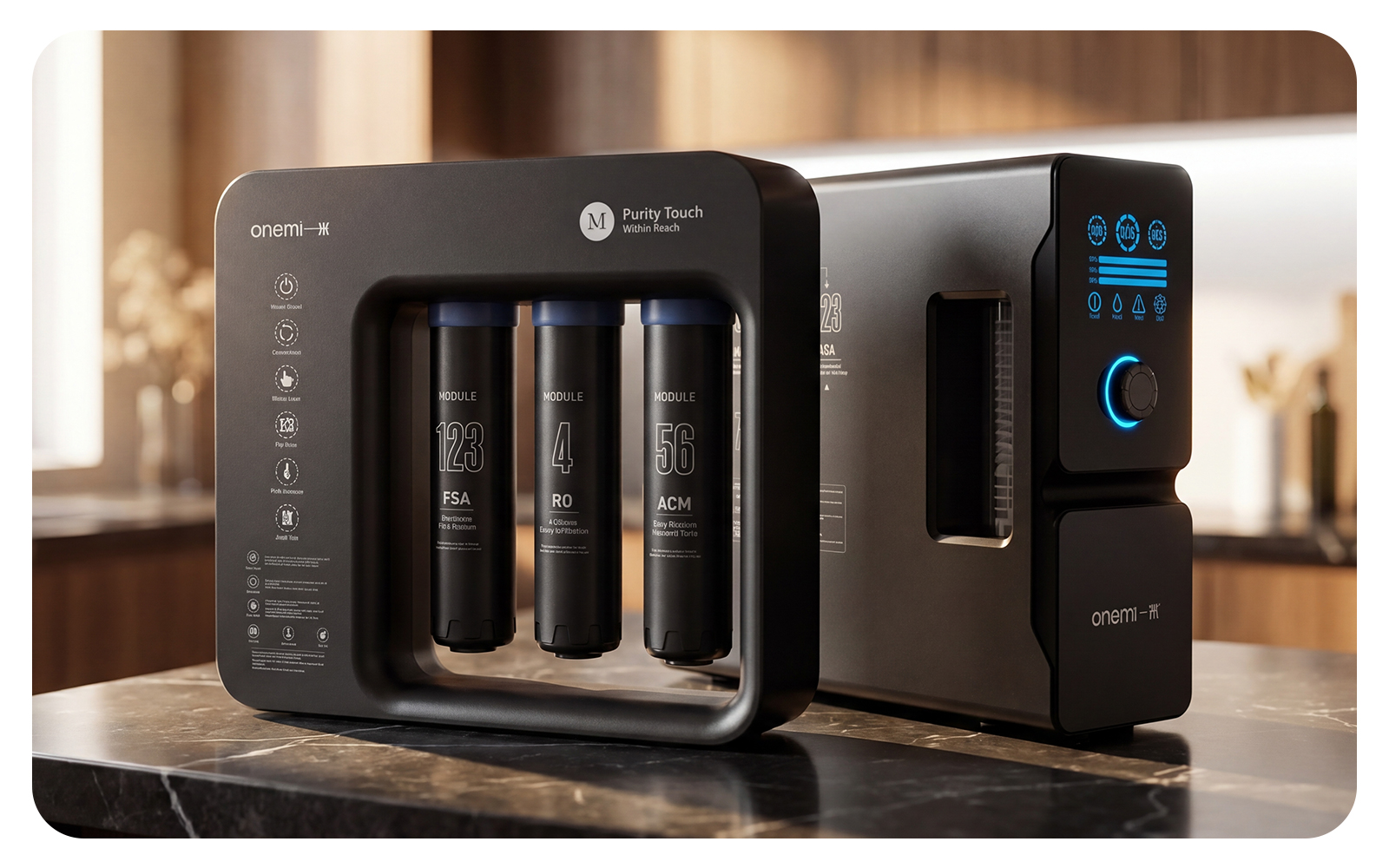
Maintenance is where the true cost of ownership hides. A cheap system with expensive replacement filters will cost you far more over three years than a premium system with long-lasting filters. Some brands, like ONEMI, design their systems with quick-twist filter cartridges that you can swap out in ten seconds without turning off your main water line or calling a plumber. Always calculate the projected filter replacement cost over a five-year period before making your final decision.
What to Look For Before You Buy
Before you pull out your credit card, you need to do a little homework on your home’s plumbing. First, find out your water pressure. Most under-sink RO systems need at least 0.14 to 0.4 MPa (20 to 60 PSI) to function correctly. If your pressure is too low, you will need to buy a system with a built-in booster pump, which will require an active electrical outlet under your sink. Make sure you actually have a power outlet down there; it’s a massive pain to discover you need to run extension cords through your cabinetry on installation day.
Next, think about your daily water usage patterns. If you have a busy household with four or five people constantly filling up water bottles, cooking pots, and pet bowls, a tankless RO system with a high flow rate (at least 800 GPD to 1000 GPD) is a lifesaver. It filters water on demand, so you never run out of clean water. If you live alone or with a partner in a small apartment, a compact 400 GPD system or even a high-end countertop unit will serve you perfectly without taking up precious cabinet space.
Finally, pay attention to smart features that actually add value rather than just inflating the price tag. Look for a faucet with an integrated TDS display. This gives you an instant, real-time reading of your water quality every time you turn on the tap, letting you know exactly when the filters are losing efficiency. Some systems also feature automatic flushing cycles that run clean water through the membrane when the system has been idle for a few hours. This simple feature prevents bacteria from building up on the clean side of the membrane and significantly extends the lifespan of your expensive RO filters.
Investing in a solid water filtration setup isn’t about chasing laboratory-grade perfection. It’s about building a reliable, low-maintenance barrier between your family and the unpredictable realities of municipal plumbing. Once you match the right technology to your local water conditions and your household’s daily flow requirements, you can stop worrying about what’s coming out of your tap and just enjoy clean, crisp water whenever you need it.