

 한국어
한국어

Executive Summary
- Disaster scenarios demand a minimum of 8 liters of potable water per person daily, far exceeding standard civilian storage capacities.
- Traditional gravity filters fail against dissolved chemical contaminants and brackish water intrusion common in coastal flooding.
- Mobile, low-voltage reverse osmosis systems provide the only reliable barrier against both biological pathogens and dissolved industrial toxins.
When a municipal water grid collapses, the clock starts ticking immediately.
Most emergency managers rely on a standard calculation: three days of stored bottled water. This assumption falls apart within the first forty-eight hours of a real-world grid failure. Roadways are blocked, supply chains freeze, and the physical reality of hauling hundreds of gallons of water to a field operations base becomes a logistical nightmare. The World Health Organization estimates that individuals require a bare minimum of about 8 liters of clean water daily just to maintain basic hydration and hygiene during severe emergencies. When you multiply that by a team of twenty field responders over a two-week deployment, you are looking at over two thousand liters of water. That is more than two metric tons of cargo space dedicated solely to hydration.
The alternative is sourcing water on-site from ponds, rivers, flooded ditches, or brackish wells. However, raw surface water in a disaster zone is a toxic cocktail of agricultural runoff, industrial chemicals, heavy metals, and pathogenic organisms. Relying on basic filtration methods in these scenarios is a gamble with high stakes. To survive and operate in compromised environments, disaster response teams must transition from passive water storage to active, high-tier on-site purification.
The Brutal Reality: Gravity Bags vs. Mobile Reverse Osmosis

Many emergency kits rely on simple gravity-fed hollow fiber membrane filters. While these devices are lightweight and highly effective at removing bacteria like E. coli and protozoan cysts, they possess a critical, potentially fatal vulnerability. They cannot filter out dissolved solids, heavy metals, volatile organic compounds, or viruses. In a flood scenario, agricultural pesticides and industrial solvents wash directly into the water table. A gravity filter will yield clear-looking water that remains highly toxic.
This is where the stark contrast between mechanical filtration and high-pressure desalination becomes clear. True reverse osmosis forces water molecules through a semi-permeable membrane with pore sizes of approximately 0.0001 microns. This process strips away up to 99% of all dissolved solids, including sodium, lead, arsenic, and microplastics. It is the difference between merely straining out mud and physically reconstructing chemically pure water from a contaminated source.
To understand the operational differences between these two methodologies, consider this direct comparison:
| Operational Parameter | Standard Gravity Filtration | High-Pressure Mobile RO Systems |
|---|---|---|
| Pore Size (Microns) | 0.1 to 0.2 microns | Approximately 0.0001 microns |
| Virus Removal Rate | Ineffective (requires chemical post-treatment) | >99.99% physical rejection |
| Chemical & Heavy Metal Rejection | 0% (passes directly through membrane) | 95% to 99% rejection rate |
| Source Water Versatility | Freshwater only (low turbidity required) | Freshwater, brackish water, and highly turbid floodwater |
| Daily Output Potential | Approximately 20 to 50 liters (highly dependent on gravity head) | Up to 1,000+ liters (continuous motorized pumping) |
| Operational Footprint | Slow, manual setup, requires hanging height | Rapid deployment, self-priming, pressurized output |
Relying solely on gravity filtration in an urban flooding scenario is a recipe for systemic organ damage. If the water source contains dissolved road salts, fuel residues, or industrial run-off, passive filtration will let those contaminants pass straight through to the user.
The Power Bottleneck in Field Operations
High-pressure reverse osmosis requires energy. Historically, this meant hauling heavy gasoline generators or relying on complex 110V AC power systems that are highly vulnerable to water damage and difficult to run off portable solar arrays. In a true field operation, every watt of power must be accounted for. If your water purification system requires a generator that consumes 2 liters of fuel per hour, you have simply traded a water logistics problem for a fuel logistics problem.
The solution lies in low-voltage DC engineering. Modern emergency water purification has shifted toward 12V DC power architectures. A 12V DC system can run directly off a vehicle’s cigarette lighter, a portable lithium battery pack, or a folding solar panel. This eliminates the energy conversion losses associated with DC-to-AC inverters, which typically waste up to 20% of your battery capacity as heat.
We saw this exact failure mode play out during a field training exercise in the swampy backwaters near Savannah, Georgia. A response team brought a high-end 110V AC filtration rig. Within twelve hours, their generator suffered a carburetor clog from humid, dusty air, rendering their primary water source useless. A compact 12V system running off a simple deep-cycle marine battery kept another team hydrated for four days without a single hiccup. This is why field-hardened operators prioritize simplicity and direct DC power over raw wattage.
A major design hurdle with portable RO systems is weight. Standard industrial RO units utilize heavy stainless steel housings and massive high-pressure pumps. For field operations, these setups are practically useless. The sweet spot for disaster response is a self-contained unit weighing under 15 kilograms. This allows a single operator to carry the system over rough terrain, drop the intake hose into a contaminated pool, and begin producing clean water within three minutes.
Critical Checklist for Tactical Water Systems
If you are evaluating water purification hardware for a disaster preparedness plan, you must look past the marketing brochures. Many systems designed for recreational RV use are marketed as “emergency ready” but lack the rugged construction required for survival scenarios. Use this technical checklist to grade any system before deploying it into the field:
- Multi-Stage Pre-Filtration: Raw water must pass through a sediment pre-filter (ideally 5 microns or less) and an activated carbon block before it ever touches the RO membrane. Without this, suspended solids will clog the expensive RO membrane within hours, rendering the system useless.
- Self-Priming High-Pressure Pump: The system must be able to draw water upward from a source at least 2 meters below the unit. Manual priming in a disaster zone is tedious and introduces contamination risks.
- Real-Time TDS Monitoring: You cannot determine water safety by sight or smell. A reliable system must feature an integrated Total Dissolved Solids (TDS) meter to verify that the membrane is actively rejecting salts and heavy metals.
- Ruggedized, IP-Rated Enclosure: The internal pumps, wiring, and electronics must be housed in a shockproof, water-resistant case (such as a Pelican or similar heavy-duty shell) that can survive drops, heavy rain, and rough transport.
- Standardized Quick-Connect Fittings: Proprietary hose connections are a massive liability. Look for systems that utilize industry-standard quick-connect fittings, allowing you to easily source replacement hoses or bypass components in the field.
Can your team service the unit in pitch-black conditions while wearing gloves? If the answer is no, the system is a liability, not an asset.
During a prolonged power outage, municipal water treatment plants lose pressure, allowing groundwater to seep into cracked delivery pipes. This means even the tap water in your home or office can become a vector for waterborne pathogens within hours of a grid failure. Having an ONEMI system ready to deploy at a central community hub can prevent widespread outbreaks of waterborne illnesses.
The Operational Reality of Membrane Maintenance
Here is a counter-intuitive finding that catches many off guard: the greatest enemy of an emergency water purifier is not dirty water, but storage. When a reverse osmosis membrane sits idle after its first use, residual moisture inside the housing becomes a breeding ground for bacteria and mold. Within weeks, a bio-film will grow over the membrane surface, permanently ruining its filtration capacity and creating a foul odor.
To prevent this, any high-quality mobile purification system must be flushed with clean water after every use. For long-term storage, the membrane must be preserved using a food-grade chemical preservative (such as sodium metabisulfite) to inhibit biological growth. This is a critical step that many casual preppers overlook. They buy a premium system, test it once with tap water, throw it in a closet for two years, and then find it completely seized up and contaminated when a real emergency strikes.
Furthermore, you must understand the limits of reverse osmosis technology. While RO is incredibly powerful, it cannot filter out volatile organic compounds (VOCs) like benzene or certain agricultural herbicides on its own. These tiny chemical molecules are often smaller than water molecules and can slip through the RO membrane. This is why a secondary activated carbon post-filter is non-negotiable. The carbon block chemically adsorbs these volatile compounds, acting as a final polishing stage to ensure the water is not only safe but actually drinkable.
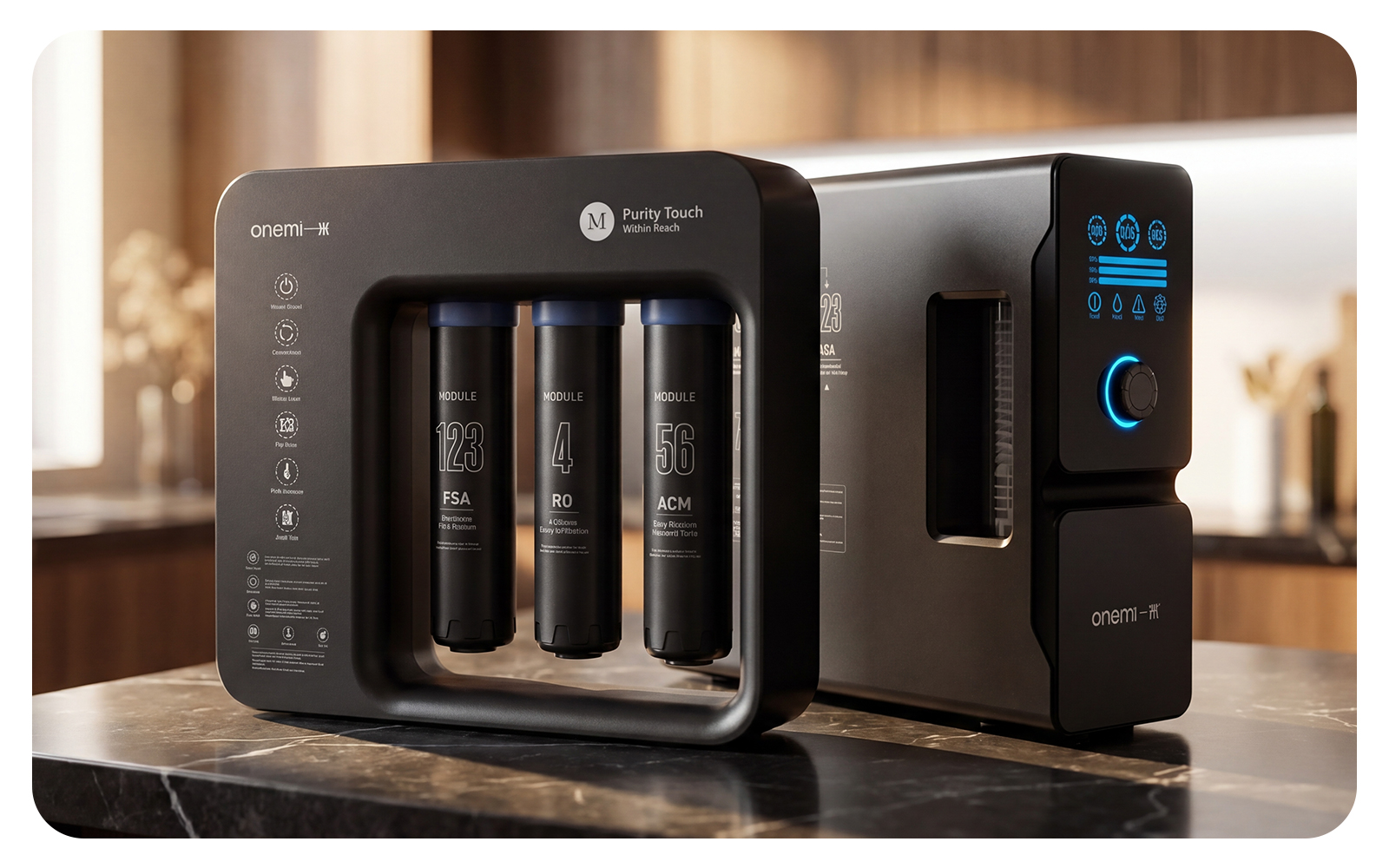
When selecting gear, look for brands like ONEMI that integrate these multi-stage filtration pathways into a single, cohesive workflow. This level of engineering ensures that you do not have to piece together separate filters, pumps, and power supplies under high-stress conditions.
Designing a Resilient Water Strategy
Relying on a single source of water or a single purification method is a single point of failure. A resilient disaster response plan utilizes a tiered approach to water security.
Your first tier should always be immediate, stored clean water for the first twenty-four hours. This covers the chaotic initial phase of any disaster when teams are setting up shelters and establishing communications. The second tier is your high-capacity mobile purification system, such as a 12V RO unit, which can be deployed near a local surface water source to establish a continuous supply. The third tier consists of individual, portable gravity or chemical treatment options for personnel operating away from the main base.
By structuring your water preparedness around this multi-layered framework, you eliminate the panic of supply chain disruptions. You stop worrying about when the next water truck will arrive because you have transformed your team into an independent water utility. In the harsh reality of field operations, self-reliance is the only true security. Investing in rugged, low-voltage reverse osmosis technology ensures that no matter how compromised the local environment becomes, your team will always have access to the most fundamental element of survival: pure, safe water.
When the grid goes dark, clean water is not just a resource—it is the foundation of your entire operational capacity. Make sure your filtration technology is up to the task before the storm arrives.