


 한국어
한국어

Executive Summary
- Alkaline water typically features a stable pH of 8.0 to 9.5, enriched with vital trace minerals like calcium, magnesium, and potassium.
- The industry is experiencing a massive shift from high-voltage artificial electrolysis to natural, media-based mineral remineralization.
- Modern multi-stage systems successfully resolve the historical trade-off between aggressive purification and essential mineral retention.
For decades, municipal water treatment in developed markets has focused almost exclusively on a single goal: making tap water sterile and safe. This defensive approach succeeded in eliminating waterborne pathogens, but it left a massive, quiet void in the quality of daily hydration. The water flowing from modern kitchen taps is frequently stripped of its natural character, presenting an acidic or neutral profile that lacks the geological richness of natural spring sources. This structural deficit has sparked a profound shift in consumer expectations, driving the rapid rise of alkaline water systems across North American and European households.
Traditional water treatment systems, particularly standard reverse osmosis units, solve the contamination problem by stripping everything out of the water, down to the last dissolved solid. While this process guarantees purity, it introduces a secondary dilemma: the resulting water is highly aggressive, chemically unstable, and often exhibits a low pH. Consumers are increasingly realizing that pure water is not necessarily healthy water. The modern residential filtration market is no longer just about removing the bad; it is about actively restoring the good.
This transition marks the beginning of the alkaline water movement, a trend that has evolved from a niche wellness fad into a scientifically backed segment of the water treatment industry.
The Great Divide: Artificial Ionization vs. Natural Mineralization


The alkaline water market is split by two fundamentally different engineering philosophies. Understanding this divide is essential for anyone looking to navigate the modern filtration landscape.
On one side of the market sit electronic water ionizers. These devices use high-voltage electrolysis plates, typically coated with platinum or titanium, to physically split water molecules apart. By running an electric current through tap water, these systems force a temporary separation of acid and alkaline ions, sending the alkaline stream to the drinking faucet and discharging the acidic stream down the drain. This process produces a high pH, but it is a highly unstable state. Because the alkalinity is driven by electrical charge rather than dissolved minerals, the pH of this water begins to drop almost immediately when exposed to air, often returning to its original state within a few hours. Furthermore, these machines require pre-filtered water that already contains a high level of dissolved solids to conduct electricity effectively, making them highly dependent on the inconsistent quality of local tap water.
In stark contrast, natural mineral remineralization mimics the earth’s hydrological cycle. Instead of forcing a change through electrical current, water slowly flows through specialized media beds containing bioceramic stones, calcified seaweed, and natural magnesium-rich deposits. As the water passes through, it gently dissolves microscopic amounts of calcium, magnesium, potassium, and silica. This process creates a naturally buffered alkaline water with a stable pH that does not degrade over time. The alkalinity is bound to physical minerals, meaning your body actually absorbs these essential electrolytes with every sip.
Let us look at how these two approaches compare across key performance metrics:
| Feature / Metric | Electronic Ionization (Artificial) | Mineral Remineralization (Natural) |
|---|---|---|
| Primary Mechanism | High-voltage electrolysis plates | Bioceramic and natural mineral media |
| pH Stability | Unstable (decays within 12 to 24 hours) | Highly stable (lasts for weeks in storage) |
| Mineral Content | Unchanged from incoming source water | Enriched with Calcium, Magnesium, Silica |
| Electricity Required | Yes (requires continuous power source) | No (functions purely on water pressure) |
| Wastewater Generation | High (continuous acidic stream discharge) | Zero (all water processed is utilized) |
| Initial Equipment Cost | Very High (typically $1,500 to $4,000) | Moderate (typically $200 to $600) |
The market has spoken clearly on this comparison. The complexity, high failure rate, and extreme cost of electronic ionizers have caused their market share to shrink. Meanwhile, natural remineralization has become the gold standard for residential water purification, offering a more reliable, sustainable, and cost-effective path to clean, mineral-rich water.
The Mineral Matrix: Why Calcium and Magnesium Matter
To understand the true value of alkaline water, we have to look past the marketing buzzwords and focus on the chemistry. The pH scale is logarithmic, meaning that water with a pH of 9 is ten times more alkaline than water with a pH of 8, and a hundred times more alkaline than neutral water at pH 7. But pH alone is a shallow metric. A high pH achieved by adding sodium bicarbonate (baking soda) to water is chemically very different from a high pH achieved through natural geological contact.
True, high-quality alkaline water is defined by its mineral matrix. When water passes through high-purity calcium carbonate and magnesium oxide media, a natural chemical exchange occurs. The water dissolves tiny, bioavailable amounts of these minerals, releasing calcium ions (Ca2+) and magnesium ions (Mg2+), along with carbonate and hydroxyl ions. These ions act as chemical buffers, neutralizing acidic compounds in the water and raising the pH to a stable range of 8.0 to 9.5. This mineral composition is what gives natural spring water its smooth, slightly sweet mouthfeel, a stark contrast to the flat, metallic taste of highly acidic reverse osmosis water or the harsh, chemical taste of artificially ionized water.
In places like Southern California, where municipal water systems often rely on heavily treated Colorado River water, the mineral balance is highly artificial and often tastes heavily of treatment chemicals. Homeowners in these areas who switch to a natural remineralization system frequently report a dramatic improvement in taste, describing the water as “soft” and “crisp” because the natural mineral balance has been restored. This is not just a subjective preference; it is a physiological response. Our bodies are naturally wired to seek out and enjoy water that contains the essential minerals we need to survive.
Overcoming the Reverse Osmosis Dilemma
For years, the water treatment industry faced a frustrating paradox. Reverse osmosis (RO) was universally recognized as the most effective technology for removing dangerous contaminants like lead, arsenic, PFAS, and microplastics. Yet, the very efficiency that made RO so good at purification also made it highly destructive to water quality. By forcing water through a semi-permeable membrane with pores as small as 0.0001 microns, RO systems strip away up to 99% of all dissolved solids, including the beneficial minerals that give water its structure and taste.
The result is “hungry” water. Because this water is completely devoid of dissolved solids, it is chemically unstable and highly aggressive. When exposed to air, it rapidly absorbs carbon dioxide, forming carbonic acid and dropping the pH down into the 5.5 to 6.5 range. When consumed, this acidic, demineralized water can actually leach minerals from the body’s tissues, particularly from the teeth and bones, to balance its own chemical state. Furthermore, cooking with demineralized water has been shown to strip up to 60% of the essential minerals out of vegetables, pasta, and meats during the boiling process.
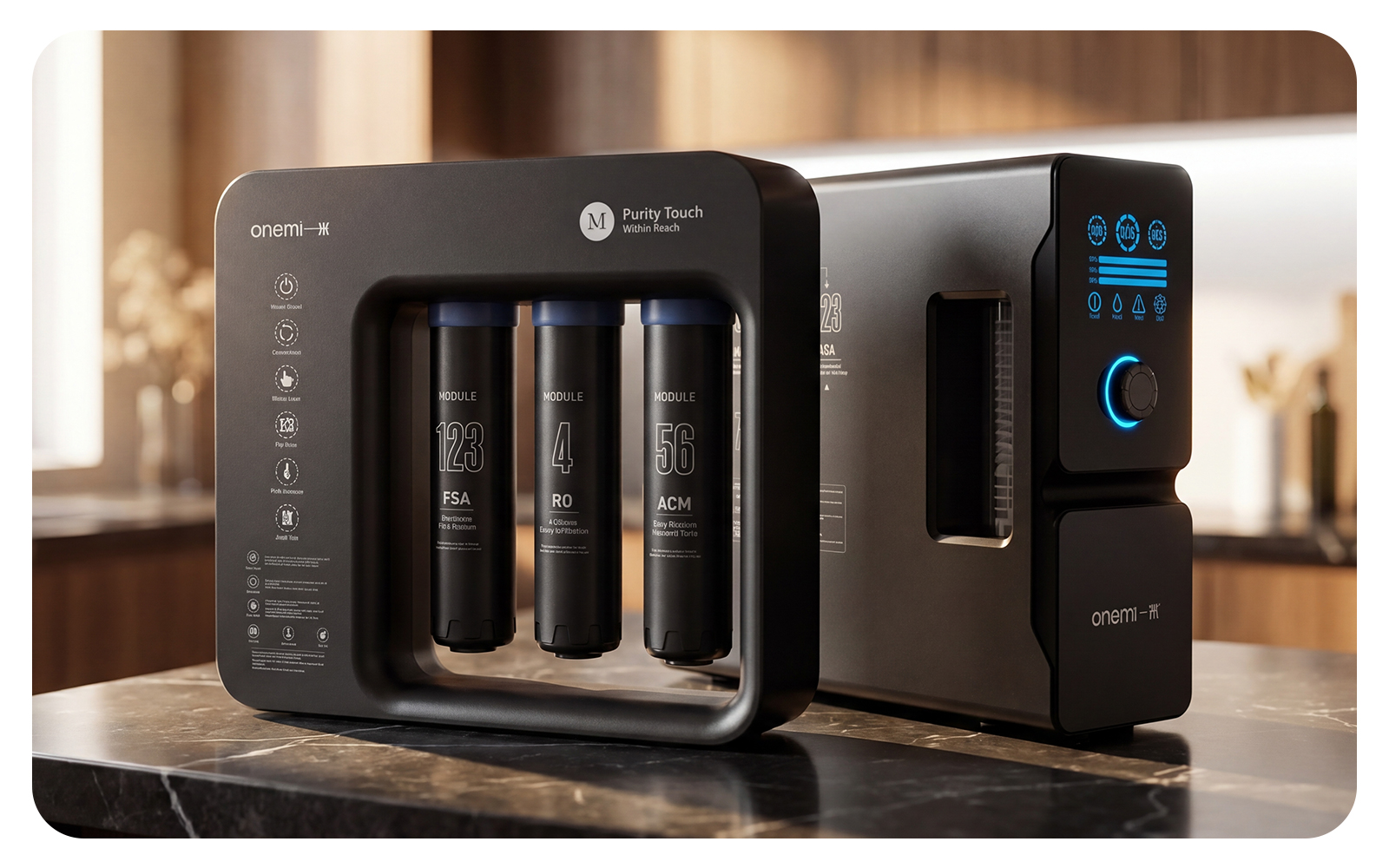
The solution to this dilemma is not to abandon reverse osmosis, but to complete the process. This is where advanced engineering from brands like ONEMI comes into play. By integrating a multi-stage natural remineralization filter directly after the reverse osmosis membrane, modern systems create a closed-loop process that first purifies water to absolute safety, and then immediately rebuilds it to optimal health. Water passes through the RO membrane to remove every trace of industrial pollution, and then immediately flows through a sophisticated bed of bioceramic stones, calcified minerals, and coconut shell carbon. This restored water emerges perfectly pure, deeply hydrated, and enriched with a balanced matrix of calcium and magnesium.
This combined approach represents the pinnacle of modern residential water treatment, ensuring that consumers no longer have to choose between purity and health.
The Hidden Realities of Alkaline Filter Maintenance
No water filtration technology is magic, and natural remineralization filters are no exception. One of the most common industry oversights is failing to explain how these systems actually degrade over time. Unlike a standard sediment filter, which simply clogs up when it is full, a remineralization filter works by slowly dissolving its own media into the water. This means the filter is constantly changing shape and volume on a microscopic level.
Over several months of heavy use, the water channels through the mineral media can become uneven, a phenomenon known in water chemistry as “channeling.” When this happens, water finds the path of least resistance, rushing through a few narrow gaps in the media rather than filtering evenly through the entire bed. This reduces the contact time between the water and the minerals, leading to a gradual drop in both the pH and the mineral richness of the output water. To prevent this, high-quality alkaline systems use internal flow restrictors and specialized baffling to force water into a spiral flow pattern, ensuring even wear and consistent mineral release across the entire lifespan of the cartridge.
Another critical factor is the contact time. If a system sits unused overnight, the water resting inside the remineralization chamber has hours to absorb minerals, resulting in a highly concentrated, high-pH first glass of water in the morning. Conversely, if you run fifty gallons of water through the system continuously to fill a backyard pool, the water will pass through too quickly to absorb significant amounts of minerals, resulting in a lower pH. Understanding these physical limits is essential for setting realistic expectations. A high-quality alkaline filter is designed to deliver its optimal pH and mineral balance under normal, daily household flow rates, typically ranging from 0.5 to 1.0 gallons per minute.
By understanding these subtle dynamics, consumers can make informed decisions, ensuring their home systems deliver pristine, mineral-rich alkaline water for years to come.