



 한국어
한국어

Executive Summary
- If you live in the South East, London, or East of England, your sediment pre-filter works harder than anywhere else in the UK — Thames Water alone reports hardness levels exceeding 300 mg/l CaCO₃ across its entire supply region.
- Backwashing models flush trapped sediment automatically every few days using reverse water flow; manual filters require you to unscrew the housing and rinse or replace the cartridge by hand.
- For most UK homes on municipal supply, a 40-micron sediment pre-filter cleaned monthly — whether backwash or manual — will protect downstream appliances and extend the life of your RO membrane by 12-18 months.
21% of UK homes sit in hard water zones where calcium carbonate levels top 200 mg/l, according to Thames Water’s 2025 quality report. That chalky residue you scrub off the kettle is the same stuff clogging your sediment pre-filter right now — only you cannot see it, because it is buried inside a blue plastic housing under the kitchen sink or out in the garage. A clogged sediment filter does not announce itself with a warning light. Instead, the shower pressure drops, the washing machine takes longer to fill, and eventually the RO membrane downstream gets punched full of silt it was never designed to handle.
The fix is not complicated. You have two choices: a backwashing pre-filter that cleans itself on a timer, or a manual cartridge housing you open and rinse with your own hands. This article walks through what each option costs, how often you need to maintain it, and which one makes sense for the water coming out of your specific UK tap.
What a Sediment Pre-Filter Actually Catches
A sediment pre-filter sits at the point where the mains water pipe enters your property — before it splits off to the boiler, the bathroom, the kitchen cold tap, and any downstream water treatment kit like a reverse osmosis system. Its only job is physical: trap particles big enough to see and feel. We are talking sand, rust flakes from ageing iron pipework, silt stirred up during water main repairs, and the fine grit that utilities cannot fully remove at the treatment plant.
The filtration mesh on most domestic units is rated at 40 microns. For reference, a grain of table salt sits around 100 microns. Anything above 40 gets caught. Anything below — dissolved minerals, chlorine, bacteria — passes straight through to the next stage in the chain. This is not a drinking water filter. It is a mechanical shield for everything that comes after it.
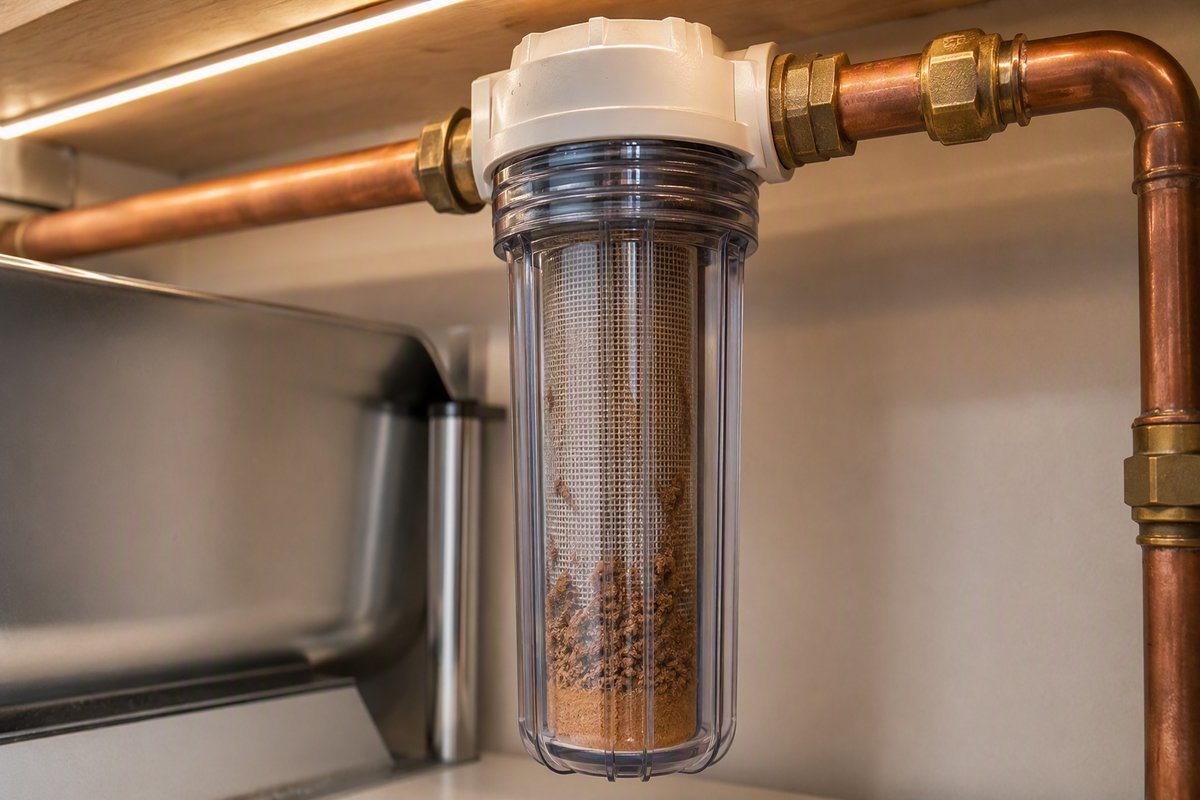
In UK homes, the sediment load varies dramatically by postcode. If your water comes from a surface reservoir in Scotland or Wales, the particulate count is negligible — rainwater runs off granite and peat, picking up almost nothing solid. If you are on a chalk aquifer borehole in Kent or Sussex, the water picks up fine calcium carbonate particles on its way through the rock. These particles are not harmful to drink, but they settle inside filter housings, boiler heat exchangers, and washing machine inlet valves as a hard, cement-like crust.
Backwashing vs Manual: How Each One Works
Manual Cartridge Filters
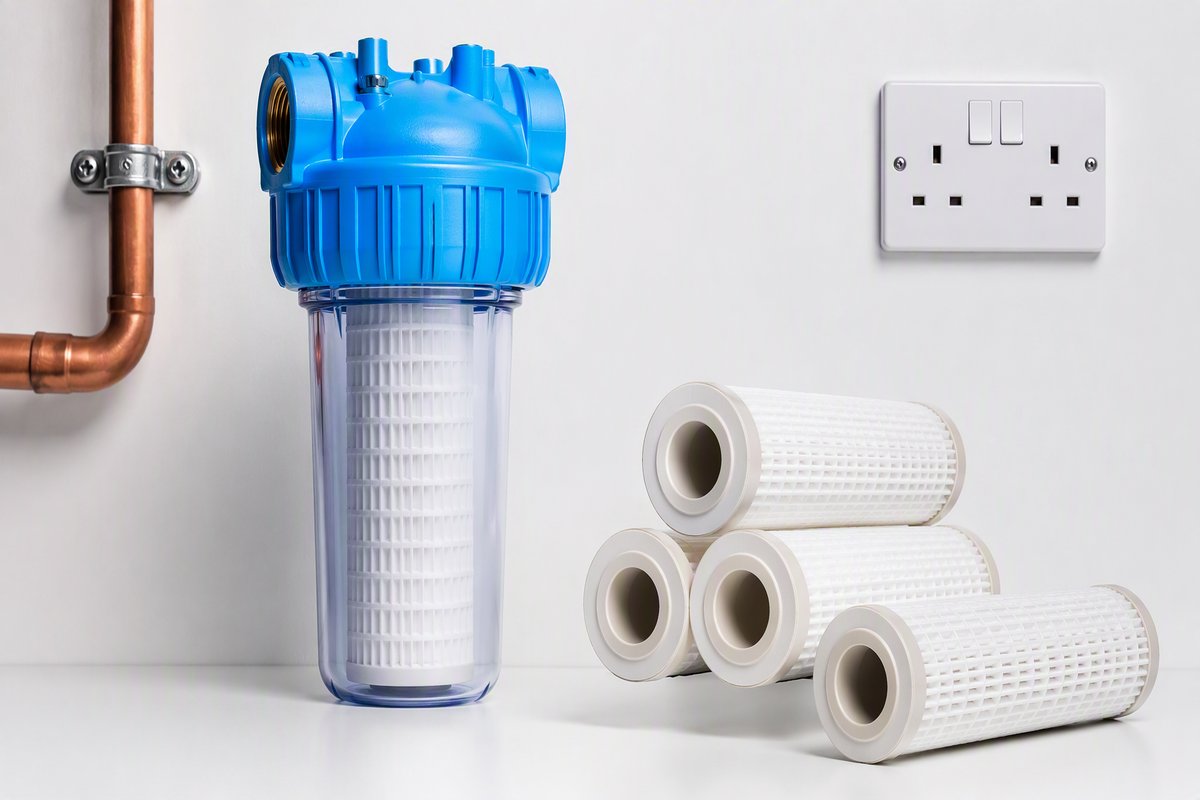
This is the simpler design. A cylindrical filter cartridge — usually pleated polyester or spun polypropylene — sits inside a screw-on plastic housing. Water enters the housing, passes through the cartridge wall from outside to inside, and exits clean. The captured debris stays on the outer surface of the cartridge.
Maintenance means turning off the water, unscrewing the housing with a spanner, pulling out the dirty cartridge, and either rinsing it under a tap or replacing it entirely. A rinseable pleated cartridge might last 12-18 months with monthly cleaning. A disposable spun cartridge needs swapping every 6-12 months depending on water quality. Cost per replacement cartridge: £8-20. The housing itself typically lasts 5-10 years.
The upside is straightforward: no electricity, no drain connection, no programming, and no moving parts. A plumber can install one in under an hour. The downside is equally straightforward: you have to remember to do it. Most people do not. A survey by Checkatrade in 2025 found that 64% of UK homeowners with whole-house water filters had not serviced them in the previous 18 months.
Backwashing Pre-Filters
A backwashing sediment filter uses the same 40-micron mesh, but adds a motorised valve and a timer. Every few days — typically at 2:00 AM when nobody is using water — the valve reverses the flow direction. Instead of water entering from the outside and passing through to the centre, clean water pushes from the inside out, blasting trapped sediment off the mesh and flushing it down a dedicated drain line.
A full backwash cycle runs 30-90 seconds and uses about 15-25 litres of water. At UK water rates averaging £1.50 per cubic metre, that works out to roughly £0.03 per cycle, or about £5-6 per year. The mesh itself needs replacing roughly every 5-7 years, and the control valve carries a typical 3-5 year warranty.
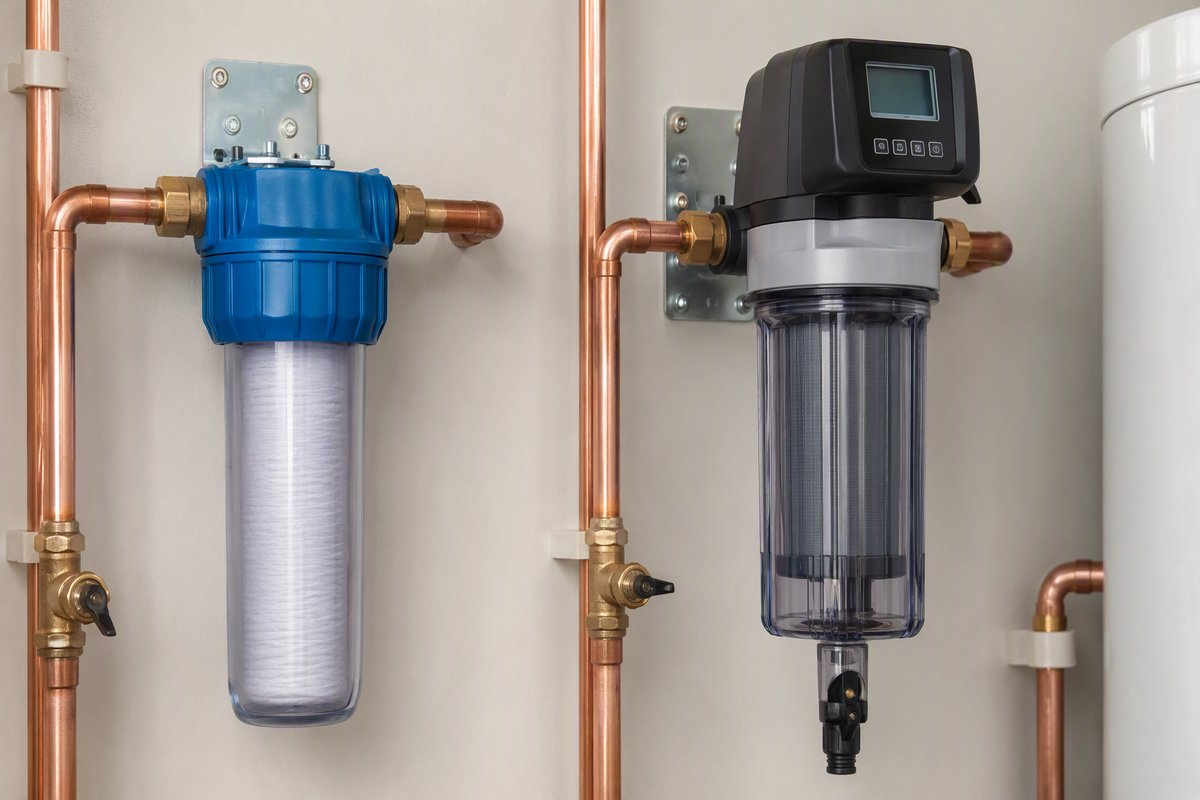
Installation is more involved. You need a nearby electrical socket for the timer motor, plus a drain connection — either a standpipe, a washing machine waste trap, or an outside drain. If your stopcock lives in a ground-floor cupboard with no power and no drain within reach, a backwashing unit is not happening without some serious replumbing.
The key advantage is consistency. The timer does not forget. The mesh stays clean, which keeps the water pressure steady and prevents the filter from becoming a bottleneck. For homes with visibly turbid water — brown after a mains flush, gritty residue in the bath — a backwashing unit is the only option that keeps up without weekly manual intervention.
UK Regional Breakdown: How Often You Really Need to Clean It
Filter maintenance schedules are not one-size-fits-all. A homeowner in Glasgow and a homeowner in Guildford are dealing with fundamentally different water chemistry. Here is what the geology under your feet means for your pre-filter:
- South East, London, East Anglia: Hard to very hard water (200-350 mg/l CaCO₃). Chalk and limestone aquifers shed fine calcium carbonate particles continuously. These particles are small — often below 30 microns — but they accumulate fast. Manual cartridges need rinsing every 4-6 weeks. Backwashing units should be set to cycle every 3-4 days.
- Midlands, Yorkshire, parts of the South West: Moderately hard (100-200 mg/l). Mixed geology with some sandstone and limestone. Sediment load is moderate. Manual cleaning every 8-12 weeks; backwash every 7 days.
- Scotland, Wales, North West, Devon/Cornwall: Soft water (below 100 mg/l). Granite and peat catchments produce very little suspended solid. Manual cleaning every 4-6 months; backwash every 10-14 days — or honestly, you might not need a sediment filter at all unless you are on a private supply.
One practical shortcut: if your filter housing is transparent, look at the mesh. When a visible brown or rust-coloured ring forms around the cartridge surface, it is time to clean. No calendar required.
What Happens When You Ignore It
Three things, in order:
Pressure drop. A clogged sediment filter restricts flow to the whole house. You will notice it first in the shower — the spray pattern weakens, the temperature fluctuates when someone turns on the kitchen tap. The pressure gauge on the filter housing (if fitted) will show a drop of 0.5 bar or more between inlet and outlet.
Cascade failure. As the pressure differential grows, particles that would normally lodge on the filter surface get forced through the mesh. They hit the activated carbon stage of your whole-house system, clog the pores, and cut the carbon’s effective lifespan by 30-50%. If you have an RO membrane downstream, sediment scoring the membrane surface reduces output and shortens membrane life — a £40 membrane replaced a year early because of a £10 filter cartridge that was not changed.
Bacteria risk. A stagnant, debris-loaded filter housing sitting at ambient temperature for months is an ideal breeding ground for heterotrophic bacteria. This is the main reason manufacturers put a 6-month maximum on cartridge changes regardless of visual condition. The filter is not sterile, and the longer organic material sits in warm water, the more things grow in it.
Cost Comparison Over 5 Years
UK prices include installation by a qualified plumber. Figures are averages based on quotes from rated Checkatrade and Which? Trusted Trader installers in 2025-2026.
| Cost Factor | Manual Cartridge | Backwashing Unit |
|---|---|---|
| Unit price | £40-90 | £180-350 |
| Installation | £80-150 | £180-300 (requires electrical + drain) |
| Annual consumables | £16-40 (cartridges) | £5-6 (water) |
| Mesh/cartridge lifespan | 6-12 months | 5-7 years |
| 5-year total (incl. install) | £200-440 | £385-680 |
| Labour over 5 years | DIY monthly + plumber callout if stuck housing | Annual valve check, otherwise hands-off |
The numbers make the manual option look cheaper on paper. But they assume you actually do the maintenance. If a neglected manual filter leads to a boiler heat exchanger scaling up and requiring a £300-500 repair, the backwashing unit suddenly looks like cheap insurance.
Which One for Your UK Home?
Pick a manual cartridge filter if:
- You live in a soft water area (Scotland, Wales, North West, Devon) and sediment load is light
- Your stopcock cupboard has no power socket and no drain within 2 metres
- You are physically able and willing to unscrew a filter housing every 4-12 weeks
- You rent the property and need something that can be taken with you or is cheap enough to leave behind — a point we cover in more depth in our guide to water filters in rental homes
Pick a backwashing unit if:
- You live in a hard water zone (London, South East, East Anglia, parts of the Midlands)
- You have visible sediment in your water — brown tint, grit in the bath, filter mesh clogging in under 3 weeks
- You have a power socket and a drain connection near the mains inlet — or are willing to pay a spark and a plumber to add them
- You want to protect a downstream investment: an RO system, a new combi boiler, or a whole-house carbon tank
- You know yourself well enough to admit that a monthly maintenance task will slide to quarterly, then annually, then never
The Middle Ground: Dual-Gradient Mesh Filters
There is a third category worth mentioning. Some manufacturers now offer pre-filters with a dual-gradient stainless steel mesh — an outer layer at 80-100 microns that catches the big stuff, and an inner layer at 40 microns for the fines. The outer layer takes the brunt of the load, which means the inner mesh stays cleaner longer and the backwash cycle can run less frequently. These sit in the £120-200 price bracket and are worth a look if your water carries a mix of coarse grit and fine silt, which is common in areas served by older cast-iron mains — parts of inner London, Birmingham, and Manchester still have Victorian-era pipes in the distribution network.
Installation: What a UK Plumber Will Actually Do
If you are having a sediment filter fitted as part of a larger water treatment install, the plumber will typically mount it on a bypass loop with isolation valves on both sides. This lets you shut off flow to the filter for maintenance without cutting water to the entire house. A bypass costs about £30-50 in extra fittings and is worth every penny the first time you need to change a cartridge at 10 PM on a Sunday.
For backwashing units, the drain line must be plumbed to a waste connection with an air gap — not directly into a soil pipe, which risks back-siphoning contaminated water into the filter. UK Water Regulations (WRAS) require a minimum 20mm air gap between the drain outlet and the receiving trap. A competent plumber knows this; if yours does not mention it, find a different plumber.
All plumbing work on the mains inlet must comply with the Water Supply (Water Fittings) Regulations 1999. The filter itself should carry WRAS approval — this is the UK-specific certification that confirms the materials in contact with drinking water meet British safety standards. Products carrying the CE marking alone are not automatically WRAS-compliant; check the manufacturer’s technical datasheet for explicit WRAS listing.
What ONEMI Brings to This
ONEMI manufactures sediment pre-filters in both manual and automatic backwashing configurations from a 12,000-square-metre facility in Guangdong. The filter mesh is 316L stainless steel — the same grade used in food processing equipment — with a 40-micron rating that balances particle capture against flow restriction. The automatic version runs a 3-second burst backwash cycle that uses less than 5 litres of water per cycle, which at UK water rates translates to under £2 per year in operating cost. The housing is transparent AS-grade plastic rated to 10 bar working pressure, so you can see the mesh condition without opening anything.
The units ship with UK-standard BSP threaded connections and include a pressure gauge, a bypass valve, and a wall-mounting bracket. Installation instructions are in English with metric measurements and WRAS-referenced air gap diagrams.
Maintenance You Can Actually Stick To
The best filter is the one you will maintain. Set a recurring calendar reminder. Stick a label on the housing with the install date and the recommended cleaning interval. If you choose a backwashing unit, test the drain line once a year — pour a cup of water down it to confirm it is not blocked by spiders, dust, or the miscellaneous debris that accumulates in utility cupboards.
And if your water comes out of the tap cloudy, or your shower head clogs with scale every six weeks, do not start with an expensive whole-house system. Start with a sediment pre-filter. It costs less than a good dinner out, and it protects everything downstream — including the equipment you have not bought yet.