


 한국어
한국어

A complete, off-grid solar Reverse Osmosis (RO) water purification setup capable of sustaining an entire household now costs less than $800 upfront. This is not a projected future estimate; it is the current reality for homeowners, homesteaders, and emergency prepared families across North America.
Executive Summary
- Modern residential solar RO units now cost under $800 all-in, delivering a complete payback in less than two years compared to buying bottled water.
- Energy-recovery mechanisms like rotary pressure exchangers cut system pump loads by 30% to 50%, allowing operations on minimal solar panel arrays.
- Off-grid water purification bypasses municipal infrastructure failures, providing a reliable defense against local groundwater contamination.
Two years ago, achieving this level of water independence required deep pockets, custom-engineered DC-to-DC converters, and a massive array of lead-acid batteries that took up half a utility shed. Today, the convergence of high-efficiency solar panels, low-voltage DC pumps, and advanced energy-recovery mechanisms has democratized clean water. If you are currently spending $35 a month on bottled water delivery or driving to a local retail water station with plastic jugs, you are paying a premium for a resource that you could harvest, purify, and store on your own property for a fraction of the long-term cost.
The Math Behind the Two-Year Payback
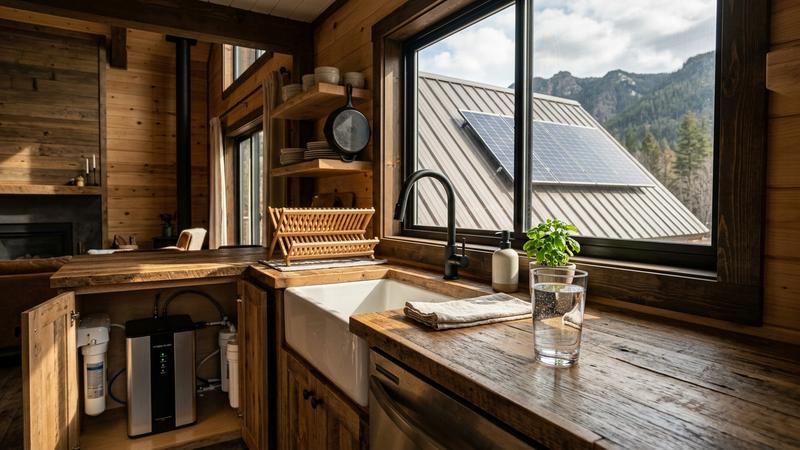
To understand how we arrived at a sub-$800 system price, we have to look at the plummeting cost of photovoltaic components and the optimization of small-scale RO membranes. Traditional water purification systems rely on high-pressure AC pumps that draw significant current during startup. This forced off-grid users to purchase oversized inverters and massive battery banks just to handle the surge. Modern setups bypass the inverter entirely, running highly efficient DC pumps directly from solar panels or small, lightweight LiFePO4 battery buffers.
Let us break down the actual hardware costs for a standard 100-gallon-per-day (GPD) off-grid solar RO setup:
| Component | Estimated Cost (USD) | Function |
|---|---|---|
| DC RO Purification Unit | $350 | Multi-stage filtration, membrane, and low-voltage pump |
| Solar Panels (2x 100W Monocrystalline) | $160 | Power generation under direct and partial sunlight |
| MPPT Charge Controller (20A) | $70 | Optimizes power transfer from panels to battery/pump |
| LiFePO4 Battery (12V 50Ah) | $120 | Provides power buffer for cloudy days and night operation |
| Storage Tank & Plumbing Fittings | $80 | Holds pressurized clean water for instant on-demand use |
| Total System Cost | $780 | Complete off-grid water independence |
Consider the financial reality of a typical family of four in the United States. Purchasing bottled water or 5-gallon carboys costs roughly $450 to $600 annually, depending on local rates and consumption habits. When you factor in the fuel and time spent transporting those heavy jugs, the real cost is much higher. By transitioning to a solar-powered RO system, the initial $780 investment is completely offset within 18 months. Beyond that point, your cost of producing clean, high-purity drinking water drops to virtually zero, save for the occasional pre-filter replacement every six months.
The Physics of Energy-Recovery in Small-Scale RO
Why did these systems use to cost thousands of dollars? The answer lies in the physics of reverse osmosis. To force water through a semi-permeable membrane and strip away dissolved solids, heavy metals, and pathogens, you must overcome the natural osmotic pressure of the water. For brackish well water or municipal tap water, this requires system pressures ranging from 50 to 80 PSI. For seawater desalinization, that pressure spikes to over 800 PSI.
Older systems achieved this by brute force, utilizing massive electric motors that consumed immense amounts of power. This is where modern engineering changed the game. By integrating miniature rotary pressure exchangers and energy-recovery loops, modern residential RO units capture the energy of the high-pressure waste stream (brine) and use it to help pressurize the incoming raw feed water. This simple mechanical recycling loop reduces the work the electrical pump has to do by 30% to 50%.
Because the pump draws significantly less current, the solar footprint shrinks dramatically. You no longer need a roof full of solar panels; a simple two-panel ground mount is more than enough to run the system while simultaneously charging a small battery backup. This efficiency breakthrough is what makes portable and cabin-scale solar water purification practical for everyday use.
A Critical Reality Check on Solar RO Systems
While the economics and physics of solar RO are incredibly compelling, we must address a major engineering limitation that most manufacturers gloss over: membrane fouling in high-iron or high-hardness source water.
If you pump raw water directly from a shallow well, pond, or rainwater collection tank straight into your RO membrane without adequate pre-treatment, your system will fail within weeks. High levels of calcium carbonate (hardness) or dissolved iron will rapidly deposit on the microscopic pores of the membrane, a process known as scaling. Once scaled, the membrane flow rate drops, system pressure spikes, and the pump will burn out trying to force water through a blocked barrier. To prevent this, your $800 budget must include or be paired with a robust pre-filtration strategy. This means using a dedicated sediment pre-filter to catch sand and rust, followed by an active carbon block to neutralize chlorine and organic compounds, and potentially a water softener or polyphosphate feeder if your raw water source is exceptionally hard.
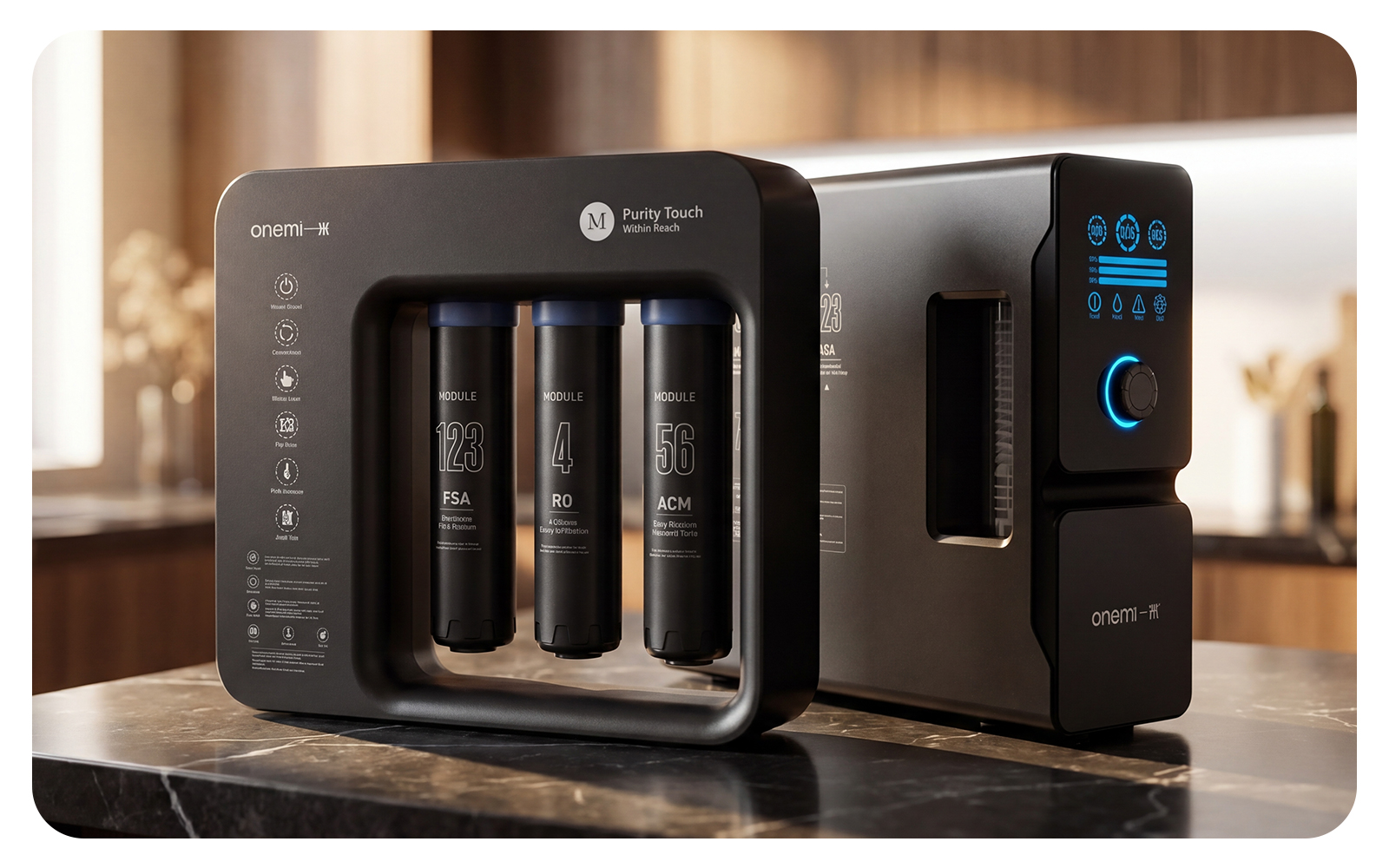
For those looking for a highly integrated, reliable solution that simplifies this entire process, ONEMI offers advanced multi-stage purification platforms designed to handle tough water conditions. By incorporating high-efficiency DC pumps and robust pre-filtration directly into their system designs, ONEMI units reduce the engineering guesswork for off-grid homeowners, ensuring that the delicate RO membranes are protected from premature fouling even when sourcing water from challenging environments.
Step-by-Step Off-Grid Installation Checklist
Setting up your own solar-powered water purification station is a straightforward weekend project if you follow a structured plan. Here is the exact checklist you need to follow to ensure a safe, efficient, and long-lasting installation:
- Evaluate the Source Water Quality: Before purchasing any hardware, test your raw water for Total Dissolved Solids (TDS), iron, pH, and hardness. This dictates whether you need extra pre-filtration stages before the RO membrane.
- Calculate Your Daily Water Budget: A standard human requires about one gallon of drinking and cooking water per day. Factor in pets and basic hygiene to determine if a 50 GPD, 100 GPD, or larger system is required.
- Position the Solar Array for Maximum Solar Insolation: Mount your panels in a location completely free of shadow from 9:00 AM to 4:00 PM. Tilt the panels to match your latitude for optimal year-round power generation.
- Install the Pre-Filtration Array: Mount your sediment and carbon block filters in an accessible location. These must be easy to service, as they require replacement every 6 to 12 months to protect the main RO membrane.
- Wire the DC Pump and Controller: Connect your solar panels to the MPPT charge controller, then connect the controller to the battery buffer. Run dedicated, fused DC lines from the battery to the RO high-pressure pump to prevent voltage drops.
- Establish the Waste Water (Brine) Runoff: RO systems produce a waste stream that carries away the concentrated impurities. Route this brine line to a dedicated drain, garden area (if the water isn’t too salty), or greywater reclamation system.
- Sanitize and Flush the System: Before drinking the first drop, run the system for at least two hours, discarding all produced water. This flushes out food-grade preservatives from the new RO membrane and sanitizes the plumbing lines.
Once these steps are complete, your off-grid homestead or emergency shelter will have a continuous, self-sustaining source of pure, pressurized drinking water that operates independently of the municipal grid, fuel supplies, or grocery store supply chains.