
 한국어
한국어

Last Tuesday, a homeowner in Warsaw’s Wilanów district watched a technician pull a thick, chalky cylinder of pure calcium carbonate from his three-year-old boiler heating element. The repair bill was exactly 1,420 PLN—nearly half the cost of a brand-new, high-efficiency water softener.
Most Polish households pay this “hard water tax” silently every single day without realizing it.
While the initial cost of installing a professional home water treatment system ranges from 150 PLN for basic under-sink systems to over 6,000 PLN for advanced multi-functional units, the real financial story lies in the hidden operational math. Hard water, which plagues over 70% of municipal and private well supplies in Poland, quietly inflates heating bills by up to 20% due to scale buildup on heat exchangers. When you calculate the true cost of ownership, ignoring water quality is actually the most expensive decision a homeowner can make.
Executive Summary
- The upfront cost of a water treatment system in 2026 ranges from 1,800 PLN to 4,500 PLN for standard family softeners, while complex multi-functional well water systems can reach 6,000 PLN.
- Operational expenses, including salt regeneration, water consumption during backwashing, and annual cartridge replacements, average between 350 PLN and 850 PLN annually.
- Implementing a dedicated system like an ONEMI water purifier protects expensive home appliances, cutting household detergent consumption by up to 50% and reducing heating energy losses.
The Real Cost of Hard Water in Polish Homes
Polish water quality standards, regulated by the Minister of Health, allow water hardness to range from 60 to 500 mg CaCO3 per liter. In practice, most regions in central, northern, and southern Poland suffer from medium to very hard water, frequently exceeding 300 mg CaCO3 per liter. This is not a health hazard, but it is a financial disaster for home infrastructure.
When hard water is heated above 55°C, calcium and magnesium ions precipitate, forming solid scale. A mere 1 mm layer of limescale on a heating coil acts as an thermal insulator, requiring 10% to 12% more energy to heat the same volume of water. For a family of four using a gas boiler or heat pump, this translates to an extra 400 to 800 PLN on annual energy bills. Add the accelerated wear on premium washing machines, dishwashers, and high-end thermostatic shower mixers, and the passive cost of untreated water quickly surpasses 1,500 PLN annually.
How much do you actually spend on soap, shampoo, and dishwashing liquids? Hard water neutralizes the active surfactants in detergents. You end up using up to twice as much product just to get a decent lather, sending money directly down the drain.
Complete Purchase and Installation Price List
The market in 2026 offers a wide spectrum of solutions depending on your specific water source. Municipal tap water primarily requires softening and chlorine removal, while private well water often demands complex filtration to remove high levels of iron, manganese, and hydrogen sulfide.
Below is a detailed breakdown of the capital expenditures required for different classes of water treatment systems, reflecting current market prices, high-quality components, and professional installation labor costs across Poland.
| System Type | Target Problem | Equipment Cost (PLN) | Installation Cost (PLN) |
|---|---|---|---|
| Inline sediment filters (Narurowe) | Sand, rust, physical particles | 150 – 450 | 200 – 400 |
| Standard Water Softener (Zmiękczacz) | Limescale, high calcium/magnesium | 1,800 – 3,800 | 500 – 900 |
| Multi-functional Filters (Zmiękczanie + Odżelazianie) | Hardness, iron, manganese, organics | 3,200 – 5,500 | 700 – 1,200 |
| Under-Sink Reverse Osmosis (RO) | Heavy metals, microplastics, chlorine, nitrates | 800 – 2,200 | 300 – 500 |
Professional installation is highly recommended for whole-house systems. A certified plumber must integrate the unit into your main water entry point, install a bypass valve system (crucial for servicing without shutting off water to the entire house), and route a drain line for the regeneration wastewater. Cutting corners here often leads to pressure drops or, worse, flooded utility rooms.
Annual Maintenance and Running Costs
A water treatment system is not a set-it-and-forget-it appliance. To maintain hygienic operation and ensure the ion-exchange resin or filtration media does not degrade prematurely, you must budget for ongoing maintenance.
For a standard 20-to-25-liter water softener operating in a household of four with water hardness of 300 mg CaCO3/l, the annual running costs break down into three main categories:
- Regeneration Salt: A typical system consumes about 1 bag (25 kg) of tablet salt every 4 to 6 weeks. At 45 to 60 PLN per bag, this totals approximately 450 to 720 PLN per year.
- Water for Backwashing: During regeneration, the system flushes the accumulated hardness ions down the drain. This process uses roughly 100 to 150 liters of water per cycle. Occurring every 7 to 10 days, this adds about 5 to 8 cubic meters of wastewater annually, costing around 60 to 110 PLN depending on local municipal water rates.
- Pre-filter Cartridge Replacement: The sediment pre-filter protecting the delicate control valve must be changed every 6 months to prevent pressure loss and bacterial growth. This costs between 40 and 100 PLN annually.
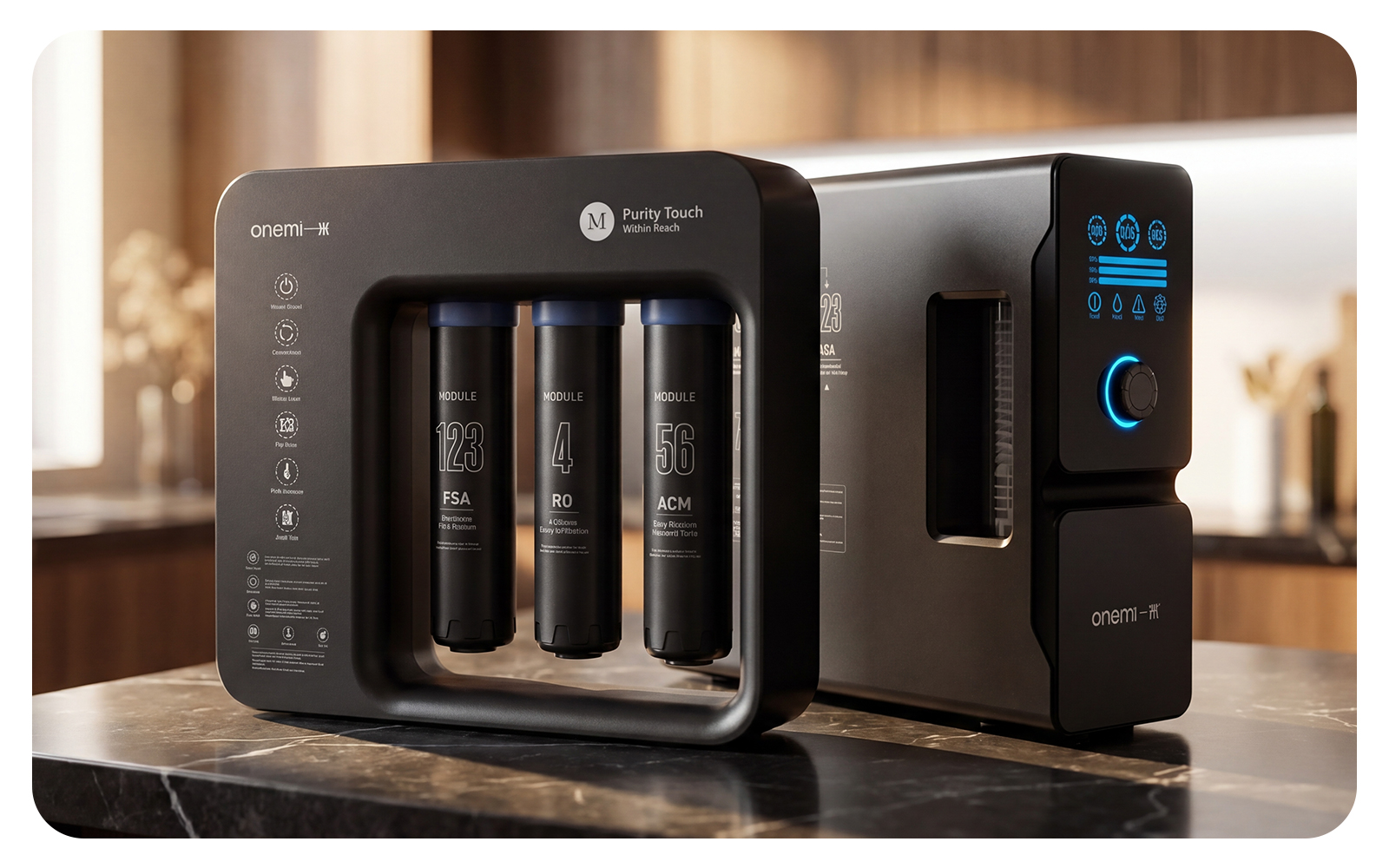
Integrating a high-efficiency drinking water solution like the ONEMI water purifier at the point of use can significantly optimize these ongoing costs. By combining whole-house softening with highly targeted, premium under-sink filtration, you protect your home infrastructure while securing bottled-quality drinking water for pennies per liter.
Annual professional servicing by an authorized technician is another cost to consider, usually running between 250 and 450 PLN. During this visit, the technician tests water hardness, sanitizes the resin bed, checks the control valve seals, and recalibrates the regeneration cycles to ensure optimal salt consumption.
Well Water vs. Municipal Water Challenges
Homeowners using municipal water systems have it relatively easy. The water is already microbiologically safe and free of heavy metals; your main goal is simply removing hardness and the unpleasant taste or smell of chlorine. A standard monosphere resin softener paired with an active carbon filter is highly effective and predictable in this scenario.
Private well owners face a completely different, highly volatile reality.
Well water often contains elevated levels of iron (exceeding the standard 0.2 mg/l) and manganese (exceeding 0.05 mg/l). These minerals cause stubborn rust stains on sanitary ware, ruin laundry, and clog plumbing lines with thick black sludge. You cannot use a standard water softener on water with high iron levels without destroying the ion-exchange resin within months. Instead, you need specialized catalytic iron removers (odżelaziacze) that oxidize dissolved iron into solid particles before filtration. Testing your well water at a certified laboratory (costing 200 to 400 PLN) is an absolute prerequisite before buying any equipment. Without a detailed chemical analysis, you are essentially gambling with your plumbing system.
How to Choose the Right System and Avoid Overpaying
The biggest mistake homeowners make is oversizing their system. A sales representative might try to sell a massive 30-liter softener to a couple living in a small house, claiming “more is always better.” It is not.
An oversized softener means water sits stagnant in the resin tank for too long, significantly increasing the risk of bacterial proliferation. It also leads to unnecessary salt and water waste during forced time-regeneration cycles. Conversely, an undersized system will regenerate too frequently, wearing out the mechanical control valve and causing annoying water pressure drops during peak usage times.
To calculate the precise size you need, multiply your daily water consumption (average is 150 liters per person) by your water hardness in French degrees (°f). A professional installer or reputable brand can use this exact mathematical load to recommend a system that operates at peak efficiency, saving you thousands of zlotys in salt and water over the system’s lifespan. Investing in a highly engineered ONEMI water purifier system guarantees that your drinking water filtration matches the exact physical parameters of your household, eliminating guesswork and preventing costly over-specification.