


 한국어
한국어

Open the cabinet beneath almost any suburban kitchen sink installed in the late 1990s or early 2000s, and you will find the same bulky, pressurized steel tank taking up nearly all the usable storage. For decades, traditional reverse osmosis systems relied on these 3-to-5-gallon holding bladders to slowly collect purified water, drop by drop, because their early membrane technology simply could not process water fast enough on demand.
Executive Summary
- Space Optimization: Tankless RO designs reclaim 40% to 60% of under-sink cabinet volume by eliminating bulky storage reservoirs.
- Water Efficiency: Advanced booster pumps and membrane chemistry achieve 75% to 80% recovery rates, reducing wastewater significantly.
- Contaminant Mitigation: High-output filtration addresses modern municipal and rural water threats, including PFAS, heavy metals, and microplastics.
This legacy setup created a silent, ongoing frustration for homeowners who wanted clean water but also needed space for trash cans, cleaning supplies, and kitchen organizers. Worse, those pressurized tanks hid a dark secret: stagnant water sitting in a dark, warm rubber bladder for days at a time, creating a prime breeding ground for bacterial biofilm. The industry needed a structural shift, which finally arrived with the development of high-flow, tankless membrane configurations.
The High-Volume Under-Sink Space Problem
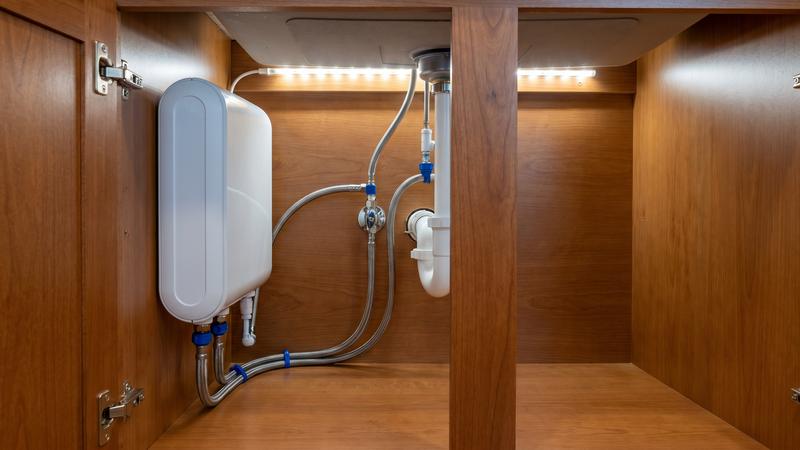
Modern residential architecture has shifted toward open-concept layouts and smaller, more efficient kitchens. In urban centers across North America, from high-rise apartments in Seattle to townhomes in Boston, cabinet footprint is premium real estate. A standard 30-inch base sink cabinet must accommodate garbage disposals, dishwasher drainage lines, hot water dispensers, and pull-out trash bins. Introducing a traditional 4-gallon RO tank, which typically measures 15 inches in height and 11 inches in diameter, effectively rendering the rest of the cabinet useless.
Beyond the physical footprint, the mechanical limitations of tank-based systems present a hidden economic cost. Traditional systems operate on a backpressure principle. As the storage tank fills, the backpressure against the RO membrane increases, which progressively slows down the filtration rate and increases the volume of water sent down the drain. By the time a traditional tank is 80% full, the system may be wasting up to 4 to 5 gallons of water for every single gallon of purified water stored.
Municipal water rates across the United States have risen by 30% to 45% over the past decade, making this level of water waste not only environmentally irresponsible but also financially draining. Homeowners are paying twice for their water: first when it enters the home through the municipal meter, and second when it is flushed directly into the sewer system as untreated concentrate. The tankless design solves this systemic inefficiency by removing the backpressure variable entirely from the filtration equation.
How Tankless RO Technology Works
To understand how a tankless system purifies water instantaneously without a storage reservoir, we must look at the fluid dynamics of high-flow filtration. Instead of relying on municipal line pressure (which fluctuates widely between 40 and 60 PSI), tankless systems utilize an integrated, internal booster pump to actively force water through the semipermeable membrane. This maintains a constant, optimal pressure of 80 to 100 PSI directly at the membrane surface, regardless of household water usage elsewhere in the building.
This steady, high-pressure environment allows for the deployment of tightly wound, high-capacity membranes rated for 600 to 1000 Gallons Per Day (GPD). For comparison, a traditional tank-based system typically uses a 50 GPD membrane. By scaling up the surface area of the membrane and pairing it with a high-torque booster pump, tankless systems deliver a rapid, continuous stream of water directly to the faucet at a rate of 0.4 to 0.6 gallons per minute.
A critical engineering challenge in these high-flow systems is the “TDS creep” phenomenon. When a tankless system sits idle, dissolved solids naturally diffuse across the membrane from the high-concentration side to the low-concentration side. The first cup of water drawn after a period of inactivity can contain elevated levels of total dissolved solids. Premium tankless designs solve this by executing an automatic, high-velocity freshwater flush of the membrane housing every time the system enters standby mode, ensuring the very first drop of water dispensed is as pure as the last.
Comparing Tank-Based vs. Tankless Systems
When evaluating water filtration infrastructure, facility managers and homeowners must weigh several competing variables. The table below outlines the core operational differences between these two generations of reverse osmosis technology.
| Operational Metric | Traditional Tank-Based RO | Modern Tankless RO |
|---|---|---|
| Physical Footprint | Large (Requires 1.5 to 2.2 cubic feet of space) | Compact (Requires 0.5 to 0.8 cubic feet of space) |
| Water Recovery Rate | 20% to 25% (1:3 or 1:4 pure-to-waste ratio) | 75% to 80% (3:1 or 4:1 pure-to-waste ratio) |
| Flow Rate at Faucet | Declines as the tank empties | Constant (0.4 to 0.6 gallons per minute) |
| Secondary Contamination Risk | Moderate to High (Biofilm buildup inside the tank bladder) | None (Direct-to-faucet closed-loop design) |
| Filter Lifespan | 6 to 12 months for pre/post carbon blocks | 12 to 24 months due to advanced composite media |
| Power Requirement | None (Operates entirely on line pressure) | Requires standard 110V AC electrical outlet |
While tankless systems represent a massive leap forward in efficiency and hygiene, they do introduce a minor operational tradeoff: the requirement for an active electrical connection beneath the sink. In older homes where garbage disposals are hardwired directly into the wall rather than plugged into a standard GFCI outlet, installing a tankless system may require hiring an electrician to install a dual-outlet box. It is a practical installation gotcha that many homeowners overlook until they have already unboxed their new unit on the kitchen floor.
During a recent field test in a historic brownstone renovation in Brooklyn, New York, our installation team ran into this exact electrical roadblock. The kitchen sink cabinet had zero electrical routing, and the local building code required a dedicated 15-amp GFCI circuit for any under-sink water appliances. This unexpected electrical upgrade added $250 to the total installation cost, demonstrating that while tankless systems save massive physical space, they require upfront planning regarding utility access.
Real-World Implications and Local Water Standards
The transition to high-efficiency tankless RO systems is not just about convenience; it is increasingly driven by regulatory changes and evolving environmental realities. In drought-prone regions such as Southern California, Arizona, and Texas, local water authorities are tightening restrictions on residential water waste. Some municipalities have even proposed bans on older, low-efficiency reverse osmosis systems that dump four gallons of water down the drain for every gallon produced. Tankless systems, with their 3:1 or 4:1 pure-to-waste ratios, easily comply with the strictest municipal conservation standards.
The nature of tap water contamination has changed. While municipal water treatment plants are highly effective at removing biological pathogens, they are struggling to cope with synthetic chemical compounds that have entered the water table over the last few decades. Per- and polyfluoroalkyl substances (PFAS), often referred to as “forever chemicals,” have been detected in the drinking water of over 200 million Americans. These compounds do not break down naturally and are linked to various metabolic and developmental health issues.
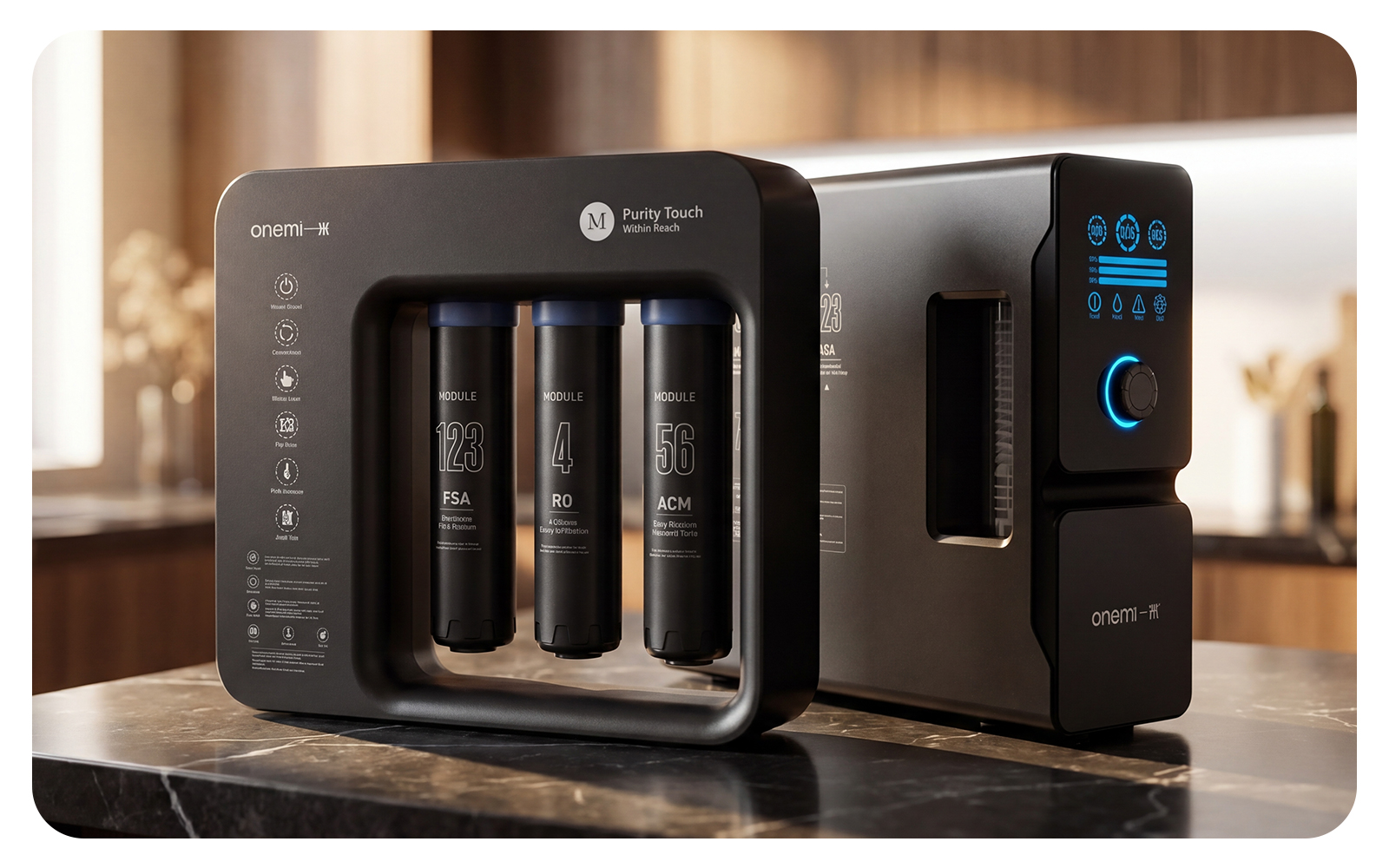
The EPA recently established legally enforceable Maximum Contaminant Levels (MCLs) for six specific PFAS compounds, setting the limit at a microscopic 4.0 parts per trillion. To consistently strip these incredibly small, persistent molecules from tap water, a filtration system must maintain precise, high-pressure contact with an advanced composite membrane. This is where the engineering of premium brands like ONEMI shines, utilizing multi-stage composite filters that combine electrostatically charged sediment layers, activated carbon blocks, and high-rejection RO membranes into a single, streamlined cartridge.
Is your tap water actually safe just because it meets minimum federal guidelines? Many water quality experts argue that federal standards lag decades behind current toxicology research, leaving individual households to act as their own final line of defense.
Investing in a high-capacity tankless RO system is no longer a luxury for those who dislike the taste of chlorine. It has become a necessary home infrastructure upgrade for families who want to guarantee their daily drinking water is free from microplastics, agricultural runoff, heavy metals, and industrial solvents. By choosing a system that fits seamlessly into existing cabinet space while running at peak water efficiency, modern households can secure long-term access to pristine drinking water without sacrificing their home’s storage capacity or bloating their monthly utility bills.
As municipal infrastructure continues to age across the country, the burden of water purification is shifting from centralized city treatment plants to the point of use. ONEMI remains committed to engineering compact, high-performance filtration solutions that empower individuals to take control of their domestic water quality. The era of the bulky, wasteful water tank is officially over, replaced by intelligent, on-demand purification technology designed for the modern world.