


 한국어
한국어

- Untreated rainwater hits your roof with COD 60-120 mg/L and suspended solids up to 200 mg/L — it is nowhere near drinkable straight from the barrel.
- A 3-stage system (sediment → carbon → UV) gets you to garden and toilet-flushing quality. Adding RO takes it to drinking standard, but the economics only stack up at scale.
- The smartest home use case for most people is outdoor + laundry + toilet, which can cut mains water consumption by 30-50% without the cost of drinking-water treatment.
A tank sitting under a downpipe, a pump humming in the garage, and a garden that does not care whether the water came from the sky or the municipal mains — that is the promise of home rainwater harvesting. The reality is messier. Roofs collect more than rain: they collect dust, bird droppings, pollen, and the slow chemical fallout from whatever is in the air above your house. The question is not whether you can collect rain. It is whether you can make it useful without turning your plumbing into a science experiment.
This guide walks through exactly what home rainwater harvesting can and cannot do, what filtration each use case demands, and where systems like whole-house sediment filters and RO units from manufacturers such as ONEMI fit into the picture. No sustainability sermon. Just the engineering reality.
What Is Actually in Your Rain Barrel
People tend to fall into one of two camps: either they think rainwater is pure enough to drink straight, or they assume it is so dirty that collecting it is pointless. Both are wrong.
Untreated roof runoff typically arrives with chemical oxygen demand (COD) in the 60-120 mg/L range and suspended solids (SS) between 50 and 200 mg/L, based on field measurements from rainwater harvesting projects across multiple climate zones. That places it well outside any drinking water standard — GB 5749-2022, China’s national drinking water regulation, requires COD below 3 mg/L and turbidity under 1 NTU, while WHO guidelines set even tighter microbiological limits. But it is also far from useless. With the right staged filtration, that same water can handle garden irrigation, toilet flushing, laundry, and even whole-house backup with a final polishing stage.
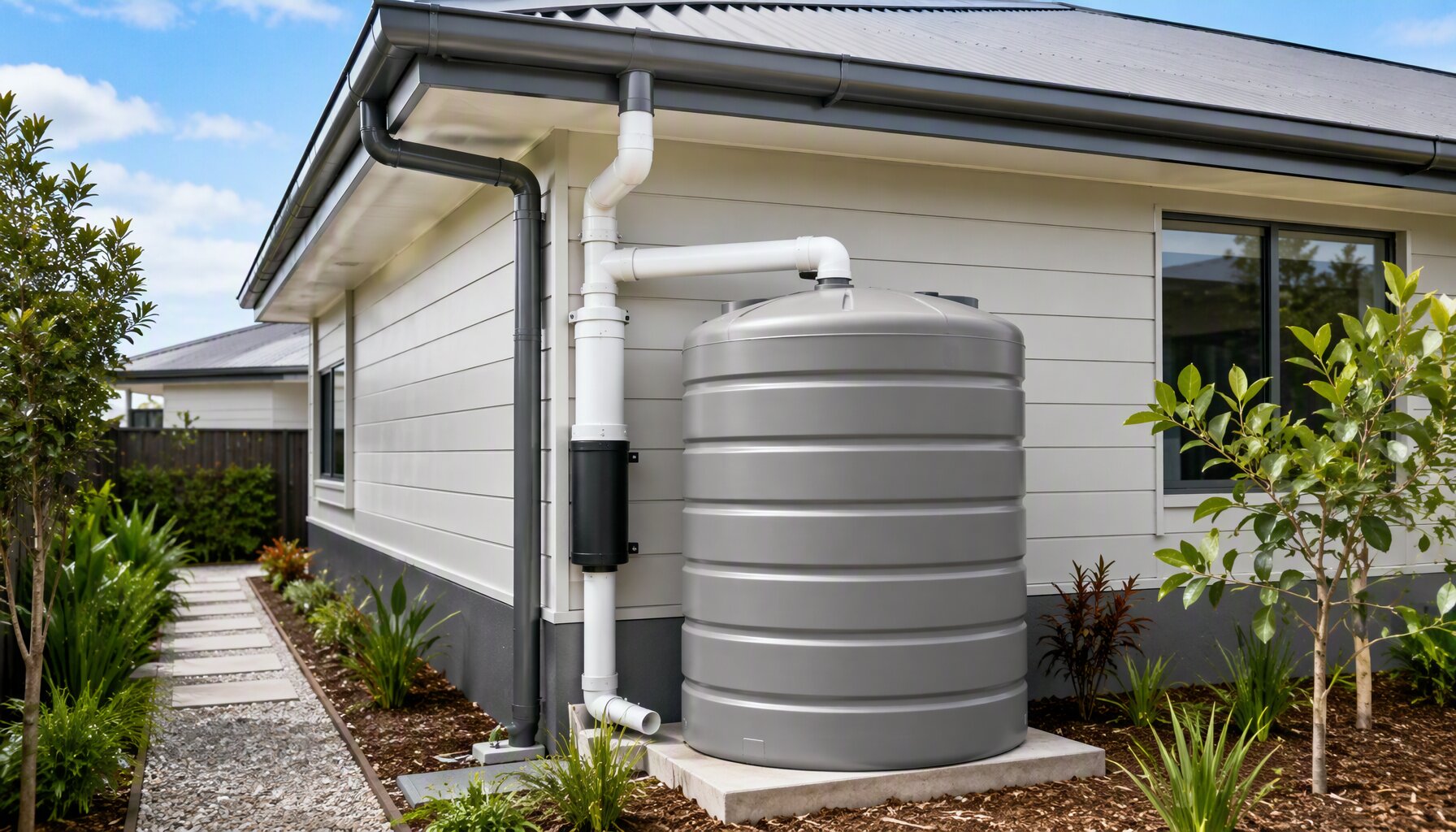
The single most important design decision in any home rainwater system is the first-flush diverter. The first 1-2 mm of rainfall on a roof surface picks up roughly 80% of the total pollutant load — accumulated dust, bird feces, decaying leaf matter, and whatever particulates have settled since the last rain. Diverting that initial volume away from your storage tank keeps the organic load in the main tank low enough that the rest of the system can manage it. Without a diverter, you are essentially seeding your storage with concentrated contamination every time it rains. COD removal from a tank without a first-flush diverter averages only 40-50%. With one, it exceeds 70% before any filtration even starts.
The Filtration Stack: What You Need for Each Use Case
Not all rainwater needs the same treatment. The filtration you pick should match what you actually plan to do with the water. Overbuilding a system to drinking-water standard when all you want is a green lawn wastes money and electricity. Underbuilding it for indoor use creates a health risk. Here is the breakdown by use case.
Garden Watering and Outdoor Cleaning
The simplest case. A single-stage sediment filter capturing particles down to 50-100 microns is usually enough to stop your irrigation nozzles from clogging. A 100-micron spin-down sediment filter installed between the tank outlet and the pump does the job for under fifty dollars in parts. You do not need carbon, you do not need UV, and you absolutely do not need RO for a sprinkler system.
The one thing worth adding even at this level is a coarse screen at the tank inlet — something in the 500-micron range to stop leaves and insects from entering the tank in the first place. Every gram of organic matter you keep out of the tank is a gram that will not decompose, generate nutrients, and feed the algae bloom you will be scrubbing out in six months.
Toilet Flushing and Laundry
This is where most home rainwater systems deliver their real economic return. Toilets and washing machines account for roughly 40-50% of household water consumption in most developed countries, and neither use requires drinking-quality water. The treatment target here is the reuse standard set by guidelines such as China’s GB/T 18920-2020 for urban miscellaneous water: COD ≤ 30 mg/L, SS ≤ 10 mg/L, and total coliforms ≤ 3 per liter.
Getting to that standard takes three stages:
- Stage 1 — Sediment filtration (50-100 microns): A backwashing sediment filter or a multi-cartridge sediment housing removes the suspended solids that make water look cloudy. ONEMI‘s whole-house pre-filter line uses a 316 stainless steel mesh that catches particles down to 40 microns and backwashes automatically, so you are not replacing cartridges every month. For a rainwater system, the backwashing feature matters because the sediment load from roof runoff is substantially higher than municipal water.
- Stage 2 — Activated carbon: Removes dissolved organics that contribute to COD and handles odor. Rainwater that sits in a tank for more than a week develops a distinct earthy smell from microbial activity. A granular activated carbon (GAC) column or carbon block cartridge strips that out before the water hits your toilet cistern or washing machine drum.
- Stage 3 — UV sterilization: A 253.7 nm UV-C lamp with a flow rate matched to your pump output kills bacteria and viruses. UV is preferred over chlorine for home systems because it leaves no chemical residual, requires no ongoing chemical handling, and costs roughly $0.02 per cubic meter of treated water in electricity. The lamp needs annual replacement; the quartz sleeve needs quarterly cleaning if your pre-filtration is not perfect.
Drinking Water — Only with RO, and Only If You Mean It
Yes, you can turn rainwater into drinking water. No, it is not economically rational for most single-family homes. The upgrade path from the three-stage system above to potable water requires adding a reverse osmosis membrane stage, which means higher pump pressure, a booster pump, a pressure tank, roughly 30-50% reject water that must be drained somewhere, and ongoing membrane replacement every 2-3 years.
The standards gap is real. Where GB/T 18920-2020 allows COD ≤ 30 mg/L for toilet flushing, GB 5749-2022 for drinking water requires COD below 3 mg/L — an order of magnitude difference — plus compliance with 106 individual parameters including heavy metals, pesticide residues, and disinfection byproducts. A residential RO membrane rated at 400-600 gallons per day (GPD) can close most of that gap, but you are now running what amounts to a small water treatment plant in your basement.
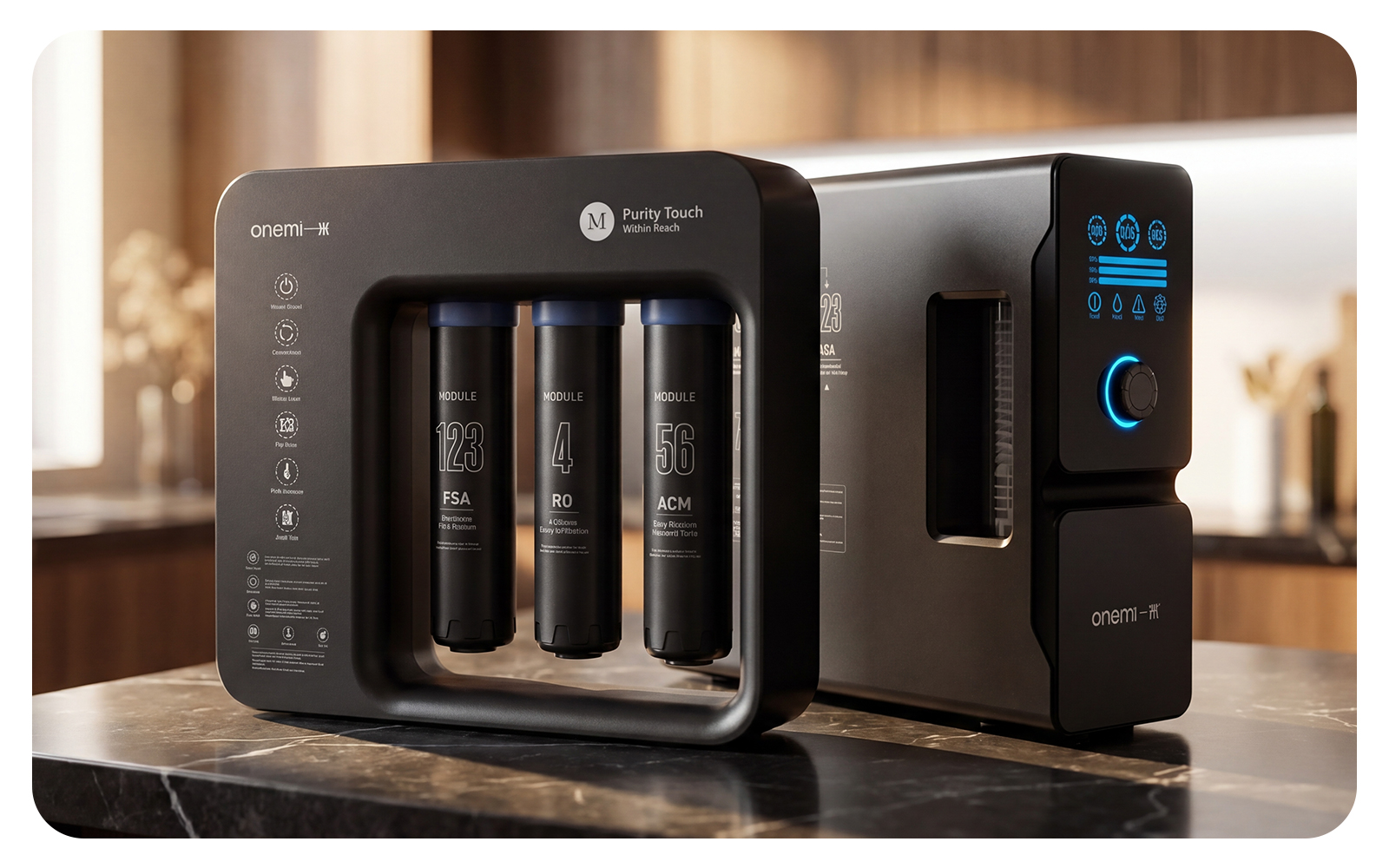
The math makes sense at community scale — a 50-home development sharing a central RO polishing stage after rainwater collection — or for off-grid properties where the alternative is bottled water delivery. For a suburban house with municipal water available at the meter, using rainwater for drinking is more of a resilience play than a cost-saving one. ONEMI‘s tankless RO systems in the 400-800 GPD range are designed for exactly these high-demand scenarios, with integrated booster pumps that can pull from a storage tank rather than requiring municipal line pressure.
Storage: The Silent Water Quality Variable
Most home rainwater guides spend 80% of their word count on filtration and 20% on storage, when it probably should be the other way around. Your tank is not just a bucket. It is a bioreactor where whatever you failed to filter out at the inlet has days or weeks to grow.
Concrete tanks are the worst option for water quality maintenance over time, despite their popularity. The rough, porous interior surface provides enormous surface area for biofilm attachment. Once a biofilm establishes itself, it sloughs off intermittently, sending turbidity spikes through your downstream filters that can overwhelm a UV system and leave you with cloudy water even after treatment. Cleaning a concrete tank requires draining it, physically scrubbing the walls, and disinfecting — an annual ritual that most homeowners skip.
Polypropylene (PP) modular tanks, wrapped in a geomembrane liner and kept fully light-excluded, are the preferred modern approach. Industry standard CJ/T 542-2020 for modular rainwater storage specifies that stored water must remain free of odor and visible suspended solids under proper operation. PP modules have smooth walls with much lower surface attachment area than concrete, and the geomembrane wrap blocks light — which means no photosynthesis, which means no algae. Water stored in a properly sealed PP tank under dark conditions shows COD increase of less than 5 mg/L over 40 days, compared to visible algal growth within 2-3 weeks in an uncovered tank.
One practical rule that saves maintenance: design your tank turnover to be under 30 days. If your tank is sized so that average usage cycles through the full stored volume within a month, the water never sits long enough for serious stagnation to set in. The Chinese outdoor drainage design standard GB 50014-2021 recommends a 30-day maximum still-water period for rainwater storage, after which recirculation through the filtration system should be triggered.
Whole-House Integration: Running Rainwater Through Your Existing Plumbing
This is the ambitious version of home rainwater harvesting — tying your collection and treatment system into the house plumbing so that toilets, laundry, and outdoor taps draw from the rainwater tank first, with an automatic switchover to municipal water when the tank runs low. It is technically straightforward but legally complicated in many jurisdictions, where cross-connection regulations require physical air gaps between rainwater and mains plumbing to prevent backflow contamination.
The hardware side is well-understood. A whole-house sediment filter rated for the flow rate of your pump sits at the system inlet. For a typical single-family setup with a 1-horsepower jet pump delivering 30-40 liters per minute, a filter housing capable of handling 50 L/min with a 40-micron stainless steel mesh element provides a balance of protection and low flow restriction. ONEMI‘s backwashing pre-filter series is designed for exactly this kind of primary filtration role — it handles sediment loads up to 50 NTU incoming turbidity and backwashes on a timer or manual trigger, which matters because rainwater sediment loads are unpredictable compared to municipal water.
Downstream of the whole-house filter, you branch the plumbing by water quality requirement: toilets and outdoor taps get water that has passed through sediment + carbon + UV; the kitchen cold tap gets an additional under-sink RO unit for drinking and cooking; the hot water system stays on mains supply unless you are willing to deal with the mineral scaling implications of running treated rainwater through your water heater.
Maintenance Reality Check
A rainwater harvesting system is more hands-on than a municipal water connection. That is not a design flaw — it is the nature of handling variable-quality source water. The maintenance load breaks down roughly like this:
| Component | Task | Frequency | Cost per Year |
|---|---|---|---|
| Gutter screens / leaf guards | Clear debris | Monthly during leaf-fall season | $0 (labor only) |
| First-flush diverter | Empty accumulated sludge | After each significant rain event | $0 |
| Sediment filter | Backwash or cartridge replacement | Cartridge: 3-6 months; Backwash: weekly | $30-80 |
| Carbon filter | Media or cartridge replacement | 6-12 months depending on COD load | $40-120 |
| UV lamp | Replace bulb | Annually (9000-hour rated life) | $25-50 |
| UV quartz sleeve | Clean | Quarterly | $0 (labor only) |
| RO membrane (if installed) | Replace | 2-3 years | $60-150 |
| Storage tank | Inspect, flush sediment | Annually | $0-100 (if hiring) |
| Pump | Check pressure switch, inspect for leaks | Every 6 months | $0 (labor only) |
The total annual operating budget for a mid-range home system running garden + toilet + laundry, excluding the initial capital cost, runs somewhere between $100 and $350 depending on your local filter cartridge pricing and whether you do the labor yourself. That trades off against a water bill reduction of 30-50%, which in most urban markets means a payback period in the 3-7 year range. The economics tilt more favorable the larger your garden and the higher your local water rates.
When Rainwater Harvesting Makes Sense — and When It Does Not
Not every house should have a rainwater system. Here are the scenarios where the investment pays off and where it is better to spend the money on a higher-efficiency mains-water appliance instead.
Strong case for rainwater harvesting:
- You have a large garden or lawn that requires regular irrigation, and your water is metered.
- You live in a region with frequent rainfall spread across the year (not a monsoon-and-drought pattern).
- You are on a rural property where municipal water is unavailable or the connection cost is prohibitive.
- You are building new and can integrate the tank, plumbing, and controls into the foundation and landscaping from day one — retrofitting is always more expensive.
- Your local water utility charges tiered rates that penalize high consumption.
Weak case:
- You live in a high-rise apartment with 3 square meters of balcony. The collection area is too small to make a meaningful dent in your usage.
- Your region gets 90% of its annual rainfall in a single 3-month season, leaving you with a dry tank for the remaining 9 months.
- You are renting. The capital investment stays with the property.
- Your motivation is purely to save money, and your water bill is under $30 a month. The payback period stretches beyond a decade.
The sweet spot for home rainwater harvesting is a detached house in a temperate climate zone with 600-1200 mm of annual rainfall spread relatively evenly across the year, a roof area above 100 square meters, and water rates above $2 per cubic meter. That describes a lot of suburban houses in North America, Europe, and parts of Oceania.
Filtration Components That Actually Matter
There is a vast difference between the filtration equipment sold for rainwater systems and the equipment that actually delivers results over years of operation. Three components in particular deserve attention because they are where most budget systems cut corners.
The sediment filter housing. Clear sump housings are popular because you can see when the cartridge is dirty, but they are also the wrong choice for any outdoor or sun-exposed installation — UV light degrades the plastic and encourages algae growth inside the housing itself. Opaque housings with pressure-relief buttons and the ability to accept multiple cartridge types (pleated, string-wound, carbon block) in the same footprint give you flexibility as your water quality changes seasonally.
The pump. A centrifugal pump is the default choice, but if your tank is below ground level or more than 5 meters from the house, a jet pump or a multistage centrifugal is required to overcome the suction lift. Undersized pumps run continuously at their maximum duty point, overheat, and die within 2-3 years. Oversized pumps cycle on and off every few seconds — called short-cycling — which destroys the pressure switch and the motor start capacitor. Match the pump curve to your peak demand, not your average.
The control system. A float switch that turns the pump off when the tank is low is the bare minimum. The next level up is a pressure switch and pressure tank that maintain consistent line pressure without the pump running continuously. The level beyond that is a smart controller with dry-run protection, pump runtime logging, automatic mains switchover, and remote monitoring — useful if the system is at a vacation home or if you travel frequently and need to know whether a storm knocked out your filtration before you get home to a flooded basement.
ONEMI‘s whole-house filtration components are engineered with these real-world operating conditions in mind. The backwashing pre-filter line handles sediment loads that would clog a standard cartridge filter within days of a heavy storm, and the tankless RO systems are compatible with pump-fed rather than mains-pressure water supplies — a detail that matters when your source is a storage tank rather than a municipal pipe.
The Bottom Line
Home rainwater harvesting works if you match the system to realistic use cases rather than aspirational ones. Trying to drink your roof runoff on a single-house budget is an expensive hobby. Using it to water the garden, flush the toilets, and run the washing machine is a practical way to cut your mains water consumption by a third to a half, with filtration costs that amortize over a few years of avoided water bills.
The technology is not the bottleneck. Sediment filters, carbon columns, UV reactors, and RO membranes are mature products with decades of field data behind them. The bottleneck is system design — sizing the tank correctly, installing a proper first-flush diverter, keeping the storage light-excluded, and matching the filtration stages to the actual end uses rather than a one-size-fits-all approach that over-treats where it is not needed and under-treats where it matters.
If all you do is put a 40-micron backwashing sediment filter between your tank and your garden tap, you have already done the single most impactful thing: keeping organic matter out of your irrigation system and your storage tank. Everything beyond that is optimization.