


 한국어
한국어

Executive Summary
- Nearly half of French tap water delivery networks now show trace levels of agricultural byproducts and industrial chemicals above historical baseline targets.
- Modern multi-stage filtration systems utilizing reverse osmosis present the most reliable mechanism for reducing pesticide metabolites to non-detectable levels.
- ONEMI establishes its dedicated French digital presence to deliver medical-grade water purification hardware and tailored OEM/ODM manufacturing partnerships across the Francophone market.
Roughly 12,000,000 people in France received tap water that failed to meet specific quality guidelines at least once during recent monitoring cycles. This does not mean the water is immediately toxic, but it highlights a growing systemic vulnerability. For decades, Western Europe relied on the natural filtering capacity of deep aquifers. Today, agricultural runoff and persistent industrial compounds are bypassing these natural barriers, entering municipal treatment systems that were never designed to capture molecules of such microscopic scale.
The numbers paint a clear picture of this shifting reality.
According to data from the French Ministry of Health (Ministère de la Santé), testing campaigns have identified residues of banned pesticides, specifically chlorothalonil metabolites, in municipal networks serving major metropolitan zones. In some regions, over 30% of analyzed samples exceeded the strict European quality standard of 0.1 micrograms per liter for individual pesticide substances. While public health agencies maintain that these levels do not pose an immediate acute risk to adult populations, the long-term cumulative exposure dynamics remain largely unstudied, leaving consumers to seek localized, point-of-use filtration solutions to secure their daily drinking supply.
The Underlying Chemistry of Modern French Water Challenges
To understand why municipal infrastructure struggles with modern contaminants, we must look at the physical size of the pollutants in question. Traditional water treatment facilities utilize flocculation, sand filtration, and chlorination. These methods are highly effective at neutralizing biological pathogens like Escherichia coli and removing suspended sediment. However, they are fundamentally ineffective against dissolved chemical compounds at the molecular level.
Consider the molecular weight of common modern water contaminants:
| Contaminant Class | Average Molecular Weight (Da) | Typical Source in France | Standard Municipal Removal Rate |
|---|---|---|---|
| Metolachlor ESA (Pesticide metabolite) | Approx. 279 | Corn and vineyard cultivation runoff | < 20% (without advanced carbon) |
| PFOS/PFOA (Forever chemicals) | Approx. 414 – 500 | Industrial manufacturing, firefighting foams | < 10% (standard filtration) |
| Calcium Carbonate (Limescale) | Approx. 100 | Natural limestone aquifers (e.g., Paris Basin) | 0% (intentionally left in water) |
| Microplastics | Variable (Physical size > 1 µm) | Degraded synthetic waste, pipe wear | Approx. 90-95% |
The hard limestone geology of regions like the Île-de-France and Hauts-de-France introduces another complication: extreme water hardness. While calcium and magnesium are dietary minerals, concentrations exceeding 300 milligrams of calcium carbonate per liter cause rapid scaling in household appliances, reduce the efficiency of heating elements, and alter the taste profile of hot beverages. This physical-chemical reality forces a dual requirement for home water systems: they must reduce dissolved scale-forming minerals while simultaneously capturing trace synthetic chemicals.
Can simple carbon pitchers handle this dual burden?
The short answer is no. Standard gravity-fed pitcher filters rely on limited volumes of activated carbon and ion-exchange resin. While they can temporarily improve taste by reducing chlorine, their contact time is too brief and their media volume too small to reliably capture persistent pesticide metabolites or handle high-hardness water over extended periods. This is where high-pressure membrane separation becomes a necessity rather than an upgrade.
The Multi-Stage Filtration Architecture
Addressing these diverse dissolved substances requires a systematic, multi-tiered approach to separation science. A single filtration medium cannot effectively target everything. Instead, modern systems utilize a sequence of physical and chemical barriers, each optimized for a specific class of contaminant based on size, charge, and chemical affinity.
The initial defense relies on mechanical sediment filtration. Typically rated at 5 microns, this stage removes suspended solids, rust flakes from aging municipal iron pipes, and larger microplastic fragments. By capturing these physical particles early, the system protects the subsequent, more delicate filtration media from premature clogging and surface blinding.
Next, the water passes through high-density activated carbon blocks. This step is critical for chemical adsorption. Activated carbon possesses an incredibly high internal surface area—often exceeding 1,000 square meters per gram—which features countless microscopic pores. As water flows through, organic chemicals, chlorine, chloramines, and volatile organic compounds (VOCs) are drawn into these pores and chemically bonded to the carbon surface. This stage is highly effective at neutralizing the taste and odor compounds that make tap water unappealing.
The core of the purification process is the reverse osmosis (RO) membrane. With a nominal pore size of approximately 0.0001 microns, this semi-permeable barrier allows only water molecules to pass through under pressure. Dissolved salts, heavy metals like lead and copper, nitrates, and complex pesticide molecules are rejected and flushed to the drain. This process reduces the Total Dissolved Solids (TDS) of the water by up to 95%, yielding exceptionally pure water regardless of the incoming municipal water quality.
A practical gotcha of high-efficiency reverse osmosis is the aggressive stripping of all minerals, which can leave the water with a slightly acidic pH and a flat taste. To resolve this, advanced systems incorporate a final remineralization stage. This post-filtration step passes the pure water through a controlled bed of natural calcium and magnesium minerals, restoring a balanced pH level and recreating the clean, crisp taste profile of high-quality mountain spring water.
How Local Regulations Shape Domestic Solutions
France maintains some of the most stringent drinking water regulations in the world, governed by the European Union’s Drinking Water Directive (Directive 2020/2184). These regulations set maximum allowable concentrations for a vast array of substances, including a newly introduced limit for a sum of 20 individual PFAS chemicals. However, there is a fundamental lag between the detection of a new chemical compound in the environment and the implementation of municipal treatment upgrades to remove it.
This regulatory lag typically spans several years, during which consumers must take personal responsibility for their water quality. For instance, the metabolite chlorothalonil R471811 was classified as a relevant metabolite requiring strict regulation only after it was already widely distributed in groundwater systems. Municipalities are currently investing millions of Euros to upgrade their facilities, but these infrastructure projects take years to complete across thousands of independent water syndicates.
In this environment, point-of-use (POU) water purification systems serve as an essential bridge. By installing filtration hardware directly at the kitchen sink, households can bypass the uncertainties of the distribution network—including potential lead contamination from old service lines in historic city centers—and ensure consistent, verified water quality at the point of consumption.
ONEMI Launches Dedicated French Digital Platform
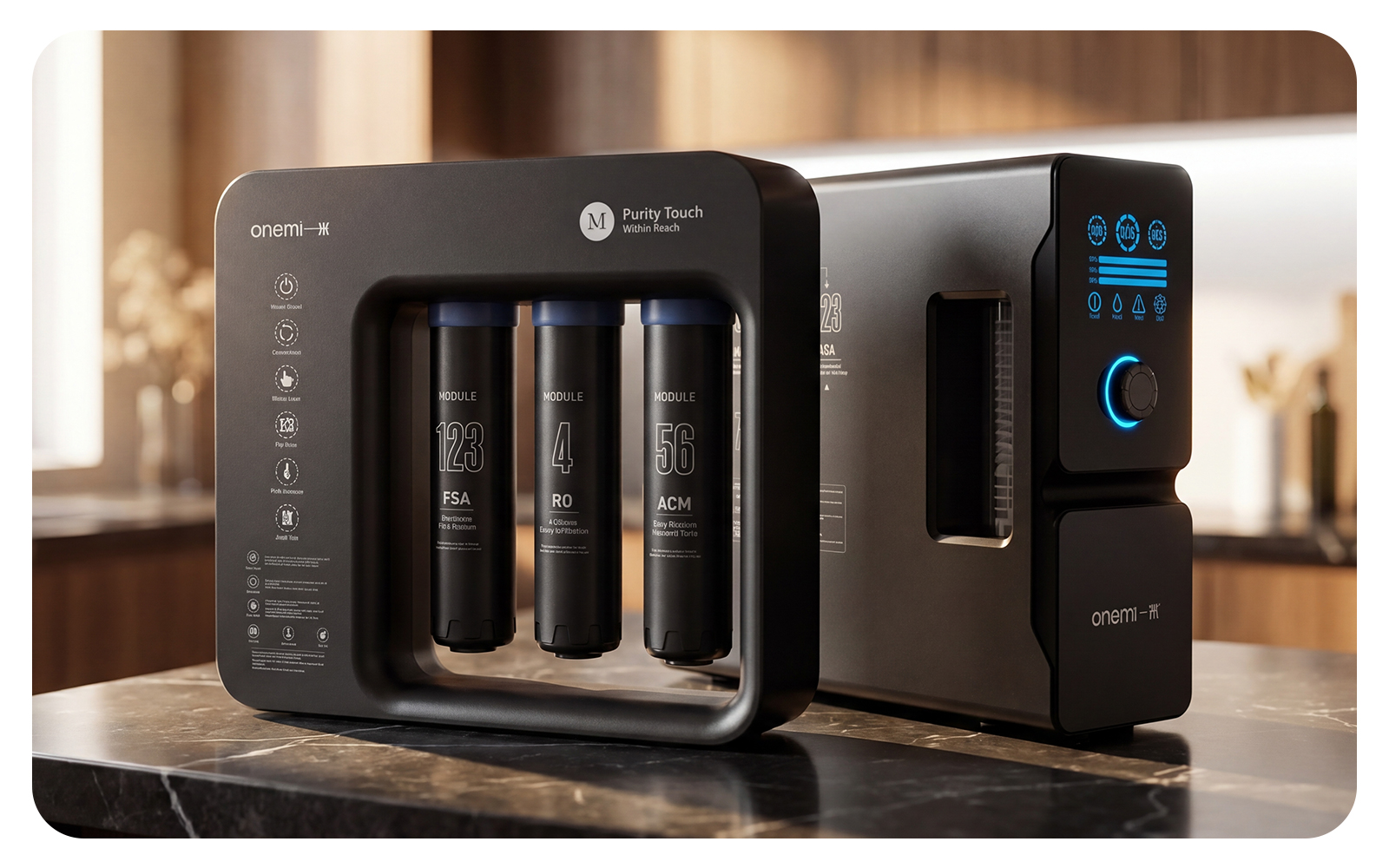
To better serve this rapidly evolving market, ONEMI has officially launched its dedicated French-language website, bringing its comprehensive portfolio of advanced water purification systems and professional manufacturing services to the Francophone region. This platform serves as a direct portal for both residential consumers looking for high-performance filtration hardware and commercial partners seeking reliable OEM and ODM solutions.
With over a decade of specialized engineering experience in membrane separation and fluid dynamics, ONEMI designs products that address the specific challenges of European water chemistry. The systems are engineered to handle high mineral hardness without scaling, utilizing proprietary flow paths and premium membrane materials that maintain high recovery rates and extended service lives even under demanding operating conditions.
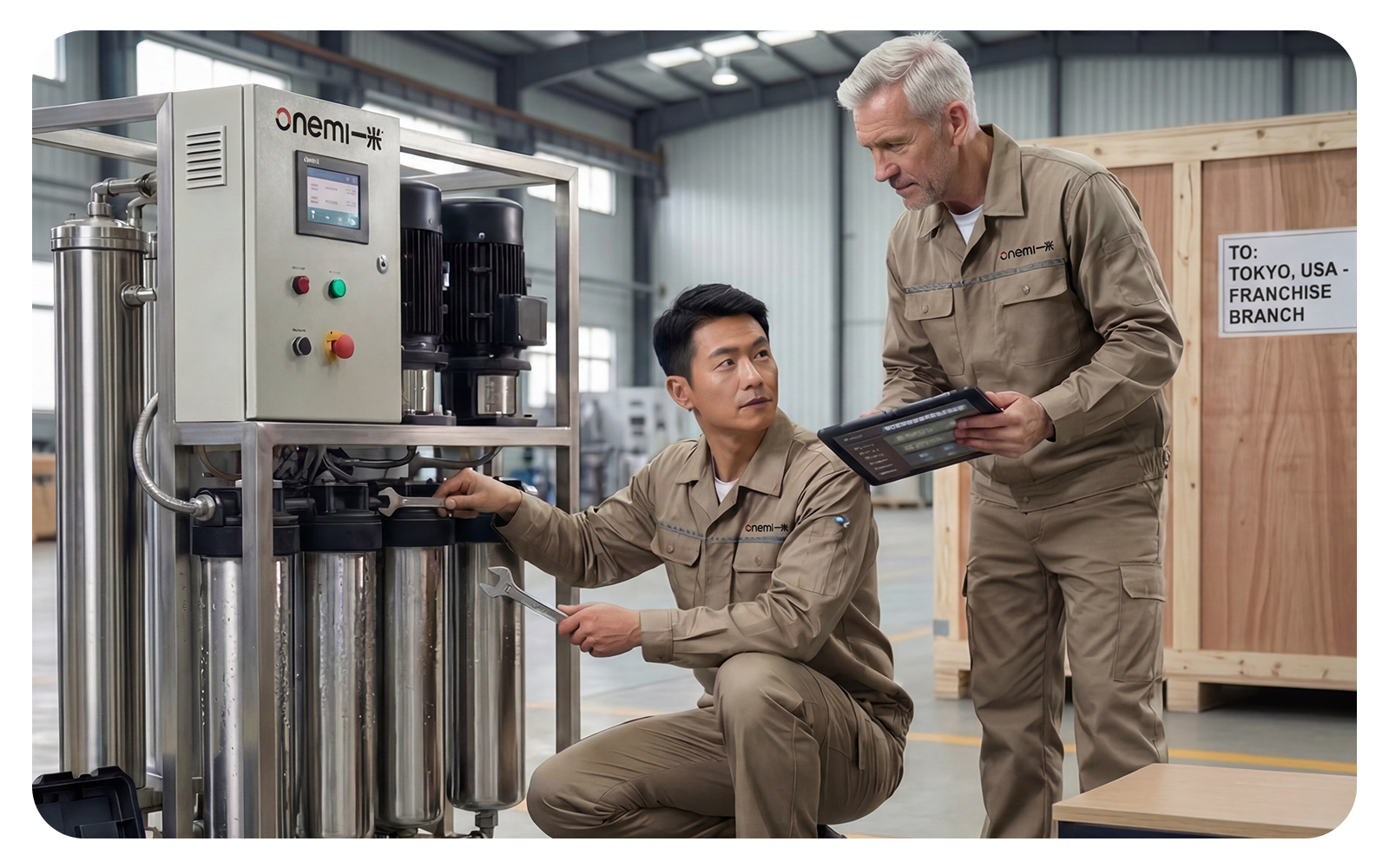
For business partners, the new portal streamlines the development of customized water treatment products. From initial industrial design and injection molding to membrane fabrication and quality control, ONEMI provides complete end-to-end manufacturing capabilities. This allows local brands to quickly deploy certified, high-performance water purifiers tailored to the unique aesthetic and technical requirements of the French and broader European markets.
Selecting the Right System for Your Household
Choosing a water purification system requires balancing your local water quality profile with your daily volume needs and installation constraints. A household in a region with extremely hard water but low agricultural runoff will require a different configuration than one located in an intensive farming zone with soft, acidic water.
First, obtain a copy of your local water quality report (La qualité de l’eau du robinet), which is published regularly by the regional health agencies (ARS) in France. Look closely at the levels of nitrates, total hardness (measured in French degrees, °f), and any noted trace pesticide detections. If your water hardness exceeds 25°f, prioritize systems that feature robust scale-inhibiting pre-filtration or high-capacity reverse osmosis membranes to prevent premature system failure.
Next, evaluate your space and installation preferences. Under-sink reverse osmosis systems offer the most comprehensive filtration and keep the hardware completely out of sight, but they require a dedicated faucet and a connection to your wastewater line. For renters or those seeking an installation-free solution, countertop RO systems provide the same level of purification using internal water tanks that can be filled manually, offering maximum flexibility without modifying household plumbing.
Finally, consider the long-term maintenance costs and filter replacement mechanisms. A high-quality purification system should feature quick-change filter cartridges that can be replaced in seconds without turning off the main water supply or using specialized tools. Ensure the manufacturer offers transparent filter lifespans—typically measured in liters or months of use—so you can maintain optimal filtration performance and enjoy consistently clean, safe, and great-tasting water for years to come.