


 한국어
한국어

You turn on your kitchen tap, and the water looks clear. It smells fine today. But last week, after that heavy rainstorm, there was a faint, earthy odor, and maybe a slight yellowish tint in the bathtub. If you rely on private well water, this uncertainty is your daily reality.
Unlike municipal water supplies, which are constantly monitored and treated under strict federal regulations like the EPA’s Safe Drinking Water Act, private wells are entirely the homeowner’s responsibility. No city engineer is testing your water every morning. If agricultural runoff, naturally occurring heavy metals, or bacterial pathogens seep into your aquifer, you are the last line of defense.
Executive Summary
- Approximately 50% to 65% of tested private wells contain at least one contaminant exceeding health or aesthetic guidelines, making regular testing essential.
- Effective well water treatment requires a multi-stage approach, starting with a 20-to-50-micron sediment pre-filter to protect downstream systems.
- Selecting the right filtration system depends entirely on your specific water chemistry, not a one-size-fits-all retail solution.
The Hidden Threats in Your Well Water
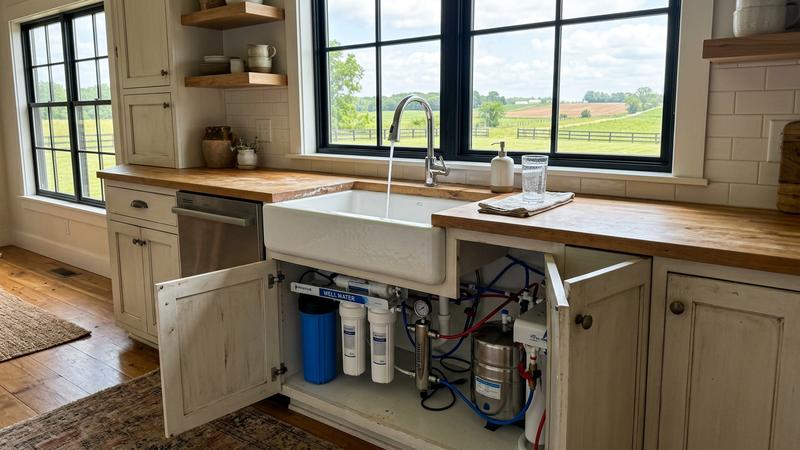
Many homeowners believe that because their water comes from deep underground, it is naturally filtered and pure. This is a dangerous misconception. Ground aquifers are highly dynamic systems, vulnerable to surface runoff, industrial activity, agricultural practices, and the natural geological formations of the earth itself.
Consider a family in rural Ohio who noticed their laundry was slowly turning a dingy orange. They assumed it was just a high iron concentration—a common, mostly harmless aesthetic issue. However, when they finally performed a comprehensive laboratory test, they discovered their water also contained arsenic levels at 24 micrograms per liter, well above the EPA maximum contaminant level of 10 micrograms per liter. The geological rock formations in their region were leaching arsenic directly into the deep aquifer, completely invisible to the naked eye.
This is the core issue with well water: the most dangerous contaminants are often tasteless, odorless, and colorless.
While iron and manganese ruin your fixtures and stain your clothes, contaminants like nitrates from agricultural fertilizers can be toxic, especially to infants. Runoff from nearby livestock operations can introduce coliform bacteria and E. coli into your well, particularly after heavy rainfall or spring snowmelt when the water table rises rapidly. Furthermore, industrial chemicals like PFAS (per- and polyfluoroalkyl substances), often referred to as “forever chemicals,” have been detected in groundwater near manufacturing plants and military bases across the country, presenting long-term health risks even at incredibly low concentrations.
Testing and Identifying Well Water Contaminants
You cannot treat what you have not measured.
Before buying any filtration equipment, you must conduct a thorough, certified laboratory water test. Do not rely on cheap home test strips from the hardware store; they lack the sensitivity required to detect low but harmful levels of heavy metals and chemical toxins. A professional laboratory analysis provides a precise breakdown of your water chemistry, which is the only blueprint you can use to design an effective treatment system.
When reviewing your laboratory report, you will typically see contaminants grouped into several distinct categories. Understanding these categories is critical because each requires a completely different filtration technology.
| Contaminant Category | Common Examples | Typical Range Found in Wells | Primary Treatment Method |
|---|---|---|---|
| Physical / Sediment | Sand, silt, clay, rust particles | 5 – 100+ mg/L | Spin-down or pleated sediment filters (20-50 microns) |
| Dissolved Metals | Iron, manganese, arsenic, lead | 0.3 – 15.0 mg/L (Iron) | Oxidizing filters, water softeners, or reverse osmosis |
| Microbiological | Coliform bacteria, E. coli, viruses | Present / Absent | Ultraviolet (UV) disinfection or chlorination |
| Chemicals / Nutrients | Nitrates, pesticides, herbicides, PFAS | 1 – 20+ mg/L (Nitrates) | Activated carbon block or reverse osmosis |
It is common for well water to suffer from multiple issues simultaneously. For instance, you might have high sediment along with elevated iron levels and a trace amount of bacterial contamination. This reality is why single-stage filters almost always fail in well water applications. They quickly clog, lose water pressure, and fail to protect your household.
Designing a Multi-Stage Filtration System
To successfully treat well water, you must build a defense-in-depth system. This means arranging different filtration technologies in a specific sequence so that each stage protects the next, ensuring maximum efficiency and system longevity.
The first line of defense is always sediment filtration. When raw water enters your home from the pressure tank, it often carries coarse sand, grit, and pipe scale. If this debris reaches your delicate carbon filters, water softeners, or reverse osmosis membranes, it will quickly clog them and ruin their internal valves. A robust sediment pre-filter, typically utilizing a 20-to-50-micron rating, is essential. For wells with heavy sand loads, a spin-down sediment filter with a flush valve allows you to easily clear out accumulated sediment without replacing the cartridge every few weeks.
Once the heavy physical particles are removed, the water moves to the secondary treatment stage. This is where we target dissolved metals and hardness minerals. If your water report shows high levels of calcium and magnesium (hard water), a water softener is integrated here. If you have high levels of dissolved iron or manganese, an oxidizing filter—often using manganese greensand or catalytic carbon—is used to convert these dissolved metals into solid particles so they can be trapped and backwashed out of the system. Brand systems like ONEMI provide advanced multi-stage setups designed to handle these complex chemical transitions seamlessly, ensuring that even the most stubborn dissolved minerals are neutralized before they reach your taps.
The third stage focuses on chemical absorption and polishing. Here, activated carbon block filters work to adsorb organic compounds, pesticides, industrial solvents, chlorine (if you use a chlorination system), and unpleasant tastes or odors. Carbon filters are highly effective, but they must be protected from sediment and metals, which is why they are placed downstream in the system architecture.
Finally, we address microbiological safety. If your well is vulnerable to bacterial contamination, a ultraviolet (UV) disinfection system should be the final step in your whole-house setup. UV light scrambles the DNA of bacteria, viruses, and protozoa, rendering them harmless without adding chemicals to your water. However, UV light only works if the water is completely clear; if there is any remaining iron or turbidity, the microbes can “hide” behind the particles and survive the light exposure. This is why the UV system must always be the very last stage of treatment.
Maintenance and Real-World Limitations
Here is a hard truth that many filtration companies won’t tell you: there is no such thing as a maintenance-free well water system.
If you install a complex multi-stage filtration system and walk away, it will eventually fail, sometimes making your water quality worse than it was initially. Over time, sediment filters clog, reducing your home’s water pressure to a crawl. Carbon blocks saturate and can begin releasing trapped chemicals back into your water stream. UV lamps lose their germicidal intensity after about 9,000 to 12,000 hours of continuous operation—roughly one year—even if the blue light is still visibly glowing.
You must commit to a regular maintenance schedule. Sediment pre-filters should be checked monthly and replaced every three to six months, depending on your water’s turbidity. Carbon and chemical cartridges typically require replacement every six to twelve months. Water softeners and iron filters need their salt or regenerant tanks replenished regularly, and their control valves must be monitored to ensure backwash cycles are running correctly.
Additionally, you should re-test your well water at least once a year, preferably in the spring when heavy rains and agricultural runoff are at their peak. Aquifers change over time. A system that worked perfectly last year might need adjustment if a local farm changes its fertilizer practices or if a new construction project shifts the local water table. By staying proactive, monitoring your system’s performance, and performing routine maintenance, you can ensure your home’s well water remains safe, clean, and refreshing for decades to come.