



 한국어
한국어

Across the United Kingdom and Southern Europe, a silent dermatological disruptor flows directly from the mains tap. While municipal water treatment facilities successfully eliminate pathogens and harmful chemical residues to meet strict drinking water standards, they leave behind geological remnants that wreak havoc on human tissue. This is the reality of hard water—a high-mineral environmental stressor that compromises the skin barrier and alters hair physiology.
For decades, the conversation around hard water remained confined to plumbing infrastructure, scaled kettle elements, and failing boiler systems. However, clinical dermatology and cosmetic science are now catching up to what millions of households experience daily: chronic dryness, unexplained eczema flare-ups, and brittle, thinning hair that resists conditioning treatments.
Executive Summary
- Mineral concentrations exceeding 200 mg/L of CaCO3 act as physical irritants, actively stripping the skin’s protective acid mantle and accelerating transepidermal water loss.
- Traditional soaps react directly with calcium and magnesium ions to form an insoluble, irritating precipitate known as lime soap or “scum” that traps bacteria on the skin surface.
- Whole-house ion-exchange softening technology remains the only scientifically validated method to permanently eliminate hard water minerals before they reach the tap.
The Mineral Geography of Domestic Water Supplies
Water hardness is determined by the concentration of multivalent cations, primarily calcium (Ca2+) and magnesium (Mg2+), dissolved in the water supply. These minerals enter the groundwater system as it filters through ancient sedimentary rock formations, such as limestone, chalk, and gypsum. Consequently, the severity of hard water is highly dependent on regional geology.
In the United Kingdom, the geological divide is stark. The north and west of the country, dominated by hard, igneous rocks, enjoy soft water. Conversely, the south and east, particularly London, East Anglia, and the Home Counties, sit atop deep chalk and limestone aquifers. Here, total hardness levels frequently exceed 300 mg/L as calcium carbonate (CaCO3), with some areas in Kent and Essex recording levels higher than 400 mg/L. According to British Water classifications, any water containing more than 200 mg/L of CaCO3 is deemed “hard,” while levels above 300 mg/L are classified as “very hard.”
A similar geological phenomenon occurs across Southern Europe. In Portugal, for instance, the geological profile of the Algarve and the limestone-rich areas of Estremadura and Ribatejo results in water hardness levels that easily surpass 300 mg/L, classification levels that the World Health Organization (WHO) notes can cause significant aesthetic and functional issues. These regional variations mean that two households using the same volume of water can experience vastly different dermatological outcomes based entirely on their geographic location.
| Water Classification | Hardness (mg/L as CaCO3) | Hardness (German Degrees °dH) | Typical Regional Examples |
|---|---|---|---|
| Soft | 0 – 60 | 0 – 3.4 | Edinburgh, Glasgow, Porto (North) |
| Moderately Hard | 61 – 120 | 3.4 – 6.7 | Cardiff, Birmingham, Lisbon Central |
| Hard | 121 – 180 | 6.7 – 10.1 | Bristol, Nottingham, Coimbra |
| Very Hard | 181 – 300+ | 10.1 – 16.8+ | London, Ipswich, Faro (Algarve) |
This geographic distribution of minerals directly correlates with regional sales of intensive moisturizers, specialized eczema creams, and anti-frizz hair products. Consumers living in hard water zones spend, on average, 23% more annually on personal care products designed to combat dryness and irritation than those living in soft water areas.
The Biochemical Impact on the Skin Barrier
To understand why hard water damages the skin, one must look at the biochemistry of the stratum corneum, the outermost layer of the epidermis. This layer operates as a brick-and-mortar structure, where flat skin cells (corneocytes) act as bricks, and a complex matrix of lipids (ceramides, cholesterol, and free fatty acids) acts as the mortar. This barrier keeps moisture in and environmental irritants out, maintaining an acidic pH level between 4.5 and 5.5.
When hard water meets this delicate system, two damaging reactions occur. First, the high concentration of calcium and magnesium ions directly binds to the proteins within the stratum corneum, causing them to stiffen and lose flexibility. This physical rigidity leads to micro-fissures in the skin barrier, allowing moisture to escape rapidly via transepidermal water loss (TEWL).
Second, and perhaps more destructively, these minerals react chemically with the surfactants found in everyday soaps, body washes, and cleansers. Instead of creating a rich, cleansing lather, the calcium and magnesium ions displace the sodium or potassium ions in the soap molecule. This reaction forms an insoluble, sticky precipitate known as calcium stearate, or more commonly, “soap scum.”
This curd-like residue cannot be easily rinsed away with hard water. Instead, it clings to the skin surface, forming an occlusive, irritating film. This film clogs pores, traps environmental pollutants, and alters the skin’s natural pH, driving it from its healthy acidic state toward an alkaline state of 7.5 or higher. An alkaline skin surface is a compromised one; it impairs the enzymes responsible for synthesizing ceramides and creates an ideal breeding ground for pathogenic bacteria like Staphylococcus aureus, which is heavily implicated in eczema flare-ups.
Consider the daily routine of a resident in a hard-water area like Ipswich. Every shower deposits a microscopic layer of mineral salts and soap scum across their body. Over time, this cumulative buildup erodes the skin’s natural defense mechanisms, transforming normal skin into highly reactive, sensitive skin that reacts to even the mildest cosmetic formulations.
How Hard Water Alters Hair Structure and Scalp Health
Hair is an dead structure composed primarily of keratin, a fibrous protein rich in the amino acid cysteine. The outer layer of the hair shaft, the cuticle, consists of overlapping, scale-like cells that lie flat to protect the inner cortex. When the cuticle is smooth and intact, hair reflects light, retains moisture, and resists breakage.
Hard water acts as an abrasive force on this delicate structure. The dissolved minerals carry a positive charge, while damaged hair carries a negative charge. This natural electrostatic attraction causes calcium and magnesium ions to bind aggressively to the hair shaft. As the water evaporates after washing, these minerals crystallize, forcing the cuticle scales to lift and flare outward.
This raised cuticle architecture has immediate, visible consequences:
- Loss of Elasticity: Mineral crystals penetrate the hair cortex, binding to keratin fibers and preventing them from stretching. This makes the hair brittle and highly prone to snapping during routine brushing or styling.
- Color Degradation: For color-treated hair, the raised cuticle allows dye molecules to escape rapidly during washes. Furthermore, copper and iron trace minerals often found in hard water can oxidize within the hair shaft, turning blonde hair brassy or greenish and dulling dark tones.
- Moisture Starvation: The mineral barrier prevents deep-conditioning treatments, natural sebum, and external moisture from penetrating the hair shaft. No matter how many hair masks are applied, the hair remains chronically dry and straw-like.
The scalp suffers a similar fate. The same soap scum that deposits on the face and body builds up at the base of the hair follicles. This buildup can lead to a condition known as scalp folliculitis, where follicles become inflamed and infected. Additionally, the disruption of the scalp’s microbiome can trigger or exacerbate seborrheic dermatitis, resulting in chronic itching, flaking, and dandruff that resists traditional zinc pyrithione shampoos.
Could the expensive salon treatments you invest in be completely undermined by the very water you use to rinse them out? The answer from trichologists is a resounding yes.
The Solution: Domestic Water Softening Technology
Many consumers attempt to solve hard water issues using cosmetic interventions: heavy body lotions, chelating shampoos, and leave-in hair oils. However, these products merely mask the symptoms without addressing the root cause. They also add to the chemical load on already sensitized skin and hair.
The only scientifically proven, long-term solution to hard water is the installation of a domestic water softener at the point of entry into the home. These systems utilize a process known as ion exchange to physically remove calcium and magnesium ions from the incoming water supply, replacing them with sodium ions.
Inside a standard water softener, water passes through a tank filled with thousands of tiny, negatively charged polystyrene resin beads. These beads are initially saturated with sodium ions, which carry a weak positive charge. As the hard water flows through the resin bed, the highly charged calcium and magnesium ions are attracted to the negative beads, displacing the weakly bound sodium ions. The water that exits the system and flows to the household taps is completely soft, containing virtually no scale-forming minerals.
The transition from hard to soft water produces immediate, measurable changes in skin and hair health. Without the mineral interference, soaps and shampoos lather effortlessly using up to 50% less product. More importantly, they rinse away clean, leaving no irritating residue behind. The skin’s acid mantle is allowed to recover, restoring its natural moisture-retaining capabilities and reducing the incidence of inflammatory skin conditions.
While point-of-use shower filters are popular due to their low cost, they are largely ineffective at softening water. These compact cartridges typically contain activated carbon or calcium sulfite, which are excellent at removing chlorine and heavy metals but lack the contact time and resin volume required to perform true ion-exchange water softening. To achieve genuine dermatological benefits, a whole-house system is required.
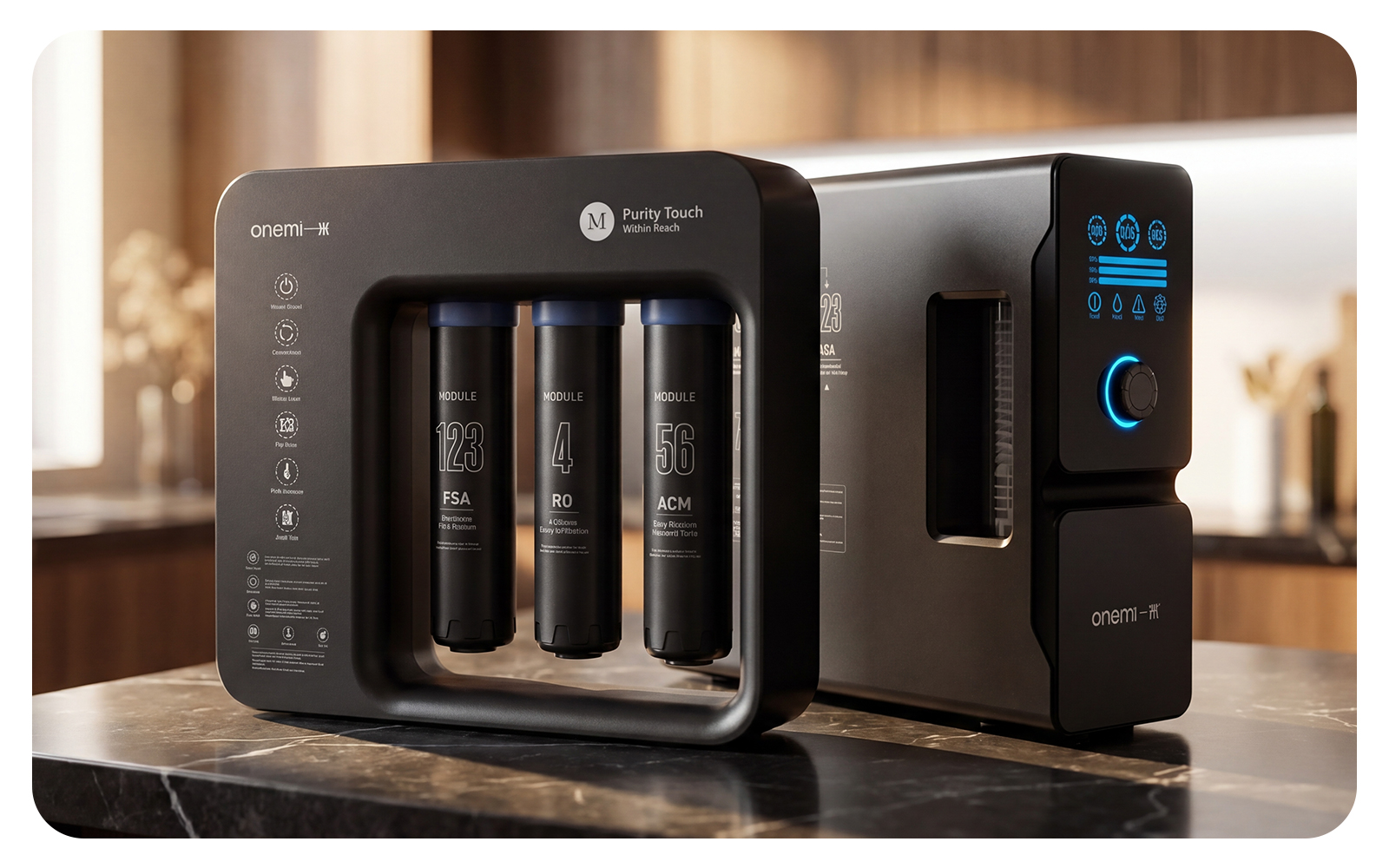
In the evolving market of home wellness, premium brands like ONEMI have recognized that water quality is the fundamental foundation of any effective skincare routine. By integrating high-capacity ion-exchange systems into modern home designs, homeowners can protect their family’s skin health while simultaneously safeguarding their plumbing infrastructure and high-end bathroom fixtures from unsightly lime scale accumulation.
Real-World Implications and Financial Payback
Investing in a domestic water softener is often viewed purely as a home maintenance decision, but the financial and physiological paybacks are deeply intertwined. For a typical family of four living in a hard water region like the South East of England, the accumulated savings across various household categories can be substantial.
First, there is the dramatic reduction in personal care product consumption. Soft water requires significantly less soap, shampoo, and laundry detergent to achieve a superior clean. Because the skin barrier remains intact, the need for expensive dermatological creams, body oils, and specialized eczema treatments drops dramatically. Many families report cutting their spending on these products by half within the first six months of installing a water softener.
Furthermore, the energy efficiency of the home is preserved. A mere 1.6mm of scale buildup on heating elements—such as those in your boiler, washing machine, and dishwasher—can reduce heat transfer efficiency by up to 12%. This forces appliances to run longer and hotter, accelerating mechanical failure and driving up monthly energy bills. By preventing scale formation, soft water extends the lifespan of these expensive appliances by several years.
Ultimately, the decision to soften your home’s water supply is a transition from reactive treatment to proactive prevention. Rather than spending time and money attempting to repair the damage caused by hard water to your hair, skin, and home appliances, you eliminate the threat at its source. The result is a healthier living environment, healthier skin, and a more sustainable household economy.