


 한국어
한국어

A microscopic layer of calcium carbonate is currently quiet-killing your household appliances. While it looks like harmless white powder on your kettle heating element, it acts as an incredibly efficient thermal insulator. When water hardness minerals precipitate out of solution and bind to metal surfaces, they create a barrier that heat struggle to penetrate. This forces your appliances to run longer, run hotter, and consume far more electricity than their engineers ever intended.
Executive Summary
- A mere 2mm of limescale buildup on heating elements increases household appliance energy consumption by up to 15%.
- Traditional salt-based ion exchange remains the only scientifically proven method to physically remove calcium and magnesium ions, reducing measurable water hardness to zero.
- Physical water conditioning technologies do not remove minerals but alter their crystalline structure to prevent adhesion, offering a salt-free alternative with specific operating limits.
Many homeowners do not realize that water quality regulations across the UK and Europe categorize water hardness based on calcium carbonate (CaCO3) equivalents, typically measured in parts per million (ppm), German degrees (°dH), or French degrees (°fH). In regions like South and East England, groundwater flows through chalk and limestone aquifers, pushing hardness levels well past 300 ppm. This is not just a cosmetic nuisance. It is an expensive utility bill driver and a threat to modern high-efficiency combi boilers.
The Real Cost of Hard Water Crystalline Thermal Insulation
Let us look at the raw physics of heat transfer. Copper, commonly used in water heater elements, has a thermal conductivity of approximately 401 W/mK. Limescale has a thermal conductivity of roughly 0.58 to 2.63 W/mK depending on its porosity and specific crystal structure. By coating a copper element in calcium carbonate, you are effectively wrapping your heating system in a thermal blanket.
This insulation effect scales predictably with thickness:
- 1.0 mm of scale: Causes approximately 8% to 10% loss in heating efficiency.
- 2.0 mm of scale: Escalates the energy waste to roughly 15%.
- 3.0 mm of scale: Results in up to a 25% surge in electricity or gas consumption to reach target water temperatures.
When heat cannot escape the heating element into the water, the metal alloy of the element itself overheats. This causes localized thermal stress, micro-fractures, and eventual premature burn-out of the heating coil. In modern tankless combi boilers, the narrow water channels within the plate heat exchanger can plug completely within 24 months of installation in hard water areas, triggering expensive descaling callouts or total component replacements.
The chemical reaction driving this damage is simple temperature-induced precipitation:
Ca(HCO3)2 → CaCO3↓ + CO2↑ + H2O
Soluble calcium bicarbonate decomposes under heat into insoluble calcium carbonate, carbon dioxide gas, and water. This reaction accelerates dramatically once water temperatures exceed 60°C, which is the standard operating temperature for domestic hot water storage systems to prevent Legionella growth.
Chemical Ion Exchange How True Softening Works
To completely eliminate limescale, you must physically remove the calcium (Ca2+) and magnesium (Mg2+) ions from the water supply. Traditional chemical water softeners achieve this through a process called ion exchange. This is the only technology that changes the actual chemistry of the water, which can be verified by a simple EDTA titration liquid drop test kit.
The process relies on a pressurized vessel filled with millions of microscopic, negatively charged polymer resin beads, typically made of sulfonated polystyrene. These beads are initially saturated with positively charged sodium ions (Na+) or potassium ions (K+). As hard water flows through the resin bed, the divalent calcium and magnesium ions—which carry a stronger positive charge than monovalent sodium—force the sodium ions off the resin and lock themselves onto the bead surface.
| Parameter | Ion Exchange (Chemical) | Physical Conditioning (Salt-Free) |
|---|---|---|
| Mineral Removal | Yes (Ca2+ and Mg2+ are completely extracted) | No (Minerals remain dissolved in the water) |
| Measurable Hardness Change | Drops to 0 ppm / 0 °dH | Remains identical post-treatment |
| Consumables Required | Water softener salt (NaCl or KCl) | None (or periodic media replacement) |
| Wastewater Generation | Yes (During regeneration cycles) | No (Zero discharge) |
| Electricity Required | Yes (For control valve operation) | No (Typically passive flow-driven) |
Once the resin beads are completely coated with calcium and magnesium, the system must undergo a regeneration cycle. The control valve reverses the water flow, flushes the accumulated hardness ions to the drain, and bathes the resin bed in a highly concentrated brine solution. The sheer volume of sodium ions in the brine forces the calcium and magnesium off the resin, resetting the system for another cycle. This cycle requires a regular supply of salt pellets and generates a small amount of salty wastewater, which is discharged into the domestic sewer system.
Physical Water Conditioning Altering Crystalline Geometry
Physical water conditioners do not use salt, do not discharge wastewater, and do not remove any minerals. Instead, they seek to alter the physical behavior of the hardness minerals so they lose their ability to stick to surfaces. This is often referred to as "water conditioning" rather than softening.
The primary technology used in modern physical systems is Template Assisted Crystallization (TAC). TAC systems utilize specialized ceramic-polymer beads with microscopic template sites on their surface. When hard water flows through these beads, dissolved calcium and magnesium ions are drawn to the templates, where they form sub-micron crystalline structures called micro-crystals. Once these crystals grow to a specific size, they detach from the template and flow harmlessly through the plumbing system. Because these minerals are already locked into a stable crystalline form, they cannot precipitate out of solution onto heating elements or pipe walls.
Other physical methods include electromagnetic and magnetic water treatment. These systems wrap coils or clamp permanent magnets around the incoming water pipe. The theory is that the magnetic field alters the crystalline structure of calcium carbonate as it passes through, favoring the formation of aragonite (a needle-like, non-adhering crystal structure) over calcite (a sticky, rhombohedral crystal structure). While laboratory tests show some success under highly controlled flow rates and temperatures, real-world field results for magnetic systems remain highly variable due to fluctuating domestic water usage patterns.
Have you ever wondered why physical conditioners perform beautifully in some homes but fail completely in others? The answer lies in water chemistry. If your water contains elevated levels of iron, manganese, or copper, these metals can permanently coat and de-activate the microscopic templates on TAC media, rendering the system useless within months. This is a crucial technical limitation that sales brochures rarely mention.
Choosing the Right Strategy for Your Home
Selecting between chemical softening and physical conditioning requires a careful analysis of your household priorities, local environmental laws, and plumbing infrastructure.
If your primary goal is the complete elimination of limescale spots on shower screens, luxurious soap lather, and a slick, soft feel on your skin, a chemical ion exchange softener is the only technology that will deliver these results. It physically strips the minerals out, ensuring that soap can react normally with the water without forming sticky soap scum. However, you must accept the ongoing maintenance of buying and loading heavy salt bags, alongside the environmental impact of discharging brine into the local water table.
In certain regions, local environmental regulations have banned or heavily restricted salt-based softeners due to the difficulty of removing chloride ions at municipal wastewater treatment plants. In these areas, physical water conditioning via TAC is the leading alternative. It protects your expensive boiler and appliances from internal scale buildup without adding sodium to your drinking water or discharging pollutants. You will, however, still see dry water spots on your dishes and glass surfaces, though these spots will be powdery and much easier to wipe away than untreated calcite scale.
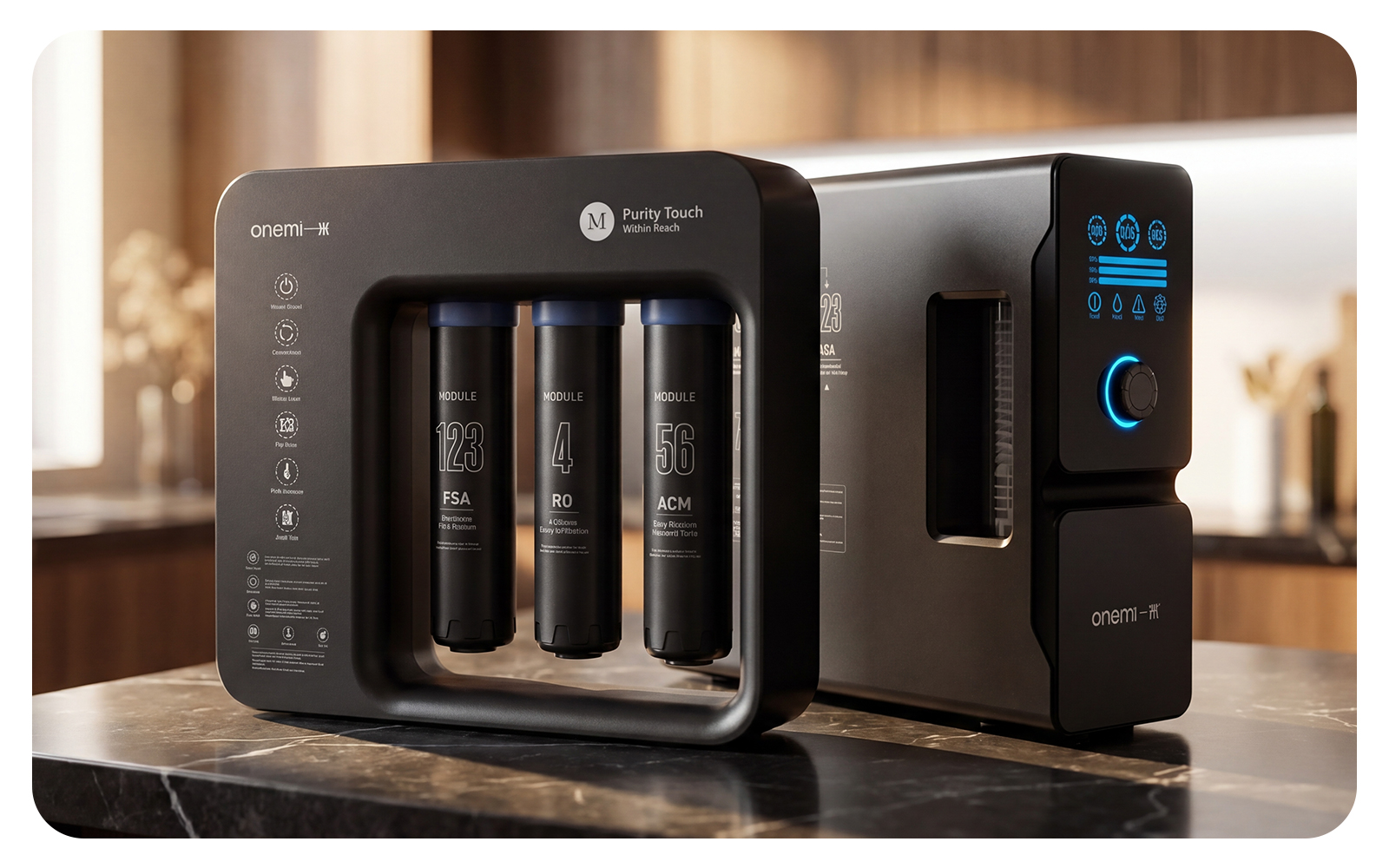
For those seeking clean drinking water alongside scale protection, integrating a high-performance filtration system is essential. Systems like the ONEMI under-sink water purifiers utilize multi-stage filtration to target a wide range of dissolved contaminants, heavy metals, and chlorine. While a dedicated drinking water filter like those from ONEMI does not replace a whole-house softener, it ensures your cooking and drinking water is free from impurities, providing a targeted solution where water quality matters most for your health. Many homeowners choose to install a physical conditioner at the main water entry point to protect the plumbing, paired with an ONEMI purification unit at the kitchen tap for pristine drinking water.
Before purchasing any system, always obtain a comprehensive water quality report from your local utility or perform an independent test. If your water hardness is below 120 ppm, physical conditioning is highly effective at preventing scale. If your hardness exceeds 250 ppm and your local regulations permit it, an ion exchange system remains the gold standard for total scale eradication. Matching the technology to your specific water chemistry is the only way to guarantee long-term protection for your home and your wallet.