



 한국어
한국어

Every time you turn on your kitchen tap, you expect clean, safe, and refreshing water. However, the physical barrier standing between your family and invisible municipal contaminants is a microscopic maze of carbon pores and semi-permeable membranes that slowly degrades with every single gallon processed.
Executive Summary
- Saturated filter cartridges suffer from contaminant breakthrough, allowing accumulated toxins to leach directly back into your drinking supply at higher concentrations than the raw incoming water.
- Standard filtration lifespans range from 3 to 6 months for activated carbon blocks, and up to 24 months for high-performance Reverse Osmosis (RO) membranes under typical municipal loads.
- Neglecting scheduled cartridge replacements compromises water pressure, creates breeding grounds for heterotrophic bacteria, and voids manufacturer warranties.
Many homeowners treat water purification as a set-it-and-forget-it utility. This oversight transforms your protective barrier into a concentrated source of secondary pollution.
The Invisible Danger of Saturated Water Filters
What happens when a filter cartridge reaches its physical limit? To understand this, we must look at the mechanics of adsorption and mechanical filtration. Activated carbon filters work by chemically binding organic compounds, chlorine, and heavy metals to their vast internal surface area. A single gram of high-quality activated carbon possesses a surface area exceeding 1,000 square meters. However, these binding sites are finite.
Once every microscopic crevice is occupied, the filter reaches its saturation point. At this juncture, a highly dangerous phenomenon known as “desorption” or “contaminant breakthrough” occurs. When water pressure spikes or chemistry shifts slightly, the weak physical bonds holding the trapped toxins can break. The cartridge begins shedding accumulated lead, volatile organic compounds (VOCs), and pesticides back into the stream. You are no longer drinking unfiltered water; you are drinking concentrated chemical discharge.
Furthermore, wet carbon beds devoid of active disinfectant (since the filter removes chlorine) become prime breeding grounds for biofilm. Heterotrophic bacteria can colonize the dark, damp interior of a spent cartridge, multiplying exponentially. While these bacteria are often non-pathogenic, they can cause digestive discomfort and severely compromise individuals with weakened immune systems.
Consider the real-world case of a residential neighborhood in Flint, Michigan. Homeowners who relied on point-of-use lead-certified filters during the height of the water crisis found that keeping cartridges in service just 15% past their rated gallon capacity resulted in sudden, massive spikes of lead in their drinking water, sometimes exceeding 150 parts per billion (ppb)—ten times the EPA’s action level of 15 ppb.
The Lifecycle of Different Filter Technologies
Different filtration media degrade at vastly different rates due to their physical construction and the specific contaminants they target. Understanding these distinctions prevents premature replacement waste while ensuring continuous protection.
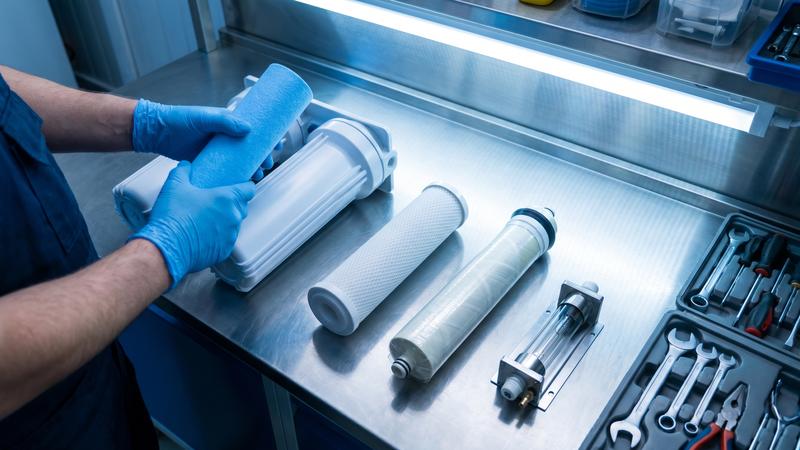
Sediment pre-filters act as the first line of defense, capturing rust, sand, silt, and scale. Because they trap physical particles, their lifespan is highly dependent on local turbidity levels. Activated carbon blocks and granular activated carbon (GAC) filters target chemical pollutants, taste, and odor. Reverse Osmosis (RO) membranes feature microscopic pores measuring 0.0001 microns, rejecting up to 99% of dissolved solids, but they are highly sensitive to chlorine damage, requiring active carbon pre-filtration to survive.
The following table outlines the standard replacement intervals and maximum processing capacities for common residential filtration technologies under standard municipal water conditions:
| Filter Type | Primary Target Contaminants | Average Lifespan (Months) | Gallon Capacity Range |
|---|---|---|---|
| Sediment Pre-Filter | Sand, silt, rust, suspended solids | 3 – 6 Months | 1,500 – 3,000 Gallons |
| Activated Carbon Block | Chlorine, VOCs, PFAS, bad taste/odor | 6 – 12 Months | 500 – 1,000 Gallons |
| Reverse Osmosis Membrane | Heavy metals, fluoride, nitrates, TDS | 24 – 36 Months | Variable (depends on recovery ratio) |
| Post-Carbon Polishing Filter | Residual storage tank taste, fine organics | 12 Months | 1,000 – 2,000 Gallons |
| Ultrafiltration (UF) Membrane | Bacteria, cysts, viruses, colloids | 12 – 18 Months | 2,000 – 4,000 Gallons |
It is important to note that these values assume municipal tap water that already meets basic EPA Safe Drinking Water Act standards. If you draw water from a private well with high iron, manganese, or hard water mineral content, your cartridge lifespans can drop by up to 50% due to physical clogging before the chemical capacity is ever reached.
How to Tell Your Filter Needs Replacing: The Actionable Checklist
Relying solely on calendar dates is a flawed strategy because household water consumption fluctuates. A family of five will saturate a carbon cartridge much faster than a single occupant. Watch for these five physical and sensory indicators that signal your filter has reached the end of its operational life.
- Significant Drop in Water Pressure: As sediment, rust, and particulate matter accumulate on the outer layers of your filter, the physical pathways for water molecules shrink. If your glass takes twice as long to fill as it did when the filter was new, the cartridge is heavily loaded with particulates and must be changed immediately.
- Return of Unpleasant Taste or Odor: Chlorine is added to municipal water for disinfection, and a fresh carbon filter removes it entirely. If you begin to smell bleach, or if your water takes on a metallic, earthy, or musty taste, the chemical binding sites on your carbon block are completely saturated.
- Visual Discoloration of the Filter Media: Many modern under-sink systems feature transparent housings for sediment pre-filters. A new sediment filter is pristine white. When it turns deep brown, dark yellow, or black, it is fully loaded with rust and silt.
- Turbidity or Floating Particles: If you notice tiny black specks in your water, your carbon block may be disintegrating or “channeling”—a process where water carves high-velocity pathways through weak spots in the media, bypassing filtration entirely.
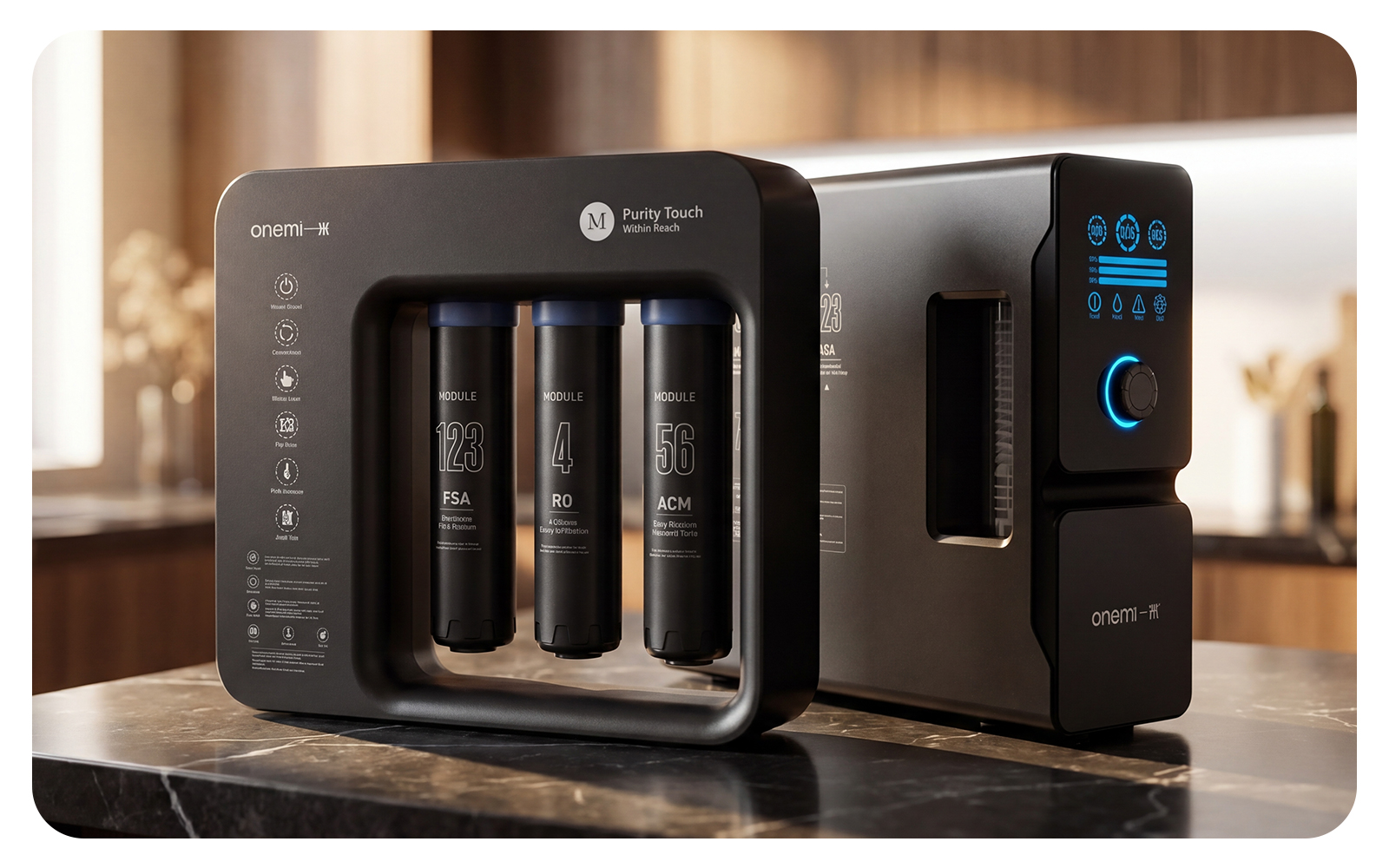
- Smart Indicator Alerts: High-end water purification systems, such as those engineered by ONEMI, utilize integrated flow meters and pressure sensors to track exact gallon usage rather than simple timers. When the indicator light shifts to red, it is an objective, data-driven prompt to swap the cartridge.
Do you actually know what is in your tap water right now? Testing your water before and after filtration with a simple Total Dissolved Solids (TDS) meter can give you an instant snapshot of your system’s performance, though keep in mind that TDS meters do not measure volatile organic chemicals or pesticides.
Step-by-Step Guide to Replacing Your Filter Cartridge
Replacing a filter cartridge is a straightforward maintenance task that does not require professional plumbing skills, provided you follow a systematic protocol to prevent leaks and airlocks.
Step 1: System Isolation
Locate the cold water shut-off valve beneath your sink (usually a chrome handle on a copper or PEX pipe) and turn it clockwise until it stops. If your system is connected to an electrical outlet for UV sterilization or a booster pump, unplug it now. Turn off the valve on your RO storage tank if you are servicing a multi-stage system.
Step 2: Pressure Relief
Open your dedicated filtered water faucet on the sink. You will see a brief trickle of water that quickly stops. Keep this faucet open throughout the process. This releases the internal hydrostatic pressure within the filter housings, making them significantly easier to unscrew.
Step 3: Housing Removal
Place a shallow pan and an absorbent towel directly beneath the filter assembly to catch residual water. Using your plastic housing wrench, slip it over the filter canister and turn it counter-clockwise (looking from the bottom up). Carefully lower the water-filled canister, discard the spent cartridge, and pour the remaining water into the sink.
Step 4: Sanitization and Inspection
Take this opportunity to wash the inside of the empty plastic housing with warm water and a few drops of mild dish soap. Rinse thoroughly. Inspect the black rubber O-ring located in the groove at the top of the housing. If it is cracked, flattened, or stretched, replace it. Apply a thin layer of food-grade silicone grease to the O-ring to ensure a watertight seal and make future removal easier.
For those utilizing advanced ONEMI systems, the quick-twist sanitary design bypasses this step entirely, allowing you to swap dry, sealed cartridges in under three seconds without exposing the internal water pathway to ambient air contaminants.
Step 5: Inserting the New Cartridge
Remove the protective plastic wrapping from the new cartridge. Place it inside the housing, ensuring it centers perfectly over the guide post at the bottom of the canister. Thread the housing back onto the manifold by hand, turning clockwise. Once hand-tight, use the housing wrench to snug it down an additional 1/4 turn. Do not over-tighten, as this can pinch and ruin the O-ring, causing slow leaks.
Step 6: System Flushing
Slowly open the cold water supply valve. Keep the drinking faucet open to allow trapped air to escape, which will cause sputtering and whistling. Run the water continuously for 5 to 10 minutes. This flushing process is critical: it washes away loose carbon fines (fine black powder) and primes the media. Check all joints and seals carefully over the next 24 hours for trace moisture.
The Real-World Financial and Environmental Cost of Neglect
Delaying cartridge replacement is a false economy. When a sediment filter clogs, the rest of your purification system must work harder. In reverse osmosis systems, a clogged pre-filter drops the pressure reaching the membrane, which drastically increases the amount of wastewater sent down the drain. Instead of a standard 3:1 waste-to-pure ratio, a starved membrane can degrade to a highly inefficient 10:1 ratio, driving up your monthly utility bills.
Furthermore, using a water filter past its prime often drives household members back to purchasing single-use bottled water out of frustration with slow flow rates or altered taste. A family of four drinking the recommended half-gallon of water per day per person consumes 730 gallons of water annually. Meeting this demand with standard 16.9-ounce single-use plastic bottles requires approximately 5,500 bottles per year, costing upwards of $1,200 and generating massive plastic waste. In contrast, maintaining a high-quality home filtration system with timely cartridge replacements costs less than $150 annually, delivering a 90% reduction in plastic waste and saving over $1,000 every single year.
By treating filter replacement as a precise, scheduled scientific necessity rather than an optional chore, you protect your family from chemical breakthrough, safeguard your plumbing infrastructure, and ensure that your drinking water remains genuinely pure, cup after cup.