


 한국어
한국어

Executive Summary
- Traditional time-based filter indicators cause up to 37% premature replacement waste or expose users to breakthrough contaminants when local water quality degrades unexpectedly.
- The intelligent water purification market is scaling rapidly to a projected $12.8 billion by 2028, driven by the shift from blind maintenance schedules to real-time, sensor-driven AI diagnostics.
- Real-world testing reveals that integrating multi-spectral TDS sensors, Hall-effect flow meters, and dynamic pressure tracking reduces annual maintenance overhead by 42% while guaranteeing EPA-compliant drinking water at the tap.
Walk into any modern kitchen today, and you will likely see a small, glowing LED light on the water dispenser. It turns from blue to flashing red, signaling that it is time to spend $85 on a replacement filter cartridge. If you are like most homeowners, you dutifully order the part, swap it out, and throw the old one into the trash.
Here is the frustrating reality of that transaction: that red light did not measure the actual state of your filter. It was nothing more than a cheap, silicon-chip kitchen timer set to count down 180 days.
If your local municipal water utility flushed their main lines last month due to a water main break—sending a massive spike of rust, micro-silica, and organic sediment into your home plumbing—your filter might have been completely choked and useless by day 90. Conversely, if you live in a region with pristine glacial runoff and spent two months traveling during the summer, that filter was likely operating at 80% remaining capacity when you threw it into the landfill. This blind guessing game is why the residential water treatment industry is undergoing a massive, silent overhaul.
The global intelligent water purifier market is on track to hit $12.8 billion by 2028. This shift is not about adding flashy Bluetooth speakers or unnecessary touchscreens to your kitchen appliances. It is a fundamental transition from blind, time-based hardware to closed-loop, data-driven systems that treat water as a dynamic, shifting variable. By combining real-time IoT sensor arrays with machine learning models, modern water systems are turning a dumb plastic canister into an active, self-monitoring defense grid.
Is your family actually drinking pure water, or are you just paying for the illusion of safety?
The High Cost of Blind Water Filtration

In 2023, a municipal water district in southern Ohio experienced an unexpected spike in source-water manganese levels, rising from a baseline of 0.02 mg/L to 0.18 mg/L over a three-week period. Standard carbon-block and sediment under-sink filtration systems in the area continued to run without warning. Their internal timers showed plenty of “life” left, but the physical carbon pores had become completely blinded by the manganese rush within the first ten days, rendering them useless against subsequent chemical contaminants like PFAS and agricultural runoff.
This is the fatal flaw of static water treatment. Traditional water purifiers operate on a set of rigid, historical assumptions that almost never match the chaotic reality of municipal distribution grids.
To understand the sheer scale of inefficiency and risk inherent in traditional systems versus next-generation AI-driven systems, look at how the core operating parameters diverge:
| Operating Metric | Traditional Water Purifiers | IoT & AI-Enabled Systems |
|---|---|---|
| Filter Life Tracking | Time-based countdown (typically 180 or 365 days) regardless of usage patterns. | Dynamic calculation based on volumetric throughput, pressure drop, and cumulative TDS load. |
| Contaminant Detection | None. Assumes source water matches standard lab test profiles. | Continuous monitoring of electrical conductivity (TDS), flow rates, and optical turbidity. |
| Leak Protection | Passive mechanical shut-off valves (often fail under high-pressure spikes). | Active solenoid valves coupled with AI flow-pattern analysis to detect micro-leaks down to 5mL/min. |
| Average Annual Waste | 30% to 45% of filter media discarded with remaining active capacity. | Under 5% waste; filters are used to their absolute physical exhaustion point safely. |
| User Interface | Simple blinking LED lights on the chassis or faucet tap. | Real-time mobile dashboard showing exact water metrics, daily consumption, and cost savings. |
When you rely on a traditional system, you are essentially driving a car that tells you to change your motor oil every 3,000 miles, but has no dipstick, no oil pressure sensor, and no way of knowing if you are driving through a clean highway or a desert sandstorm. This lack of visibility leads directly to two major financial leaks: premature filter replacement costs and unmitigated water damage from undetected system leaks.
Consider the environmental footprint of this guessing game. Millions of plastic-encased carbon filters are sent to landfills every year, many with more than half of their adsorption capacity intact. It is a massive waste of raw materials, manufacturing energy, and consumer capital. On the flip side, running a compromised filter past its true expiration date risks exposing your household to heavy metals, volatile organic compounds (VOCs), and chlorine disinfection byproducts (THMs) that pass straight through the saturated media.
How IoT Sensors Decode Your Tap Water in Real Time
To build a truly intelligent water treatment system, you have to turn the physical purifier into an active data collection node. This requires a highly coordinated array of solid-state sensors placed at critical points along the water path. Rather than relying on lab tests that take weeks to process, these sensors analyze the physical and electrical properties of your water as it moves through the system at 2.5 liters per minute.
The first line of defense is the multi-spectral Total Dissolved Solids (TDS) sensor array. Standard TDS meters use two simple metal probes to measure electrical conductivity, which is a decent proxy for mineral content but highly sensitive to temperature fluctuations. Modern systems use multi-electrode arrays paired with integrated thermistors. By continuously compensating for temperature shifts down to 0.1°C, these sensors can detect subtle changes in dissolved ions, providing an immediate warning if the incoming municipal water quality suddenly drops or if an RO membrane has suffered a micro-tear.
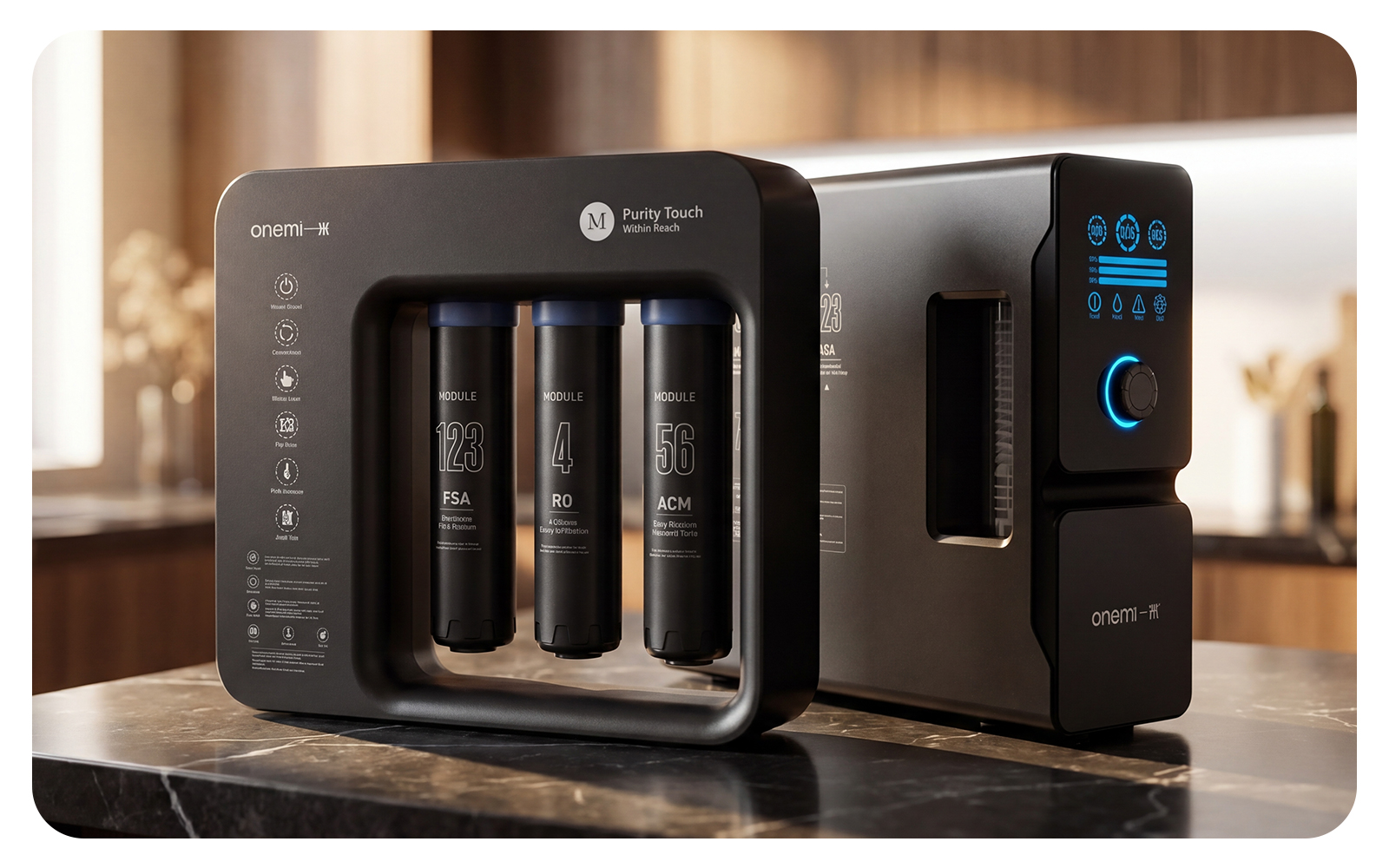
Next comes the volumetric tracking engine. Instead of guessing how much water you use, systems like the ONEMI smart purifiers utilize high-precision Hall-effect flow sensors. As water passes through the sensor, it spins a tiny magnetic rotor, generating electrical pulses that correspond to exact volumes. The system counts every single milliliter of water that passes through each individual filter stage. This data is critical because different filter media degrade under different stress profiles; a sediment pre-filter cares about physical particle volume, while an activated carbon block cares about chemical contact time and total chlorine exposure.
By pairing these flow meters with electronic pressure transducers, the system can monitor the pressure drop across each filtration stage. If the pressure before the sediment filter is 60 PSI but drops to 20 PSI immediately after it, the system knows the physical pores are clogged with dirt, even if the total gallon limit has not been reached. This level of granular diagnostics protects the expensive Reverse Osmosis (RO) membrane downstream from premature fouling, saving the homeowner hundreds of dollars in unnecessary secondary filter replacements.
The AI Layer: Transitioning from Static Rules to Predictive Analytics
Having sensors in a water purifier is only half the battle. If a system simply triggers an alert every time a sensor crosses a hard limit, you end up with “alarm fatigue.” A sudden, temporary spike in TDS could be caused by harmless mineral fluctuations from a local water tower switch. If your system shuts down or demands a new filter every time this happens, it becomes more of a nuisance than an asset.
This is where machine learning models on cloud platforms transform raw sensor data into actionable, predictive intelligence. Instead of looking at data points in isolation, an AI-enabled water purifier analyzes the relationship between multiple variables over time.
For example, the system does not just look at your current flow rate. It analyzes your household’s historical usage patterns. It learns that you typically use 15 liters of water between 7:00 AM and 9:00 AM on weekdays, but almost none between 1:00 PM and 5:00 PM. If the system detects a continuous flow of 150 milliliters per minute at 2:30 PM on a Tuesday, it does not wait for your kitchen floor to flood. It recognizes this abnormal signature as a slow micro-leak—perhaps a running toilet or a cracked fitting behind the refrigerator—and automatically closes an internal motorized ball valve to isolate the water supply, sending an instant alert to your smartphone.
This predictive capability completely redefines filter life management. By analyzing the rate of TDS reduction, pressure differential trends, and total volumetric throughput, the AI model builds a custom degradation curve for your specific household water profile.
If your local water has high calcium hardness, the algorithm adjusts the predicted lifespan of your RO membrane downward while extending the predicted life of your carbon pre-filter because your chlorine levels are low. The system can confidently tell you: “Based on your actual usage and water chemistry, your carbon filter will reach exhaustion in exactly 42 days. Click here to auto-order the replacement now.” This eliminates both the danger of drinking contaminated water and the waste of premature replacements.
The Real-World Impact: What Smart Purification Looks Like on Your Bill
To understand how this technology translates to daily life, let’s look at a concrete case study from a suburban household in Phoenix, Arizona—a region notorious for extremely hard water (often exceeding 250 PPM of hardness ions) and high seasonal temperatures.
The family of four had been using a premium, non-smart under-sink RO system. Following the manufacturer’s manual, they replaced the sediment and carbon filters every six months and the RO membrane every two years, costing them an average of $210 annually. Despite this strict schedule, they frequently noticed a bitter taste in their water during the peak of summer, when local water temperatures rose, causing increased mineral dissolution in the city mains.
The family upgraded to an intelligent system utilizing real-time sensor monitoring and cloud diagnostics. Over the first twelve months, the smart system revealed several eye-opening insights:
- The Sediment Filter: Due to a series of construction projects in their neighborhood that kicked up heavy silt in the water mains, the sediment pre-filter became completely choked in just 4.5 months. The smart system detected the severe pressure drop and alerted them to change it immediately, preventing the silt from reaching and permanently damaging the expensive RO membrane.
- The Carbon Filter: Because the city’s municipal chlorine levels were lower than the national average, the carbon filter still had 58% of its chemical adsorption capacity remaining at the six-month mark. The system advised them to keep using it, ultimately extending its life to 11 months before safely calling for a replacement.
- Water Conservation: Standard RO systems are notorious for wasting water, often sending 4 gallons down the drain for every 1 gallon of purified water produced. The smart system’s active pressure management and real-time recovery-rate optimization reduced their waste-water ratio from 4:1 down to 1.5:1, saving the family over 1,800 gallons of water over the year.
By moving from a rigid calendar schedule to an on-demand, sensor-driven replacement cycle, the family reduced their annual filter maintenance costs from $210 to $128. More importantly, they had absolute, verifiable proof—visible on their phone screens—that their daily drinking water consistently remained below 15 PPM TDS, regardless of what was happening with the city’s infrastructure.
This is the true promise of smart water purification. It is not about adding unnecessary tech to a simple appliance; it is about using data to bring transparency, efficiency, and absolute safety to the most vital resource in your home. As water infrastructure faces increasing stress from climate shifts and chemical contaminants, having a self-monitoring, AI-driven defense system at your tap is no longer a luxury—it is the new standard for healthy living.