


 한국어
한국어

Imagine coming home after a long day, carrying two heavy 5-gallon water jugs up the stairs, only to realize the plastic seals look slightly weathered. Or maybe you are standing in your kitchen in Chicago, staring at a glass of tap water that smells faintly of chlorine, wondering if the aging lead service lines in your neighborhood are slowly leaching toxins into your morning coffee. You want clean water, but you rent your apartment, and your landlord would lose their mind if you drilled a hole in the granite countertop to install a traditional under-sink filtration system.
This is the exact dilemma that drove Sarah, a graphic designer living in a 1920s apartment building in Boston, to look for a better way. She tried pitcher filters, but they took forever to drip through and left a white crust of calcium in her kettle. She looked at under-sink reverse osmosis systems, but the plumbing schematic looked like a NASA blueprint. Then, she discovered countertop reverse osmosis (RO) systems—compact, plug-and-play appliances that require zero installation. Within ten minutes of unboxing, she was drinking bottled-quality water right from her kitchen counter.
Executive Summary
- No-drill, zero-plumbing design makes these systems ideal for renters, historic homes, and students.
- Modern multi-stage filtration targets 99% of contaminants including PFAS, lead, microplastics, and heavy metals.
- Smart features like instant heating, custom temperatures, and real-time TDS monitoring redefine kitchen convenience.
If you are tired of the bottle-lugging routine or worried about what is actually coming out of your tap, a countertop RO system might be exactly what you need. These compact units sit right on your kitchen counter—no plumbing modifications, no drilling, no calling an expensive handyman. Just pure, clean water at the touch of a button.
The Realities of Modern Tap Water
Most people assume that if water flows from a municipal tap in a developed country, it is perfectly safe. The reality is far more complicated. While municipal water treatment plants do an incredible job of killing immediate biological threats like cholera and E. coli, our aging infrastructure and modern chemical footprint introduce new hazards. The EPA recently set historic, legally enforceable limits for six specific PFAS (per- and polyfluoroalkyl substances)—often called “forever chemicals”—in drinking water, acknowledging their links to cancer and developmental issues. These chemicals do not break down in the environment, and standard pitcher filters barely touch them.
Then there is the physical infrastructure. Millions of homes in the US are still served by lead service lines. Even if the water leaving the treatment plant is lead-free, it can pick up this highly toxic heavy metal as it travels through old city mains and your home’s internal plumbing. For families with young children, even trace amounts of lead can cause irreversible cognitive delays.
Let us look at how different filtration methods stack up against these modern threats:
| Contaminant | Standard Pitcher Filter | Faucet-Mounted Filter | Countertop RO System |
|---|---|---|---|
| Chlorine & Odor | Excellent | Excellent | Excellent |
| Lead & Heavy Metals | Moderate (some brands) | Moderate | 99% Removal |
| PFAS (Forever Chemicals) | Poor | Poor | 99% Removal |
| Fluoride & Nitrates | None | None | 95% – 98% Removal |
| Microplastics | Partial | Partial | 99.9% Removal |
Standard carbon pitchers rely on gravity, giving the water very little contact time with the filtration media. They are fine for making municipal water taste slightly less like a swimming pool, but they are completely outclassed when it comes to dissolved solids, heavy metals, and industrial runoff.
How Countertop Reverse Osmosis Works
Reverse osmosis is not a chemical treatment; it is a physical process. Think of it as a microscopic sieve. The heart of the system is a semi-permeable membrane with pores so incredibly small—roughly 0.0001 microns—that virtually nothing but water molecules can pass through. To put that in perspective, a single human hair is about 70 microns wide, and a typical bacterium is around 1 micron.
To force water through this ultra-tight membrane, the system uses an internal electric pump to build pressure. On one side of the membrane, you get pure, delicious water (the permeate). On the other side, the rejected contaminants are flushed away in a concentrated stream of water (the brine). In traditional under-sink systems, this wastewater is piped directly into your household drain. Countertop units handle this differently: they recycle the water. You fill a removable tank with tap water, the machine processes it, delivers clean water to an internal reservoir, and sends the wastewater back into a separate chamber of the tank. Once the remaining water becomes too concentrated with minerals, the machine alerts you to dump it and refill.
Here is a counter-intuitive finding that surprises many first-time buyers: countertop RO systems are actually much more water-efficient than traditional under-sink systems. While a standard under-sink RO system might waste 3 to 4 gallons of water for every gallon of pure water produced, modern countertop units achieve a waste ratio of 3:1 or even 4:1 in reverse—meaning they produce 3 to 4 cups of pure water for every 1 cup of wastewater. This is because they use highly efficient, pressurized internal loops that maximize every drop before requiring a tank flush.
The Ultimate Countertop RO Buying Checklist
When shopping for a system, it is easy to get lost in marketing jargon. Let us break down the essential features you need to evaluate into a practical checklist so you can find the perfect match for your kitchen.
1. Filtration Stages and Certifications
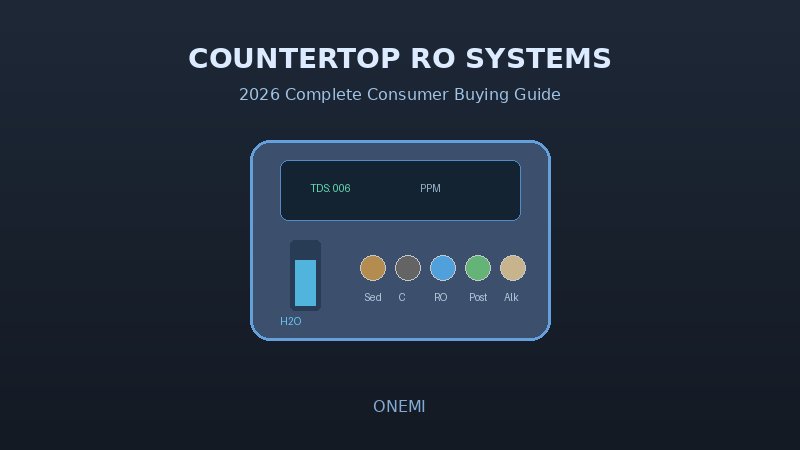
Do not just look at the number of stages; look at what those stages actually do. A high-quality countertop RO system should feature at least a 3-stage process: a sediment/carbon pre-filter to catch rust, sand, and chlorine; the RO membrane itself; and a post-carbon block or remineralization filter to polish the taste. Look for systems that use NSF/ANSI certified components (specifically NSF 58 for reverse osmosis). This ensures the machine has been independently tested to remove the contaminants it claims to target.
2. Water Recovery Rate and Tank Capacity
If you live in a multi-person household, tank size matters. Most countertop models feature tap water tanks ranging from 3 to 5 liters (0.8 to 1.3 gallons). If the tank is too small, you will find yourself refilling it constantly. Pay attention to the pure water reservoir size as well—this is the internal tank that holds the water that has already been filtered and is ready to dispense instantly. Look for a system with a waste water ratio of 3:1 or better to minimize how often you have to dump the mineral-heavy runoff.
3. Instant Heating and Temperature Control
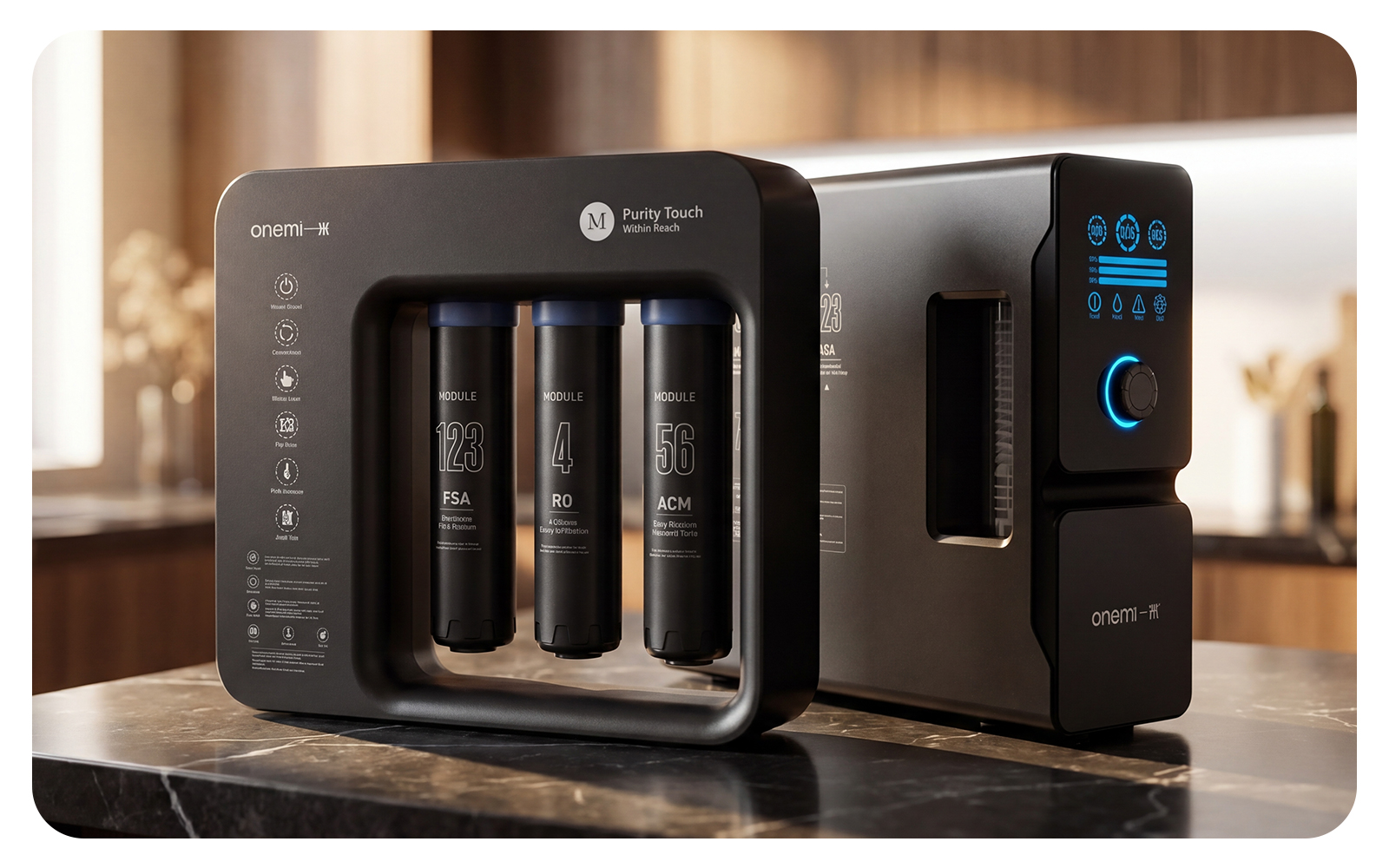
One of the greatest quality-of-life upgrades in modern countertop RO systems is built-in heating. Brands like ONEMI design systems that do not just filter water, but instantly heat it to precise temperatures. Imagine being able to dispense water at 115°F for baby formula, 185°F for delicate green tea, or 203°F for French press coffee in under three seconds. This completely eliminates the need for an electric kettle, saving valuable counter space and energy.
4. Filter Lifespan and Replacement Costs
An inexpensive machine can quickly become a money pit if the replacement filters are overpriced or need to be changed every three months. High-quality RO membranes should last between 12 and 24 months, while pre- and post-filters typically last 6 to 12 months. Before you buy, check the price of replacement filters and calculate the annual cost of ownership. Most premium systems feature quick-twist designs, allowing you to swap filters in ten seconds without any tools.
5. Smart Features and Interface
A good user interface makes daily operation effortless. Look for a clear LED or touch display that shows real-time Total Dissolved Solids (TDS) levels of both the incoming tap water and the filtered water. This gives you immediate, visual proof that the system is working. Other helpful features include filter life indicators, child safety locks (critical if you have instant-hot dispensing), and a “flush” button to manually clean the membrane.
Installation, Maintenance, and Living with Your System
The beauty of a countertop RO system lies in its simplicity. Unbox it, wash the water tank, plug it into a standard outlet, and you are almost ready to go. However, there is one practical “gotcha” that catches many new owners off guard: the initial flushing process. When you first install new filters, they contain loose carbon dust and manufacturing residues. You must run 3 to 5 full tanks of water through the machine and dump them before the water is safe and tasty to drink. Skipping this step will result in bitter, cloudy water.
Daily maintenance is incredibly simple but non-negotiable. Because these systems are ductless and recirculate wastewater, you must dump the leftover concentrated brine water every time you refill the tank. Do not simply top off the tap water tank when it gets low; doing so will rapidly build up mineral scaling on your expensive RO membrane, cutting its lifespan in half. Every week, take a moment to wash the removable plastic tanks with mild dish soap and warm water to prevent any biofilm from forming, especially if your kitchen gets direct sunlight.
Is there a downside? Yes, countertop RO systems do take up physical space—typically about the footprint of a premium espresso machine or a large blender. If you have microscopic countertops, you will need to sacrifice some prep space. But for most users, trading a few inches of counter space for unlimited, delicious, contaminant-free water—without ever having to lift a 40-pound plastic jug again—is the easiest bargain they have ever made.