


 한국어
한국어

Last October, I stood in a bright, modern kitchen in suburban Chicago helping a friend, Sarah, install what she thought was a state-of-the-art water filtration system. She had spent weeks researching online, eventually settling on a premium Ultrafiltration (UF) system because she loved the idea of keeping “natural minerals” in her family’s drinking water while avoiding any wastewater. The system looked beautiful under her sink, the water ran crystal clear, and she felt an immediate sense of relief knowing her two young kids were finally drinking safe water.
Two months later, her local municipal utility issued a routine water quality report revealing a spike in dissolved lead and radium-226 from aging city mains. When we tested her tap, the UF-filtered water still contained almost the exact same level of heavy metals as the raw tap water. Sarah was devastated. She realized too late that her premium filter was essentially blind to the most dangerous, microscopic threats lurking in her pipes. This is the quiet reality of the home water filtration market: a massive gap between what people think their filters are doing and what the physics of membrane technology actually allows.
Executive Summary
- Reverse Osmosis (RO) membranes feature a pore size of approximately 0.0001 microns, making them the only reliable residential technology capable of removing dissolved heavy metals, nitrates, and PFAS.
- Ultrafiltration (UF) membranes operate at a much larger scale of roughly 0.01 to 0.1 microns, offering excellent sediment and bacteria removal without requiring electricity or producing wastewater, but failing completely against dissolved solids.
- Choosing the correct technology depends entirely on your local source water chemistry, plumbing age, and specific contaminant risks rather than system cost alone.
The Microscopic Divide Under Your Sink
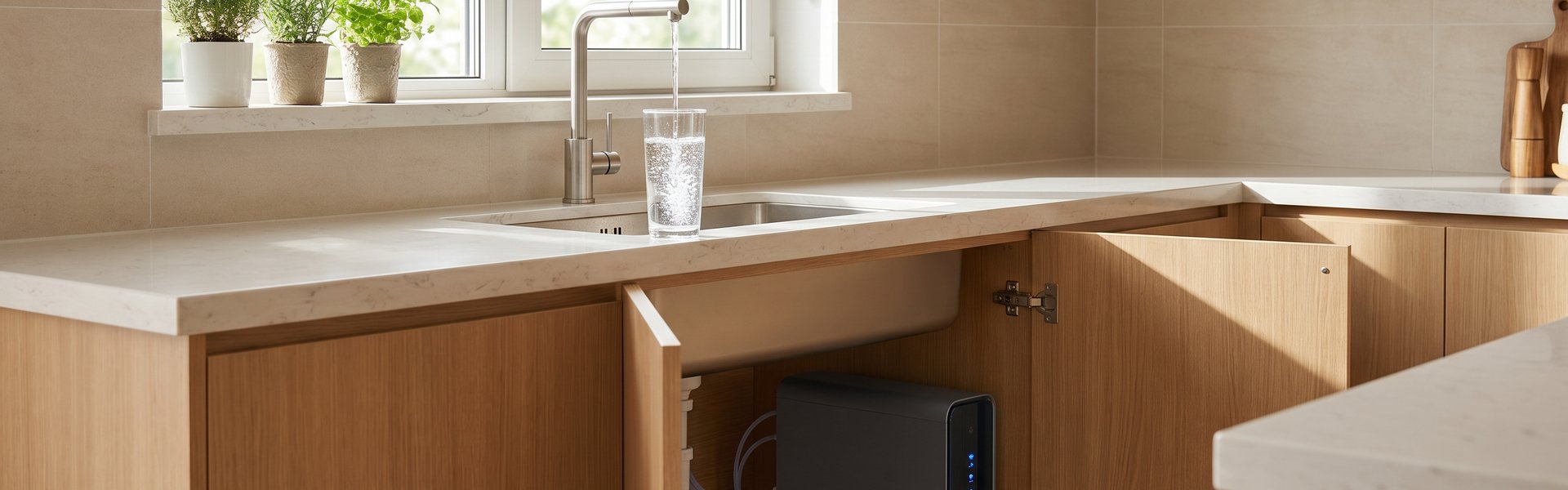
To understand why Sarah’s filter failed to stop the lead, we have to look at the physical world of membrane pores. It is easy to get lost in marketing jargon about “multi-stage purification” and “space-age materials,” but water filtration is ultimately a game of physical sieving. If a contaminant is smaller than the hole in the membrane, it passes through. It is that simple.
An Ultrafiltration membrane is made of hollow fiber tubes that look like tiny, microscopic straws. The walls of these straws are perforated with pores ranging from 0.01 to 0.1 microns. To put that into perspective, a single human hair is about 70 microns wide. A typical bacterium is around 1 micron. A UF membrane easily blocks suspended solids, rust, microplastics, and virtually all common waterborne bacteria like E. coli or cysts like Giardia. It does this beautifully using only your home’s natural water pressure, requiring no electricity and generating zero wastewater. For many households on clean municipal water where the only concern is chlorine taste and sediment, this is more than enough.
But dissolved contaminants exist in an entirely different dimension.
When heavy metals like lead, arsenic, or chromium dissolve in water, they do not float around as suspended particles. They dissociate into individual ions. These ions, along with dissolved salts like sodium and magnesium, are incredibly small—typically measuring between 0.0001 and 0.001 microns. Trying to catch a dissolved lead ion with a UF membrane is like trying to catch a mosquito with a chain-link fence.
This is where Reverse Osmosis comes in. An RO membrane is not just a finer version of a UF filter; it operates on a fundamentally different scale. With a pore size of approximately 0.0001 microns—about 100 times smaller than the tightest UF membrane—RO acts as a semi-permeable barrier that rejects almost everything except the water molecules themselves. To force water through these incredibly tight pores, the system must overcome natural osmotic pressure. This requires significant water pressure, which is why RO systems produce a stream of concentrated wastewater (brine) that carries the rejected contaminants down the drain.
A Direct Comparison of Filtration Capabilities
When you are looking at your family’s health, you cannot rely on vague promises of “pure water.” You need to know exactly what is being stopped at the gate. The structural differences between these two technologies translate directly into what ends up in your drinking glass.
Here is how the two technologies stack up across the most common and dangerous water contaminants found in modern municipal and private well systems:
| Contaminant Class | Typical Size (Microns) | Ultrafiltration (UF) | Reverse Osmosis (RO) |
|---|---|---|---|
| Sediment, Rust & Silt | > 1.0 | Complete Removal (99.9%) | Complete Removal (99.9%) |
| Bacteria & Cysts | 0.5 to 10.0 | Complete Removal (>99.99%) | Complete Removal (>99.99%) |
| Viruses | 0.02 to 0.4 | Partial to High (90-99%) | Complete Removal (>99.99%) |
| Dissolved Lead & Copper | 0.0001 to 0.0003 | No Removal (0%) | Excellent Removal (95-99%) |
| Fluoride & Nitrates | 0.0001 to 0.0002 | No Removal (0%) | Excellent Removal (90-98%) |
| PFAS / “Forever Chemicals” | 0.0001 to 0.0005 | Ineffective (0-10%) | Highly Effective (95-99%) |
| Total Dissolved Solids (TDS) | Various Ions | No Reduction | Significant Reduction (90-97%) |
Looking at this data, it becomes clear why relying on a UF membrane can be risky if your water contains invisible, dissolved threats. While UF is an exceptional barrier for microbiological elements, it leaves the door wide open for chemical contaminants that have been linked to long-term health issues. For families living in older urban areas with lead service lines, or near industrial zones where PFAS has contaminated the local aquifer, an RO system is not a luxury—it is a necessity.
The Environmental and Practical Trade-offs Nobody Tells You
If RO is so clearly superior at removing contaminants, why doesn’t everyone just install one and call it a day?
Because in the real world of home maintenance, every engineering triumph comes with a practical price tag. Over the years, I have seen many homeowners tear out expensive RO systems after six months simply because they could not stand the drop in water pressure or the sound of water trickling down their drain. Understanding these trade-offs before you buy will save you hundreds of dollars and hours of frustration.
The first major hurdle is wastewater. Because RO relies on cross-flow filtration to constantly sweep away rejected contaminants from the membrane surface, it must discard a portion of the incoming water. Older residential RO systems were notoriously wasteful, often sending up to 4 gallons of water down the drain for every single gallon of purified water produced. While modern high-efficiency systems have improved this ratio to about 1:1 or 2:1, it is still a hard pill to swallow for environmentally conscious homeowners or those living in drought-prone areas with high water rates. UF systems, by contrast, operate on a dead-end filtration path. Every drop of water that enters a UF system comes out of your faucet, resulting in zero waste.
Then there is the issue of mineral depletion. RO is so effective that it strips water of everything, including beneficial minerals like calcium and magnesium. This results in highly pure but slightly acidic water, which some people find tastes flat or “empty.” Many high-end RO systems now include a remineralization cartridge to add these essential elements back into the water before it reaches your glass, but this adds another layer of maintenance. UF membranes leave these dissolved minerals untouched, preserving the natural taste and pH of your local water supply.
Do you really want another appliance that requires a power outlet under your kitchen sink?
Most traditional RO systems require a booster pump to maintain the high pressure (usually above 40 PSI) needed to force water through the membrane efficiently. This means you need an electrical outlet nearby, and you will have to tolerate a quiet hum when the system is actively purifying water. A UF system runs silently on your home’s existing line pressure, requiring no electricity whatsoever. Brands like ONEMI have worked to bridge these operational gaps by developing highly efficient, compact filtration systems that optimize water pressure and minimize waste, making the choice between purity and convenience much easier for modern households.
How to Test Your Tap and Choose Your Side
You should never buy a water filter based on a gut feeling or a scary news headline. The only way to make an intelligent decision is to know exactly what is coming out of your specific tap. Water quality varies wildly not just from city to city, but from street to street depending on the age of the municipal mains and the plumbing inside your walls.
If you are on city water, your first step is to look up your local water utility’s annual Consumer Confidence Report (CCR). This public document lists the average levels of regulated contaminants detected in your local supply. However, remember that the city tests water at the treatment plant, not at your kitchen faucet. If your home was built before 1986, there is a strong possibility that lead solder or lead service lines are leaching heavy metals into your water after it leaves the plant. To get an accurate picture, purchase a certified third-party laboratory testing kit. These kits require you to fill a few vials with your tap water and mail them to an accredited lab, which will return a detailed breakdown of your actual heavy metal, chemical, and TDS levels.
Here is a simple rule of thumb to guide your final decision:
Choose an Ultrafiltration (UF) system if your laboratory test shows low TDS (under 150 ppm), no heavy metals, and no chemical contamination. UF is perfect for municipal water that simply needs a final polish to remove chlorine taste, sediment, and potential biological pathogens that might slip through a temporary main break. It is also an excellent option for RVs, off-grid cabins, or homes with limited under-sink space and no electrical access.
Choose a Reverse Osmosis (RO) system if your water test reveals high TDS (above 250 ppm), heavy metals like lead or arsenic, high nitrates from agricultural runoff, or local contamination from industrial chemicals like PFAS. If you rely on private well water, an RO system is almost always the safer choice due to the unpredictable nature of groundwater aquifers. Brands like ONEMI offer advanced multi-stage RO systems that include integrated carbon blocks and remineralization stages, ensuring that while the dangerous contaminants are stripped away, the final glass of water you drink is balanced, healthy, and refreshing.
Ultimately, the choice between RO and UF is not about finding the “best” filter on the market. It is about matching the physical capabilities of a membrane to the specific molecular threats in your water. Take the time to test your tap, weigh the practical trade-offs of wastewater and maintenance, and choose the technology that gives you genuine peace of mind every time you fill your glass.