



 한국어
한국어

Executive Summary
- Global regulatory bodies are rapidly tightening enforceable limits on PFAS, transitioning from parts-per-trillion advisory levels to strict near-zero mandates.
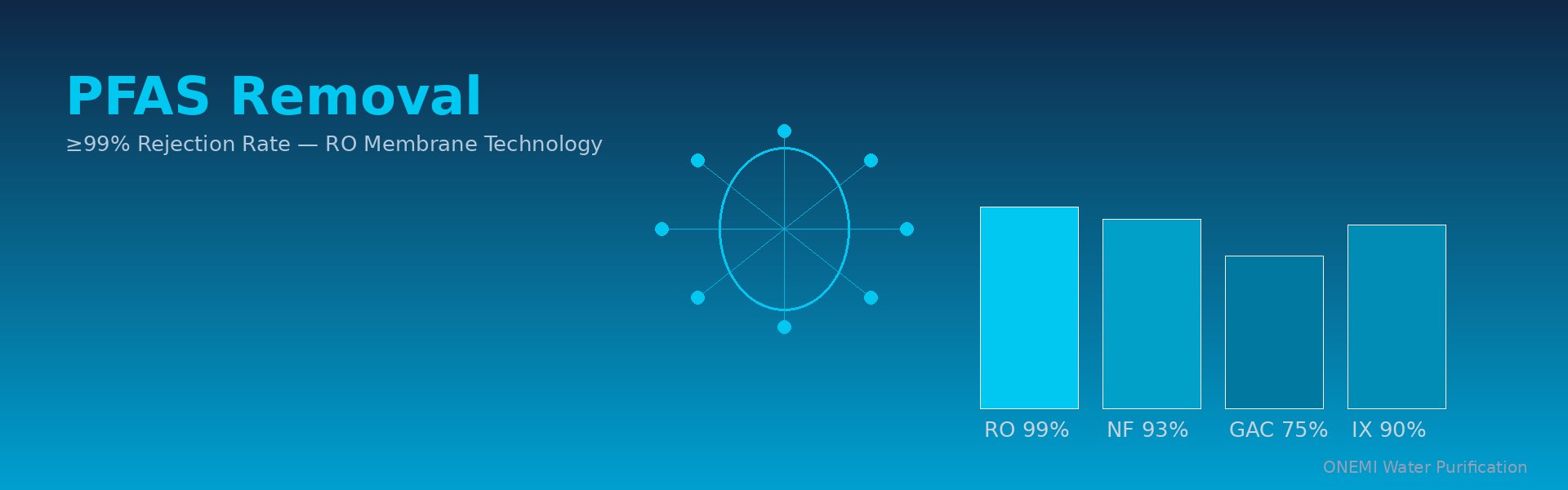
- Standard carbon block and pitcher filters exhibit rapid breakthrough curves, whereas multi-stage reverse osmosis (RO) maintains a stable 96% to 99% rejection rate for short-chain and long-chain PFAS.
- Deploying point-of-use RO systems with integrated mineralization is the most practical defense against municipal infrastructure lag and secondary pipe contamination.
Per- and polyfluoroalkyl substances (PFAS) have transitioned from a specialized industrial chemistry concern to an urgent public health crisis. These synthetic compounds, characterized by their virtually unbreakable carbon-fluorine bonds, do not degrade under natural environmental conditions. They accumulate silently in human tissue, bloodstreams, and municipal aquifers.
For decades, municipal water treatment facilities designed their infrastructure around biological pathogens, sediment, and basic chemical disinfection. They were never engineered to strip out highly stable, microscopic fluorinated organics. As a result, millions of households receive tap water that technically meets legacy safety standards but contains elevated concentrations of these persistent chemicals. This systemic gap places the burden of final purification directly on the consumer at the point of use.
The Global Regulatory Crackdown on Forever Chemicals
The regulatory landscape for drinking water is undergoing its most drastic transformation in a generation. Environmental protection agencies worldwide are abandoning voluntary advisory levels in favor of legally enforceable maximum contaminant limits (MCLs). This shift is driven by clinical data linking prolonged exposure to low-nanogram levels of PFAS to metabolic disruption, immune suppression, and endocrine disorders.
In the United States, the Environmental Protection Agency (EPA) finalized its National Primary Drinking Water Regulation in 2024, establishing legally enforceable MCLs for six specific PFAS compounds. The limits are extraordinarily stringent. For PFOA and PFOS, the MCL is set at a mere 4.0 parts per trillion (ppt). Additionally, the Hazard Index limit for mixtures containing PFHxS, PFNA, PFBS, and GenX chemicals is set at a ratio of 1.0, forcing municipal water authorities to completely re-evaluate their filtration baselines. This represents a drop of over 90% from previous health advisory levels, signaling that no amount of these compounds is considered safe for long-term human consumption.
Across the Pacific, China’s Ministry of Ecology and Environment has initiated a parallel overhaul of its wastewater and drinking water quality frameworks. The draft revisions to national standards explicitly label key PFAS variants as controlled pollutants, targeting industrial discharge pathways to protect municipal intake zones. In Europe, the recast Drinking Water Directive mandates a limit of 0.5 micrograms per liter for total PFAS, driving municipal and residential water filtration adoption to historic highs. The regulatory consensus is clear: legacy filtration methods are no longer legally or biologically acceptable.
Is your home filtration system actually engineered to intercept a molecule that can bypass municipal concrete sand filters? Most consumers assume any basic carbon pitcher will suffice, unaware that short-chain PFAS variants slip through these simple barriers within weeks of first use.
The financial implications for municipal water districts are staggering. Upgrading a single municipal plant to handle PFAS via granular activated carbon (GAC) or ion exchange resins can cost upwards of $10 million to $80 million in capital expenditure, plus millions more in annual media replacement costs. Because these public upgrades will take years—and in some rural districts, decades—to fully implement, point-of-use (POU) filtration systems installed directly under kitchen sinks have become the primary line of defense for families seeking immediate protection.
How PFAS Penetrates Standard Household Filters
To understand why standard filters fail, one must look at the molecular structure of PFAS. These compounds consist of a hydrophobic, fully fluorinated carbon tail and a hydrophilic head group. This dual nature allows them to act as highly effective surfactants, meaning they dissolve easily in water and migrate rapidly through soil and conventional filtration media.
Simple gravity-fed pitcher filters and basic refrigerator filters rely almost exclusively on loose granular activated carbon. While GAC is highly effective at removing chlorine, taste, and odor compounds, its performance drops off precipitously when confronted with PFAS. The main issue is competitive adsorption. Organic matter, calcium, and other naturally occurring minerals in tap water compete for the limited binding sites on the carbon surface. Within a few weeks of use, the carbon pores become saturated, allowing PFAS molecules—particularly short-chain variants like PFBS and PFBA—to break through and enter the drinking water cup.
In contrast, multi-stage filtration systems utilizing advanced physical separation technology do not rely solely on chemical adsorption. They create a physical barrier through which water molecules can pass, but larger, complex chemical ions cannot. This brings us to the core mechanism of advanced water purification: reverse osmosis.
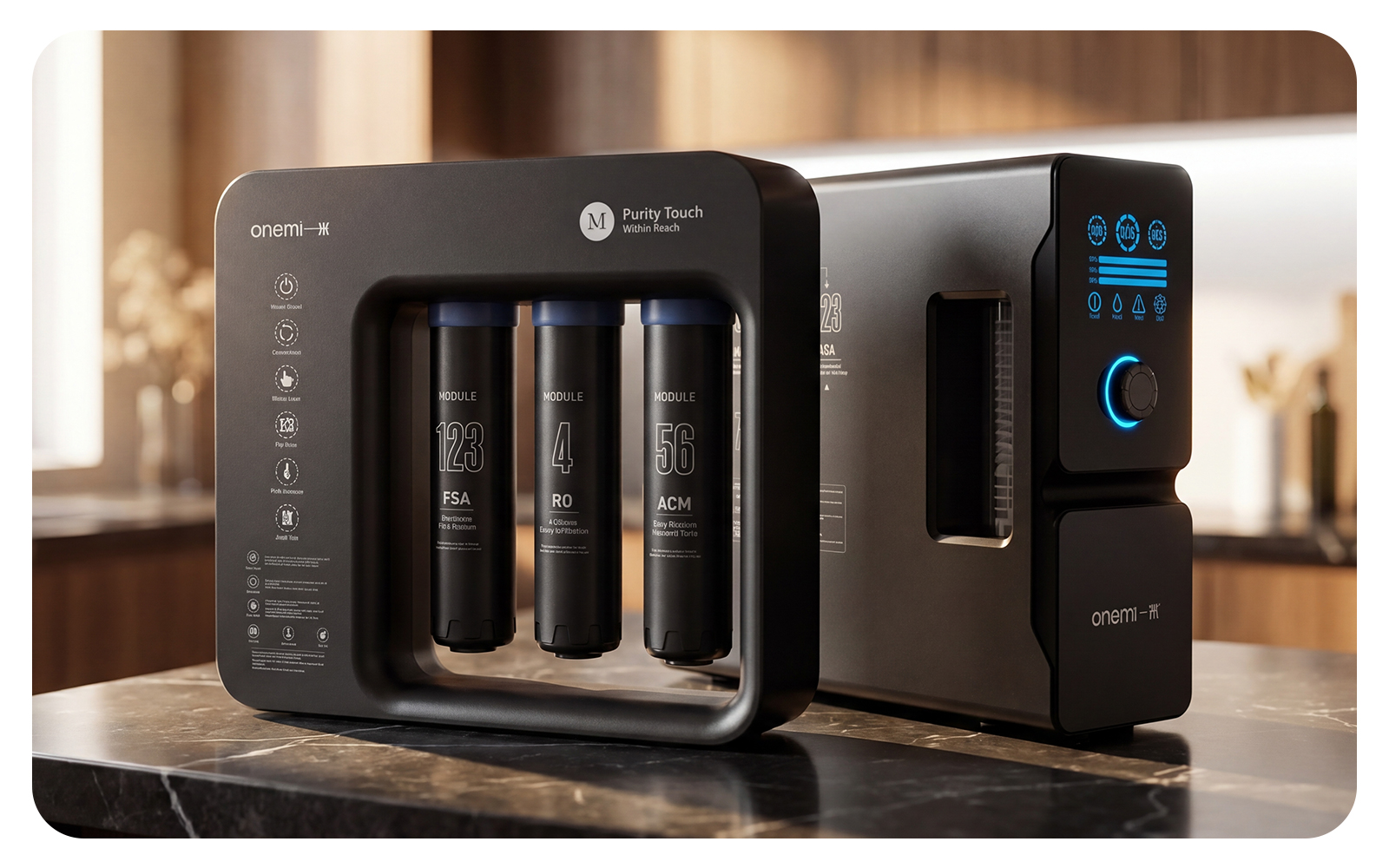
ONEMI water purifiers utilize a multi-stage filtration sequence designed specifically to address this breakthrough phenomenon, combining high-density carbon blocks with advanced semi-permeable membranes to ensure long-term contaminant rejection. Without this physical barrier, a filtration system is merely delaying, rather than preventing, PFAS exposure.
| Technology Type | PFOS/PFOA Rejection Rate | Short-Chain PFAS Rejection | Lifespan & Maintenance Profile |
|---|---|---|---|
| Granular Activated Carbon (GAC) | 60% – 80% (Initial) | < 40% (Rapid breakthrough) | High maintenance; requires replacement every 2-3 months to prevent dumping. |
| Carbon Block (Extruded) | 80% – 92% | 50% – 70% | Moderate lifespan; performance drops as organic loading increases. |
| Standard Reverse Osmosis (RO) | 96% – 99% | 90% – 95% | Long-lasting; membrane requires replacement every 12-24 months. |
| Multi-Stage RO with Mineralization | > 98% | 95% – 99% | Optimal; physical barrier coupled with post-treatment pH balancing. |
The Science of Multi-Stage Reverse Osmosis in PFAS Removal
Reverse osmosis works by forcing pressurized water through a semi-permeable membrane with pore sizes measuring approximately 0.0001 microns. To put this in perspective, a single strand of human hair is about 75 microns wide. Because PFAS molecules have a molecular weight typically ranging from 300 to over 500 Daltons, they are physically too large to pass through the dense polymer matrix of a high-quality polyamide thin-film composite (TFC) membrane.
The separation process relies on two distinct mechanisms:
- Size Exclusion: The physical pore size of the RO membrane acts as a molecular sieve, blocking compounds based on their physical dimensions and molecular weight.
- Charge Repulsion: Most PFAS compounds carry a negative charge in typical drinking water pH ranges. The surface of an RO membrane also carries a net negative charge, causing the membrane to actively repel the PFAS ions, pushing them away from the membrane surface and into the waste stream.
While standard RO is highly effective, it does have a technical limitation that consumers must understand: it strips out beneficial minerals alongside contaminants. Pure RO water is slightly acidic and flat in taste because it lacks calcium, magnesium, and potassium. Advanced residential purification systems solve this by incorporating a post-filtration mineralization stage. This stage passes the purified water through a balanced bed of natural calcite and corosex media, restoring essential minerals, raising the pH to an alkaline range of 7.5 to 8.5, and significantly improving the flavor profile.
Consider the real-world case of Wilmington, North Carolina, where industrial discharge of GenX (a short-chain PFAS alternative) contaminated the Cape Fear River basin for decades. Local municipal systems struggled to adapt, leaving over 250,000 residents exposed to high levels of fluorinated compounds. Independent university testing of residential filtration systems in this region confirmed that while standard carbon pitchers failed to consistently remove GenX, under-sink reverse osmosis systems maintained a steady removal rate exceeding 97%, providing the only reliable barrier for local families.
This Wilmington case highlights a critical practical gotcha: consumers often buy filters based on initial laboratory ratings without realizing that real-world tap water contains sediment, chlorine, and heavy metals that rapidly degrade a filter’s active surface area. A robust system must use sediment pre-filters and carbon blocks to shield the delicate RO membrane from fouling, ensuring the system maintains its high rejection rate over its entire service life.
Selecting the Right Protection System for Your Home
When evaluating water purification systems for your home, it is essential to look beyond marketing claims and focus on certified performance metrics. A structured approach to selecting a system ensures long-term protection against the full spectrum of modern chemical contaminants.
1. Verify NSF/ANSI Certifications
Do not rely on a manufacturer’s internal testing claims. Look for systems that are independently tested and certified to NSF/ANSI Standard 53 (for health effects) or NSF/ANSI Standard 58 (specifically for reverse osmosis systems). These certifications guarantee that the system has been subjected to rigorous testing with water containing high concentrations of contaminants and has successfully reduced them below detectable limits.
2. Assess the Pre-Filtration Architecture
An RO membrane is highly sensitive to chlorine and physical sediment, which can cause chemical degradation and physical tearing of the membrane fibers. A premium system should feature a multi-stage pre-filtration array, including a high-density sediment filter to capture rust and sand, followed by an activated carbon block to adsorb chlorine and volatile organic compounds (VOCs). This protective sequence preserves the integrity of the primary RO membrane, ensuring it can perform its PFAS-rejection duties without premature failure.
3. Check the Wastewater Ratio
Historically, reverse osmosis systems were criticized for their water waste, often requiring four to five gallons of flush water for every gallon of purified water produced. Modern engineering has dramatically improved these metrics. High-efficiency systems now operate at ratios of 1.5:1 or even 2:1 (two parts pure water to one part wastewater), drastically reducing environmental impact and municipal water bills while maintaining maximum contaminant rejection.
For those seeking an engineered solution that addresses these criteria, ONEMI offers high-capacity reverse osmosis systems designed with multi-stage filtration and integrated mineralization. These systems ensure that your drinking water is not only free of persistent industrial chemicals like PFAS but is also balanced with essential minerals for optimal hydration.
Maintaining a water purifier is not a set-it-and-forget-it task. Even the most advanced system requires timely filter replacements. Many modern under-sink systems now feature smart monitoring faucets and color-coded LED indicators directly on the system chassis, removing the guesswork from filter life tracking. Investing in a system with quick-change twist-and-lock filters ensures that maintenance can be performed in under a minute without turning off the main water supply, preventing the accidental bypass of untreated water into your household.
Ultimately, the rise of PFAS in municipal water supplies is a reminder that the quality of our tap water can no longer be taken for granted. While regulatory bodies and municipal water works slowly transition their infrastructure to meet modern chemical challenges, point-of-use reverse osmosis filtration remains the most reliable, scientifically proven method to secure clean, mineral-rich, and PFAS-free water for your household.
With an ONEMI system installed in your kitchen, you effectively bypass municipal infrastructure lag, taking direct control of your family’s health at the point of consumption.