

 한국어
한국어

A quiet panic is sweeping through the research and development departments of major home appliance brands this quarter.
By the end of this year, water purification factories that fail to re-engineer their filtration media will find themselves locked out of both Western retail networks and East Asian municipal supply chains simultaneously. What was once a niche marketing angle for premium eco-friendly brands has overnight become a hard barrier to market entry. Manufacturers who spent millions optimizing flow rates and smart-screen interfaces are discovering that their current carbon block suppliers cannot meet the newly aligned, ultra-stringent chemical filtration thresholds now mandated on opposite sides of the Pacific.
Executive Summary
- The simultaneous enforcement of the US EPA’s 4.0 parts per trillion limit and China’s updated GB 5749 and GB 34914 standards has created an unprecedented regulatory bottleneck for global water purifier OEMs.
- Traditional granular activated carbon and standard RO membranes are proving insufficient to consistently hit near-zero PFAS levels under high-flow, residential conditions without rapid degradation.
- Winning the next decade of the water filtration market requires an immediate shift toward specialized, multi-barrier composite media and certified compliance-ready supply chains.
The Dual-Hemisphere Regulatory Squeeze
How did the global water treatment industry find itself in this sudden compliance bottleneck?
The catalyst is an unprecedented alignment of regulatory timelines in the United States and China, catching many original equipment manufacturers (OEMs) off guard. In Washington, the Environmental Protection Agency (EPA) finalized its National Primary Drinking Water Regulation, establishing legally enforceable Maximum Contaminant Levels (MCLs) for six individual per- and polyfluoroalkyl substances (PFAS). The limits for the two most common legacy compounds, PFOA and PFOS, are now set at an incredibly low 4.0 parts per trillion. To put that in perspective, four parts per trillion is equivalent to a single drop of water diluted in approximately twenty Olympic-sized swimming pools. For water purifier brands selling in North America, this is no longer a voluntary certification standard under NSF/ANSI 53 or 58; it is the new baseline for consumer safety expectations.
At the exact same time, China has rolled out its updated Standards for Drinking Water Quality (GB 5749) alongside revised water efficiency mandates (GB 34914). The domestic Chinese market, which historically focused heavily on heavy metal removal and TDS reduction, has pivoted sharply toward organic micro-pollutant control. The GB standard modernization introduces strict limits on a wider array of industrial runoffs, forcing domestic manufacturers to upgrade their filtration systems. For global OEMs operating factories in Zhejiang and Guangdong provinces, this means their production lines must now satisfy two entirely different, highly complex testing protocols simultaneously if they wish to export globally while maintaining domestic market share.
The financial implications are severe. Retailers in California, New York, and Western Europe are already updating their vendor agreement policies, demanding certified proof of PFAS reduction before placing purchase orders for the upcoming holiday and spring product cycles.
Why Traditional Carbon Blocks are Failing the New Tests
For decades, the standard recipe for a residential under-sink water filter was simple: a sediment wrap, a block of extruded coconut shell activated carbon, and a standard reverse osmosis membrane. This combination works beautifully for chlorine, taste, odor, and even lead. PFAS, however, is a different beast entirely.
The carbon-fluorine bond is one of the strongest known to chemistry, making these “forever chemicals” highly resistant to thermal degradation, photolysis, and biological breakdown. They are also highly mobile in water. While standard activated carbon can initially adsorb PFOA and PFOS via hydrophobic interactions, its capacity degrades rapidly. In a real-world kitchen, as the filter cartridge processes hundreds of gallons of water containing organic matter, surfactants, and minerals, the active sites on standard carbon blocks become crowded. The PFAS molecules, which are highly soluble, begin to break through the filter long before the rated lifetime of the cartridge is reached. A filter rated for 1,000 gallons for chlorine reduction might only effectively remove PFAS for the first 200 gallons before efficiency plummets below acceptable levels.
ONEMI engineers have noted that many mid-tier OEM factories are attempting to solve this issue by simply packing more standard carbon into their cartridges, a brute-force approach that raises raw material costs, increases system pressure drop, and reduces flow rates to a crawl—ultimately ruining the user experience at the kitchen tap.
Furthermore, standard reverse osmosis membranes, while highly effective at rejecting larger molecules, face distinct challenges with short-chain PFAS compounds like GenX or PFBS. These shorter chemical chains can sometimes slip through the polymeric matrix of low-grade membranes, especially under fluctuating municipal water pressures.
| Filtration Technology | PFAS Removal Mechanism | Key Limitation for OEMs | Compliance Status (US/China) |
|---|---|---|---|
| Standard GAC (Granular Carbon) | Physical Adsorption | Rapid saturation; channeling issues; poor short-chain capture | Non-Compliant over long lifespans |
| Modified Carbon Blocks | Chemically tuned surface adsorption | Higher raw material cost; requires precise flow regulation | Conditional (Requires strict bypass control) |
| Standard RO Membrane | Size Exclusion / High Rejection | High wastewater ratio; struggles with short-chain GenX | Conditional (Must meet GB water efficiency levels) |
| Composite Multi-Barrier (ONEMI Solution) | Synergistic Adsorption + Membrane Separation | Requires specialized factory tooling and strict QA | Fully Compliant (Exceeds EPA & GB standards) |
The Sourcing Trap: Why “Certified” Components Can Still Fail
Here is a counter-intuitive finding that has cost several European brands hundreds of thousands of dollars in recalled inventory this past season: importing an NSF-certified carbon block and pairing it with a certified RO membrane does not guarantee a compliant finished water purifier.
Water filtration is a dynamic system. When a consumer turns on a modern smart faucet, a sudden drop in pressure occurs inside the filter housing. If the internal bypass valves, O-rings, or structural adhesives inside the cartridge assembly are not perfectly spec’d, microscopic amounts of water will bypass the filter media entirely during those first few seconds of operation. In a test lab measuring parts per million, this tiny bypass is invisible. But when testing for parts per trillion under the new EPA guidelines, even a 0.01% bypass of untreated water will cause the entire system to fail compliance certification instantly.
This is the practical gotcha of the new regulatory landscape. Brands cannot simply buy off-the-shelf components, assemble them in a generic OEM facility, and stamp a compliance logo on the box. The entire fluid pathway—from the inlet valve to the faucet tip—must be designed to prevent fluid bypass and secondary contamination. Furthermore, many cheap plastics and elastomeric seals used in low-cost manufacturing facilities actually leach trace amounts of plasticizers and organic compounds back into the purified water, registering as contaminants under ultra-sensitive modern laboratory testing equipment.
The Path Forward for Global Brands
To survive this regulatory transition, water purifier brands must shift their procurement strategy from component sourcing to integrated system engineering.
First, the filter media must be upgraded to specialized composite blocks that combine premium-grade coconut shell carbon with proprietary ion-exchange resins or specialized synthetic adsorbents designed specifically to target both long-chain and short-chain PFAS compounds. These composite materials maintain high adsorption kinetics even under high-flow conditions, ensuring the filter remains effective throughout its entire rated lifespan.
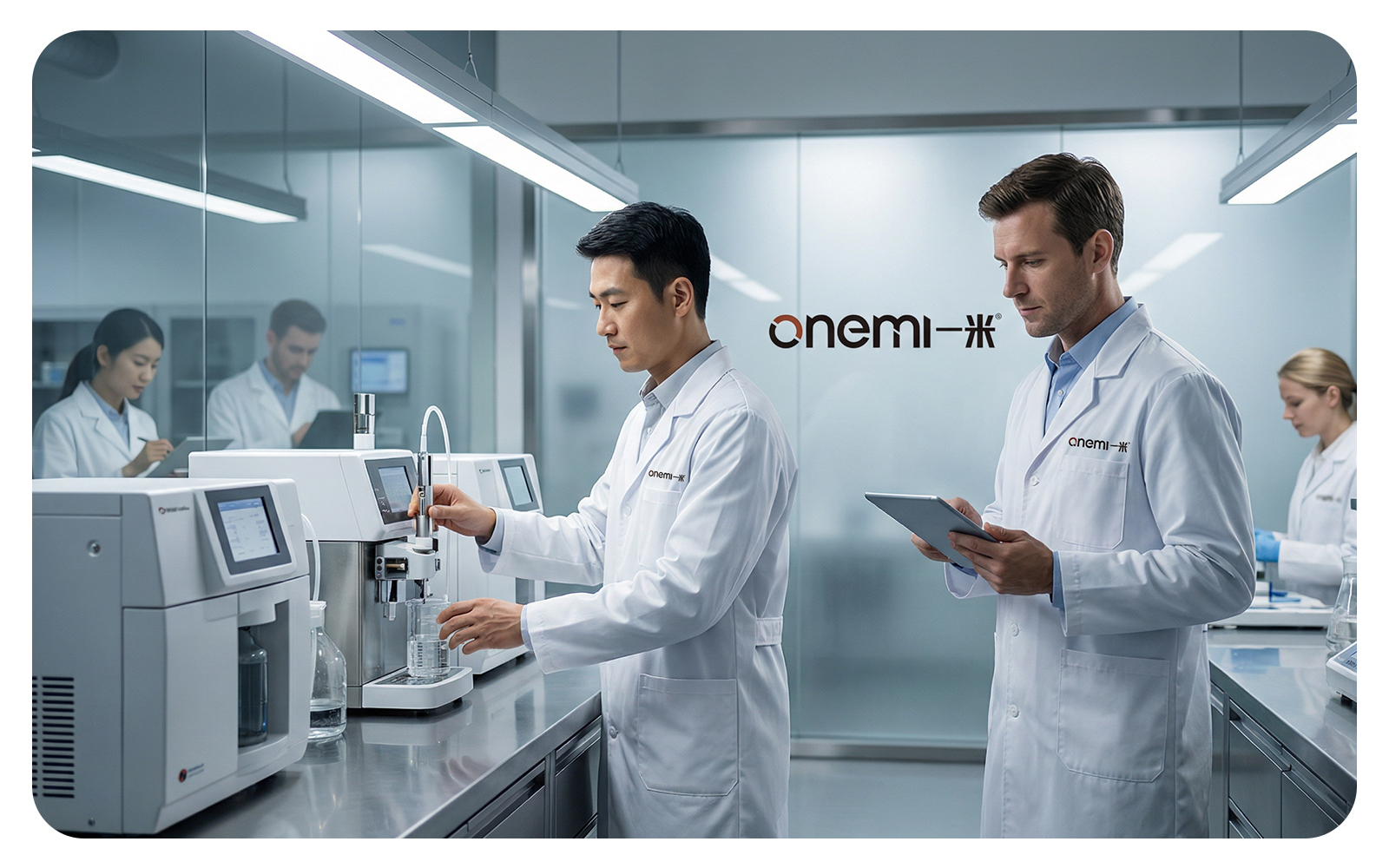
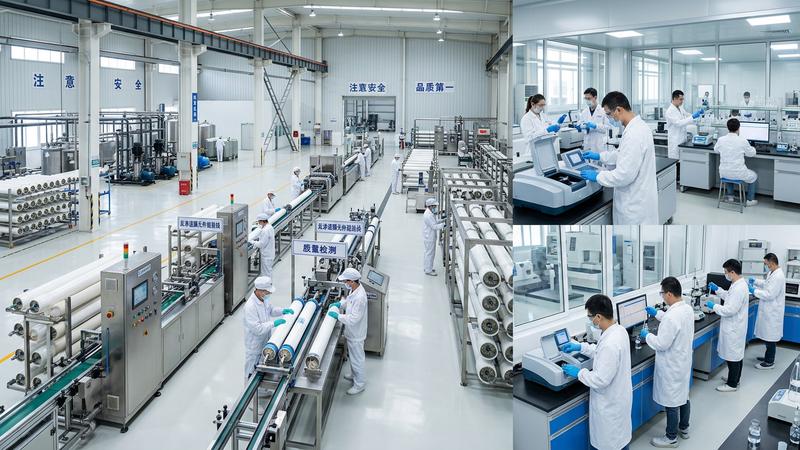
Second, manufacturing partners must possess advanced testing capabilities on-site. It is no longer viable to wait three months for third-party laboratory results to verify if a production batch meets the required standards. Factories must be equipped with high-performance liquid chromatography coupled with mass spectrometry (HPLC-MS) to perform regular, batch-level testing of effluent water. This level of quality control is what separates premium manufacturing partners from low-cost assembly shops.
Finally, system design must prioritize water efficiency without sacrificing filtration performance. Under China’s GB 34914 standard, water purifiers are graded on their wastewater-to-pure-water ratio. Traditional RO systems that waste three gallons of water for every gallon produced are being phased out by consumer preference and regulatory penalties. The modern standard requires high-recovery RO systems that operate at a 2:1 or even 3:1 pure-to-waste ratio, requiring advanced membrane chemistry and smart flow management systems that can handle high recovery rates without scale build-up or membrane fouling.
The transition window is closing fast. Brands that proactively audit their supply chains and partner with technologically advanced, compliance-ready OEMs will secure their market position for the next decade, while those relying on legacy filtration designs will find themselves locked out of the world’s most lucrative consumer markets.